How artificial intelligence can take a mobile app to the next level?
Introduction
In a mad rush to conquer users, every app business is trying to offer the most engaging experience possible. Be it through marketing or with break-through innovations, app businesses are focused on making a mark in the life of their users. While an important contributor to the success of app businesses, marketing doesn’t guarantee a loyal convert. On the other hand, conveniences and interactive experiences introduced through innovations always steal the show with users. Artificial Intelligence (AI) is one such innovation that is redefining the way modern devices work. There is a reason why the artificial intelligence market is expected to grow to USD 190.61 Billion by 2025!
AI has moved far beyond experimentation and is now deeply embedded into everyday mobile experiences. With the rise of on-device intelligence, edge computing, and multimodal models, mobile apps are no longer dependent solely on cloud processing. This shift enables faster responses, stronger privacy controls, and uninterrupted experiences even in low-connectivity environments, setting a new benchmark for user expectations.
AI has given a new meaning to the process of human and machine interaction. By 2020, customers will manage 85% of their relationship with the enterprise without interacting with a human. The science of AI tends to emulate human intelligence through learning, logic and self-correction. A device with AI tends to ‘learn’ by identifying behavioural patterns from its vast database, the same way as a human analyses stuff. AI then allows the device to predict the actions of a user based on the result of the analysis.
An app with AI stands out because it has unique capabilities of interacting with humans and interpreting relevant information for further use. AI is flexible enough to be implemented in every kind of device and system for any specific requirements. AI makes modern mobile apps a fun, interactive experience for the user and is fairly convenient to employ. Users are influenced by the personalised quality of virtual assistance in devices with the integration of AI in mobile apps.
As fancy as it sounds, the ‘AI revolution’ is not just for the big players. There was a vast number of innovations in the field of AI over the past few years. Thus even small businesses can now leverage the AI technology to offer a better UX to its users and improve their ROI. We at Promatics offer customised consultations and AI backed business solutions to suit all kind of mobile app businesses.
AI has moved far beyond experimentation and is now deeply embedded into everyday mobile experiences. With the rise of on-device intelligence, edge computing, and multimodal models, mobile apps are no longer dependent solely on cloud processing. This shift enables faster responses, stronger privacy controls, and uninterrupted experiences even in low-connectivity environments, setting a new benchmark for user expectations.
Types of Artificial Intelligence
Overall, there are three types of artificial intelligence that are used in mobile applications:
Weak – NAI (Narrow Artificial Intelligence)
Strong- AIG (Artificial General Intelligence) and ASI (Artificial Superintelligence).
The AI Revolution in Mobile App User Experience
What truly differentiates AI-driven mobile apps today is their ability to operate contextually across touch, voice, vision, and intent simultaneously. Modern users expect apps to understand not just commands, but situations, where they are, what they are doing, and what they are likely to need next. This evolution has turned AI from a backend capability into a core UX differentiator.
The penetration of AI technologies in the retail market will exceed 8 billion USD by 2024. As more and more users get used to context-aware computing and relish real-time responses, the demand for AI apps is set to increase further in the near future. Below is the list of engaging user experiences that AI has helped apps offer its users:
I. Face Detection
An important component ensuring safety in modern-day devices, the Face detection feature is an innovation that is a result of the use of AI. The feature allows a user’s face detection in digital images. Additionally, it also represents the digital image/video into multiple frames. Face detection in real-time helps surveillance and virtual monitoring for movement through devices. Mobile devices benefit from face detection by using it for unlocking a phone, securing confidential data and enhance picture clicking experience with improvements like smile shutter, adjusting the camera’s lenses in different light conditions, creating depth in an image, usage of various filters, etc.
II. Voice and Image Recognition
The vivid ability of AI empowered devices of automatically and accurately recognizing human speech is termed as Voice Recognition. Conversational User Interfaces (CUI) are widely popular among app developers nowadays. Users can now conduct searches on search engines not only by text but by using images and voice as well.
III. Automated Chatbots
AI-powered chatbots are evolving into autonomous digital agents. Beyond answering queries, they can execute tasks, manage workflows, integrate with enterprise systems, and adapt their tone based on user sentiment. These intelligent agents are becoming a central touchpoint for customer engagement across industries such as banking, healthcare, retail, and SaaS.
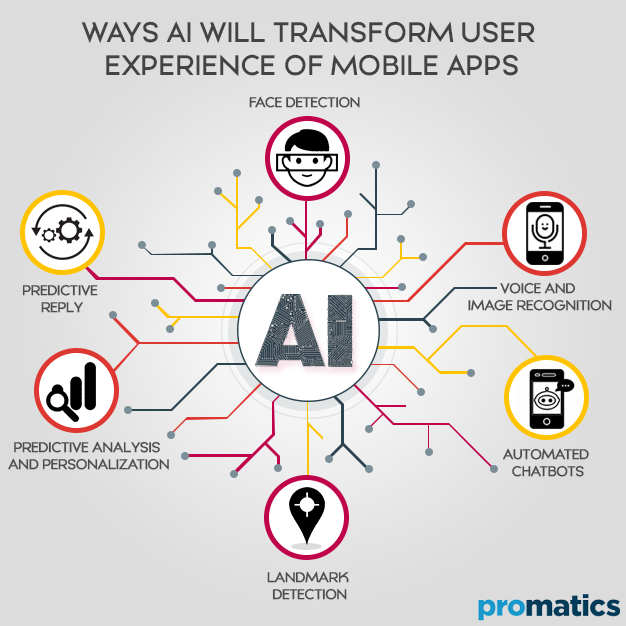
IV. Landmark Detection
A unique convenience to the users, Landmark Detection allows one to locate particular points in a 2D image. AI helps a device differentiate between an artificial and natural structure, with Landmark detection.
V. Predictive Reply
True saviour for initiating apt communication and productive correspondence, Smart Reply feature of AI comes to rescue of a user regularly. While a normal mobile app may or may not understand the language of a user, smart reply capabilities allow the app to understand the communication between user and device and replies accordingly. AI uses the info from the current data sets to develop an understanding of the situation and predicts the end result.
VI. Predictive Analysis and personalization
Personalization has evolved beyond recommendations. AI now dynamically adjusts UI layouts, notification timing, content density, and feature visibility based on individual user behavior. This ensures that each user experiences a version of the app that feels uniquely tailored to their habits, preferences, and usage patterns.
Tips to Take Your Mobile App Experience to Next Level with AI
# Tip 1: An intelligent user experience is the end result of well-integrated mobile app design and machine learning development. Make it a point to discuss elements like user experience, product vision, and business goals with the team, time and again. Only a team with shared concepts, good communication and a common language can achieve that goal. Host collaborative work environments for machine learning experts and user experience designers. Start with a blueprint of data pipelines and user interfaces that brings product planning to match the expected users’ reality.
# Tip 2: Focus vividly on the use case of the product you are working. This will help you fine tune the intricate details of the project like determining the user flow and overall experience.
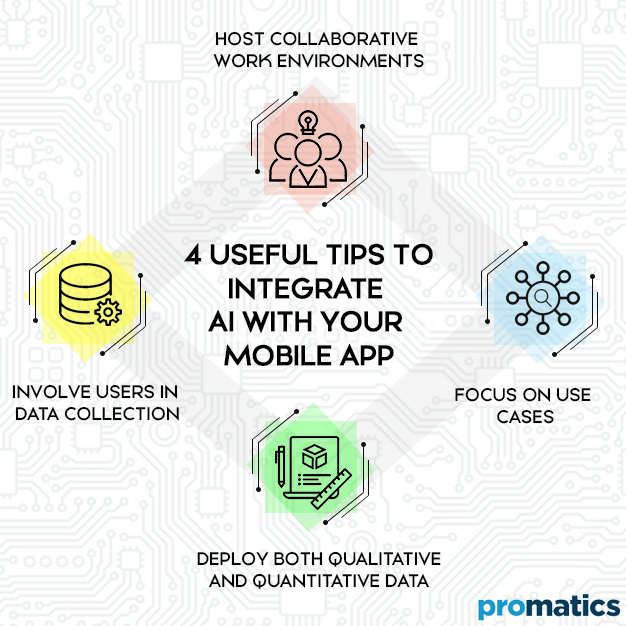
#Tip 3: It is crucial to take into account both qualitative and quantitative data. Qualitative research methods like questionnaires, interviews, etc to measure how the users like experience your app provides. Many seemingly insignificant factors like the effectiveness of the feedback loop, prowess of data point capturing intention and user behaviour is important for creating a fruitful AI app experience for the users. Combination of both types of data helps us with such insights.
#Tip 4: Designing for AI requires caution and expertise. Data collection, conversion and integration plays an important role in all AI driven apps. Always make it known to a user that their data is being used by AI. Giving them the option to alter the collected information such that it suits the context it is to be used to serve is important. Additionally, you can give them the option to change what the AI learns. This ensures that the AI generated predictions are exactly what the users desire.
#Tip 5: As AI capabilities expand, users are becoming more conscious of transparency and trust. Explainable AI allows users to understand why a particular recommendation, alert, or decision was made. Incorporating ethical AI practices, such as bias monitoring, consent-driven data usage, and explainability, helps build long-term trust and strengthens brand credibility.
Final Thought
AI has become a foundational requirement for mobile apps aiming to stay relevant in a highly competitive digital ecosystem. Users now expect intelligent, adaptive, and privacy-first experiences as standard. Businesses that fail to integrate AI meaningfully risk falling behind in engagement, retention, and scalability.
Intuitive user experiences are on the rise, thanks to AI technologies. Daunting popularity of technology has lead to the introduction of cost-effective AI integration in mobile apps. We are a leading mobile app development company working with AI technologies and learning all the while. We provide the best-in-class iOS and Android app solutions with AI integration, to help our clients. Feel free to write back to us for a consultation regarding AI integration in your mobile app.
