AI Agent Development Companies: Benefits, Services & How to Choose the Right Partner (2026 Guide)

TL;DR
- AI agent development enables autonomous systems that plan, decide, and act
- Helps automate workflows, improve decisions, and boost efficiency
- AI companies provide custom agents, integrations, and scalable solutions
- Use cases include customer support, analytics, and process automation
- Choosing the right partner ensures successful AI adoption and growth
What if your software could analyze problems, make decisions, and execute tasks autonomously without constant human input? This is no longer a futuristic concept. With the rapid evolution of AI development and artificial intelligence development services, AI agents are transforming how businesses operate, automate workflows, and deliver smarter digital experiences.
Today, organizations across industries are investing in AI agent development services to build intelligent systems that can analyze data, respond to users, and perform complex business tasks independently.
Unlike traditional automation tools, enterprise AI agents can learn from data, adapt to changing conditions, and execute multi-step workflows autonomously. From intelligent customer support assistants and AI-powered research tools to autonomous workflow systems, these solutions are becoming a critical part of modern digital infrastructure.
However, building reliable and scalable AI agent solutions for businesses requires deep expertise in machine learning, natural language processing, system architecture, and enterprise system integration.
This is where AI agent development companies play a crucial role. These specialized firms help businesses design, develop, and deploy intelligent AI agents tailored to their operational needs.
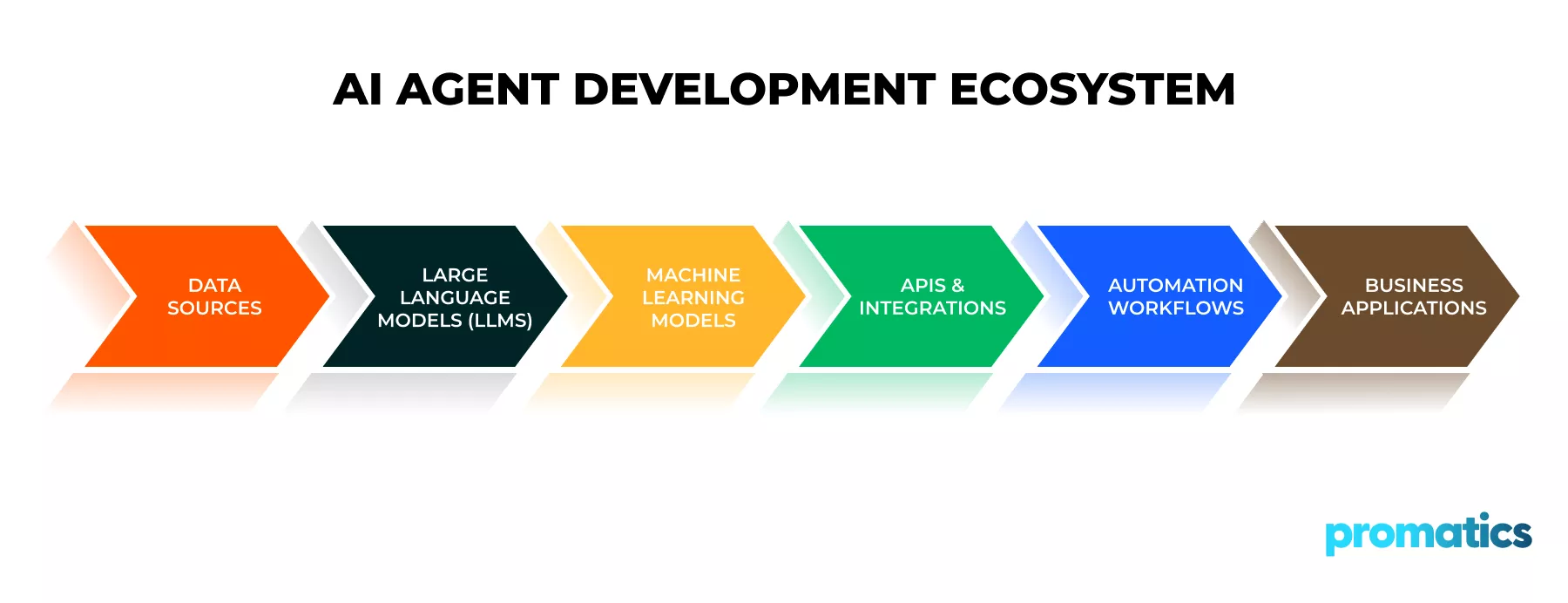
Why AI Agent Development Companies Are Essential for Modern Businesses
Many organizations want to implement intelligent automation but lack the technical expertise required for AI development and artificial intelligence solutions. As a result, enterprises increasingly partner with AI agent development companies and artificial intelligence development companies that specialize in building advanced AI-powered systems.
Building automation systems requires knowledge across multiple disciplines, from computer programming and conversation design to enterprise system integration and data management. Rather than hiring expensive specialists across all these areas, companies find it more cost – effective to partner with established development firms that already have proven expertise and success track records.
Current AI Market Overview
The latest AI agent statistics reveal a significant rise in adoption, driven by enterprises leveraging LLM-powered automation and real-time task execution.
| Metric | Value |
| Forecast for 2026 | USD 7.92 billion |
| Market Growth Rate (2026-2034) | CAGR of 45.82% |
| Dominate Region | North America |
| Fastest Growing Market | Asia Pacific |
By 2040, generative technology is expected to contribute between $2.6 trillion and $4.4 trillion each year to the global economy across multiple industries.
How AI Agent Development Companies Transform Business Operations
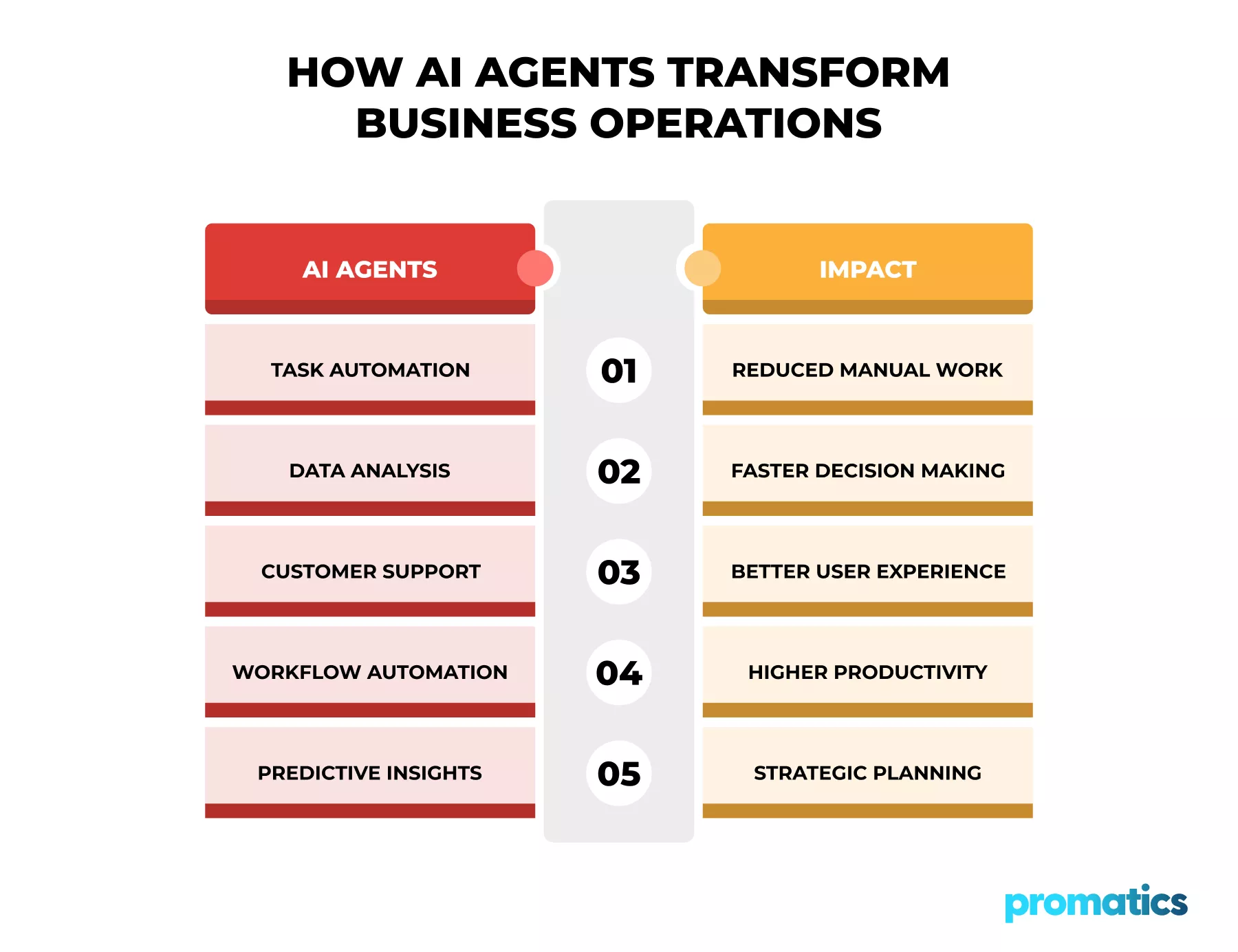
As businesses increasingly adopt artificial intelligence to streamline operations, AI agents are becoming essential tools for enterprise automation, intelligent decision-making, and digital transformation. Organizations are relying on AI agent development companies to build solutions that improve efficiency and productivity. Unlike traditional software that follows predefined rules, AI agents can analyze data, learn from patterns, and execute tasks autonomously.
Building and deploying these systems requires specialized expertise. AI agent development companies help organizations design, integrate, and scale AI agents that optimize workflows and reduce operational complexity.
This shift is already visible in adoption trends. 39% of users are comfortable using AI agents for scheduling and routine tasks highlighting growing trust in intelligent automation.
Below are some of the key ways AI agent development companies help businesses improve their operations.
1. Improving Decision-Making with Data Insights
Modern businesses generate massive amounts of data, but extracting useful insights from this data can be challenging.
AI agent development companies create intelligent agents that analyze large datasets in real time and provide actionable insights for business leaders. These agents can:
- Identify market trends
- Detect anomalies in operations
- Forecast demand and sales patterns
- Recommend strategic actions
This helps companies make faster, data-driven decisions that improve overall efficiency and competitiveness.
2. Enhancing Customer Support and Engagement
Customer experience is a critical factor in business success. AI agents can significantly improve how companies interact with customers.
AI development companies build AI-powered support agents that can:
- Provide instant responses to customer queries
- Handle multi-language support
- Assist customers across websites, mobile apps, and messaging platforms
- Escalate complex issues to human agents when necessary
This results in faster response times, improved customer satisfaction, and reduced support costs.
3. Optimizing Internal Workflows
AI agents can coordinate tasks across departments, helping organizations operate more efficiently.
For example, AI agents can:
- Manage project workflows
- Automatically assign tasks to team members
- Monitor operational performance
- Track deadlines and deliverables
AI agent development companies design these systems to integrate with existing tools like CRM platforms, project management software, and ERP systems, ensuring smooth operational workflows.
4. Enabling Intelligent Process Automation
Traditional automation relies on predefined scripts and rules. AI agents go a step further by enabling intelligent process automation.
These agents can:
- Understand natural language inputs
- Adapt to changing scenarios
- Execute multi-step processes independently
- Learn and improve over time
For businesses, this means greater flexibility and smarter automation across complex operations.
5. Reducing Operational Costs
AI agents can significantly reduce the cost of business operations by minimizing manual intervention.
AI agent development companies help organizations:
- Reduce labor costs associated with repetitive tasks
- Improve resource utilization
- Minimize human errors
- Increase operational scalability without expanding teams
Over time, this results in higher productivity and stronger profit margins.
6. Scaling Business Operations Efficiently
As businesses grow, managing operations manually becomes increasingly difficult.
AI agent development companies build scalable AI systems that can handle growing workloads without affecting performance. These systems help organizations:
- Manage higher volumes of customer interactions
- Process large datasets efficiently
- Expand services without significant infrastructure changes
This enables businesses to scale operations while maintaining efficiency and service quality.
Core Capabilities of Leading AI Agent Development Companies
AI agents are becoming essential tools for businesses looking to automate workflows, improve decision-making, and deliver intelligent digital experiences. However, building reliable and scalable AI agents requires specialized expertise in artificial intelligence, data engineering, and system integration.
AI agent development companies provide this expertise by offering a combination of technical capabilities, development frameworks, and strategic consulting services. Below are some of the key features that define leading AI agent development companies.
1. Expertise in Advanced AI Technologies
One of the most important features of AI agent development companies is their deep knowledge of artificial intelligence technologies and frameworks.
These companies typically specialize in areas such as:
- Machine learning and deep learning
- Natural language processing (NLP)
- Large language model (LLM) integration
- Reinforcement learning
- Predictive analytics
This expertise enables them to build intelligent AI agents capable of understanding data, learning from interactions, and performing complex tasks autonomously.
2. Custom AI Agent Development
Every business has unique operational requirements. A key capability of AI agent development companies is their ability to design and build custom AI agents tailored to specific business needs.
Custom development services often include:
- AI-powered virtual assistants
- Autonomous workflow agents
- AI research and analysis agents
- Customer service automation agents
- Intelligent business process agents
Custom-built AI agents ensure that the solution aligns with the company’s workflows, industry requirements, and long-term goals.
3. Integration with Existing Business Systems
AI agents rarely operate in isolation. They need to interact with multiple business systems such as:
- CRM platforms
- ERP systems
- Marketing automation tools
- Customer support platforms
- Data analytics systems
AI agent development companies specialize in integrating AI agents with existing enterprise software ecosystems, ensuring seamless communication between systems and enabling automated workflows across departments.
4. Scalable AI Infrastructure
As businesses grow, the demand for AI-driven automation increases. Leading AI agent development companies build solutions that are highly scalable and capable of handling increasing workloads.
They typically leverage:
- Cloud infrastructure
- distributed computing systems
- containerized AI deployments
- scalable APIs and microservices architecture
This allows organizations to expand their AI capabilities without rebuilding the system from scratch.
5. AI Agent Training and Optimization
AI agents must continuously learn and evolve to deliver optimal results. AI development companies support this through training, fine-tuning, and ongoing performance optimization to improve effectiveness over time. This growing reliance on AI-driven automation is reflected in user behavior, with 36% of users preferring automated purchasing decisions and 70% relying on AI agents to manage loyalty programs, highlighting increasing trust in intelligent systems.
This ongoing optimization typically includes:
- Model training with domain-specific datasets
- Performance monitoring and evaluation
- Continuous learning mechanisms
- System updates and improvements
As AI agents process more data and interactions, they become increasingly accurate, efficient, and reliable.
6. Security and Compliance
Businesses rely on AI systems to handle sensitive data, making security a critical component of AI agent development.
Professional AI agent development companies implement:
- secure data processing protocols
- encryption and access control systems
- compliance with data protection regulations
- secure API integrations
These security measures ensure that AI agents operate safely while protecting business and customer data.
7. Ongoing Support and Maintenance
AI solutions require continuous monitoring and maintenance to ensure optimal performance. Leading AI agent development companies provide post-deployment support services, including:
- system monitoring
- bug fixes and updates
- performance improvements
- infrastructure optimization
This ongoing support helps businesses maintain reliable AI operations and adapt their systems as technology evolves.
How AI Agent Development Companies Build Enterprise-Ready AI Agents
1. Business Requirement Analysis
Companies begin by identifying the specific operational challenges and goals of the business. This helps ensure the AI agent is designed to solve real problems such as workflow automation, customer support, or data analysis.
2. AI Agent Architecture Design
Development teams design the technical framework that enables the AI agent to process information, interact with systems, and execute tasks efficiently within enterprise environments.
3. Data and System Integration
AI agents are integrated with enterprise tools such as CRM platforms, databases, APIs, and analytics systems to access the data needed for intelligent decision-making.
4. Autonomous Task Execution
Developers implement reasoning and workflow automation capabilities that allow AI agents to perform tasks independently, handle multi-step processes, and adapt to changing conditions.
5. Performance Testing and Validation
Before deployment, companies conduct rigorous testing to evaluate accuracy, reliability, and scalability. This ensures the AI agent performs effectively under real-world operational workloads.
6. Enterprise Deployment
AI agents are deployed using cloud infrastructure, APIs, and scalable architectures so they can operate smoothly across enterprise systems and support growing workloads.
7. Continuous Monitoring and Optimization
After deployment, companies monitor AI performance, update models, and improve workflows to ensure the agent remains accurate, secure, and aligned with evolving business needs.
Top AI Agent Development Companies to Watch in 2026
As businesses increasingly adopt AI agent development services to automate workflows, analyze data, and improve decision-making, specialized companies are helping organizations build enterprise-ready AI agents. Leading firms such as Promatics Technologies, LeewayHertz, Accenture, and IBM Consulting are driving innovation in AI automation solutions and intelligent agent systems.
1. Promatics Technologies – Enterprise AI Agent Development Experts
Promatics Technologies is a leading provider of AI agent development services, helping businesses design and deploy enterprise AI agents that automate workflows, improve decision-making, and enhance digital experiences.
The company specializes in building AI automation solutions that integrate seamlessly with CRM systems, enterprise platforms, and SaaS products.
Strength: Building scalable AI agents for web, mobile, and enterprise software ecosystems.
Expertise: AI-powered assistants, intelligent workflow automation, LLM-powered agents, predictive analytics, and enterprise AI integrations.
Value proposition: Promatics Technologies delivers custom-built AI agents tailored to business operations, enabling organizations to automate complex processes while maintaining flexibility and scalability.
Use Cases:
- AI customer support and virtual assistants
- Automated workflow and task management agents
- Business analytics and decision-support AI agents
- AI-driven productivity assistants for teams
2. LeewayHertz – Advanced Multi-Agent Systems
LeewayHertz specializes in designing advanced AI agents and multi-agent systems capable of performing complex enterprise workflows. Their solutions leverage modern AI frameworks to build autonomous agents that can collaborate and perform multi-step processes.
Strength: Developing sophisticated multi-agent architectures that enable autonomous task execution.
Expertise: LLM integration, AI orchestration frameworks, machine learning systems, and autonomous decision-making models.
Use Cases:
- Enterprise workflow automation
- AI research and data analysis agents
- Productivity copilots for internal teams
3. Accenture – Large-Scale Enterprise AI Agents
Accenture helps organizations deploy AI agents at enterprise scale, integrating AI systems across departments such as finance, supply chain, customer service, and operations.
Strength: Combining strategic consulting with large-scale AI implementation capabilities.
Expertise: AI copilots, intelligent automation platforms, enterprise data systems, and digital transformation strategies.
Use Cases:
- AI-powered enterprise decision intelligence
- Supply chain and operations automation
- Workforce productivity copilots
4. IBM Consulting – Secure and Governed AI Agents
IBM Consulting develops secure AI agent solutions designed for industries where data governance and compliance are critical, including finance, healthcare, and government sectors.
Strength: Strong AI governance frameworks combined with enterprise-grade infrastructure.
Expertise: AI planning agents, enterprise automation systems, and AI-powered analytics platforms.
Use Cases:
- AI compliance and risk monitoring agents
- Automated enterprise workflow orchestration
- AI-powered business intelligence systems
5. RTS Labs – Data-Driven AI Automation
RTS Labs builds data-driven AI agents that help businesses analyze information and automate operational processes. Their solutions are designed to integrate with existing enterprise data environments.
Strength: Developing AI agents that transform raw business data into actionable insights.
Expertise: Machine learning, enterprise data analytics, workflow automation, and decision-support systems.
Use Cases:
- Data analysis and reporting agents
- AI-driven operational insights
- Intelligent workflow automation
6. Markovate – AI Product Development Specialists
Markovate works with startups and enterprises to develop AI-enabled digital products and intelligent assistants. The company focuses on building scalable AI applications that enhance product capabilities.
Strength: Rapid development of AI-powered applications and agents.
Expertise: LLM-powered applications, AI assistants, predictive analytics, and recommendation systems.
Use Cases:
- AI assistants for SaaS platforms
- Customer support automation agents
- AI-powered product recommendation engines
7. Appinventiv – AI-Enabled Enterprise Applications
Appinventiv develops AI-integrated mobile and enterprise applications, helping businesses embed AI agents into digital platforms to enhance customer engagement and automation.
Strength: Combining product development expertise with advanced AI technologies.
Expertise: Conversational AI, machine learning, and enterprise software development.
Use Cases:
- AI chat agents for customer engagement
- AI-powered mobile applications
- Intelligent enterprise automation systems
Industries Transforming with AI Agent Development
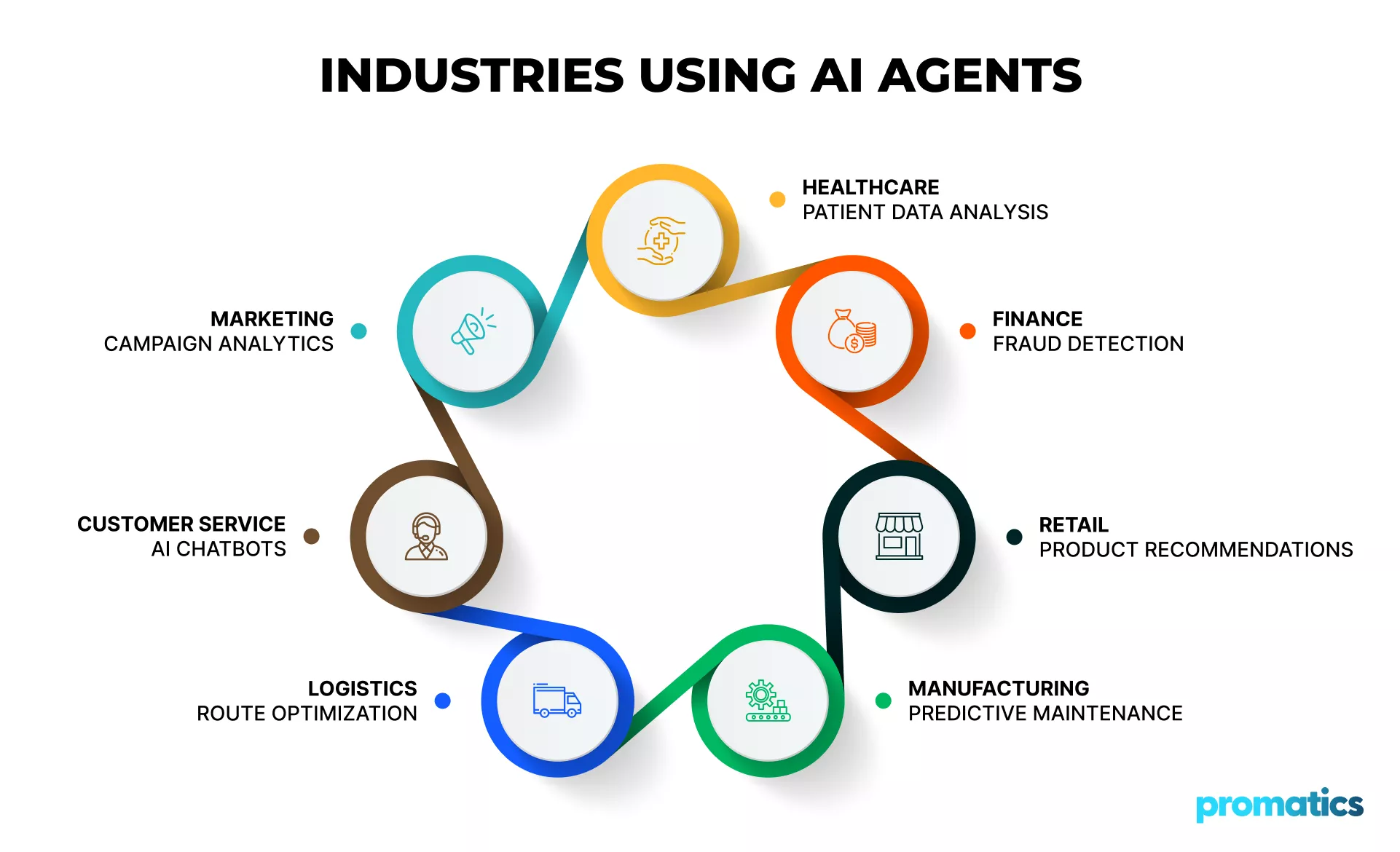
AI agents are transforming how industries operate by enabling automation, real-time decision-making, and intelligent data analysis. By partnering with AI agent development companies, businesses across multiple sectors can deploy systems that streamline operations, enhance productivity, and improve customer experiences. Below are some of the key industries benefiting from AI agent solutions.
1. Healthcare
AI agents help healthcare providers analyze patient data, automate administrative tasks, and support medical decision-making. These systems can assist with patient scheduling, medical record analysis, and remote patient monitoring, helping healthcare organizations improve efficiency and care delivery.
2. Finance and Banking
In the financial sector, AI agents are used to detect fraud, analyze transactions, and provide intelligent financial insights. Banks and fintech companies use AI agents to automate compliance checks, risk analysis, and customer support services.
3. Retail and E-commerce
Retail businesses leverage AI agents to enhance customer experience and optimize sales strategies. AI-powered agents can recommend products, manage inventory, automate customer support, and analyze consumer behavior to improve marketing and sales performance.
4. Manufacturing
Manufacturing companies use AI agents to monitor production systems, predict equipment failures, and optimize supply chains. These intelligent systems analyze operational data to improve efficiency, reduce downtime, and support smarter production planning.
5. Logistics and Supply Chain
AI agents help logistics companies optimize delivery routes, track shipments, and forecast demand. These systems automate supply chain operations and improve coordination between suppliers, warehouses, and distribution networks.
6. Customer Service and Support
AI agents are widely used to automate customer interactions and support processes. Businesses deploy AI-powered virtual assistants to answer queries, resolve issues, and provide personalized support across digital channels.
7. Marketing and Advertising
Marketing teams use AI agents to analyze campaign performance, generate insights, and personalize marketing strategies. These systems help businesses target audiences more effectively and improve customer engagement.
How to Choose the Best AI Agent Development Company
Choosing the right AI agent development company is crucial for successfully implementing intelligent automation in your business. A reliable partner should not only have strong technical expertise but also understand your operational goals and industry requirements. Here are key factors to consider when selecting an AI agent development company.
1. Evaluate Technical Expertise
Look for companies with proven expertise in machine learning, natural language processing, large language models (LLMs), and AI automation frameworks. Strong technical capabilities ensure the company can build scalable and intelligent AI agents tailored to your needs.
2. Review Industry Experience
Different industries have unique challenges and compliance requirements. Choosing a company with experience in your specific industry ensures they understand the workflows, regulations, and operational complexities involved.
3. Assess Custom Development Capabilities
Every business requires different AI solutions. A good development company should offer custom AI agent development rather than relying solely on generic tools. Custom solutions ensure the AI agent aligns with your business processes.
4. Check Integration Expertise
AI agents often need to integrate with existing systems such as CRM platforms, ERP software, analytics tools, and customer support platforms. Make sure the company has experience integrating AI solutions with enterprise systems.
5. Prioritize Security and Compliance
AI agents often handle sensitive data. The development partner should implement secure data processing, encryption protocols, and compliance with relevant regulations to protect your business information.
6. Evaluate Scalability and Infrastructure
Your AI system should be able to grow with your business. Choose a company that builds scalable AI architectures using cloud platforms, APIs, and modular infrastructure to support future expansion.
7. Look for Ongoing Support and Maintenance
AI solutions require continuous monitoring and improvement. Reliable development companies provide post-deployment support, performance monitoring, and system updates to ensure the AI agent continues to perform effectively.
CTO & CIO Technology Checklist for AI Adoption in 2026
As organizations accelerate digital transformation, CTOs and CIOs must focus on adopting emerging technologies while ensuring security, scalability, and operational efficiency. In 2026, priorities are shifting toward AI-driven systems, intelligent automation, data governance, and resilient digital infrastructure.
Here is a practical checklist to help technology leaders align their strategies with evolving business and technology trends.
1. AI and Automation Strategy
Ensure your organization has a clear strategy for implementing AI agents, automation tools, and AI-powered analytics. Evaluate opportunities where AI can improve operational efficiency, customer experiences, and decision-making.
2. Data Infrastructure and Governance
Data is the foundation of modern AI systems. CTOs and CIOs should establish strong data governance frameworks, centralized data platforms, and secure data pipelines to ensure data accuracy, accessibility, and compliance.
3. Cloud and Scalable Infrastructure
Assess whether your infrastructure can support growing workloads and AI applications. Adopt cloud-native architectures, microservices, and scalable APIs to enable faster innovation and system flexibility.
4. Cybersecurity and Risk Management
As organizations adopt advanced technologies, cybersecurity risks also increase. Implement zero-trust security models, advanced threat detection systems, and regular security audits to protect enterprise systems and sensitive data.
5. AI Governance and Ethical AI
Organizations deploying AI must ensure responsible AI usage and compliance with regulatory standards. Establish governance policies that address transparency, bias mitigation, and ethical AI development.
6. Integration of Emerging Technologies
Evaluate how technologies such as generative AI, AI agents, IoT, and advanced analytics can be integrated into your existing technology stack to drive innovation and business growth.
7. Talent and Skill Development
Technology adoption requires skilled teams. Invest in AI training, data engineering capabilities, and cross-functional digital skills to ensure your workforce can manage and optimize advanced technology systems.
8. Technology Vendor and Partnership Strategy
Carefully select technology vendors and development partners that align with your long-term innovation goals. Strategic partnerships can accelerate the deployment of AI and other advanced technologies.
9. Performance Monitoring and Optimization
Implement systems to continuously monitor application performance, infrastructure efficiency, and AI system accuracy. Regular optimization ensures technology investments deliver measurable business value.
Challenges and Risks of Working with AI Automation Development Companies
Smart automation and AI-driven systems can significantly improve business efficiency, but partnering with automation development companies also comes with certain challenges. Organizations must carefully evaluate potential risks to ensure successful implementation and long-term value from automation initiatives.
Below are some of the common challenges businesses may face when working with smart automation development partners.
1. Integration with Existing Systems
Many businesses operate on complex IT infrastructures that include legacy systems, multiple software platforms, and data silos. Integrating smart automation solutions into these environments can be challenging and may require significant customization.
2. Data Quality and Availability
Automation systems rely heavily on accurate and well-structured data. If an organization lacks reliable datasets or has fragmented data sources, it can affect the performance and effectiveness of automated solutions.
3. Security and Data Privacy Risks
Automation platforms often handle sensitive business and customer data. Without proper security frameworks, organizations may face risks related to data breaches, unauthorized access, and regulatory compliance issues.
4. Over-Reliance on Automation
While automation improves efficiency, excessive reliance on automated systems can create operational risks if systems fail or produce inaccurate results. Businesses must maintain human oversight and governance mechanisms.
5. High Initial Implementation Costs
Developing and deploying intelligent automation solutions can require significant upfront investment in technology infrastructure, development resources, and system integration.
6. Vendor Lock-In
Some automation platforms rely on proprietary technologies or frameworks. This can make it difficult for organizations to switch vendors or modify systems in the future without major redevelopment.
7. Change Management and Workforce Adoption
Introducing automation may require employees to adapt to new workflows and technologies. Without proper training and change management strategies, organizations may face resistance to adoption and operational disruption.
The Future of AI Agent Development for Businesses
AI agents are rapidly becoming a core component of modern AI development and enterprise artificial intelligence solutions. Organizations across industries are investing in AI development services and AI agent development companies to automate workflows, improve customer experiences, and enhance business decision-making.
Partnering with the right AI development company or artificial intelligence development company can help businesses successfully implement intelligent automation and scalable AI systems.
Promatics Technologies stands out as a trusted partner for organizations looking to build intelligent automation systems. With expertise in LLM-powered assistants, enterprise workflow automation, and AI-driven analytics, Promatics helps businesses design and deploy AI agents that improve efficiency, productivity, and innovation.
Looking to build enterprise AI agents for your business? Connect with Promatics Technologies to explore tailored AI solutions that drive measurable results.
