AI Agent Development Services: Is It Worth Investing in 2026?
TL;DR
- AI agents can automate tasks with minimal human effort
- Businesses use them for support, sales, analytics, and operations
- They help reduce costs and save time
- AI agents improve productivity and decision-making
- Companies can scale operations faster with AI automation
- AI agent development is becoming a smart long-term investment in 2026
Businesses are moving beyond traditional automation and basic chatbots. As customer expectations rise and operations become more data-driven, companies need intelligent systems that can automate tasks, analyze data, make decisions, and adapt in real time. According to the Google Cloud AI Trends 2026 Report, over 80% of enterprises are exploring AI-powered automation and intelligent agents to improve efficiency, customer engagement, and decision-making. This shift is driving rapid investment in AI agent development and enterprise AI solutions.
This growing demand is driving the adoption of AI agent development services, AI-powered automation solutions, and enterprise AI development across industries. Unlike conventional software that follows fixed instructions, AI agents can understand context, optimize workflows, and improve performance over time. From automating customer support and streamlining operations to enhancing productivity and decision-making, AI agents are helping businesses scale more efficiently.
By combining artificial intelligence, predictive analytics, and workflow automation solutions, AI agents help businesses simplify processes, improve operational efficiency, and make smarter business decisions at scale.
But what exactly are AI agents, and why are businesses investing heavily in them in 2026? To understand their growing impact, it’s important to first explore how AI agents work, the different types of AI agents, and the technologies that power these intelligent systems.
What are AI Agents?
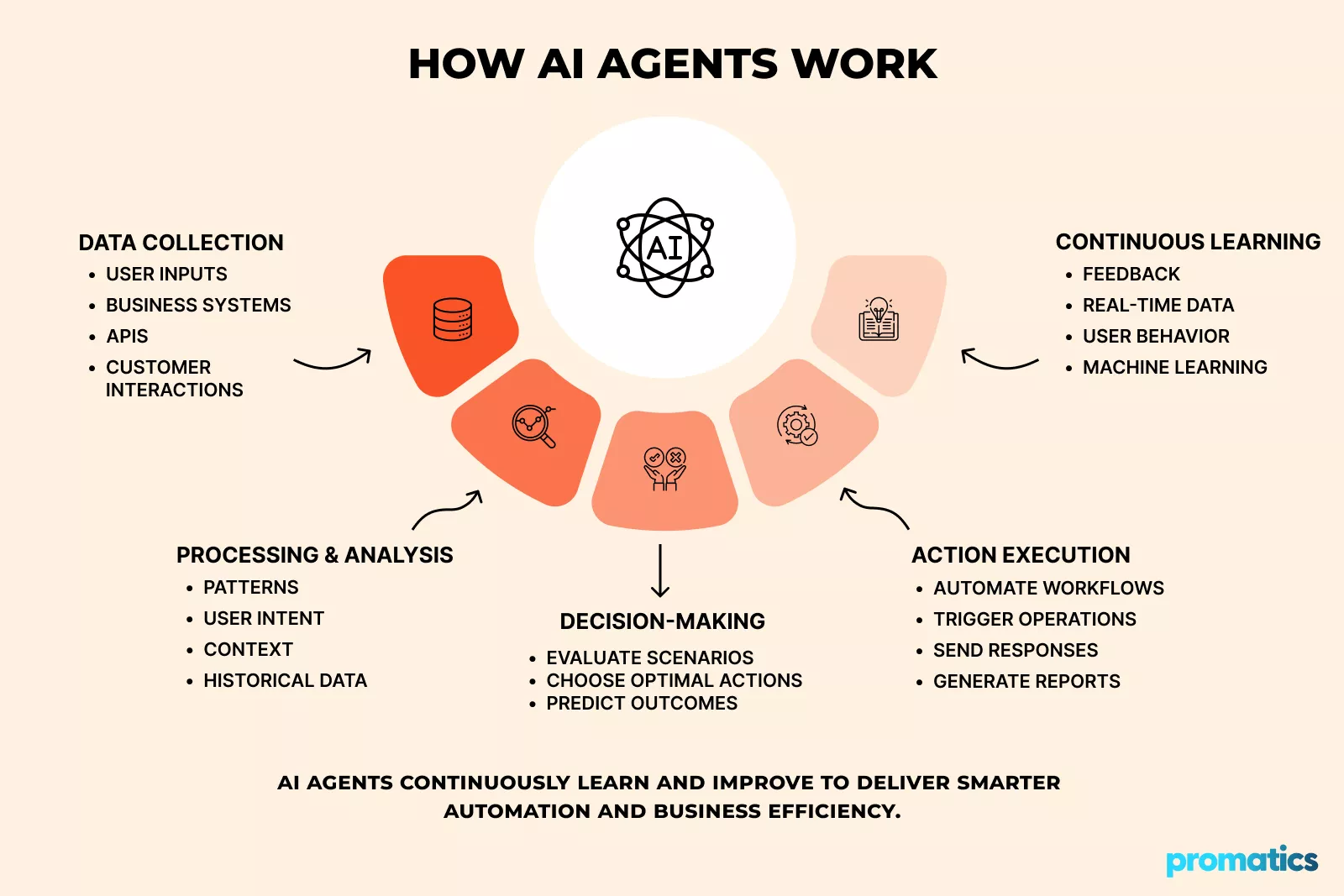
An AI agent is an intelligent software system that can perform tasks, make decisions, and solve problems with minimal human involvement. Unlike traditional software that follows fixed rules, AI agents can analyze data, understand context, adapt to changing situations, and take actions automatically to achieve specific goals.
In simple terms, AI agents work like digital assistants that can observe, process information, and respond intelligently in real time. Businesses use AI agent development services to automate workflows, improve efficiency, reduce manual effort, and streamline operations across departments.
From customer support and recommendation systems to workflow automation and business analytics, AI agents are becoming an essential part of modern businesses. According to recent AI adoption reports, 88% of companies already use AI in at least one business function, creating a strong foundation for the growth of enterprise AI development and intelligent AI agents across industries.
Simple Reflex Agents
Simple reflex agents are entry-level AI agents that make decisions based solely on current inputs and fixed rules. They respond directly to current inputs or conditions without considering past experiences or future outcomes. These agents operate using predefined rules and are ideal for straightforward tasks.
Example: Automatic spam filters or motion sensor lights.
Learning Agents
Learning agents continuously improve their performance by learning from past experiences, user interactions, and feedback. They adapt their behavior over time to produce better results and more accurate responses.
These agents usually consist of:
- A learning component
- A decision-making system
- A feedback mechanism
Example: Netflix and Spotify recommendation systems that improve suggestions based on user preferences and viewing history.
Model-Based Reflex Agents
Model-based reflex agents maintain an internal understanding of their environment. Instead of reacting only to immediate inputs, they track changes and use stored information to make more informed decisions.
These agents are more advanced because they can evaluate situations based on both current and previous conditions.
Example: Smart thermostats that adjust room temperature based on user behavior and environmental conditions.
Goal-Based Agents
Goal-based AI agents are designed to achieve specific objectives. Before taking action, they evaluate different possibilities and choose the path that best helps them reach the desired goal.
These agents are highly useful for planning, navigation, and decision-making tasks.
Example: Virtual assistants like Alexa or AI-powered navigation systems.
Utility-Based Agents
Utility-based agents go a step further by comparing multiple outcomes and selecting the most beneficial option. Instead of simply achieving a goal, they focus on maximizing efficiency, accuracy, or overall value.
These agents are commonly used in environments where multiple decisions are possible and optimization is important.
Example: AI systems used in financial trading or route optimization platforms.
Hierarchical Agents
Hierarchical AI agents work within a structured system where higher-level agents manage and coordinate lower-level agents. Complex tasks are divided into smaller, manageable actions, making the overall process more efficient.
This structure helps simplify large-scale operations and improves coordination between tasks.
Example: AI systems used in robotics, manufacturing, and enterprise workflow automation.
Multi-Agent Systems
Multi-agent systems consist of multiple AI agents working together within a shared environment. These agents may collaborate, communicate, or operate independently to achieve individual or collective goals.
Such systems are highly effective for solving large and complex problems that require distributed intelligence.
Example: Autonomous vehicle networks, smart traffic management systems, and collaborative robotics.
As AI technology continues to evolve, AI agents are becoming more intelligent, autonomous, and capable of handling increasingly complex responsibilities. From customer service and healthcare to finance and logistics, these intelligent systems are transforming how businesses operate by enabling smarter automation, faster decision-making, and improved operational efficiency.
Key Technologies Behind AI Agents
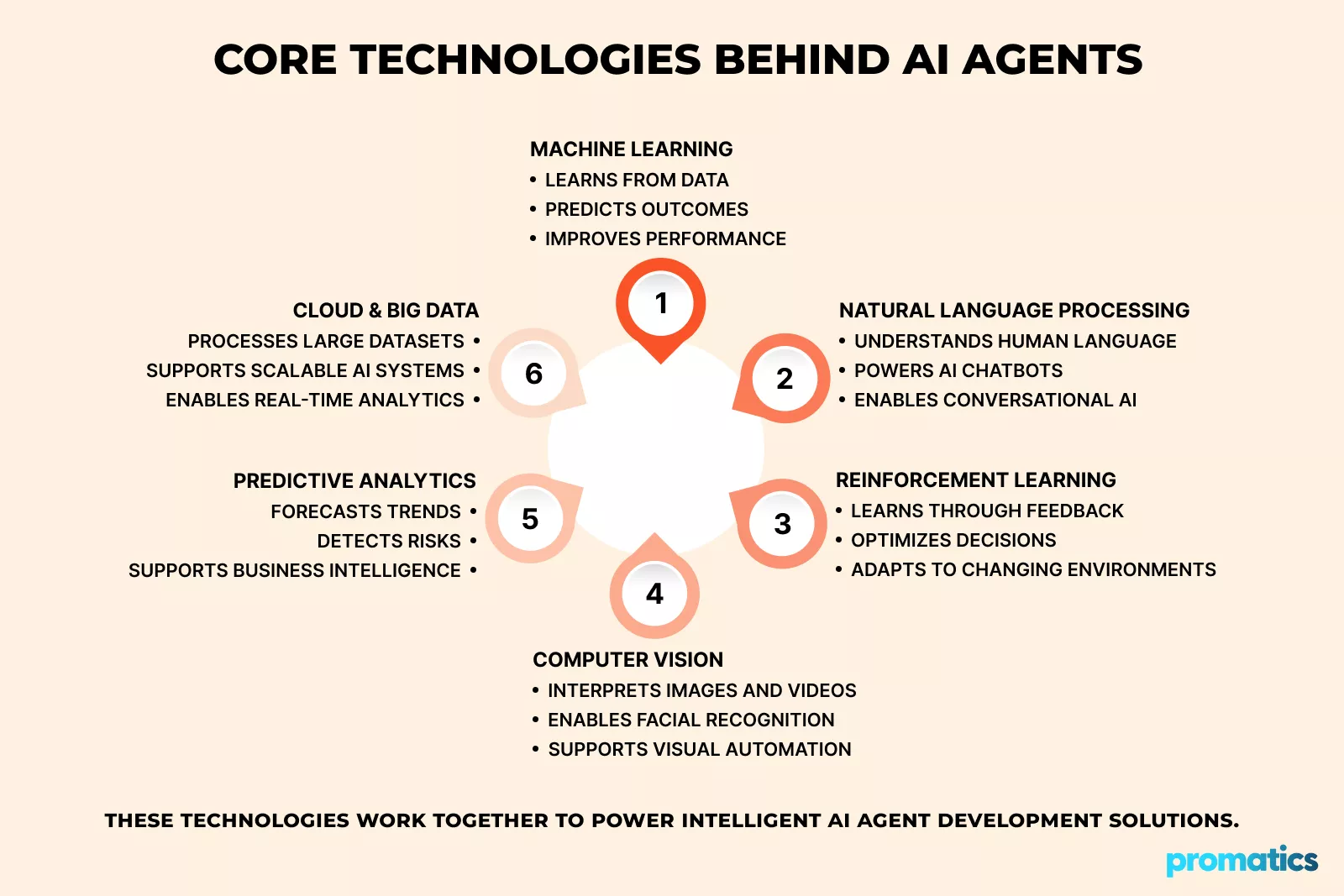
AI agents rely on a combination of advanced technologies that enable them to learn, adapt, make decisions, and automate complex tasks intelligently. These technologies work together to create systems capable of understanding data, interacting with users, optimizing workflows, and continuously improving performance over time.
As businesses increasingly invest in AI agent development services and intelligent automation solutions, understanding the technologies powering these systems becomes essential.
Machine Learning (ML)
Machine Learning is one of the core technologies behind modern AI agents. It enables systems to learn from data, identify patterns, and improve their accuracy without requiring explicit programming for every scenario.
Instead of following fixed instructions, AI agents powered by machine learning can analyze historical data, recognize trends, and make predictions based on previous experiences. This helps businesses automate decision-making, improve operational efficiency, and deliver smarter user experiences.
Organizations investing in machine learning development services often use AI agents to:
- Predict customer behavior
- Detect fraud and anomalies
- Automate business workflows
- Improve recommendation systems
- Generate data-driven insights
For example, e-commerce platforms use machine learning algorithms to recommend products based on browsing history and purchasing behavior, while financial institutions use AI-powered analytics to identify suspicious transactions in real time.
As AI agents process more data, they continuously become smarter, faster, and more efficient.
Natural Language Processing (NLP)
Natural Language Processing (NLP) enables AI agents to understand, interpret, and respond to human language naturally. This technology enables more natural and human-like communication between machines and users through text and voice interactions.
Modern businesses use NLP development services and AI chatbot development solutions to improve customer engagement, automate support systems, and streamline communication processes.
NLP helps AI agents:
- Understand user intent
- Analyze text and speech
- Generate contextual responses
- Translate languages
- Summarize information
- Detect customer sentiment and emotions
This technology powers:
- AI chatbots
- Virtual assistants
- Voice-enabled applications
- Customer support automation
- Conversational AI platforms
For instance, AI-powered customer support systems can instantly resolve queries, route tickets to the correct department, and provide personalized assistance 24/7. Businesses adopting conversational AI solutions can significantly improve response times while reducing operational workload.
Reinforcement Learning
Reinforcement Learning is an advanced AI technique where agents learn through interactions and feedback from their environment. In this approach, AI systems receive rewards for successful actions and penalties for poor decisions, helping them improve performance over time.
This technology is widely used in advanced AI development solutions and autonomous AI systems where continuous optimization and intelligent decision-making are required.
Reinforcement learning allows AI agents to:
- Adapt to changing environments
- Optimize business processes
- Improve strategic decision-making
- Learn from real-time experiences
- Automate complex workflows intelligently
Examples include:
- Autonomous vehicles learning safe navigation
- Robotics improving operational accuracy
- AI systems optimizing supply chain operations
- Intelligent recommendation engines refining suggestions over time
Businesses using AI-powered automation can leverage reinforcement learning to build systems that adapt to changing challenges with minimal human involvement.
Computer Vision
Computer Vision enables AI agents to interpret and analyze visual information from images, videos, and real-world environments. This technology allows machines to “see” and process visual data similarly to humans.
Companies investing in computer vision development services use AI agents for:
- Facial recognition
- Quality inspection in manufacturing
- Medical image analysis
- Smart surveillance systems
- Autonomous driving technologies
For example, healthcare organizations use computer vision AI systems to analyze medical scans, while retail companies use visual intelligence solutions to monitor customer behavior and optimize store layouts.
Predictive Analytics
Predictive analytics enables AI agents to forecast future outcomes by analyzing historical and real-time data. These AI systems identify patterns, trends, and risks to support faster and more accurate business decisions.
Businesses using predictive analytics solutions and AI-powered business intelligence services can:
- Forecast customer demand
- Predict market trends
- Optimize inventory management
- Reduce operational risks
- Improve sales and marketing strategies
By turning raw data into actionable insights, predictive AI agents help organizations scale operations with greater confidence and precision.
Cloud Computing & Big Data
Modern AI agents require massive computing power and access to large datasets to function effectively. Cloud computing and big data technologies provide the infrastructure needed to process, store, and analyze information at scale.
Businesses investing in cloud application development services and enterprise AI development solutions use cloud infrastructure to:
- Deploy scalable AI systems
- Process real-time data faster
- Integrate AI across enterprise platforms
- Improve operational flexibility
- Support intelligent automation at scale
Big data technologies also allow AI agents to analyze enormous volumes of structured and unstructured information, helping businesses generate deeper insights and improve decision-making.
Together, these technologies form the foundation of intelligent AI agents capable of learning, reasoning, communicating, and acting autonomously. As AI continues to evolve, businesses investing in custom AI solutions, AI integration services, and enterprise AI development will gain a significant competitive advantage through smarter automation, improved efficiency, and data-driven innovation.
The Role of AI Agents in Modern Business Scalability
As businesses grow, managing operations efficiently becomes increasingly complex. Expanding customer demands, rising operational costs, fragmented workflows, and growing volumes of data can quickly slow down productivity and decision-making. This is where AI agent development solutions are transforming modern enterprises.
AI agents are helping organizations move beyond traditional automation by enabling intelligent, adaptive, and scalable business operations. Recent industry research from Google Cloud shows that businesses adopting AI agents are seeing measurable improvements in productivity, workflow automation, and operational agility. As enterprises increasingly prioritize AI-powered business automation, AI agents are becoming a key driver of scalable digital transformation strategies.
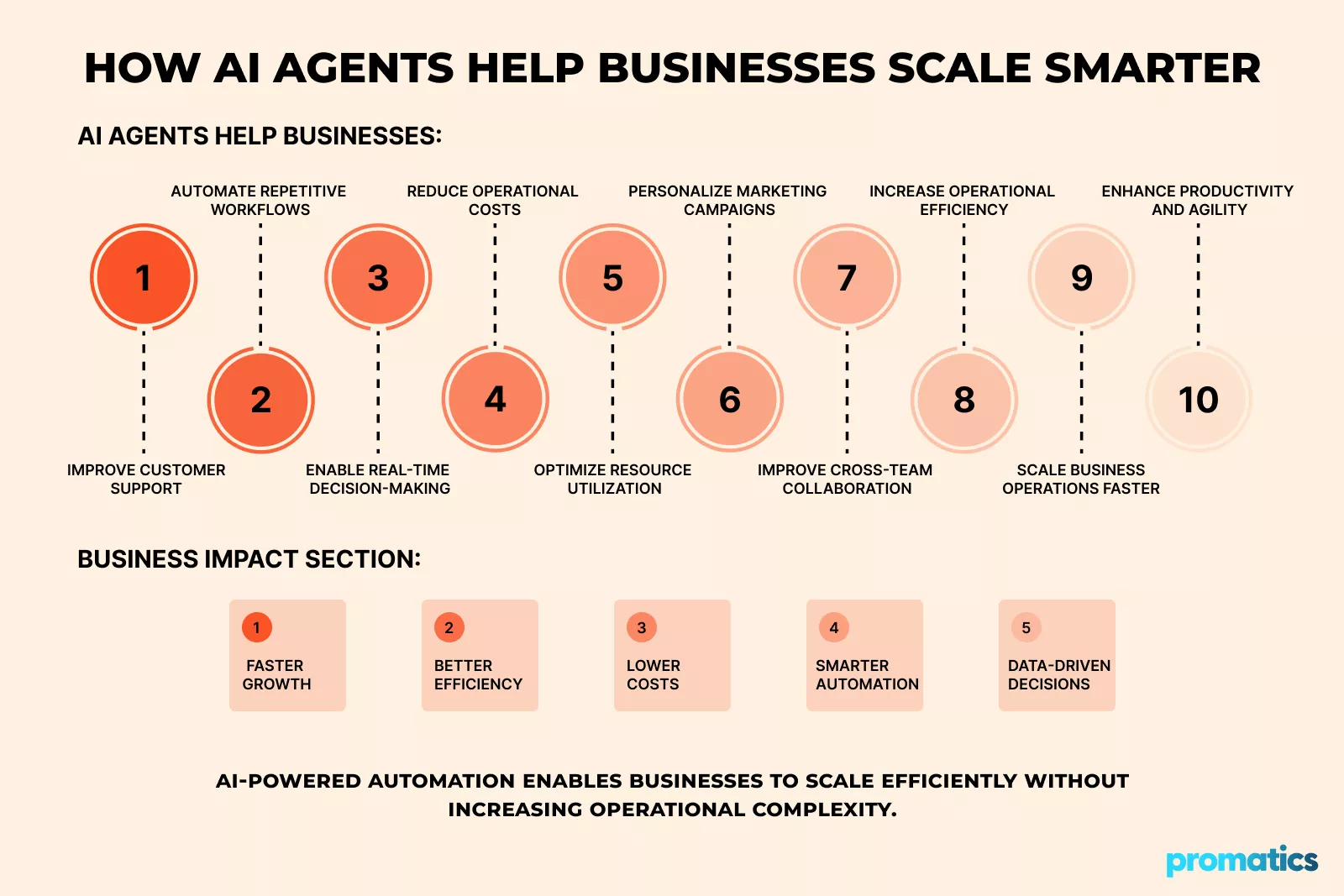
These systems can automate workflows, analyze large datasets, improve collaboration, enhance customer experiences, and support faster decision-making all while reducing manual effort. Let’s explore how AI agents are revolutionizing modern business scalability.
Automating Repetitive and Time-Consuming Tasks
As organizations scale, routine operational tasks such as data entry, reporting, ticket handling, and customer support requests increase significantly. Managing these repetitive processes manually not only consumes valuable resources but also slows down overall efficiency.
Businesses investing in AI-powered business automation and AI agent development services can streamline these workflows intelligently. AI agents automate repetitive operations, allowing employees to focus on strategic, creative, and high-value tasks. Enterprises using AI agents in IT and workflow automation report up to a 30% reduction in incident response times, demonstrating the growing impact of workflow automation solutions and intelligent process management.
AI agents can:
- Automatically process and categorize customer queries
- Route requests to the appropriate department instantly
- Generate real-time business performance reports
- Reconcile financial transactions with minimal human oversight
- Automate workflow approvals and administrative operations
By reducing manual bottlenecks and operational delays, AI agents enable enterprises to scale efficiently without proportionally increasing workforce requirements or operational costs.
Enabling Smarter Decision-Making with Data Insights
Modern businesses generate enormous volumes of data every day. However, scaling successfully requires more than just collecting data. Organizations need actionable insights that support fast and informed decision-making.
AI agents powered by machine learning development services and predictive analytics solutions can analyze massive datasets in real time, uncover hidden patterns, detect anomalies, and identify opportunities that traditional systems may overlook.
These intelligent systems help businesses:
- Forecast customer demand accurately
- Optimize pricing strategies
- Predict inventory requirements
- Identify operational inefficiencies
- Support strategic business planning
By transforming raw data into meaningful intelligence, AI agents empower enterprises to make faster, smarter, and more confident business decisions at scale.
Enhancing Customer Experience at Scale
Delivering consistent and personalized customer experiences becomes increasingly challenging as businesses expand. Long response times, inconsistent communication, and limited support availability can negatively impact customer satisfaction. According to the Google Cloud AI Agent Trends 2026 Report, customer service and support remain among the top use cases for AI agents, with businesses increasingly investing in conversational AI solutions and AI chatbot development services to deliver faster and more personalized customer interactions.
AI-powered conversational AI solutions, AI chatbot development services, and virtual assistants help businesses scale customer engagement intelligently while maintaining service quality.
AI agents can:
- Provide 24/7 customer support
- Deliver instant and personalized responses
- Handle high volumes of customer interactions simultaneously
- Automate onboarding and support processes
- Recommend products and services based on customer behavior
For example, e-commerce businesses use AI recommendation engines to personalize shopping experiences, while financial organizations automate customer onboarding through intelligent virtual assistants.
This enables businesses to maintain seamless, efficient, and highly personalized customer experiences even during rapid growth phases.
Streamlining Operational Workflows
One of the biggest barriers to scalability is disconnected systems and inefficient workflows. Departments often operate in silos, leading to communication gaps, duplicated tasks, and delayed execution.
AI agent development solutions help organizations build unified and intelligent operational ecosystems by integrating platforms such as CRM, ERP, HR, and analytics systems into connected workflows.
AI agents help businesses:
- Automate cross-department coordination
- Improve workflow visibility
- Ensure seamless data exchange between systems
- Reduce duplication and operational delays
- Increase overall business agility and efficiency
By creating connected and intelligent workflows, AI agents enable enterprises to scale operations smoothly without sacrificing speed, quality, or productivity.
Optimizing Resource Utilization
Traditional business scaling often requires hiring additional employees, expanding infrastructure, and increasing operational investments. However, this approach can quickly become expensive and difficult to manage.
Businesses leveraging enterprise AI development solutions can maximize existing resources through intelligent automation and process optimization.
AI agents help organizations:
- Automate labor-intensive operations
- Reduce process redundancies
- Improve workflow accuracy
- Optimize production schedules
- Predict maintenance requirements
- Improve warehouse and logistics management
For example, manufacturers use AI agents to improve production efficiency, while logistics companies use intelligent automation systems to optimize delivery routes and inventory operations.
This allows businesses to achieve higher productivity while controlling operational expansion costs.
Reducing Operational Costs
Operational efficiency is essential for sustainable business growth. Manual processes, human errors, and workflow inefficiencies can significantly increase operational expenses over time.
AI agents reduce costs by automating processes, improving accuracy, and optimizing business performance across departments.
Key benefits include:
- Lower administrative overhead
- Reduced manual errors and delays
- Improved productivity and operational speed
- Better resource allocation
- Higher process consistency and output quality
As businesses scale, these improvements lead to greater profitability and long-term operational sustainability.
Improving Business Speed and Agility
In today’s rapidly evolving market, businesses must adapt quickly to changing customer demands and market conditions. Organizations that respond faster gain a significant competitive advantage.
AI agent development solutions improve agility through:
- Real-time decision-making
- Predictive analysis
- Automated process execution
- Intelligent workflow optimization
AI agents can identify potential bottlenecks before they impact operations, recommend corrective actions, and support smoother transitions during scaling phases.
This level of responsiveness allows enterprises to scale rapidly while maintaining operational stability, flexibility, and efficiency.
Personalizing Marketing and Sales at Scale
As businesses grow, maintaining personalized marketing and customer engagement manually becomes increasingly difficult. AI agents solve this challenge by enabling data-driven personalization at scale.
Businesses using AI-powered marketing automation solutions can:
- Segment audiences intelligently
- Personalize campaigns across channels
- Optimize lead nurturing workflows
- Analyze customer behavior patterns
- Improve engagement and conversion rates
More than 51% of marketing teams already use AI agents for personalization and campaign optimization, making AI-driven customer engagement a major focus area for modern businesses. AI agents use customer data and behavioral insights to deliver highly relevant experiences, ensuring that every interaction feels personalized and meaningful.
This helps businesses strengthen customer relationships, improve retention, and drive scalable revenue growth through smarter engagement strategies.
Enhancing Collaboration Across Teams
As organizations expand, maintaining smooth communication and coordination between departments becomes more challenging. Miscommunication and delayed information sharing can reduce operational efficiency.
AI agents act as intelligent digital coordinators that help teams collaborate more effectively by:
- Automating internal communications
- Scheduling meetings intelligently
- Summarizing discussions and reports
- Providing real-time project updates
- Improving knowledge sharing across departments
This ensures that cross-functional teams remain aligned, connected, and productive as the business continues to scale.
Future-Proofing Business Growth
Scalability is not just about short-term expansion, it’s about building systems that can adapt and evolve with future business needs. Modern AI integration services and custom AI solutions are designed with scalability, flexibility, and continuous learning capabilities at their core.
Gartner predicts that AI agents could contribute between $2.6 trillion and $4.4 trillion annually to global business value, making custom AI solutions and intelligent automation key long-term investments for enterprises.
AI agents can:
- Adapt to changing business environments
- Learn from new data and experiences
- Evolve alongside emerging technologies
- Respond to market shifts and customer demands
- Continuously improve operational performance
By adopting intelligent AI-driven systems, businesses can future-proof operations, maintain long-term competitiveness, and build resilient growth strategies in an increasingly digital world.
Key Challenges Businesses Face in AI Agent Development
While AI agents offer significant advantages in automation, efficiency, and intelligent decision-making, developing and implementing them successfully comes with several challenges. Businesses investing in AI agent development services must address technical, operational, and ethical complexities to ensure reliable and scalable AI solutions.
Below are some of the most important challenges organizations face during AI agent development.
Data Quality and Availability
AI agents rely heavily on data to learn, make decisions, and improve performance over time. The accuracy and effectiveness of an AI system depend largely on the quality of the data it receives.
If the data is incomplete, outdated, inconsistent, or biased, AI agents may generate inaccurate predictions, poor recommendations, or unreliable outcomes. This can directly impact business operations and customer experiences.
To build effective machine learning development solutions, businesses must ensure:
- Clean and structured datasets
- Real-time and relevant information
- Consistent data management practices
- Reduced bias and duplication in data sources
High-quality data is essential for training intelligent AI systems that can operate accurately and efficiently at scale.
System Integration Complexity
Integrating AI agents into existing enterprise systems is often a complex process. Businesses typically operate multiple platforms such as CRM systems, ERP software, analytics tools, cloud infrastructure, and legacy applications.
Enabling AI agents to interact smoothly across different systems requires strategic planning, robust infrastructure, and dependable AI integration services.
Organizations may face challenges such as:
- Compatibility issues with legacy systems
- Data synchronization problems
- Workflow disruptions during implementation
- Security and infrastructure limitations
Without proper integration strategies, businesses may struggle to unlock the full potential of AI-powered automation and intelligent workflows.
Ethical and Transparency Concerns
As AI agents become more autonomous and involved in decision-making, ethical considerations are becoming increasingly important. Businesses must ensure that AI systems operate responsibly, transparently, and without unfair bias.
At the same time, more than 70% of IT leaders consider AI governance and compliance among their biggest deployment challenges, emphasizing the growing importance of secure and responsible enterprise AI solutions.
Issues related to privacy, accountability, and decision transparency can impact customer trust and regulatory compliance.
Organizations developing enterprise AI solutions should focus on:
- Transparent AI decision-making processes
- Responsible use of customer data
- Bias detection and mitigation
- Data privacy and security compliance
- Human oversight for critical decisions
Building ethical AI systems not only reduces risks but also helps businesses establish long-term trust with customers and stakeholders.
Security and Data Privacy Risks
AI agents often process sensitive business and customer information, making cybersecurity and data protection critical priorities. Weak security measures can expose organizations to data breaches, unauthorized access, and compliance risks.
Businesses implementing AI-powered business automation solutions must invest in:
- Secure cloud infrastructure
- Data encryption and access controls
- Continuous system monitoring
- Compliance with data protection regulations
Protecting sensitive information is essential for maintaining operational security and customer confidence.
High Development and Maintenance Costs
Developing advanced AI agents requires significant investment in technology, infrastructure, skilled professionals, and continuous optimization. Training AI models, maintaining datasets, and updating systems regularly can increase long-term operational costs.
Many businesses face challenges related to:
- Hiring AI and machine learning experts
- Managing cloud computing expenses
- Scaling AI infrastructure efficiently
- Maintaining model performance over time
However, despite the initial investment, well-implemented AI agent development solutions can deliver substantial long-term ROI through automation, productivity improvements, and operational efficiency.
Continuous Learning and Adaptation
Business environments constantly evolve, and AI agents must adapt to changing customer behaviors, market trends, and operational requirements. Static AI systems quickly become outdated if they are not continuously monitored and improved.
To maintain effectiveness, businesses need:
- Continuous model training
- Real-time performance monitoring
- Regular updates and optimization
- Adaptive learning capabilities
Organizations investing in custom AI solutions must ensure their AI agents remain scalable, flexible, and capable of evolving alongside business growth.
Despite these challenges, AI agents continue to play a transformative role in modern enterprises. With the right development strategy, reliable infrastructure, and ethical implementation practices, businesses can successfully leverage AI agents to improve efficiency, automate operations, and build smarter, future-ready systems.
Conclusion
AI agents are changing the way modern businesses operate by making processes faster, smarter, and more efficient. From automating repetitive tasks and improving customer interactions to supporting better decision-making and scalable operations, AI agents are helping companies move beyond traditional automation and build more intelligent business systems.
As businesses continue to scale in 2026, the demand for AI-powered automation and intelligent workflows will only continue to grow. Companies that invest in the right AI agent development solutions today will be better positioned to improve productivity, reduce operational costs, enhance customer experiences, and adapt quickly to changing market demands.
However, successful AI implementation requires the right technology partner, development strategy, and scalable infrastructure to ensure long-term results.
Promatics Technologies helps businesses develop custom AI agent solutions aligned with their unique operational objectives. With expertise in AI agent development, machine learning, conversational AI, and enterprise automation, Promatics delivers scalable solutions designed to drive real business impact. Connect with Promatics Technologies to develop intelligent AI solutions that streamline workflows, improve efficiency, and support long-term business growth.
