Enterprise MVP Development with AI: Faster, Smarter & Scalable Product Builds in 2026
TL;DR
- Modern MVP development is shifting from temporary prototypes to scalable enterprise-ready platforms.
- Businesses are prioritizing faster validation, continuous iteration, and long-term scalability.
- Workflow automation, cloud-native infrastructure, and modular architecture are accelerating product development.
- Successful MVPs focus on operational efficiency, maintainability, security, and user experience from day one.
- Human expertise still plays a critical role in architecture planning, scalability, governance, and product strategy.
- The future of MVP development is centered around adaptable, scalable, and continuously evolving digital products.
Launching a product has never been easier, but building one that can truly scale is where most businesses struggle.
In today’s fast-moving digital market, companies are under constant pressure to launch faster, innovate continuously, and respond quickly to changing customer expectations. But rushing into full-scale development without proper validation often results in wasted budgets, delayed timelines, and products that fail to deliver long-term value.
That is why businesses are moving toward smarter MVP development strategies.
Instead of spending months building complex platforms upfront, startups and enterprises are now focusing on lean, scalable products that solve specific problems, gather early customer feedback, and improve based on real market demand. This approach helps reduce risk, shorten development cycles, and create a stronger foundation for future growth.
MVP development in 2026 is also very different from traditional approaches. Earlier, MVPs were often treated as temporary prototypes built only for testing ideas. Today, businesses need products that can evolve into enterprise-grade platforms without requiring complete redevelopment later. Scalability, cloud infrastructure, workflow automation, integrations, performance, and long-term maintainability are now becoming essential parts of the MVP planning process itself.
In this blog, we’ll explore how enterprise MVP development is evolving in 2026, the frameworks behind scalable product engineering, the key stages of building a successful MVP, common scaling challenges businesses face, and how organizations are turning early-stage products into enterprise-ready digital platforms.
The New Reality : Why AI Changes the MVP Equation
The way businesses build digital products has changed dramatically. Earlier, developing an MVP required large engineering teams, long timelines, and heavy upfront investments before companies could validate real market demand. Most MVPs were created only for quick testing, which later resulted in scalability issues, technical debt, and expensive redevelopment challenges.
Today, that approach no longer works.
The growing importance of scalable MVP development is evident from the fact that 63% of successful unicorns began as MVP applications before evolving into large-scale digital platforms. Modern product development is driven by faster development frameworks, workflow automation, cloud-native infrastructure, and smarter engineering processes that help startups and enterprises launch products much faster than traditional development models. Businesses can now reduce repetitive development work, speed up deployment cycles, improve operational efficiency, and make better product decisions using real-time customer insights.
As a result, enterprise MVP development is no longer just about building a quick prototype. It has become a strategic process focused on creating scalable digital foundations that support long-term growth.
Customer expectations are also changing rapidly. Users now expect seamless experiences, faster performance, personalized interactions, and continuous feature improvements from the first version of a product. Whether it is SaaS platforms, fintech apps, healthcare solutions, or enterprise software, businesses are expected to deliver products that are scalable and future-ready from day one.
This is why modern MVP strategies increasingly focus on:
- modular architecture
- API-first development
- cloud scalability
- long-term maintainability
At the same time, market competition is moving faster than ever. Businesses that spend too much time overbuilding products often lose opportunities to faster-moving competitors. Companies are now prioritizing rapid validation, continuous iteration, and scalable deployment strategies to launch products faster while staying flexible enough to evolve with changing market demands.
In 2026, MVP development is no longer about building the smallest possible product. It is about building smarter, scalable, and adaptable platforms that can grow alongside the business while supporting faster innovation and long-term success.
2026 Enterprise MVP Development Trends & Statistics
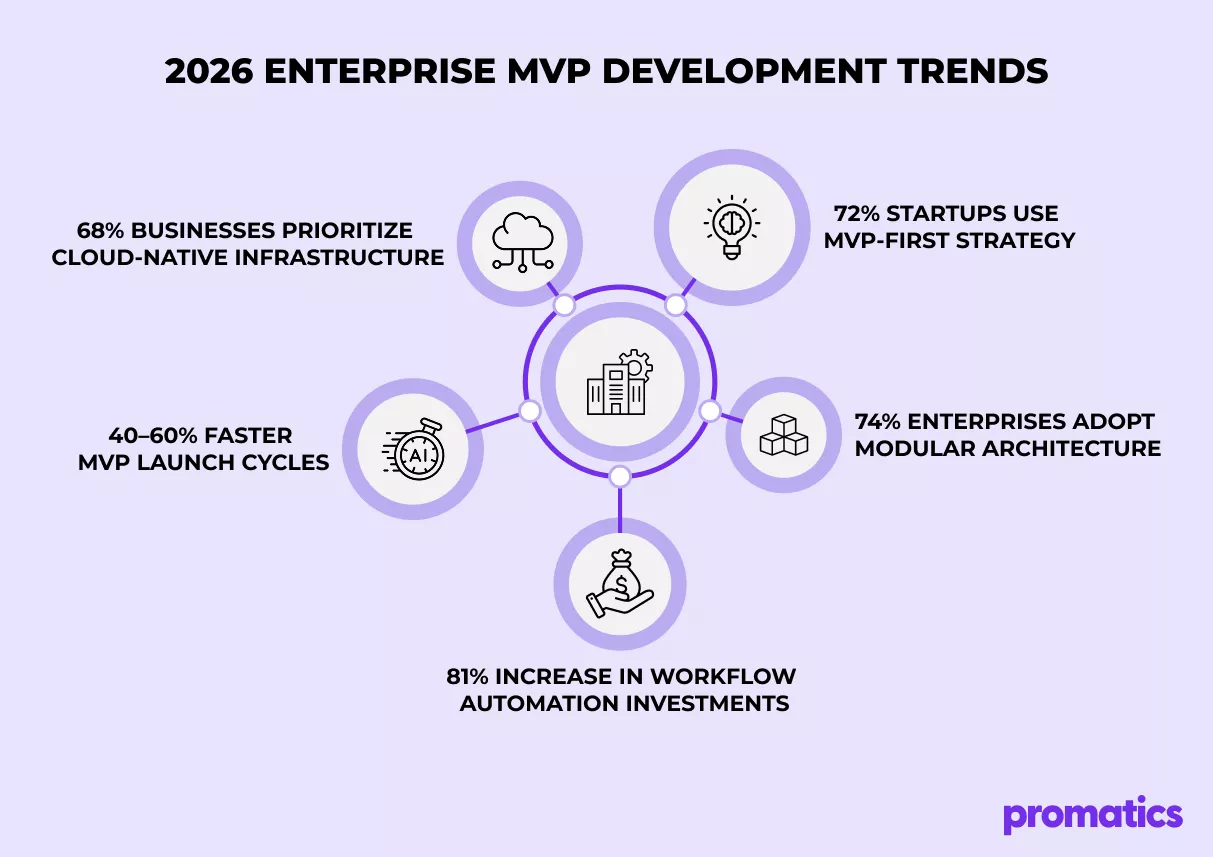
Enterprise MVP development is evolving rapidly as businesses prioritize faster launches, scalable architecture, and operational efficiency. Recent industry reports show that organizations are increasingly adopting AI-assisted engineering workflows, cloud-native infrastructure, and workflow automation solutions on-first product strategies to accelerate product validation while reducing long-term development risks. According to recent industry reports, 72% of startups use an MVP approach to validate products faster and reduce development risk before scaling.
Unlike traditional MVPs that were often built only for short-term testing, modern MVPs are now designed as scalable digital foundations capable of supporting continuous iteration, enterprise integrations, and long-term product growth. This shift is changing how startups and enterprises approach software development in 2026.
| 2026 Enterprise MVP Trend | Industry Insight |
| Companies using AI-assisted development workflows | 72% |
| Businesses prioritizing cloud-native MVP infrastructure | 68% |
| Enterprises adopting modular architecture strategies | 74% |
| Average reduction in MVP launch timelines | 40–60% |
| Teams using AI coding assistants regularly | 76% |
| Organizations increasing workflow automation investments | 81% |
| MVPs facing scalability challenges after launch | 42% |
| Companies prioritizing security during MVP planning | 69% |
These trends highlight a major industry shift toward building smarter and more scalable products from the beginning itself. Businesses are increasingly focusing on flexible architecture, automated deployment systems, continuous delivery pipelines, and real-time product iteration to stay competitive in rapidly evolving digital markets.
Strategic Implementation: Where AI Delivers the Greatest ROI
The biggest advantage of modern MVP development is not just faster product launches. The real value comes from implementing intelligent systems strategically in areas where they create measurable business impact. Modern MVP strategies can reduce development costs by up to 60% compared to traditional software development approaches by focusing on rapid validation and iterative deployment Businesses that focus on solving operational bottlenecks, improving workflow automation solutions, and accelerating decision-making often see the highest return on investment.
Below are the areas where modern technologies are delivering the greatest ROI in enterprise MVP development.
1. Faster Product Development Cycles
One of the biggest benefits businesses are seeing is reduced development time. Modern development includes custom software development frameworks, automation tools, and intelligent coding assistants help teams streamline repetitive engineering tasks, accelerate testing, and simplify deployment workflows.
This allows businesses to:
- launch MVPs faster
- reduce engineering overhead
- shorten release cycles
- iterate products more quickly
Instead of spending months building initial product versions, companies can now validate ideas in weeks while still maintaining scalability and performance standards.
2. Workflow Automation
Operational workflows are becoming one of the highest-impact implementation areas. Businesses are increasingly automating repetitive processes that previously consumed significant manual effort and operational time.
Common automation use cases include:
- customer support workflows
- document processing
- invoice handling
- employee onboarding
- approval systems
- scheduling and notifications
By automating routine operations, businesses improve efficiency, reduce human error, and allow teams to focus on higher-value strategic work.
3. Better Product Decision-Making
Modern MVP strategies rely heavily on real-world customer insights instead of assumptions. Research also indicates that nearly 70% of companies using MVP strategies gain better user insights through faster customer feedback and real-world product testing. Businesses can now track how users interact with products, which features perform best, and where operational bottlenecks exist.
This helps teams:
- prioritize high-impact features
- improve user experiences
- identify customer pain points
- reduce unnecessary development work
Faster access to product insights enables businesses to make smarter decisions and improve product-market fit much earlier in the development cycle.
4. Improved Customer Experience
Customer expectations are higher than ever. Users now expect faster performance, personalized interactions, and seamless digital experiences from the first version of a product.
Modern implementation strategies help businesses improve:
- response times
- customer engagement
- personalization
- onboarding experiences
- support efficiency
Products that deliver smoother and more responsive experiences often see better customer retention and stronger long-term engagement.
5. Scalable Infrastructure Management
Scalability is one of the most important factors in enterprise MVP development. Businesses now prioritize cloud-native infrastructure and flexible deployment systems from the beginning to avoid expensive redevelopment later.
Modern infrastructure strategies help organizations:
- scale products efficiently
- optimize cloud resources
- improve system reliability
- reduce downtime
- manage growing user demand
This creates stronger digital foundations that can support long-term business growth without major architectural changes.
6. Faster Testing & Deployment
Testing and deployment processes traditionally consumed a large portion of development timelines. Modern automation tools now streamline:
- quality assurance workflows
- deployment pipelines
- performance monitoring
- bug detection
- release management
This allows businesses to release updates faster while maintaining product stability and performance.
7. Operational Cost Reduction
Another major ROI area is operational efficiency. Businesses can significantly reduce costs by minimizing repetitive tasks, optimizing infrastructure usage, and improving workflow productivity.
This helps organizations:
- lower operational overhead
- reduce manual workload
- improve team productivity
- optimize resource allocation
Instead of expanding teams rapidly, businesses can scale operations more efficiently using smarter systems and automated workflows.
8. Continuous Product Improvement
Modern MVP development is no longer a one-time launch process. Businesses are now focused on continuous iteration and long-term product evolution.
Real-time insights and performance monitoring help organizations:
- release improvements faster
- adapt to changing customer needs
- identify scaling challenges early
- improve product performance continuously
This creates more adaptable products that can evolve alongside changing business and market demands.
The companies seeing the greatest ROI today are not simply adopting advanced technologies for trend value. They are implementing them strategically in areas that improve operational efficiency, accelerate product growth, and create scalable digital foundations for long-term success.
AI-Assisted MVP Development vs Traditional MVP Development
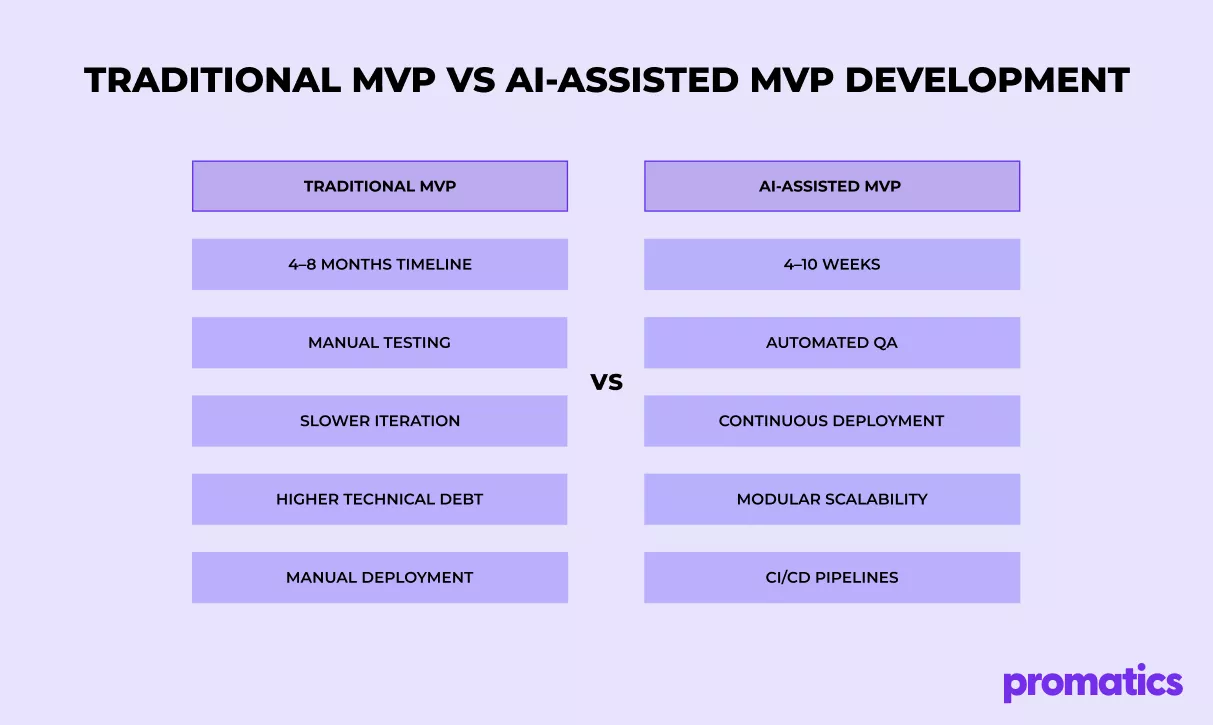
The biggest transformation in modern product engineering is not just faster development, but the ability to build scalable products with greater efficiency and lower maintenance costs. AI-assisted workflows are helping businesses accelerate delivery cycles, with some enterprise MVP providers reporting up to 60% faster time-to-market.
AI-powered product development workflows, cloud automation, and intelligent engineering systems are also reshaping how businesses validate, build, and launch products more efficiently.
The comparison below highlights how enterprise MVP development in 2026 differs from traditional software development approaches.
| Factor | Traditional MVP Development | AI-Assisted MVP Development (2026) |
| Development Timeline | 4–8 months | 4–10 weeks |
| Testing Workflows | Mostly manual testing | Continuous automated testing |
| Infrastructure Setup | Manual configuration | Cloud-native automated deployment |
| Product Iteration Speed | Slower release cycles | Continuous deployment & updates |
| Scalability Planning | Often delayed until later stages | Integrated from the beginning |
| Operational Efficiency | Higher repetitive workload | Workflow automation driven |
| Deployment Management | Manual releases | CI/CD-based release pipelines |
| Product Decisions | Assumption-driven | Analytics-driven optimization |
| Customer Feedback Integration | Slower implementation | Real-time iteration cycles |
| Maintenance Overhead | Higher technical debt risk | Better modular maintainability |
This shift is allowing businesses to validate products faster, reduce operational bottlenecks, and build scalable digital platforms without sacrificing long-term flexibility and maintainability.
Where Most MVPs Still Fail in 2026
Despite faster engineering workflows and modern development automation, many MVPs still struggle to achieve long-term success. One of the biggest misconceptions in product development is assuming that faster launches automatically lead to better products.
In reality, many MVPs fail because businesses prioritize speed over scalability, product-market validation, infrastructure planning, and customer experience optimization. While modern development tools can accelerate engineering workflows, poor strategic planning still creates operational and scalability challenges later.
The table below highlights some of the most common reasons MVPs continue to fail in 2026.
| Common MVP Failure Reason | Estimated Impact |
| Poor product-market fit | 34% |
| Scalability limitations | 22% |
| Weak infrastructure planning | 18% |
| Limited customer feedback integration | 15% |
| Security and compliance gaps | 11% |
Businesses are increasingly realizing that launching quickly is only one part of successful MVP development. Long-term product stability also depends on scalable architecture, continuous feedback systems, strong infrastructure planning, and operational flexibility from the early stages itself.
This is why modern enterprise MVP strategies are placing greater emphasis on maintainability, workflow reliability, cloud scalability, and customer-driven iteration rather than simply reducing development timelines.
Balancing Speed and Quality in Modern MVP Development
While faster development cycles and automation are helping businesses launch products more quickly, speed alone is not enough. One of the biggest challenges in modern MVP development is maintaining product quality while accelerating engineering and deployment workflows.
Many businesses assume that faster development automatically leads to better productivity. However, without proper oversight, rapid workflows can create:
- scalability issues
- inconsistent user experiences
- security vulnerabilities
- unstable deployments
- technical debt
- long-term maintenance challenges
This is why successful enterprise MVP development focuses on balancing speed with quality, performance, and long-term maintainability.
1. Strong Architecture Planning from the Beginning
Quality starts with the right foundation. Even during the MVP stage, businesses need scalable and maintainable system architecture that can support future growth.
Modern MVPs increasingly prioritize:
- modular architecture
- API-first development
- scalable cloud infrastructure
- clean code structures
- flexible deployment systems
Building strong architecture early helps businesses avoid expensive redevelopment and operational bottlenecks later.
2. Human Oversight Remains Critical
Automation can accelerate repetitive engineering tasks, but human expertise is still essential for maintaining quality.
Development teams still need to review:
- business logic
- security standards
- product workflows
- system performance
- user experience consistency
Without proper oversight, rapid development can introduce bugs, workflow failures, and unreliable product behavior that negatively impacts scalability and customer trust.
3. Automated Testing & Continuous QA
Modern development workflows rely heavily on continuous testing to maintain product stability.
Businesses are increasingly automating:
- regression testing
- performance testing
- deployment validation
- bug detection
- API testing
This helps teams identify issues earlier in the development cycle and reduce production-level failures after launch.
Continuous QA processes are especially important for enterprise products where even small workflow disruptions can affect operations and customer experience.
4. Performance & Scalability Monitoring
A product that works well for a few hundred users may fail under enterprise-scale traffic if performance monitoring is ignored.
That is why modern MVP strategies include:
- infrastructure monitoring
- application performance tracking
- load testing
- server optimization
- cloud resource management
Monitoring systems help businesses identify bottlenecks early and maintain consistent performance as the product scales.
5. Security & Compliance Validation
As products scale, security becomes a critical part of quality management. Businesses handling customer data, financial information, or enterprise workflows must ensure that security standards are maintained throughout the development lifecycle.
Modern enterprise MVPs increasingly focus on:
- secure authentication systems
- encrypted data handling
- role-based access controls
- compliance-ready infrastructure
- regular vulnerability testing
Ignoring security during rapid development often creates expensive risks later.
6. Continuous Feedback & Iteration
Maintaining quality is not just about writing cleaner code. It also involves improving the product continuously based on real user feedback and operational insights.
Businesses now rely on:
- customer behavior analysis
- feature usage tracking
- workflow monitoring
- support feedback
- performance analytics
This helps teams refine the product consistently while improving user satisfaction and long-term scalability.
7. Documentation & Process Standardization
Faster workflows often create documentation gaps that later slow down scaling and maintenance.
Strong development processes now include:
- clear technical documentation
- deployment guidelines
- workflow standards
- code review systems
- infrastructure documentation
Well-documented systems improve collaboration, simplify maintenance, and reduce operational dependency on individual developers.
In modern enterprise MVP development, speed without quality creates long-term problems. The most successful businesses are the ones that combine faster development workflows with strong architecture, continuous testing, performance monitoring, and operational discipline.
In 2026, maintaining quality is no longer a separate phase after development. It has become an ongoing process built directly into the product engineering lifecycle itself.
Real Business Impact: What Accelerated MVP Development Looks Like
The impact of modern development acceleration is now clearly visible, with businesses across industries improving product delivery speed, operational efficiency, customer experience, and scalability through smarter engineering workflows, automation-driven MVP strategies, and advanced digital transformation solutions.
Industry research shows that businesses adopting MVP-first strategies can achieve approximately 35% faster time-to-market compared to traditional development cycles. What once took months of planning, development, testing, and deployment can now be completed in significantly shorter timelines without compromising long-term scalability.
Below are some of the most common real-world outcomes businesses are achieving through accelerated MVP development.
1. Faster Time-to-Market
One of the biggest advantages businesses are experiencing is dramatically shorter product launch cycles.
Earlier, building an MVP often required:
- lengthy development sprints
- manual testing processes
- infrastructure setup delays
- multiple deployment bottlenecks
Today, streamlined engineering workflows and automated deployment systems allow businesses to move from idea validation to product launch much faster.
This helps companies:
- test ideas quickly
- respond faster to market trends
- launch before competitors
- reduce product development delays
For startups, this means reaching investors and customers faster. For enterprises, it means accelerating innovation without disrupting existing operations.
2. Reduced Development Costs
Modern automation-driven workflows are helping businesses reduce repetitive engineering work and optimize resource allocation more effectively.
Companies are lowering costs by:
- minimizing manual development tasks
- automating testing workflows
- simplifying deployment management
- reducing rework cycles
- improving team productivity
Instead of expanding large development teams early, businesses can now scale product development more efficiently while maintaining operational control.
3. Faster Product Iteration
Traditional product updates often required long release cycles and slow feedback loops. Modern MVP strategies now allow businesses to release updates continuously based on real-world user insights.
This helps organizations:
- improve products faster
- fix issues quickly
- respond to customer feedback efficiently
- test new features with lower risk
Continuous iteration has become a major competitive advantage in fast-moving digital markets.
4. Improved Operational Efficiency
Businesses are also seeing strong results from workflow automation and process optimization.
Many organizations are streamlining:
- customer onboarding
- support workflows
- internal approvals
- reporting systems
- scheduling processes
- document management
This reduces operational bottlenecks, improves team efficiency, and allows employees to focus more on strategic tasks instead of repetitive manual work.
5. Better Customer Experiences
Modern users expect products to be faster, smoother, and more responsive from the very beginning.
Businesses that prioritize scalable MVP development are improving:
- platform performance
- personalization
- response times
- onboarding experiences
- feature accessibility
These improvements often lead to:
- higher customer engagement
- better retention rates
- increased user satisfaction
- stronger brand trust
6. Stronger Scalability & Long-Term Growth
One of the most important real-world outcomes is improved scalability planning.
Earlier MVPs often failed when businesses tried to scale rapidly because the systems were never designed for long-term growth. Modern MVP development now focuses heavily on:
- cloud scalability
- modular architecture
- API-first systems
- flexible deployment infrastructure
This allows businesses to scale products more smoothly without major redevelopment later.
7. Smarter Business Decision-Making
Modern analytics and monitoring systems are helping businesses make more informed product decisions using real-world performance insights.
Companies can now track:
- user behavior
- feature adoption
- workflow performance
- operational bottlenecks
- customer engagement patterns
This helps teams prioritize improvements that drive measurable business impact instead of relying on assumptions.
The biggest shift in modern product development is not just faster execution. Businesses can now launch smarter products, optimize continuously, and scale more efficiently with lower operational complexity. Many MVP-focused agencies have already helped clients raise over $1B+ through scalable MVP-first products.
In 2026, successful MVP development is defined not only by speed, but by the ability to combine rapid execution with scalability, efficiency, and long-term growth.
Why Human Expertise Still Matters in Modern MVP Development
Modern development workflows are helping businesses build and launch products faster than ever. Automation tools and intelligent systems are reducing repetitive work, accelerating testing, and improving efficiency across the development lifecycle.
However, faster development does not replace human expertise. Building scalable enterprise products still requires strategic thinking, technical decision-making, and strong product engineering expertise.
The table below highlights where human expertise continues to play a critical role in modern MVP development.
| Area | What Automation Helps With | Why Human Expertise Still Matters |
| Product Strategy | Speeds up research, analytics, and data processing | Humans understand market gaps, customer behavior, and long-term business goals better |
| Architecture Planning | Assists with infrastructure setup and development workflows | Scalable system design, security planning, and platform decisions require engineering expertise |
| User Experience Design | Helps generate layouts and interface suggestions | Human designers create intuitive, emotionally engaging, and customer-focused experiences |
| Workflow Automation | Automates repetitive operational tasks | Teams still need to identify which workflows actually improve business efficiency |
| Testing & QA | Accelerates bug detection and automated testing | Human validation is needed to identify usability issues and real-world workflow problems |
| Security & Compliance | Helps monitor vulnerabilities and system performance | Security governance, compliance requirements, and risk management need expert oversight |
| Product Scalability | Supports cloud scaling and deployment automation | Engineers must plan infrastructure growth, performance optimization, and long-term maintainability |
| Customer Experience | Improves personalization and response efficiency | Human understanding is essential for building trust, empathy, and meaningful user interactions |
| Business Decision-Making | Provides analytics and operational insights | Leadership teams must still make strategic product and growth decisions |
One of the biggest misconceptions in modern product development is assuming that faster workflows automatically lead to better products. In reality, businesses that rely too heavily on automation without proper oversight often face:
- inconsistent user experiences
- scalability issues
- poor architecture decisions
- security vulnerabilities
- operational inefficiencies
This is especially important in enterprise MVP development, where products are expected to scale into long-term business platforms rather than temporary prototypes.
Successful companies use modern technologies to improve efficiency, but they still rely heavily on experienced teams for:
- product strategy
- system architecture
- customer experience planning
- operational scalability
- security governance
- long-term product vision
In 2026, the most effective MVP development strategies are not about replacing people with automation. They are about combining faster development workflows with human expertise to build products that are scalable, reliable, and ready for long-term growth.
The Next Phase of MVP Development: Smarter, Faster & More Autonomous
The future of MVP development is no longer centered only around building products faster. It is evolving toward creating intelligent, scalable, and highly adaptive digital platforms that can continuously improve, automate workflows, and respond to changing business needs in real time. Recent reports show that 78% of venture-backed startups launch mobile-first products, highlighting the growing demand for scalable and continuously evolving digital experiences
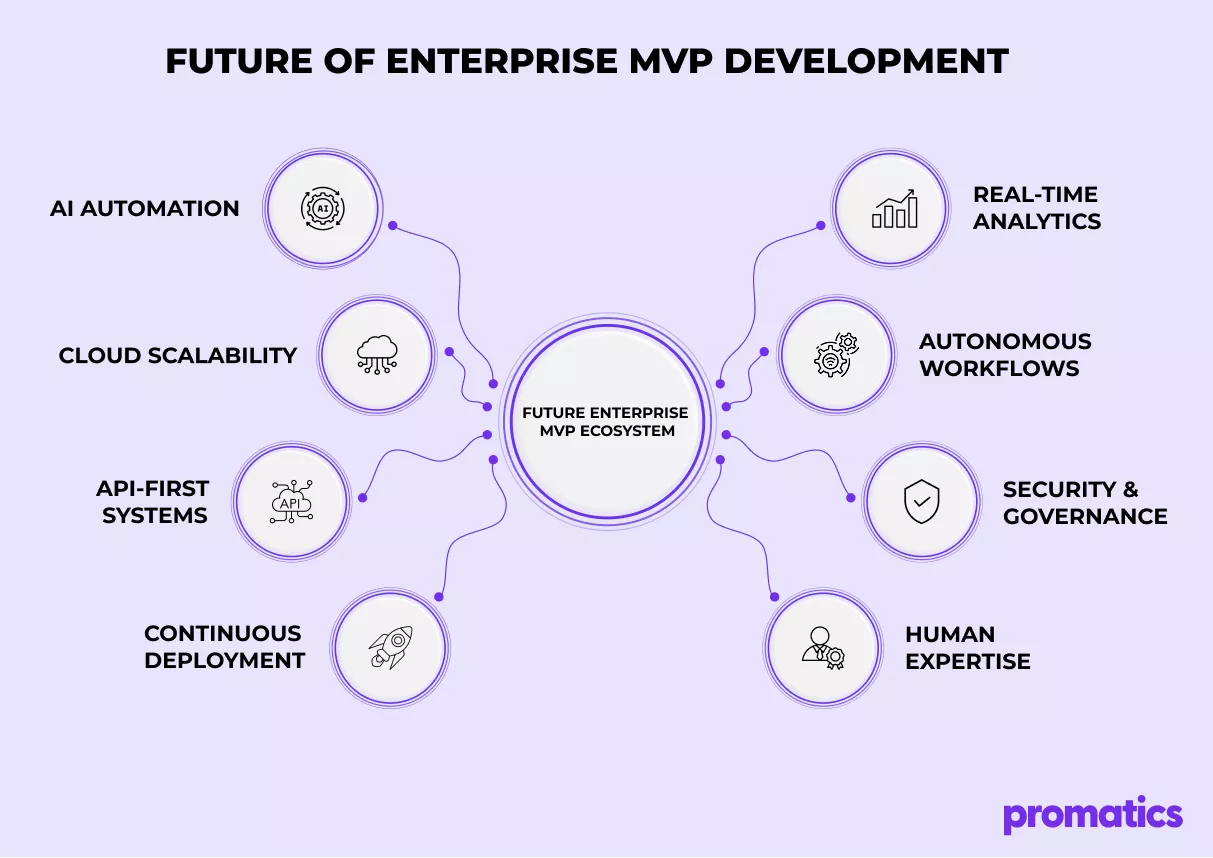
Over the last few years, businesses have already transformed how products are launched and validated. But from 2026 onward, the biggest shift will come from the convergence of:
- intelligent automation
- cloud-native infrastructure
- workflow orchestration
- real-time analytics
- scalable enterprise systems
- autonomous operational processes
This convergence is fundamentally changing how modern software products are designed, deployed, and scaled.
Recent enterprise technology reports show that intelligent systems are rapidly moving from experimental tools into deeply integrated operational platforms embedded within everyday business workflows.
1. MVPs Will Become Continuous Product Ecosystems
Traditional MVPs were often built as temporary versions of a product meant only for validation. Future-ready MVPs are becoming long-term digital ecosystems designed to evolve continuously without major redevelopment.
Businesses are increasingly building products with:
- modular architecture
- cloud scalability
- API-first infrastructure
- flexible deployment systems
- continuous release pipelines
This allows organizations to launch faster while continuously improving products based on real-world user behavior and operational insights.
Instead of treating MVP development as a one-time process, businesses are now focusing on continuous product evolution.
2. Workflow Automation Will Become Core to Product Design
One of the biggest changes shaping future MVP development is the rise of workflow-driven products.
Modern enterprise applications are increasingly designed to automate:
- internal operations
- customer onboarding
- support systems
- reporting workflows
- scheduling processes
- enterprise approvals
- data handling tasks
The goal is no longer just building software interfaces. Businesses are now building operational systems that actively improve efficiency across departments.
Industry reports suggest that enterprise software is rapidly evolving toward “autonomous enterprise” models where systems can handle operational tasks more proactively.
3. Faster Development Will Reshape Product Competition
Development timelines are shrinking rapidly across the software industry. Businesses that previously needed months to build and deploy products can now launch functional platforms in significantly shorter timeframes.
This acceleration is changing market competition completely.
Companies are now able to:
- validate ideas faster
- experiment with lower risk
- release updates continuously
- adapt quickly to customer feedback
- scale products more efficiently
According to recent enterprise software reports, development acceleration is significantly reducing the gap between idea validation and production deployment.
As a result, businesses that fail to innovate quickly may struggle to compete with faster-moving, more adaptive product teams.
4. Enterprise Products Will Become More Context-Aware
Future enterprise applications are expected to become more responsive and context-aware rather than static systems with fixed workflows.
Modern products are increasingly being designed to:
- personalize user experiences
- understand operational patterns
- recommend actions dynamically
- improve workflow efficiency
- support real-time decision-making
This shift is transforming enterprise software from passive systems into more intelligent operational platforms that adapt continuously based on user behavior and business activity.
Research shows that future enterprise platforms will increasingly rely on contextual memory, automation workflows, and integrated operational intelligence.
5. Security & Governance Will Become Even More Important
As enterprise systems become more automated and data-driven, businesses are placing greater focus on:
- security
- compliance
- data governance
- infrastructure transparency
- operational accountability
Future MVP strategies will increasingly prioritize secure cloud environments, compliance-ready architectures, encrypted workflows, and stronger monitoring systems from the beginning itself.
This is especially important for industries like:
- healthcare
- fintech
- insurance
- enterprise SaaS
- cybersecurity
Recent enterprise reports show growing demand for secure and auditable infrastructure capable of protecting sensitive operational and customer data.
6. Human Expertise Will Still Drive Product Success
Despite rapid automation and faster development workflows, human expertise will remain one of the most important parts of successful MVP development.
Technology can accelerate:
- engineering workflows
- deployment cycles
- operational processes
- data analysis
But businesses still rely on people for:
- product strategy
- architecture planning
- customer understanding
- operational decisions
- business scalability
- governance and oversight
Industry leaders continue to emphasize that human judgment, consistency, and strategic thinking remain critical in modern software development environments.
7. The Future Will Favor Scalable & Adaptive Products
The next generation of successful digital products will not simply be the fastest to launch. They will be the products that can:
- scale efficiently
- adapt continuously
- integrate seamlessly
- automate intelligently
- improve based on real-world insights
This is why modern MVP development is increasingly focused on building strong digital foundations instead of temporary prototypes.
Businesses are now prioritizing:
- scalable architecture
- operational flexibility
- faster iteration cycles
- long-term maintainability
- cloud-native systems
- integrated workflows
The future of MVP development is becoming less about launching minimum products and more about creating adaptable platforms capable of supporting long-term digital growth.
In the coming years, the businesses that succeed will be the ones that combine faster innovation with scalability, operational efficiency, strong governance, and continuous product evolution.
Enterprise MVP Technology Stack in 2026
Modern enterprise MVP development relies heavily on scalable infrastructure, modular engineering practices, cloud-native systems, and automation-driven workflows. Businesses are increasingly adopting flexible technology stacks that support faster deployment, continuous iteration, seamless integrations, and long-term scalability.
The technologies below are commonly used in enterprise MVP development in 2026.
| Technology Layer | Commonly Used Solutions |
| Frontend Development | React, Next.js, Flutter |
| Backend Development | Node.js, Python, Go |
| Cloud Infrastructure | AWS, Microsoft Azure, Google Cloud |
| Containerization | Docker, Kubernetes |
| Databases | PostgreSQL, MongoDB |
| CI/CD Pipelines | GitHub Actions, Jenkins |
| Monitoring & Observability | Grafana, Datadog |
| AI Development Assistants | GitHub Copilot, Cursor, Claude |
| Workflow Automation | Zapier, n8n, Make |
| API Management | REST APIs, GraphQL |
The growing adoption of modular and cloud-native technology stacks is helping businesses improve deployment speed, scalability, infrastructure reliability, and long-term maintainability. Instead of building isolated software systems, organizations are increasingly creating interconnected digital ecosystems that can evolve continuously alongside changing business needs.
Conclusion
Enterprise MVP development is evolving beyond simply launching prototypes quickly. In 2026, businesses are focusing on building scalable, adaptable, and future-ready digital products that support long-term growth. Faster development workflows, cloud-native infrastructure, and automation are helping organizations reduce development cycles while improving scalability, efficiency, and product quality.
However, successful MVP development is no longer defined only by speed. Businesses that succeed are balancing rapid execution with strong architecture, maintainability, security, and customer-focused experiences. Scalable MVP development services are now helping enterprises reduce risk, accelerate digital transformation, and build products designed for continuous innovation.
At Promatics Technologies, businesses can leverage product engineering, enterprise application development, cloud-native solutions, and digital transformation expertise to build MVPs designed for long-term scalability and enterprise success.
