Why Custom Mobile App Development Services Are Better for Business Growth

TL;DR
- Custom mobile apps are built for specific business needs and workflows
- Deliver better UX, security, and seamless integrations
- Improve ROI, efficiency, and customer engagement
- Offer scalability and flexibility over generic solutions
- Help businesses stay competitive and future-ready
In today’s mobile-first world, generic mobile apps do not satisfy the advanced needs of modern companies. Modern people spend around 4 hours and 37 minutes daily on their smartphones.
And the sales from the mobile app market surpassed $935 in 2023. This massive boom highlights the importance of custom applications for achieving solutions that simply can not be provided.
This is why tech-savvy businesses nowadays choose custom mobile app development as a better choice, because it offers personalized consumer reports, improved safety features, and seamless integration capabilities that off-the-shelf solutions cannot provide.
In this blog, we will look at what custom mobile app improvement is, why general solutions fall short, how custom apps drive ROI, and a way to pick out the right development agency.
What is Custom Mobile App Development?
Custom mobile app development is the system of designing, building, and maintaining mobile programs mainly particularly tailored to a business’s unique wishes. Unlike ready-made applications, which offer standardized features to a large audience, custom apps are created with a thorough understanding of business objectives and internal workflows.
A custom app’s every feature, functionality, layout, and backend architecture is in sync with the business operations and customer interactions. This practice enhances operational efficiency, customer adoption, and flexibility for years to come.
Key Stages of Custom Mobile App Development
- Discovery & Planning
This process makes a specialty of understanding business goals, identifying users’ needs, defining functionality, and outlining technical requirements.
- UI/UX design
Designers maintain branding, propensity to complexity, and usability in their design of intuitive interfaces that are clean, intuitive, and engaging for users.
- Development
The app is created using the perfect technology and frameworks for the desired platform: Android, iOS, or cross-platform.
- Testing and QA
Rigorous testing ensures that the app is stable, robust, and plays smoothly across devices and walking systems.
- Launch & Maintenance
Following deployment, the app is constantly monitored, updated, and optimized to maintain traditional, expected performance and relevance.
The primary benefit of custom development is control. Whether the app supports customer engagement, internal operations, eCommerce, or data management, it is intended to work within your organization, not the other way around.
Why Off-the-Shelf Solutions Are Still Not The Best Option
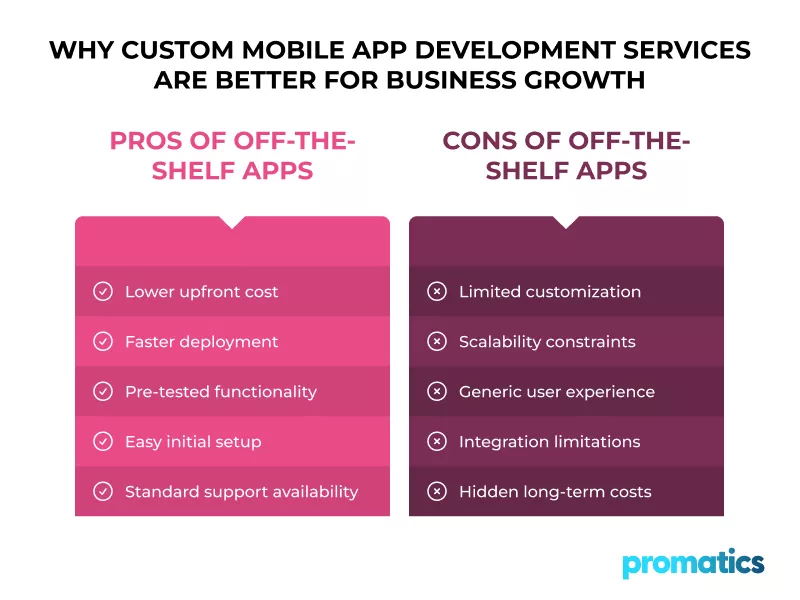
For an ordinary person, it is easy to think that off-the-shelf mobile applications can be a rapid and low-cost solution, especially during the early stages. However, these are typically designed to be very generic and to meet the needs of a large audience rather than those of your business specifically. The whole one-size-fits-all concepts usually result in very few customizations, limited integrations, and features not perfectly aligned with your workflows or goals.
In lots of situations, companies are trying to work with software constraints and not letting technology support their growth. After some time, what used to be a convenient solution can become a barrier to innovation, a cause of reduced operational efficiency, and a factor in poor overall performance.
Top Reasons to Choose a Custom Mobile Application Development Company
Amidst millions of applications in app stores, it is not enough to just have an app to be noticeable; it is necessary to offer value and consistency. Custom application development allows companies to accomplish this.
1. Tailored Solutions for Business Needs
Custom applications are developed around your organization’s workflows, demands, and clients, thereby ensuring that there is a great alignment with the organization’s operations and improved performance overall.
2. Scalable Architecture for Long-Term Growth
Custom applications are made with scaling in mind so that companies can add features, users, and integrations without losing performance or having to bear the cost of a rebuild.
3. Better User Experience and Brand Identity
Complete control over UI/UX means that the app not only represents your brand but also offers easy and attractive experiences that provide retention.
4. Enhanced Security and Full Ownership
Custom development allows businesses to implement industry-specific security measures and retain full ownership of supply code and data.
Understanding the Custom App Development Process
Custom app development is a structured journey that transforms business ideas into scalable, secure, and user-focused digital products.
1. Discovery & Requirement Analysis
Stakeholders and development teams collaborate to define objectives, users, features, and success metrics, creating strong abilities and achievement metrics and developing a robust foundation for the mission.
2. Strategic Planning & Architecture
The proper era stack and device shape are determined to ensure scalability, performance, and long-term sustainability.
3. UI/UX Design
Wireframes, prototypes, and designs are created to make certain intuitive navigation and everyday emblem experience.
4. Development & Implementation
Frontend, backend, APIs, and integrations are built using an agile approach for flexibility and splendid control.
5. Testing & Quality Assurance
Extensive testing ensures stability and consistent performance across devices and platforms.
6. Deployment & Launch
The app is prepared for release with proper compliance, maintained submissions, and performance checks.
A structured process reduces risks, improves transparency, and guarantees the app evolves along with the commercial enterprise.
Build Your App with Promatics Technologies
Developing a custom mobile utility goes past writing code. It’s about growing a digital solution that reflects your enterprise vision, supports your workflows, and supplies significant personal stories. A well-designed custom app offers the power to conform, scale, and innovate without obstacles.
At Promatics Technologies, organizations throughout industries depend on custom mobile app answers designed for overall performance, scalability, and long-term effect. From structure-making plans to cross-platform optimization, the focus is on building applications that are reliable today and ready for tomorrow.
If you’re planning to create a mobile app that truly represents your brand, is secure and scalable, and is built around your goal, we’re here to help.
Let’s build a custom mobile app that scales with your business.