Hybrid App Development Explained: Building Scalable Mobile Apps in 2026

TL;DR
- Hybrid apps use a single codebase to build apps for both iOS and Android platforms
- Faster development cycles and lower overall costs compared to native app development
- Modern frameworks deliver near-native performance and smooth user experience
- Easier maintenance with centralized updates across multiple platforms
- Ideal for scalable, cost-effective, and cross-platform business applications
Mobile applications have evolved from simple digital touchpoints into essential business infrastructure. In 2026, they play a critical role in customer acquisition, brand engagement, operational efficiency, and long-term revenue growth. For startups, mobile apps accelerate market validation and user feedback. For enterprises, they drive large-scale digital transformation and ecosystem expansion.
Yet, building and maintaining separate native applications for iOS and Android often leads to higher costs, extended development timelines, and complex maintenance processes. In today’s competitive and fast-moving digital environment, businesses cannot afford fragmented development strategies or slow innovation cycles.
This is where hybrid app development emerges as a strategic solution.
No longer considered a compromise, modern hybrid mobile application development has matured into a scalable, enterprise-ready approach that balances speed, performance, and flexibility. By enabling cross-platform efficiency without sacrificing user experience, hybrid development helps businesses launch faster and scale smarter.
This blog explores how hybrid app development works, why it is strategically important in 2026, and how organizations can implement scalable hybrid app solutions effectively.
Understanding Hybrid App Development
Hybrid app development refers to building mobile applications that run across multiple operating systems, primarily iOS and Android, using a unified codebase. Instead of writing two entirely separate applications in Swift and Kotlin, developers use cross-platform frameworks that allow shared business logic and UI components.
In simple terms:
Build once. Deploy everywhere. Maintain efficiently.
Modern hybrid app design and development leverage technologies such as JavaScript, TypeScript, Dart, and C#, combined with advanced UI frameworks.
At Promatics Technologies, our hybrid app development services focus on selecting the right architectural foundation from the beginning. There are two major approaches in hybrid development:
- WebView-based frameworks (e.g., Ionic with Capacitor)
- Native-rendered cross-platform frameworks (e.g., Flutter and React Native)
It is important to clarify a common misconception. Modern frameworks such as Flutter and React Native do not simply run inside a WebView. Flutter compiles to native machine code, while React Native renders native UI components through a bridge architecture. This significantly enhances performance and responsiveness.
Today’s hybrid applications can access:
- Camera and media libraries
- GPS and location services
- Push notifications
- Biometric authentication
- Bluetooth connectivity
- Background services
- Secure local storage
As a result, hybrid mobile application development in 2026 delivers near-native performance while maintaining efficiency and cost advantages..
Why Hybrid App Development Is Strategically Important in 2026
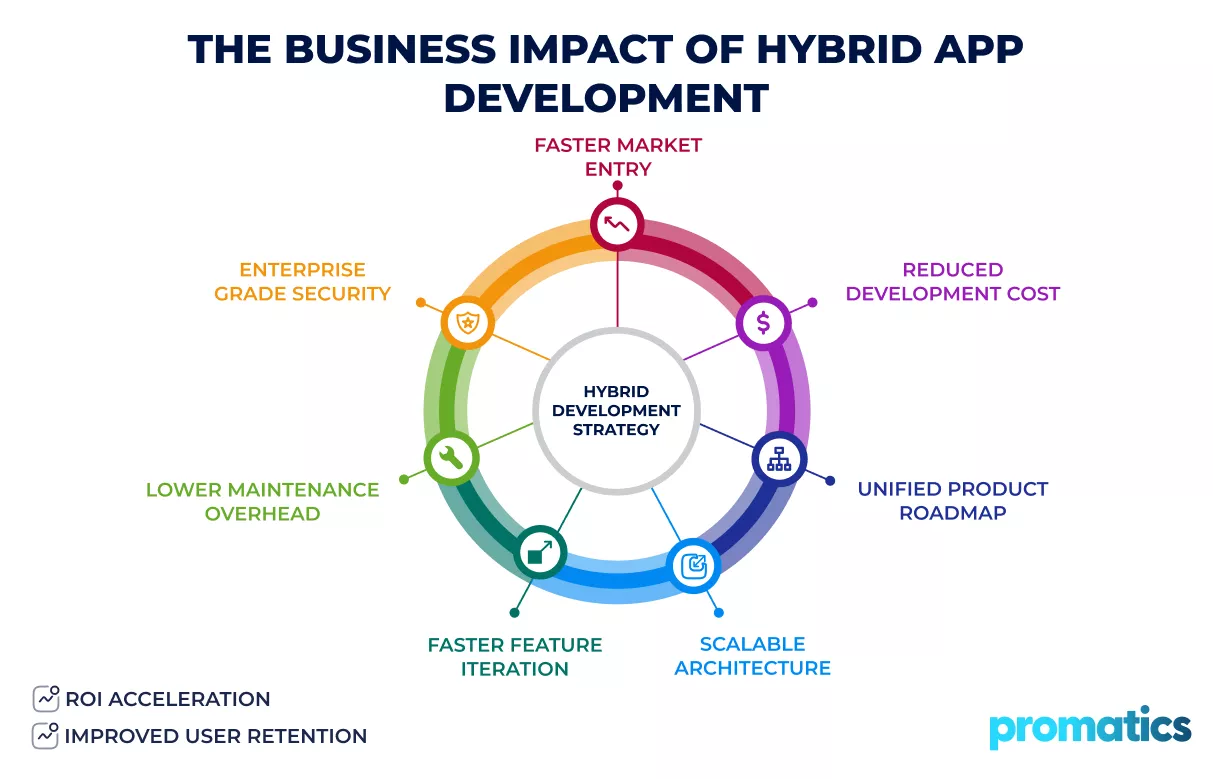
The digital environment in 2026 is defined by speed, agility, and continuous iteration. Businesses must release products quickly, gather user feedback, refine features, and scale infrastructure, often within compressed timelines.
At Promatics Technologies, we help clients choose hybrid strategies when their goals include faster go-to-market execution combined with scalable architecture.
- Accelerated Time-to-Market
With a single shared codebase, development cycles are significantly reduced. Feature releases, updates, and bug fixes can be deployed simultaneously across platforms.
For startups launching MVPs, this means faster validation. For enterprises expanding into mobile, it means reduced operational friction.
- Cost Optimization Without Sacrificing Quality
Hybrid app development services reduce the need for duplicate teams. Instead of maintaining separate iOS and Android engineering units, businesses can streamline development resources while preserving quality and scalability.
Over time, maintenance and feature upgrades become easier to manage, reducing total cost of ownership.
- Unified Brand Experience Across Devices
Consistency is essential for user trust. Hybrid app solutions allow businesses to maintain unified design systems while respecting platform-specific guidelines.
This ensures:
- Consistent UI/UX
- Predictable navigation
- Cohesive branding
- Optimized user engagement
- Cloud-Native Scalability
Modern cross-platform mobile app development integrates seamlessly with microservices, API-first architectures, and cloud infrastructure. This ensures that apps can scale as user demand grows.
At Promatics Technologies, we architect hybrid applications with scalability in mind from day one, ensuring infrastructure can handle growth without requiring rework.
- Enterprise-Level Security
Security is no longer optional. Hybrid app development in 2026 incorporates encrypted local storage, secure authentication, token-based API security, and DevSecOps pipelines.
With the right architecture, hybrid applications meet enterprise compliance standards across industries such as fintech, healthcare, and SaaS.
Core Features of Modern Hybrid Applications
Hybrid app development today is engineered for resilience, performance, and long-term sustainability.
- Native-Like Performance
Advanced rendering engines enable smooth animations and responsive UI transitions, creating a seamless experience for users.
- Offline Support
Local databases and intelligent caching ensure uninterrupted usage even without active internet connectivity.
- Code Reusability and Maintainability
Shared business logic reduces redundancy and technical debt. Updates are easier to deploy across platforms.
- Cloud Integration
Hybrid apps are designed to integrate with cloud platforms for analytics, CI/CD automation, monitoring, and real-time synchronization.
- AI-Driven Enhancements
Modern hybrid mobile application development supports predictive search, recommendation engines, chatbots, and personalized experiences.
At Promatics Technologies, our hybrid app design and development strategy focuses not only on launch speed but also on long-term adaptability.
Leading Frameworks Powering Hybrid App Development in 2026
Selecting the right framework is a strategic decision.
- Flutter
Flutter is ideal for visually rich applications requiring strong UI consistency. Its compiled architecture delivers high-performance rendering and scalability.
- React Native
React Native remains a popular choice for startups and SaaS platforms seeking rapid iteration and JavaScript ecosystem advantages.
- Ionic
Ionic works well for content-driven and internal enterprise applications where web expertise can be leveraged.
- .NET MAUI
For enterprises deeply integrated within Microsoft ecosystems, .NET MAUI offers robust cross-platform capabilities.
At Promatics Technologies, our hybrid app development services begin with framework evaluation aligned with business goals rather than trends.
Hybrid vs Native vs Progressive Web Apps
Choosing hybrid development is not about following industry hype. It is about strategic alignment.
A hybrid is ideal when speed, cost-efficiency, and shared logic matter most. Native development remains preferable for graphics-intensive gaming or AR-driven applications. PWAs are suitable when app store presence is not essential.
A trusted hybrid app development company evaluates business priorities before recommending a solution.
Advantages and Limitations of Hybrid Development
Hybrid app solutions offer:
- Reduced development costs
- Faster product launches
- Centralized maintenance
- Simplified testing cycles
- Scalable architecture
However, highly complex animations may require optimization, and certain hardware-intensive features might need custom native modules.
When architectured properly, these limitations are manageable and rarely impact most business applications.
Implementation Challenges and Solutions
Performance bottlenecks can be mitigated through optimized state management and efficient API communication. Plugin dependencies should be evaluated carefully to ensure long-term reliability. Security must be embedded throughout the development lifecycle.
At Promatics Technologies, we address these challenges through structured architectural planning and rigorous QA processes.
Best Practices for Hybrid App Development in 2026
Successful hybrid app design and development requires:
- API-first backend planning
- Modular component architecture
- Continuous integration pipelines
- Performance profiling and optimization
- Secure authentication frameworks
- Long-term maintainability planning
Hybrid apps must be built not just for launch but for sustained evolution.
The Future of Hybrid App Development
Hybrid development continues to evolve rapidly. Improvements in rendering engines, AI-assisted coding tools, enhanced native bridges, and broader cross-platform capabilities are narrowing the gap between hybrid and native performance.
Cross-platform mobile app development is becoming the default choice for many business-driven applications.
Final Words
Hybrid app development delivers maximum value when built on strong architectural foundations and aligned with business objectives. Speed and cost efficiency matter, but scalability, security, and long-term performance matter even more.
At Promatics Technologies, we provide end-to-end hybrid app development services tailored to startups, SaaS platforms, and enterprise organizations. As an experienced hybrid app development company, we focus on building scalable, secure, and high-performing cross-platform applications that grow alongside your business.
Our approach combines strategic planning, modern frameworks, cloud-native integration, and performance optimization to deliver reliable hybrid app solutions that drive measurable business outcomes.
If you are planning to launch or scale your mobile application, our team at Promatics Technologies is ready to help you design, build, and deploy a future-ready solution that stands out in today’s competitive digital ecosystem.
Let’s build smarter. Let’s scale faster. Let’s innovate with confidence.
