AI Agent Development: Architecture, Cost, and Implementation Guide
TL;DR
- AI agent development requires the right architecture, frameworks, integrations, and security controls. Costs depend on workflow complexity, testing, and maintenance. Businesses should start with a focused use case, validate performance, and scale with continuous monitoring and human oversight.
- AI agents are moving from experimentation toward practical business applications, but successful adoption depends on more than the capabilities of an AI model. According to Merge’s 2026 AI agent statistics, 43% of surveyed companies already connect their agents to Model Context Protocol (MCP) servers, while another 53% plan to adopt them within the following 12 months. The research also found that 81% of companies using MCP employ it for targeted lookups in third-party software, highlighting the importance of reliable integrations in agent development.
- These findings point to a practical challenge: building an AI agent is not just about enabling reasoning. It also requires connecting business systems, managing permissions, validating actions, and ensuring consistent execution. From selecting the right architecture to estimating development costs and preparing for production, each decision affects the reliability and long-term value of the solution.
- This guide explores the technical considerations involved in AI agent development, including architecture patterns, frameworks, enterprise use cases, implementation steps, and cost factors.
AI agents are moving from experimentation toward practical business applications, but successful adoption depends on more than the capabilities of an AI model. According to Merge’s 2026 AI agent statistics, 43% of surveyed companies already connect their agents to Model Context Protocol (MCP) servers, while another 53% plan to adopt them within the following 12 months. The research also found that 81% of companies using MCP employ it for targeted lookups in third-party software, highlighting the importance of reliable integrations in agent development.
These findings point to a practical challenge: building an AI agent is not just about enabling reasoning. It also requires connecting business systems, managing permissions, validating actions, and ensuring consistent execution. From selecting the right architecture to estimating development costs and preparing for production, each decision affects the reliability and long-term value of the solution.
This guide explores the technical considerations involved in AI agent development, including architecture patterns, frameworks, enterprise use cases, implementation steps, and cost factors.
What Does AI Agent Development Involve?
AI agent development involves creating software that uses AI models, tools, and application logic to complete defined tasks. Depending on its design, an agent can interpret an objective, select an action, interact with connected systems, evaluate the result, and continue until it reaches a stopping condition.
Unlike a conventional automation script, an AI agent can make context-dependent decisions. However, this flexibility also introduces uncertainty, making validation and controlled execution essential.
Businesses considering AI agent development services should first establish whether their workflow genuinely requires agent-based decision-making or can be handled more reliably through conventional software.
AI Agent Architecture: Core Design Decisions
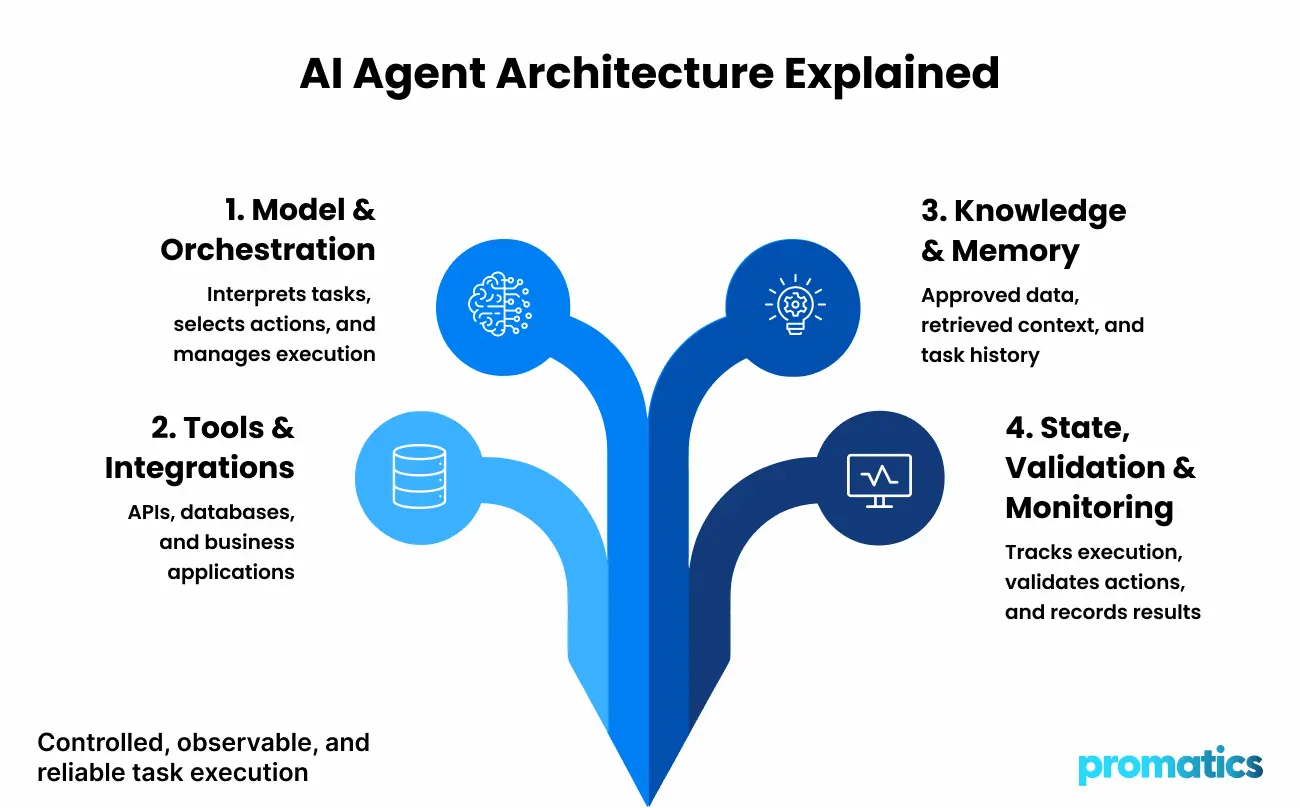
AI agent architecture determines how models, tools, data sources, and application services interact. The right design depends on task complexity, integration requirements, response times, and the consequences of an incorrect action.
1. Model and Orchestration Layer
The model interprets the task and selects potential actions. The orchestration layer manages execution, maintains workflow state, invokes tools, and determines whether the task is complete.
The model should not directly control unrestricted business operations. Application code must validate proposed actions before execution.
2. Tool and Integration Layer
Tools allow agents to interact with business applications through APIs, databases, and internal services.
For example, an agent processing a purchase request might retrieve supplier information, check inventory, and prepare a purchase order. Each operation should use authenticated interfaces with permissions appropriate to the task.
For systems with numerous integrations, a dedicated tool layer can simplify maintenance and provide consistent validation, logging, and error handling.
3. Knowledge and Memory Layer
Agents may need access to documents, historical interactions, operational records, or current business data.
Retrieval-augmented generation (RAG) helps retrieve relevant information from approved sources. Memory can preserve task context or selected information across interactions.
These capabilities serve different purposes: retrieval supplies relevant knowledge, while memory maintains context. Neither should be added without a clear requirement.
4. State, Validation, and Monitoring
Production agents need to track completed steps, failed operations, pending approvals, and results returned by connected systems.
Validation checks whether an action satisfies business rules. Monitoring records relevant execution events, latency, errors, and resource consumption.
These components make agent behavior easier to troubleshoot and prevent failures from silently propagating through a workflow.
Single-Agent vs. Multi-Agent Systems
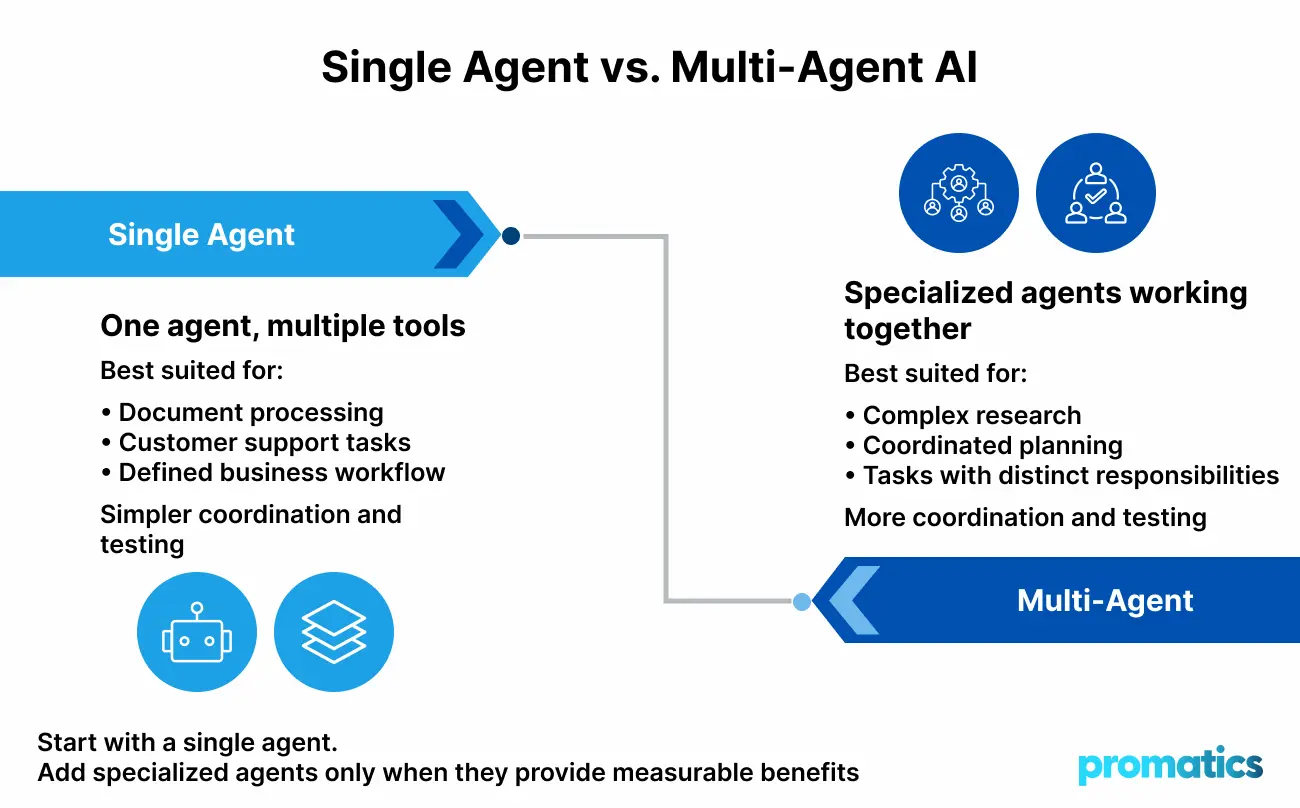
A single-agent architecture is generally suitable when one agent can complete a coherent task using several tools. A multi-agent architecture distributes work across specialized agents coordinated through a defined workflow.
| Consideration | Single agent | Multi-agent system |
| Workflow | One connected task | Multiple specialized tasks |
| Coordination | Relatively simple | Requires handoffs and orchestration |
| Testing | Easier to isolate failures | Must test individual agents and interactions |
| Operating overhead | Usually lower | Can increase through additional model calls |
| Suitable applications | Document processing, support workflows | Complex research or coordinated planning |
A multi-agent system is not inherently more accurate. It may introduce additional latency, duplicated work, inconsistent outputs, and more complex failure paths.
Start with a single agent or deterministic workflow. Introduce multiple agents only when separate responsibilities provide a measurable advantage.
AI Agent Frameworks and Technology Selection
Framework selection should follow architecture requirements rather than popularity. Common options include:
- LangGraph: Useful for stateful workflows, explicit execution paths, and controlled agent orchestration.
- LangChain: Provides components for connecting language models with tools, retrieval systems, and application services.
- CrewAI: Supports role-based coordination among specialized agents.
- OpenAI Agents SDK: Provides building blocks for tool use, agent handoffs, and tracing in supported model-driven workflows.
The appropriate choice depends on integration needs, team expertise, deployment constraints, and the level of control required. Frameworks evolve, so verify current documentation and production suitability before committing to a stack.
Model selection also matters. Compare candidate models using representative tasks, measuring accuracy, latency, structured output quality, and cost. A smaller model may be sufficient for classification or extraction, while more complex reasoning tasks may justify a more capable model.
Enterprise AI Agent Use Cases
The most suitable enterprise AI agents operate within defined workflows and have access to the data and tools needed to complete their assigned responsibilities.
Examples include:
- Document operations: Extract information from contracts, invoices, and forms, then validate records against business rules.
- IT service management: Classify incidents, retrieve troubleshooting information, and create or update tickets.
- Sales operations: Research accounts, summarize CRM activity, and prepare follow-up tasks for review.
- Business intelligence: Retrieve approved data, generate analytical summaries, and flag unusual metrics.
- Software engineering: Assist with code review, test generation, issue triage, and documentation.
For each use case, define which actions the agent may perform independently and which require human approval.
AI Agent Development Cost: What Determines the Budget?
AI agent development cost depends on the scope of work rather than the model alone. A prototype connected to one API has different requirements from an enterprise agent operating across several systems.
The main cost drivers include:
- Workflow complexity: More decision paths and exceptions increase engineering and testing effort.
- System integrations: Legacy software, custom APIs, and inconsistent data can significantly expand scope.
- Knowledge preparation: Document processing, retrieval configuration, and data permissions require additional work.
- Security requirements: Authentication, access controls, auditability, and approval workflows add implementation effort.
- Evaluation: Testing against real-world scenarios and failure conditions is necessary before production use.
- Deployment and maintenance: Hosting, monitoring, model usage, integration updates, and ongoing optimization create recurring expenses.
A useful estimate separates the project into discovery, prototype, integration, production hardening, and ongoing operations.
For planning purposes, compare three levels of scope:
| Project scope | Main cost considerations |
| Proof of concept | One workflow, limited data, minimal integrations |
| Integrated agent | Production APIs, workflow validation, evaluation, monitoring |
| Enterprise implementation | Multiple systems, governance, advanced reliability, scale requirements |
These are scope categories, not fixed price quotations. A reliable estimate requires technical discovery, expected usage volumes, integration assessment, and defined acceptance criteria.
Businesses should also estimate recurring model and infrastructure costs. Track the cost per successfully completed task rather than token consumption alone, since retries and failed executions can increase total expenditure.
How to Implement an AI Agent
A practical AI agent implementation process follows six stages.
Step 1: Define the workflow. Identify the business task, required inputs, expected outputs, exceptions, and measurable success criteria.
Step 2: Audit data and integrations. Confirm that the necessary records, APIs, permissions, and knowledge sources are available and sufficiently reliable.
Step 3: Design the architecture. Select the model, orchestration pattern, tool interfaces, memory requirements, and human approval points.
Step 4: Build a narrow prototype. Implement one end-to-end workflow before expanding the agent’s responsibilities. This exposes integration and reliability issues early.
Step 5: Evaluate and secure. Test normal scenarios, incomplete data, tool failures, unauthorized requests, and prompt-injection attempts. Verify that access restrictions are enforced in application code.
Step 6: Deploy and monitor. Begin with a controlled rollout. Track successful completion, error rates, escalation frequency, latency, and cost. Expand autonomy only when measured performance supports it.
This phased approach helps businesses identify technical risks before committing to a larger deployment.
Security and Production Readiness
Enterprise AI agents can introduce risks because they interpret instructions and interact with connected systems. A malicious document, for example, might contain instructions designed to redirect an agent’s behavior.
Essential controls include:
- Least-privilege access to tools and business data.
- Server-side validation of tool arguments and business rules.
- Human approval for sensitive or irreversible actions.
- Protection against prompt injection and unauthorized data access.
- Execution limits, timeouts, and bounded retries.
- Audit logs, monitoring, and repeatable evaluation.
Never rely solely on a system prompt to enforce security restrictions. Permissions and critical business rules must be enforced by the application and connected services.
Measuring AI Agent Performance
An agent that produces convincing responses may still fail to complete business tasks correctly. Evaluation should focus on operational outcomes.
Track task completion rate, factual accuracy, tool-call success, failure recovery, escalation rate, latency, and cost per successful task.
Compare results against the existing workflow to determine whether the agent provides measurable value. Review failures regularly and repeat evaluations after changes to models, prompts, tools, or business rules.
Conclusion
AI agents are transforming how businesses approach automation, decision-making, and complex workflows. However, successful AI agent development requires more than choosing the right model or framework. It depends on a well-designed architecture, reliable system integrations, secure data access, continuous evaluation, and clearly defined boundaries for autonomous actions.
For businesses planning to adopt enterprise AI agents, the best approach is to start with a specific, high-impact workflow, validate its performance, and measure its contribution to operational efficiency, accuracy, and cost savings. As the system matures, organizations can expand its capabilities while maintaining appropriate security controls and human oversight.
The goal is not simply to automate more tasks, but to build intelligent systems that deliver consistent, scalable, and measurable business outcomes.
Looking to turn your AI strategy into a production-ready solution? Explore Promatics Technologies’ AI agent development services to evaluate your requirements, identify the right architecture, and build custom AI agents aligned with your business objectives.
