Hybrid App Development Services in 2027: AI, Frameworks, and Trends
TL;DR
- Hybrid app development in 2027 is evolving with AI-native features, on-device AI processing, agentic automation, and API-first architecture. Frameworks such as Flutter, React Native, Ionic, Kotlin Multiplatform, and .NET MAUI help businesses build applications for iOS and Android with shared codebases. Choosing the right development approach requires evaluating performance, security, scalability, user experience, and long-term maintenance to create future-ready mobile applications.
- What if you could build a powerful mobile app for both iOS and Android without developing two entirely separate codebases? That is one of the key advantages of hybrid and cross-platform app development. In 2027, businesses are looking beyond faster development and lower costs, focusing on AI-powered features, intelligent automation, and personalized user experiences. 3.Frameworks such as Flutter and React Native help development teams create scalable applications while maintaining consistent experiences across platforms. As mobile technology evolves, understanding the latest hybrid app development trends for 2027 can help businesses choose suitable technologies, integrate emerging capabilities, and build future-ready applications.
What if you could build a powerful mobile app for both iOS and Android without developing two entirely separate codebases? That is one of the key advantages of hybrid and cross-platform app development. In 2027, businesses are looking beyond faster development and lower costs, focusing on AI-powered features, intelligent automation, and personalized user experiences.
Frameworks such as Flutter and React Native help development teams create scalable applications while maintaining consistent experiences across platforms. As mobile technology evolves, understanding the latest hybrid app development trends for 2027 can help businesses choose suitable technologies, integrate emerging capabilities, and build future-ready applications.
What Are Hybrid App Development Services?
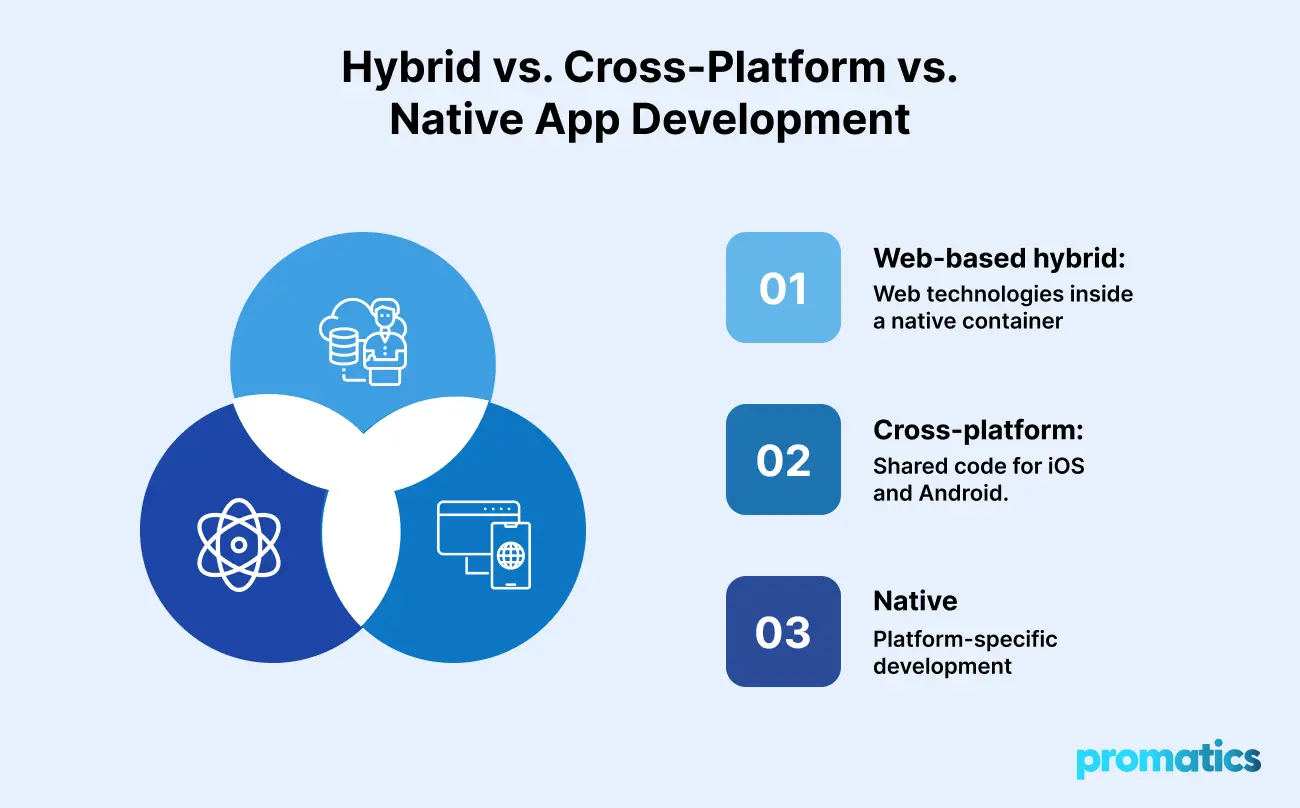
Hybrid app development services cover the planning, design, development, testing, deployment, and maintenance of mobile applications that run across platforms. Depending on the approach, development teams may use web technologies inside a native container or frameworks that allow code sharing between iOS and Android.
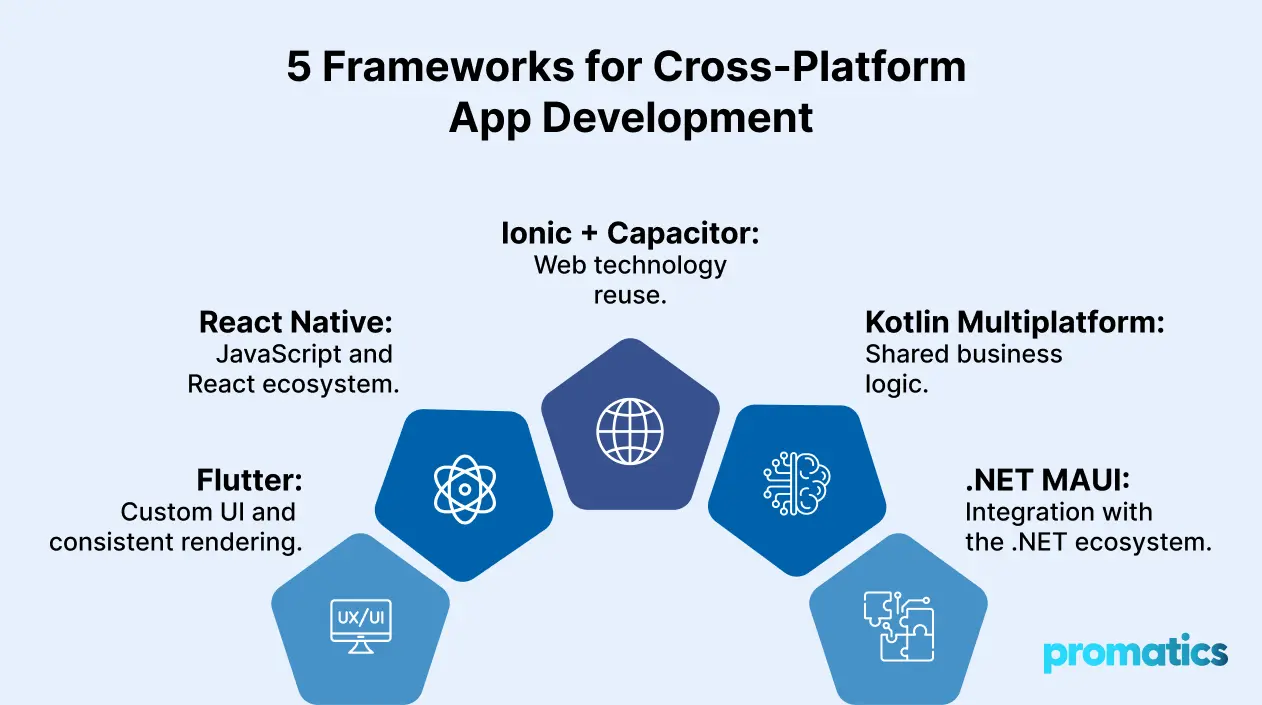
Technologies used for multi-platform mobile development include Ionic with Capacitor, Flutter, React Native, Kotlin Multiplatform, and .NET MAUI. These technologies differ in how they render interfaces, share code, and access native device capabilities.
A typical development engagement includes:
- Business analysis, discovery, and technical planning
- Mobile UI/UX design and prototyping
- Framework selection and application architecture
- Frontend and backend development
- API and third-party integrations
- AI feature integration
- Performance and security testing
- App Store and Google Play deployment
- Ongoing maintenance and optimization
For organizations planning a new digital product, choosing the right mobile app development services can help align technology decisions with business goals, user requirements, and long-term maintenance needs.
Hybrid vs. Cross-Platform vs. Native App Development
Hybrid, cross-platform, and native development are often discussed together, but they describe different implementation approaches.
| Development approach | How it works | Suitable applications |
| Native development | Separate platform-specific implementations using Swift or Kotlin | Graphics-intensive apps, advanced hardware integration, and platform-specific products |
| Cross-platform development | Shared application code across platforms | Marketplaces, business apps, booking platforms, and customer-facing applications |
| Web-based hybrid development | Web technologies run inside a native container | Content-driven apps, internal tools, and web-oriented applications |
Cross-platform frameworks can reduce duplicated development effort, while traditional web-based hybrid approaches can suit products that rely heavily on existing web technologies.
Native development remains valuable when specialized hardware access, demanding graphics, or platform-specific capabilities are essential. The best approach depends on technical requirements, user experience expectations, performance targets, and the development team’s expertise.
Hybrid App Development Trends Shaping 2027
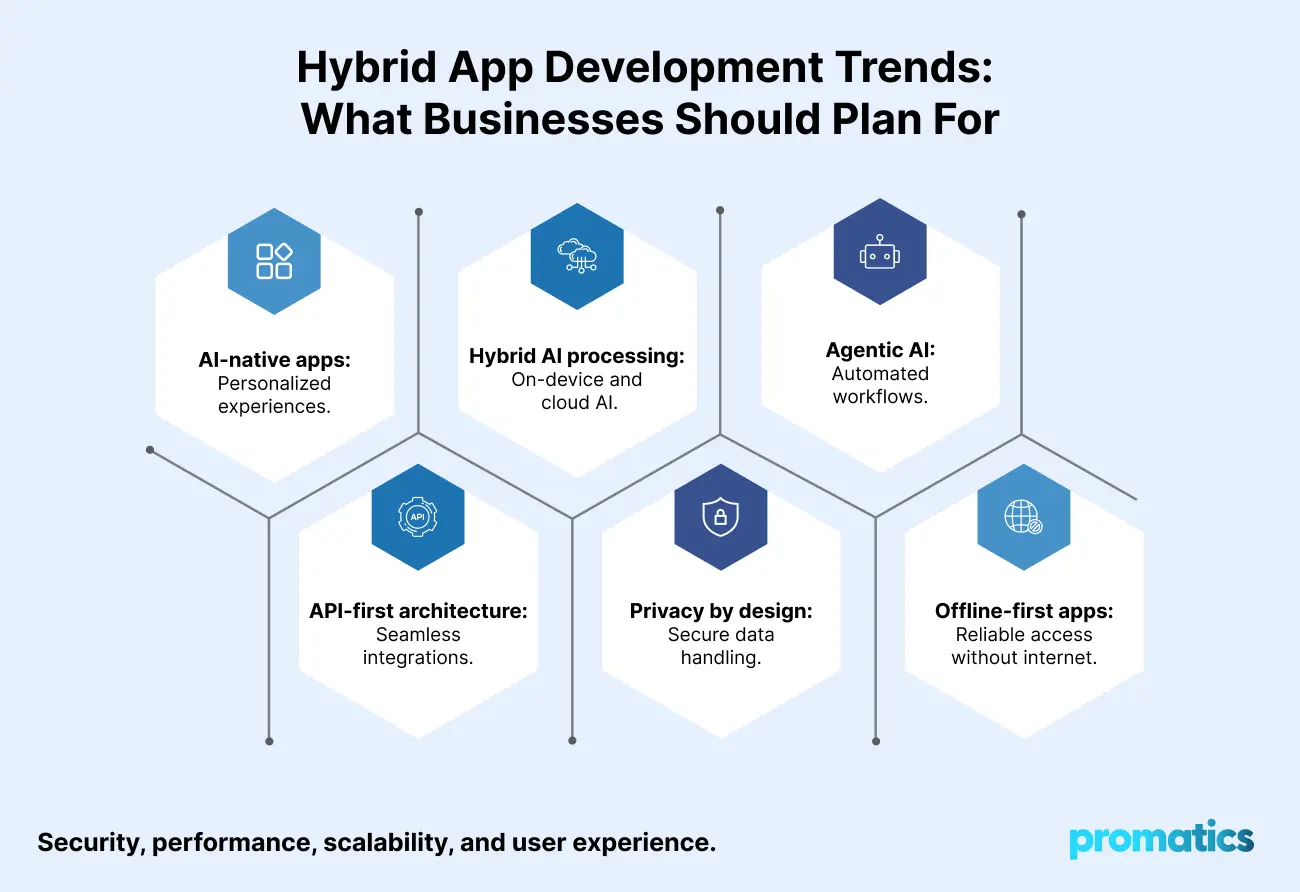
1. AI-Native Mobile Applications
AI is moving beyond standalone chatbots and becoming part of how mobile applications deliver their core functionality.
AI-native applications are designed around intelligent capabilities from the beginning. Instead of simply adding a chatbot to an existing interface, developers can redesign workflows to help users find information, make decisions, and complete supported tasks more efficiently.
Common use cases include:
- AI-powered product discovery
- Personalized recommendations
- Intelligent search and summarization
- Context-aware customer support
- Automated business workflows
For example, an e-commerce application could interpret a user’s shopping requirements, recommend relevant products, and explain the differences between available options.
Successful implementation requires reliable data access, appropriate model selection, privacy controls, and measurable performance objectives. Businesses can explore AI and machine learning development to understand how intelligent capabilities can support mobile and digital products.
2. On-Device AI and Hybrid AI Processing
On-device AI enables compatible devices to process certain AI tasks locally rather than sending every request to a cloud service.
This approach can reduce network dependence, improve responsiveness for supported tasks, and help keep selected information on the device. However, local models have limitations related to memory, processing power, device compatibility, and model size.
Cloud-based AI remains useful for more demanding operations, while hybrid AI processing combines local execution with cloud capabilities.
For example, a mobile application could perform a simple classification locally and send a more complex request to a cloud model.
Businesses should evaluate privacy, latency, reliability, device compatibility, and operating costs before choosing an architecture. On-device AI should not be assumed to work on every phone or support every model capability.
3. Agentic AI and Workflow Automation
AI agents can coordinate multiple steps to accomplish a defined task using authorized tools and services.
In mobile applications, potential use cases include preparing bookings, organizing customer support requests, retrieving relevant information, and assisting with business workflows.
However, agentic functionality requires more than connecting an AI model to an API. Developers must define permissions, validate requests, restrict available actions, and provide confirmation steps for sensitive operations.
For example, a business application could help employees prepare an expense report by collecting relevant information and checking entries before submission. The employee would retain control over final approval.
The priority should be to automate useful workflows while maintaining user control, accountability, and security.
4. API-First Mobile Application Architecture
API-first architecture allows mobile applications, backend systems, and authorized external services to communicate through well-defined interfaces.
This approach makes applications easier to integrate with payment systems, customer relationship management platforms, inventory databases, analytics tools, and AI services.
It also creates opportunities to expose selected business capabilities to AI agents through secure, documented interfaces.
For example, a retail application might use separate APIs for product search, inventory checks, order tracking, and payment processing. Each operation can enforce its own authorization and validation rules.
A well-designed API architecture can also make it easier to introduce new features without unnecessarily changing the entire application.
Read this guide to enterprise API development for more information about architecture, integration, security, and scalability.
5. Cross-Platform Frameworks for Faster Development
Flutter and React Native remain important options for businesses seeking shared-codebase mobile development.
Flutter supports custom interfaces and consistent rendering, while React Native is useful for teams with JavaScript and React experience. Both can support applications that integrate cloud AI services.
The choice should account for the development team’s skills, required device capabilities, third-party dependencies, performance requirements, and maintenance plans.
Applications that rely on advanced graphics or specialized hardware may still benefit from native components or a fully native implementation.
Businesses should evaluate frameworks through practical prototypes instead of relying solely on feature comparisons or popularity.
6. Privacy-First Mobile App Development
AI-powered applications can process personal information, business records, location data, and user-generated content. Protecting this information is an important part of application architecture.
Privacy-focused development involves:
- Collecting only necessary information
- Providing appropriate consent and disclosure
- Applying authentication and access controls
- Encrypting data in transit and protecting it at rest
- Reviewing third-party SDKs and dependencies
- Restricting information sent to external AI services
- Defining appropriate data retention and deletion practices
Businesses operating across multiple markets should evaluate the privacy and industry-specific obligations that apply to their applications.
Security and privacy should be planned from the initial development stages rather than added immediately before launch.
7. Offline-First Mobile Applications
Offline-first architecture allows selected application functions to continue working when internet connectivity is limited or unavailable.
This is particularly useful for logistics, field services, travel, retail operations, and applications used in remote environments.
Developers can combine local storage, caching, queued actions, and background synchronization to preserve important functionality.
However, offline support requires careful handling of data conflicts, duplicate submissions, synchronization failures, and changes made on multiple devices.
The objective is not necessarily to make every feature available offline, but to ensure that essential tasks remain reliable when connectivity is interrupted.
8. AI-Assisted Development and Automated Testing
AI-assisted development tools can help engineering teams generate code suggestions, prepare test cases, document components, and identify potential defects.
These tools can reduce repetitive work, but they do not remove the need for human engineering review.
Generated code, dependencies, application behavior, and security-sensitive functionality must still be tested before release.
For production applications, AI-assisted development should complement established engineering practices, including code review, automated testing, performance monitoring, and release management.
9. Adaptive Interfaces and Improved Accessibility
Mobile applications need to support different screen sizes, orientations, device capabilities, and accessibility requirements.
Reusable design systems and adaptable layouts help maintain a consistent user experience across smartphones, tablets, and compatible foldable devices.
Developers should also consider readable typography, accessible controls, screen-reader compatibility, and intuitive navigation.
Testing across supported devices helps identify interface inconsistencies before release and reduces the risk of usability problems after launch.
How to Choose the Right Hybrid Mobile App Framework
Selecting a framework requires evaluating the product’s requirements rather than following the latest technology trend.
| Framework | Key advantage | Considerations |
| Flutter | Consistent interfaces and custom UI development | Requires Dart expertise |
| React Native | JavaScript and React ecosystem | Library compatibility and upgrade management |
| Ionic with Capacitor | Reuse of web technologies | Graphics-intensive applications require performance evaluation |
| Kotlin Multiplatform | Shared business logic | UI strategy and platform integration need planning |
| .NET MAUI | Integration with the .NET ecosystem | Existing team skills and ecosystem fit |
Before committing to a framework, businesses should build a small proof of concept and evaluate:
- Application startup time and responsiveness
- Memory consumption and battery use
- Application size and rendering performance
- Access to required device features
- Third-party library compatibility
- Testing and long-term maintenance requirements
- Compatibility with the intended AI model runtime
For businesses that need a consistent custom interface, Flutter may be worth evaluating. Teams with existing React expertise may find React Native a practical option. The final decision should reflect the product’s requirements and the team’s ability to maintain the application.
Real-World Hybrid and Cross-Platform App Development Case Studies
Real-world examples help businesses understand how shared-codebase development can support product delivery across iOS and Android. The following companies used cross-platform technologies, which are related to hybrid development but are not the same as traditional web-based hybrid apps.
1. BMW: Building a Consistent Global Mobile Experience with Flutter
BMW adopted Flutter for its My BMW App to improve consistency across mobile platforms and support its broader app ecosystem. According to Flutter’s official BMW case study, the app launched in July 2020 and expanded to 47 countries across five continents. BMW also worked on automating build and testing processes for multiple app variants.
Why this matters: A shared-codebase approach can help teams maintain more consistent features across platforms and manage releases across markets. Businesses still need to plan for platform-specific integrations, testing, and ongoing maintenance.
For organizations building applications for multiple markets or device types, the right mobile app development services should account for architecture, usability, platform requirements, and long-term support.
2. eBay Motors: Accelerating Cross-Platform App Development
eBay Motors used Flutter to develop its automotive marketplace app for iOS and Android. In its engineering case study, eBay reports that the team prepared its first beta within three months of the initial product request and achieved approximately 98.3% shared code across platforms.
Why this matters: Shared-codebase development can help teams coordinate feature development and releases across iOS and Android. The actual benefits depend on product complexity, team experience, third-party dependencies, and the amount of platform-specific functionality required.
Marketplace apps also rely on dependable backend services for listings, search, accounts, messaging, and transactions. Planning the integration layer through a clear approach to enterprise API development can help keep these capabilities organized and maintainable.
Key Lessons for Businesses Planning a Mobile App in 2027
These case studies highlight several practical considerations:
- Assess code reuse realistically: Shared code can reduce duplicated implementation, but it does not eliminate all platform-specific work.
- Prioritize user experience: Consistent interfaces, responsive interactions, and reliable performance matter more than choosing a framework solely because it is popular.
- Plan for scale: Backend architecture, APIs, security, monitoring, and automated testing are important parts of a production-ready application.
- Validate the framework early: A proof of concept can help identify performance constraints, integration gaps, and maintenance risks before a larger investment.
- Use AI where it solves a real problem: AI-powered search, recommendations, or support can add value when they fit the product’s goals and are implemented with appropriate privacy and security controls. Businesses can explore AI and machine learning development capabilities for relevant use cases.
These examples are cross-platform case studies, rather than proof that the apps use traditional web-based hybrid architecture. The right approach depends on the application’s requirements, the team’s skills, and the expected user experience.
How Much Do Hybrid App Development Services Cost in 2027?
The cost of hybrid app development depends on application scope, number of screens, backend complexity, integrations, AI functionality, security requirements, and maintenance expectations.
The following figures are indicative planning estimates, not fixed market prices or verified industry averages.
| Project type | Indicative timeline | Indicative cost |
| MVP with core features | 8 to 14 weeks | $10,000 to $30,000 |
| Mid-complexity application | 4 to 6 months | $30,000 to $70,000 |
| Enterprise or AI-intensive application | 6 to 12 months or more | $70,000+ |
Actual costs can vary substantially by project, development provider, region, and technical complexity.
Factors That Influence Development Costs
- Application complexity: More screens, user roles, integrations, and workflows generally require more development effort.
- AI integration: Model integration, evaluation, cloud inference, monitoring, and fallback mechanisms can increase implementation and operating costs.
- Security requirements: Applications handling sensitive information or payments may need additional testing and controls.
- Framework and platform integration: Specialized device functionality can require native modules or platform-specific development.
- Maintenance: Operating system updates, framework upgrades, monitoring, and future enhancements should be included in the long-term budget.
Businesses should compare development proposals against the same documented requirements and confirm which deliverables, integrations, and support services are included.
How to Build a Future-Ready Hybrid Mobile Application
A future-ready mobile application requires more than selecting a popular framework. Businesses should establish a technical foundation that supports product changes, new integrations, and evolving user expectations.
A practical approach includes the following steps.
1. Define Business Objectives
Identify the problem the application will solve, its intended users, and the outcomes that will determine success. Establish measurable indicators such as user engagement, task completion, retention, and operational efficiency.
2. Select the Appropriate Architecture
Evaluate native, cross-platform, and web-based hybrid approaches against performance requirements, development resources, device capabilities, and maintenance needs.
3. Design APIs and Data Flows
Plan how the application will communicate with backend services, third-party platforms, and AI models. Establish access controls and data-handling rules before implementing sensitive workflows.
4. Introduce AI Where It Adds Value
Choose AI features based on specific user or business needs. Test model accuracy, response time, operating costs, and fallback behavior before releasing them to users.
5. Validate Security and Performance
Test the application across supported devices and network conditions. Review authentication, authorization, dependencies, data protection, and error handling.
6. Plan for Continuous Improvement
Monitor crashes, performance, user feedback, and operating costs after launch. Schedule framework upgrades, security reviews, and feature improvements as part of the maintenance plan.
How Promatics Technologies Supports Mobile App Development
Promatics Technologies helps businesses plan and develop mobile applications around their product requirements, technical constraints, and growth objectives.
The development process can include discovery, architecture planning, UI/UX design, application development, backend integrations, AI implementation, testing, deployment, and ongoing maintenance.
Key areas of focus include:
- Discovery and planning: Define business goals, user journeys, functional requirements, and technical constraints.
- Architecture and framework selection: Evaluate suitable native and cross-platform technologies.
- UI/UX design: Develop interfaces around usability, accessibility, and consistent user experiences.
- Development and integration: Implement application features, backend functionality, and required APIs.
- AI integration: Incorporate appropriate AI capabilities where they support defined business use cases.
- Testing and optimization: Validate functionality, performance, security, and compatibility.
- Deployment and support: Prepare application releases and plan ongoing maintenance.
The objective is to select technologies based on the application being built rather than introducing unnecessary complexity.
Businesses can explore mobile app development services or AI and machine learning development capabilities to learn more.
Conclusion
Hybrid app development services in 2027 are evolving alongside AI, cross-platform frameworks, and changing user expectations. Businesses must consider more than development speed. Architecture, security, device compatibility, integration requirements, and long-term operating costs all influence the success of a mobile application.
AI-native experiences, on-device processing, agentic workflows, API-first design, and offline functionality offer practical opportunities when they address real user and business needs.
The most effective strategy is to select the right development approach, validate important technical assumptions early, and build a product that can evolve as requirements change.
For businesses planning a new mobile application or improving an existing product, mobile app development services can provide a starting point for evaluating suitable technologies and development approaches. Contact our team to discuss your mobile application requirements.
