Agentic AI vs. AI Agents: Architecture, Capabilities, and Business Applications
TL;DR
- AI agents are autonomous software systems that use reasoning, tools, and contextual information to perform specific tasks. Agentic AI represents a broader approach to building intelligent systems that can coordinate multiple agents, break down complex objectives, and manage interconnected workflows. While individual AI agents are suitable for focused automation, Agentic AI enables businesses to automate more complex, end-to-end operations.
- Choosing between them depends on workflow complexity, business objectives, integration requirements, and the level of autonomy required.
Artificial intelligence is moving beyond generating text, answering questions, and analyzing information. Businesses are increasingly exploring systems that can make decisions, execute tasks, interact with enterprise applications, and coordinate multiple operations with limited human intervention.
Two concepts driving this transformation are AI agents and Agentic AI.
Although these terms are frequently used interchangeably, they describe different aspects of intelligent automation. AI agents are autonomous software entities designed to accomplish specific objectives, while Agentic AI refers to a broader approach to building systems that demonstrate coordinated, goal-oriented behavior across complex workflows.
For example, an AI agent can analyze incoming customer queries, retrieve relevant information, and generate appropriate responses. An Agentic AI system can coordinate customer support, order management, inventory verification, and escalation processes through multiple specialized agents.
This distinction matters for organizations planning to invest in enterprise AI solutions. Selecting the right architecture can influence development complexity, operational efficiency, scalability, security, and long-term return on investment.
In this guide, we explore Agentic AI vs. AI agents, how their architectures work, their capabilities, real-world business applications, implementation challenges, and how organizations can determine which approach fits their requirements.
AI Adoption Is Moving Toward More Autonomous Workflows
Recent industry research shows why AI agents and Agentic AI are receiving growing attention. In McKinsey’s 2026 State of AI report, nearly nine in ten respondents said their organizations regularly used AI in at least one business function, while 44% reported that AI was scaling across the enterprise. Agent adoption is also advancing, particularly among larger organizations: 40% of respondents from companies with more than $1 billion in annual revenue said their organizations were scaling AI agents, compared with 22% of respondents from smaller organizations. These findings point to a shift from isolated AI experiments toward broader operational deployment.
The opportunity is also reflected in market forecasts. Grand View Research’s AI Agents Market report estimates that the global market was valued at $7.6 billion in 2025 and could reach $182.9 billion by 2033, representing a projected 49.6% CAGR from 2026 to 2033. These are market estimates, not guaranteed outcomes, but they indicate the scale of investment and commercial interest surrounding AI agent technologies.
What Are AI Agents?
AI agents are autonomous software systems that use artificial intelligence to perceive information, interpret context, make decisions, and perform actions to achieve defined objectives.
Unlike conventional chatbots that primarily respond to user queries, AI agents can interact with external tools, databases, APIs, and software applications to complete tasks.
An AI agent generally operates through a continuous process of understanding an objective, selecting an appropriate action, executing it, and evaluating the result.
For example, consider an AI-powered customer support agent.
When a customer submits a request about an order, the agent can:
- Understand the customer’s question.
- Retrieve order information from the company’s database.
- Check the current delivery status.
- Identify whether the order requires additional attention.
- Generate a response based on verified information.
- Escalate the issue when human intervention is necessary.
The agent performs these steps using its assigned tools and permissions rather than relying entirely on predefined responses.
Key Characteristics of AI Agents
1. Goal-Oriented Execution
AI agents receive specific objectives and determine how to accomplish them within their assigned scope.
2. Reasoning and Decision-Making
They interpret inputs, evaluate available information, and select suitable actions based on their objectives.
3. Tool Integration
Agents can connect with APIs, databases, CRM platforms, enterprise applications, and external services.
4. Context Awareness
They can use conversation history, retrieved information, and available memory to make more relevant decisions.
5. Autonomous Task Execution
Depending on their permissions and design, AI agents can perform tasks without requiring human approval at every individual step.
6. Feedback-Based Adaptation
Agents can evaluate action results and adjust subsequent steps when a task does not produce the expected outcome.
What Is Agentic AI?
Agentic AI is an approach to designing intelligent systems that can independently pursue broader objectives through reasoning, planning, action, and coordination.
Rather than limiting automation to individual tasks, Agentic AI systems can manage interconnected workflows, divide complex objectives into smaller activities, and coordinate specialized agents to complete them.
These systems may use one agent with multiple tools or several specialized agents working together through an orchestration layer.
For example, an enterprise wants to automate its customer acquisition process.
An Agentic AI system could coordinate different agents responsible for:
- Market research and prospect identification.
- Customer data enrichment.
- Lead qualification.
- Personalized communication preparation.
- CRM updates.
- Follow-up scheduling.
- Performance reporting.
Each agent handles a specific responsibility while the overall system coordinates the workflow toward a shared business objective.
This makes Agentic AI particularly relevant for organizations looking to implement advanced AI workflow automation across multiple departments.
The shift toward coordinated workflows is also highlighted in Google Cloud’s 2026 AI Agent Trends report, which draws on insights from more than 3,466 global executives and Google AI experts. The report describes a move from one-off task prompts toward agents that can orchestrate complex, end-to-end workflows with partial autonomy. It also points to practical applications in customer service, software quality, and threat detection.
Key Characteristics of Agentic AI
1. Multi-Step Planning
Agentic AI can break broader business objectives into smaller tasks and determine the sequence required to complete them.
2. Multi-Agent Collaboration
Multiple specialized agents can communicate, exchange information, and coordinate their activities.
3. Dynamic Decision-Making
The system can adjust its execution strategy based on new information, changing conditions, or unexpected results.
4. Workflow Orchestration
An orchestration layer manages task allocation, dependencies, agent communication, and workflow progression.
5. Persistent Context and Memory
Depending on the implementation, systems can retain relevant information across tasks and interactions.
6. Human-AI Collaboration
Agentic systems can operate with varying degrees of autonomy while involving human employees in important decisions, approvals, and exception handling.
It is important to understand that Agentic AI does not automatically mean fully autonomous AI. Its autonomy depends on system architecture, business permissions, risk requirements, and governance policies.
Agentic AI vs. AI Agents: Key Differences
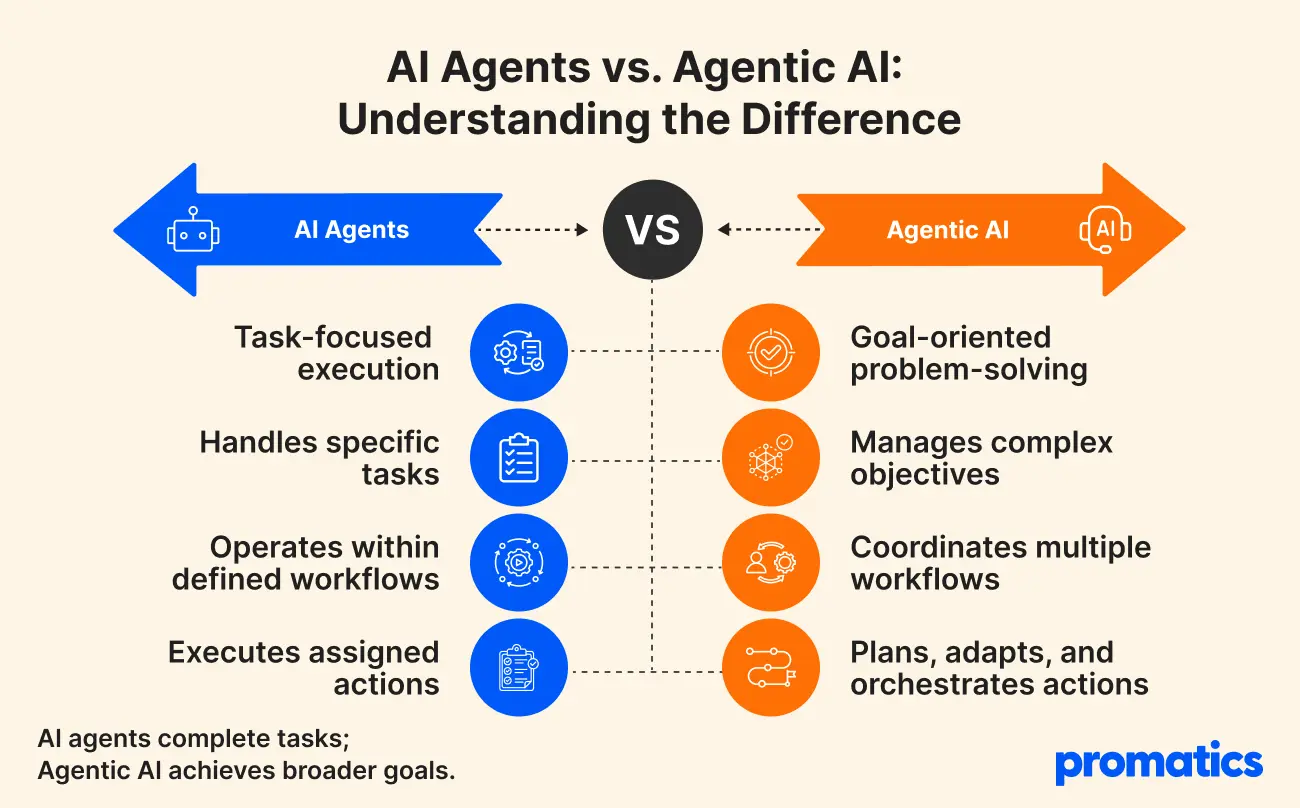
The primary difference between AI agents and Agentic AI is their scope of operation and the architecture used to achieve business objectives.
An AI agent is generally an individual intelligent system designed to perform specific tasks. Agentic AI describes a broader system-level approach that can coordinate agents and other software components to accomplish more complex objectives.
However, the distinction is not absolute. An individual AI agent can also demonstrate agentic capabilities. The terms overlap in technical literature, and their precise usage varies across organizations and research communities.
The following comparison explains the distinction from a practical enterprise architecture perspective.
| Comparison Factor | AI Agents | Agentic AI |
| Definition | Individual autonomous software entities | Broader intelligent system or architectural approach |
| Scope | Specific tasks or workflows | Complex, interconnected business objectives |
| Architecture | Usually single-agent architecture | Single-agent or multi-agent orchestration |
| Task Management | Handles assigned tasks | Decomposes and coordinates multiple tasks |
| Collaboration | Can operate independently or integrate with other agents | Often emphasizes coordinated agent collaboration |
| Decision-Making | Decisions within a defined operational scope | Decisions across multiple workflow stages |
| Memory | Task-level or contextual memory | Potentially shared or persistent system-level memory |
| Integration | Connects with assigned tools and APIs | Coordinates multiple tools, agents, and enterprise systems |
| Complexity | Generally lower for focused implementations | Usually higher for complex implementations |
| Business Applications | Customer support, scheduling, data extraction | End-to-end operations, research, and cross-department automation |
AI Agents vs. Agentic AI: A Practical Example
Imagine an eCommerce company handling hundreds of customer orders daily.
A standalone AI agent could monitor incoming customer requests, retrieve order information, and provide delivery updates.
An Agentic AI system could manage a broader order resolution workflow.
It could coordinate:
- A customer support agent to understand the complaint.
- An order management agent to retrieve transaction details.
- An inventory agent to check product availability.
- A logistics agent to investigate delivery delays.
- A resolution agent to recommend an appropriate action.
- A human approval workflow for refunds or exceptional cases.
The difference is not simply the number of agents. It is how the system plans, coordinates, and manages the overall objective.
Understanding the Architecture of AI Agents
An AI agent architecture consists of several interconnected components that allow the system to receive information, reason about tasks, interact with external systems, and evaluate results.
A typical AI agent architecture includes the following layers.
1. Input and Perception Layer
The input layer receives information from users, applications, databases, APIs, or external environments.
Depending on the application, inputs may include:
- Text and voice commands.
- Customer information.
- Transaction records.
- Documents and images.
- Application events.
- Real-time business data.
Natural language processing and multimodal AI capabilities help agents interpret different types of information.
2. Reasoning and Planning Layer
The reasoning layer interprets the objective and determines the appropriate steps.
Large language models (LLMs) frequently act as the reasoning engine in modern AI agents.
The model evaluates the available context, determines what information is missing, and selects the next action.
3. Memory and Context Layer
Memory allows an agent to maintain relevant information during task execution.
It may include:
- Conversation history.
- Previous task results.
- User preferences.
- Retrieved business information.
- Structured operational data.
Depending on the requirements, developers may use databases, vector databases, or other storage systems to manage memory.
4. Tool and Integration Layer
This layer enables agents to interact with external systems.
Examples include:
- CRM and ERP platforms.
- Payment gateways.
- Internal business APIs.
- Cloud services.
- Enterprise databases.
- Third-party applications.
Secure API integrations allow agents to retrieve information and execute permitted actions.
5. Execution and Feedback Layer
After selecting an action, the agent executes it through the assigned tools.
It then evaluates the result and determines whether the objective has been completed or requires another action.
This creates a reasoning-action-feedback loop.
Understanding the Architecture of Agentic AI
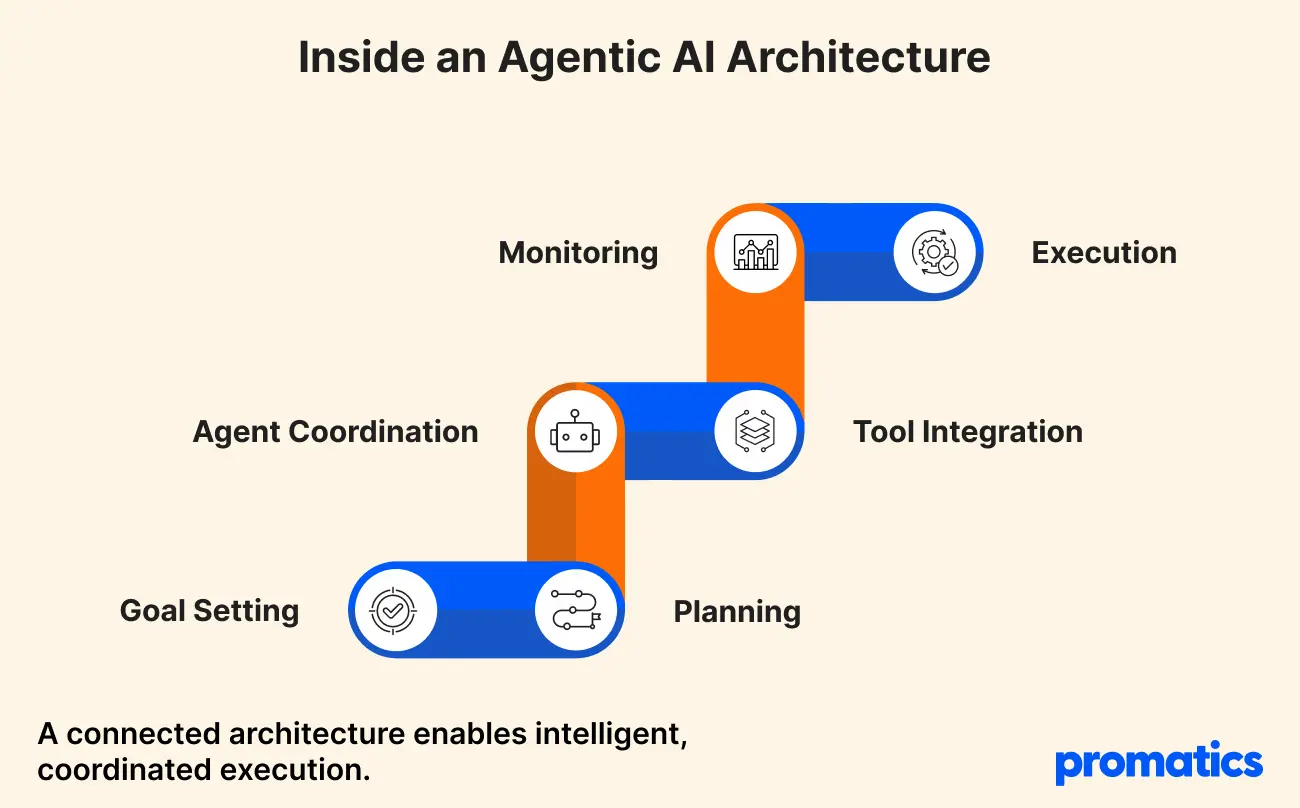
Agentic AI architecture extends individual agent capabilities through orchestration, coordination, shared context, and workflow management.
A production-ready system may contain the following components.
1. Goal and Instruction Layer
The process begins with a high-level business objective.
For example:
“Analyze customer complaints, identify recurring product issues, and prepare an operational report with recommended actions.”
The system interprets the objective and identifies the tasks required to achieve it.
2. Planning and Orchestration Layer
An orchestrator determines how the objective should be divided into smaller tasks.
It can:
- Break down complex objectives.
- Identify task dependencies.
- Assign responsibilities to specialized agents.
- Manage execution sequences.
- Track task progress.
- Handle failures and exceptions.
The orchestration layer is particularly important when multiple agents need to collaborate.
3. Specialized Agent Layer
Individual agents perform specific responsibilities.
For example, an enterprise research system may include:
- Research Agent: Collects information from approved sources.
- Analysis Agent: Identifies patterns and insights.
- Validation Agent: Checks information and flags inconsistencies.
- Reporting Agent: Organizes findings into structured reports.
Each agent operates within its defined responsibilities and permissions.
4. Shared Knowledge and Memory Layer
Multiple agents may require access to common business information.
A shared knowledge layer can provide relevant context through:
- Enterprise databases.
- Vector databases.
- Knowledge graphs.
- Document repositories.
- Retrieval-Augmented Generation (RAG).
This helps agents work with consistent information while maintaining appropriate access controls.
5. Integration and Tool Layer
The system connects agents with external software, APIs, enterprise applications, and data services.
The Model Context Protocol (MCP) can provide a standardized way for AI applications to discover and interact with external tools and resources.
6. Monitoring and Governance Layer
Enterprise Agentic AI requires continuous monitoring and control.
This layer manages:
- Authentication and authorization.
- Agent permissions.
- Execution logs.
- Performance monitoring.
- Human approval checkpoints.
- Error handling.
- Security policies.
- Auditability.
These controls help ensure that autonomous operations remain aligned with business requirements.
How Do AI Agents and Agentic AI Work Together?
AI agents and Agentic AI are not competing technologies. They can function as complementary components of the same intelligent software ecosystem.
An individual agent provides specialized capabilities, while the broader Agentic AI architecture coordinates those capabilities toward a larger objective.
Consider a financial services organization that wants to automate its document processing operations.
A multi-agent workflow could operate as follows:
Step 1: Document Collection
An intake agent receives invoices, statements, and supporting documents.
Step 2: Information Extraction
An extraction agent identifies relevant fields, transaction values, dates, and customer details.
Step 3: Verification
A validation agent compares extracted information against approved business records.
Step 4: Exception Detection
A compliance agent identifies missing information, unusual transactions, or inconsistencies.
Step 5: Workflow Execution
A processing agent updates the relevant enterprise system or prepares an approval request.
Step 6: Human Review
Transactions requiring additional verification are routed to authorized employees.
Step 7: Reporting
A reporting agent generates a summary of processed documents, pending approvals, and exceptions.
The orchestration layer coordinates the complete workflow, while individual AI agents perform specialized activities.
This approach allows businesses to automate connected processes without depending on one large, monolithic AI component.
Business Applications of AI Agents and Agentic AI
The business value of AI agents and Agentic AI depends on how effectively they address operational challenges.
Here are some practical applications across industries.
1. Customer Support and Experience
AI agents can handle common customer requests, retrieve account information, and provide contextual assistance.
Agentic AI can coordinate more complex customer service workflows involving multiple departments.
Business applications:
- Automated customer support.
- Intelligent ticket classification.
- Order tracking and issue resolution.
- Customer sentiment analysis.
- Personalized customer communication.
- Escalation management.
For example, a customer support system can identify a delivery complaint, investigate the order, check logistics information, and prepare a resolution through coordinated agents.
Google Cloud also shares examples of operational impact from deployed agentic workflows. In one example, manufacturer Danfoss uses AI agents to automate email-based order processing, automating 80% of transactional decisions and reducing the average customer response time from 42 hours to near real time. The result illustrates how coordinated agents can connect customer communication with back-office processes rather than simply answering questions. (Google Cloud, AI Agent Trends 2026)
2. Sales and Marketing Automation
AI agents can support sales teams by qualifying leads, researching prospects, updating CRM records, and preparing personalized communications.
Agentic AI can coordinate multiple activities across the customer acquisition lifecycle.
Business applications:
- Lead identification and qualification.
- Customer segmentation.
- CRM data enrichment.
- Campaign analysis.
- Personalized outreach preparation.
- Sales performance reporting.
- Follow-up workflow management.
Businesses can use these capabilities to develop more intelligent AI automation platforms that reduce repetitive work while allowing sales teams to focus on relationship building.
Importantly, outbound communications should remain subject to consent, privacy, and applicable marketing regulations.
3. Healthcare Operations
Healthcare organizations can use AI agents to support administrative and information management workflows.
Potential applications include:
- Appointment scheduling.
- Patient query management.
- Medical document classification.
- Clinical documentation assistance.
- Insurance claim processing.
- Administrative workflow coordination.
Agentic AI can coordinate activities across scheduling, documentation, and administrative systems.
However, clinical decisions and high-impact patient care activities require appropriate professional oversight, validation, and regulatory safeguards.
4. Financial Services and Banking
Financial institutions handle large volumes of transactions, customer requests, compliance documentation, and operational data.
AI agents can assist with:
- Transaction monitoring.
- Fraud signal identification.
- Document verification.
- Customer support.
- Financial data analysis.
- Compliance documentation.
Agentic AI can coordinate information across these processes, helping teams investigate exceptions and manage complex workflows.
High-impact financial decisions should remain subject to appropriate validation and authorization.
5. eCommerce and Retail
AI agents can improve shopping experiences and streamline retail operations.
Examples include:
- Product recommendations.
- Inventory monitoring.
- Customer query resolution.
- Order status management.
- Product information retrieval.
- Demand analysis.
Agentic AI can coordinate inventory, logistics, customer support, and order management processes to improve operational visibility.
6. Manufacturing and Supply Chain
Manufacturing operations involve interconnected activities across procurement, production, inventory, quality management, and logistics.
AI agents can analyze operational information and identify potential disruptions.
Agentic AI can coordinate multiple workflows to support:
- Predictive maintenance.
- Production planning.
- Inventory optimization.
- Supplier communication.
- Quality inspection.
- Supply chain monitoring.
- Operational reporting.
For example, when an equipment monitoring system detects an unusual pattern, an AI agent can analyze the available information and notify the maintenance team. A broader Agentic AI system could coordinate maintenance scheduling, spare-part availability, and production planning.
7. Software Development and IT Operations
AI agents are increasingly being used to support software engineering and IT operations.
Individual agents can assist with code generation, documentation, testing, debugging, and technical research.
Agentic AI can coordinate multiple stages of the software development lifecycle.
Potential applications include:
- Code review.
- Automated testing.
- Bug identification.
- Documentation generation.
- Development workflow management.
- Infrastructure monitoring.
- Incident investigation.
AI coding tools can accelerate development activities, but generated code still requires human review, testing, and security validation.
AI Agents vs. Agentic AI: Which Should Businesses Choose?
There is no universal answer. The right approach depends on the complexity of the business process and the level of autonomy required.
When Should You Choose AI Agents?
AI agents are suitable when:
- The business needs to automate specific tasks.
- The workflow has a clearly defined objective.
- The number of required integrations is limited.
- A single agent can complete the task effectively.
- The organization wants to validate an AI use case before expanding it.
For example, an organization may begin with an AI agent that classifies incoming support tickets and suggests appropriate responses.
When Should You Choose Agentic AI?
Agentic AI may be more suitable when:
- Multiple business processes need coordination.
- Tasks involve several interconnected systems.
- Different specialized capabilities are required.
- Workflows change based on incoming information.
- The objective requires multiple planning and execution stages.
- The organization needs broader workflow automation.
For example, a large eCommerce business may need an intelligent system that coordinates customer support, order management, inventory, and logistics.
Can Businesses Start With AI Agents and Move Toward Agentic AI?
Yes. A phased implementation can help businesses reduce technical complexity and validate value before expanding autonomy.
An organization can begin with a focused AI agent, evaluate its performance, and gradually introduce additional agents and orchestration capabilities as business requirements evolve.
This approach supports controlled adoption and helps avoid unnecessary architectural complexity.
Technologies and Frameworks Powering Agentic AI Development
Building reliable AI agents and Agentic AI systems requires more than selecting an LLM. Developers need frameworks, integration layers, memory systems, databases, and infrastructure that support reasoning, execution, and monitoring.
Some important technologies include:
Large Language Models
LLMs provide the reasoning and language capabilities used by many modern AI agents.
Examples include:
- OpenAI models.
- Anthropic Claude.
- Google Gemini.
AI Agent Frameworks
Agent development frameworks help organize tool usage, reasoning, task execution, and collaboration.
Examples include:
- LangChain.
- LangGraph.
- CrewAI.
Model Context Protocol
MCP provides a standardized protocol for connecting AI applications with external tools and resources.
It can simplify how agents discover and interact with supported systems.
Vector Databases
Vector databases help applications retrieve relevant information from large collections of unstructured data.
Common options include:
- Pinecone.
- Qdrant.
- Weaviate.
- Chroma.
Retrieval-Augmented Generation
RAG connects LLMs with external knowledge sources, helping AI systems generate responses using relevant business information.
Cloud and Backend Infrastructure
Production-grade AI systems also require reliable infrastructure for:
- Model deployment.
- API management.
- Data processing.
- Authentication.
- Logging and monitoring.
- Workflow execution.
- Scalability.
Technology selection should depend on the application’s complexity, data requirements, performance expectations, security needs, and deployment environment.
Challenges of Implementing Agentic AI and AI Agents
Although autonomous AI systems offer significant opportunities, their implementation introduces technical and operational challenges.
1. Data Quality and Context Management
AI agents depend on accurate and relevant information.
Incomplete, outdated, or inconsistent data can result in incorrect decisions and unreliable execution.
Businesses should establish appropriate data validation, knowledge management, and retrieval processes.
2. Security and Access Control
Agents may interact with sensitive enterprise systems and business information.
Unrestricted access can create serious operational and security risks.
Organizations should implement:
- Role-based access control.
- Least-privilege permissions.
- Secure API authentication.
- Data encryption.
- Execution monitoring.
- Audit logs.
3. Hallucinations and Incorrect Actions
LLMs can generate inaccurate information or misunderstand instructions.
When an agent can execute actions, these errors may have consequences beyond an incorrect response.
Businesses should implement validation mechanisms, reliable data retrieval, action constraints, and human approval for high-impact activities.
4. Multi-Agent Coordination
Agentic AI systems introduce additional complexity because multiple agents must communicate and coordinate correctly.
Poor task allocation, conflicting outputs, and communication failures can affect overall performance.
Well-defined responsibilities, structured communication, and orchestration controls are essential.
5. Cost and Performance Optimization
Every additional agent, model interaction, tool call, and retrieval operation can introduce infrastructure and operational costs.
Businesses should monitor:
- Token consumption.
- Model usage.
- API costs.
- Execution latency.
- Infrastructure requirements.
- Task completion rates.
The architecture should use the simplest approach capable of achieving the desired business outcome.
6. Governance and Human Oversight
Autonomous systems require clearly defined operational boundaries.
Businesses should determine which actions agents can execute independently, which require approval, and which should always remain under human control.
For enterprise adoption, governance should be incorporated into the architecture rather than added after deployment.
How to Build an Agentic AI Solution for Your Business
Developing an Agentic AI system requires a structured approach that connects technical capabilities with business requirements.
Step 1: Identify Business Opportunities
Start by identifying repetitive, time-consuming, or interconnected workflows that could benefit from intelligent automation.
Evaluate the potential business impact before selecting the technology.
Step 2: Define the Required Level of Autonomy
Determine whether the solution needs a single AI agent or a coordinated multi-agent architecture.
Not every workflow requires multiple agents.
A focused agent may be more cost-effective and easier to manage for clearly defined tasks.
Step 3: Prepare Business Data and Integrations
Identify the databases, APIs, enterprise applications, and knowledge sources the system needs to access.
Establish data quality, authentication, and permission requirements before implementation.
Step 4: Select the Right AI Models and Frameworks
Choose appropriate LLMs, agent frameworks, orchestration technologies, and retrieval systems based on the use case.
The objective should be to create a reliable architecture rather than use the largest number of AI technologies.
This practical approach is consistent with Google Cloud’s 2026 AI Agent Trends report, which emphasizes moving from isolated tasks to connected systems and pairing agent adoption with workforce readiness. Technology selection should therefore account for operating processes and employee oversight, not just model and framework capabilities.
Step 5: Develop and Integrate Agents
Build individual agents with clearly defined responsibilities, available tools, and execution boundaries.
For multi-agent systems, establish how agents communicate, delegate tasks, and share relevant context.
Step 6: Test and Validate the System
Evaluate the solution using realistic business scenarios.
Testing should cover:
- Task completion accuracy.
- Tool execution reliability.
- Security and access permissions.
- Error handling.
- Agent coordination.
- Response quality.
- Performance and latency.
Step 7: Deploy, Monitor, and Optimize
Begin with a controlled deployment and monitor the system against defined business KPIs.
Measure task completion rates, time saved, error rates, operational costs, and human intervention requirements.
Use these insights to improve the system over time.
The Future of Agentic AI and Autonomous Business Systems
AI agents and Agentic AI are expected to play an increasingly important role in enterprise software and business automation.
Several developments are shaping this direction.
Market projections underline the growing commercial interest. Grand View Research forecasts that the AI agents market could grow from $10.9 billion in 2026 to $182.9 billion by 2033, at a 49.6% CAGR. The estimate reflects demand for automation, advances in natural language processing, and interest in more personalized customer experiences.
1. More Collaborative Multi-Agent Systems
Businesses will increasingly explore specialized agents that collaborate across departments and software platforms.
This can support more coordinated business operations and reduce fragmented automation.
2. Integration With Enterprise Applications
AI agents are moving closer to everyday business software.
Integration with CRM, ERP, HRMS, financial systems, and productivity platforms can make AI-driven workflows more useful in real business environments.
3. Better Context and Memory Management
Improvements in retrieval, memory, and knowledge management can help agents work with more relevant information across extended workflows.
4. Human-AI Collaboration
The future of enterprise AI is not necessarily about removing people from workflows.
Instead, intelligent systems can handle repetitive execution while employees focus on strategic decisions, exceptions, and complex problem-solving.
5. Greater Focus on Security and Governance
As agents gain access to more enterprise tools and data, organizations will need stronger identity management, permission controls, monitoring, and accountability.
6. Agentic Capabilities in Digital Products
AI capabilities will increasingly become part of web applications, mobile products, and SaaS platforms.
This creates opportunities for businesses to develop intelligent digital products that can understand user objectives and perform actions within defined boundaries.
Conclusion
AI agents and Agentic AI represent important developments in the evolution of intelligent software.
AI agents enable businesses to automate focused tasks through reasoning, tool integration, and autonomous execution. Agentic AI extends these capabilities by coordinating agents, managing complex workflows, and pursuing broader business objectives.
The choice between them should depend on the problem being solved rather than the technology’s complexity or popularity. Businesses beginning their AI journey can start with focused AI agents, while organizations managing interconnected processes may benefit from a broader Agentic AI architecture.
Successful implementation ultimately depends on reliable data, appropriate architecture, secure integrations, effective governance, and continuous performance evaluation.
For businesses looking to turn these capabilities into practical digital solutions, Promatics Technologies offers expertise in AI engineering, custom software development, and intelligent application development. Through its AI Agent Development Services, businesses can explore solutions involving custom AI agents, multi-agent systems, LLM integration, and AI-powered workflow automation.
As intelligent technologies continue to evolve, choosing the right development approach and technology partner will help businesses build scalable, secure, and future-ready digital products.
