Healthcare App Development Cost in India: Complete Breakdown
Healthcare applications have become an important part of how hospitals, clinics, healthcare startups, and digital health businesses deliver services in 2026. From virtual consultations and appointment booking to remote patient monitoring and AI-powered healthcare solutions, mobile technology is helping organizations make healthcare more accessible and efficient.
According to Fortune Business Insights, the global mHealth apps market is projected to grow from USD 40.65 billion in 2025 to USD 88.70 billion by 2032. This growth highlights the increasing demand for digital healthcare solutions.
However, developing a healthcare application requires more than designing an interface and building a few features. Businesses must consider data security, healthcare integrations, regulatory requirements, testing, infrastructure, and ongoing maintenance.
So, how much does healthcare app development cost in India?
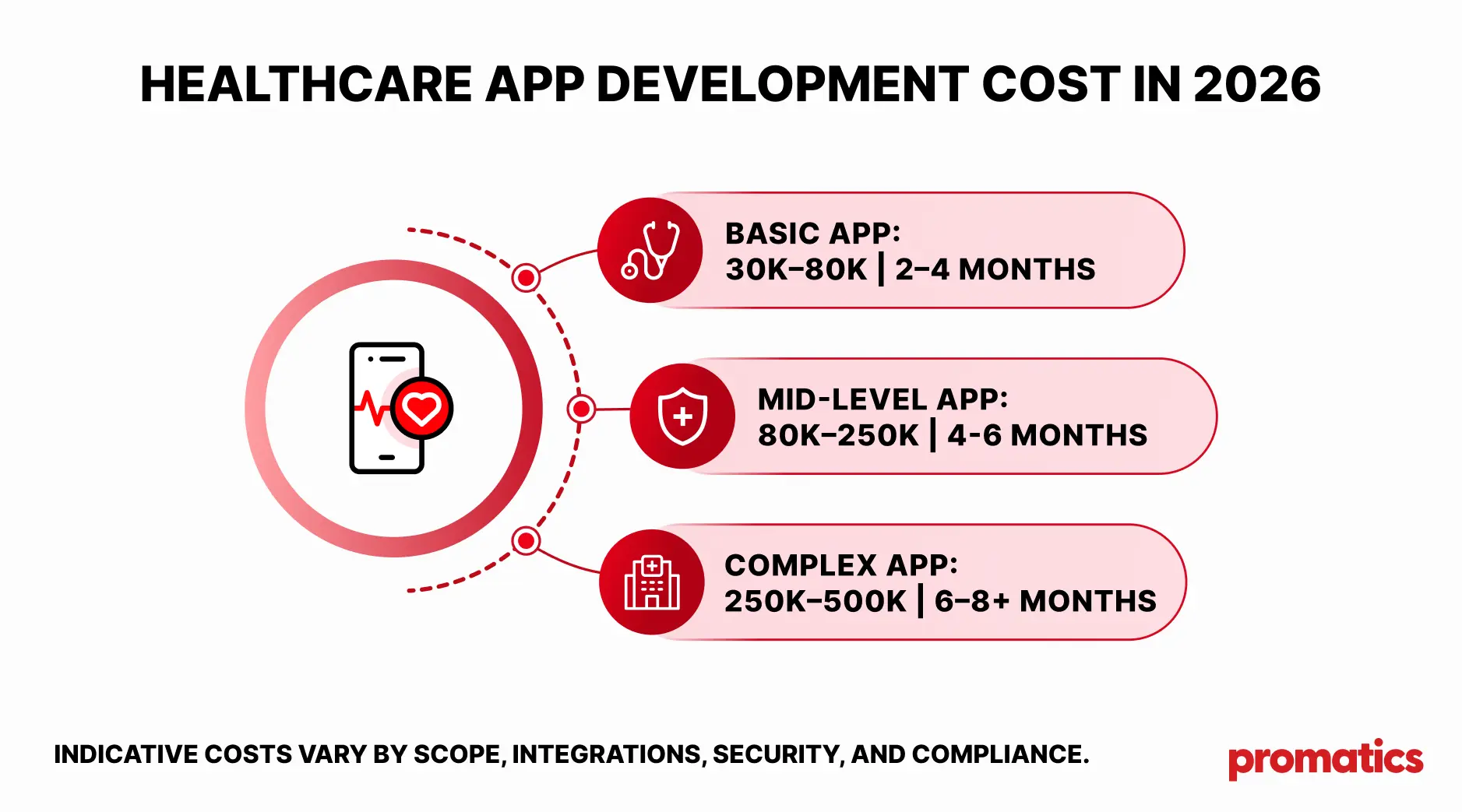
Healthcare app development can cost approximately $30,000 to $500,000 or more, depending on the application’s complexity, features, integrations, security requirements, and technology stack. These are indicative estimates, not fixed market rates. The actual investment depends on the project scope and development approach.
This guide explains healthcare app development costs, major cost drivers, essential features, emerging technologies, development timelines, and practical ways to manage your budget.
Healthcare App Development Cost in India: At a Glance
The cost of developing a healthcare app depends primarily on its functionality and technical complexity.
| Healthcare app complexity | Estimated development cost | Estimated timeline | Examples |
| Basic | 30,000–80,000 | 2–4 months | Appointment booking, wellness tracking, basic patient portals |
| Mid-level | 80,000–250,000 | 4–6 months | Telemedicine, e-prescriptions, doctor discovery |
| Complex | 250,000–500,000+ | 6–8+ months | Integrated telehealth platforms, EHR-connected applications, remote patient monitoring |
These estimates are illustrative planning ranges. Actual costs and timelines may vary based on team composition, the number of platforms, third-party services, compliance obligations, integration complexity, and the scope of testing. Projects involving extensive clinical integrations or advanced AI may require more time and investment.
Although the table uses USD for comparison, a project developed in India may be quoted in INR. The final amount depends on the vendor’s pricing model, delivery scope, and commercial terms.
What Factors Affect Healthcare App Development Cost?
Healthcare app development costs depend on the application’s purpose, technical requirements, target users, and operational environment. A basic appointment-booking app generally requires less engineering effort than a platform that combines virtual consultations, electronic health records, AI capabilities, and remote patient monitoring.
Understanding these cost factors helps businesses prioritize requirements and plan a realistic budget.
1. App Type and Complexity
The type of healthcare application determines its core workflows, user roles, integrations, and technical architecture.
Common healthcare application types include:
- Telemedicine apps: Support virtual consultations, video calls, messaging, and appointment scheduling.
- Patient portal apps: Allow users to access medical records, prescriptions, test results, and appointment information.
- Remote patient monitoring apps: Collect health measurements from compatible wearables and medical devices.
- Hospital management apps: Help healthcare organizations manage appointments, patient information, staff, and operational processes.
- Doctor discovery apps: Help patients find healthcare professionals, compare relevant information, and book consultations.
- AI-powered healthcare apps: Support use cases such as document processing, healthcare information retrieval, and predictive analytics.
Each application type has different engineering requirements. A doctor discovery platform may need search, profiles, availability management, and booking functionality. A remote monitoring platform may also require device connectivity, data synchronization, alert workflows, and clinical review interfaces.
The more complex the workflows, the greater the development, testing, and integration effort is likely to be.
2. Features and Functional Requirements
Features directly influence development costs because each functionality requires design, backend development, integration, testing, and security controls.
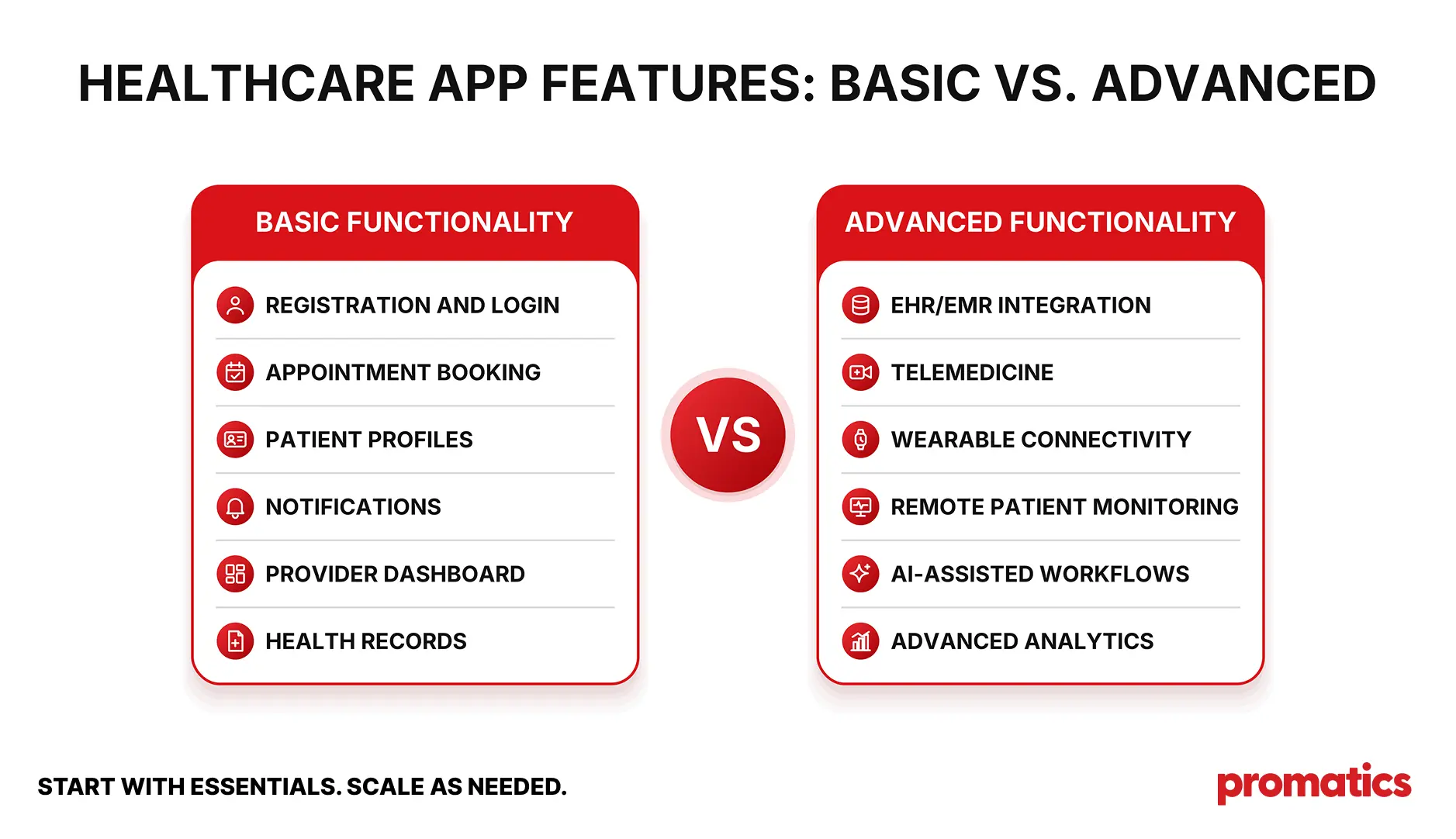
Essential features may include user registration, authentication, appointment management, patient profiles, notifications, and administrative dashboards.
Advanced functionality may include:
- Video consultations and secure messaging
- EHR and EMR integration
- Electronic prescriptions
- Payment and billing workflows
- Insurance-related integrations
- Wearable device connectivity
- AI-assisted information retrieval
- Analytics and reporting dashboards
For example, a basic appointment scheduling workflow is generally less complex than building a real-time telemedicine experience with secure communications and connections to external clinical systems.
Cost optimization tip: Prioritize features according to patient needs, clinical workflows, and business objectives. Features that are not essential to the first release can be considered for later development phases.
3. UI/UX Design and Accessibility
Healthcare applications must be easy to navigate for patients, healthcare professionals, and administrative staff. Confusing interfaces can make it harder for users to find information, complete appointments, or understand instructions.
UI/UX design costs depend on the number of user roles, screens, workflows, design iterations, and accessibility requirements.
Important design considerations include:
- Accessible typography, layouts, and navigation
- Simple registration and onboarding
- Clear presentation of health information
- Easy appointment scheduling and rescheduling
- Support for different screen sizes
- Multilingual experiences where required
- Separate interfaces for patients, doctors, and administrators
Applications intended for diverse patient populations may require additional usability research and accessibility testing.
Investing in user experience early can also reduce the need for costly redesigns after launch.
4. Data Security and Regulatory Compliance
Security is a fundamental requirement for healthcare applications because they may collect, store, process, or transmit sensitive personal and health information.
Applicable obligations depend on the countries served, the data involved, the organization’s role, and the application’s intended use. For example, HIPAA may apply to covered entities and business associates handling protected health information in the United States. The GDPR may apply to the processing of personal data within its territorial scope in the European Union.
Depending on the application, security and compliance work may include:
- Encryption of sensitive data in transit and at rest
- Role-based access controls
- Multi-factor authentication
- Consent and privacy management
- Audit logs and activity monitoring
- Secure data storage and transmission
- Vulnerability assessments and penetration testing
- Appropriate documentation and risk management
Applications that qualify as regulated medical devices may also require additional validation, documentation, and regulatory assessment.
These requirements can increase initial development costs, but planning for them early helps reduce security gaps and expensive rework.
5. EHR, EMR, and Third-Party Integrations
Healthcare applications frequently need to exchange information with existing systems, including electronic health records, electronic medical records, laboratories, pharmacies, payment providers, insurance platforms, and connected devices.
Integration costs depend on:
- The number of systems involved
- API availability and documentation
- Data formats and mapping requirements
- Vendor access restrictions
- Data synchronization frequency
- Legacy system compatibility
- Testing and error-handling requirements
Standards such as HL7 and FHIR can support healthcare interoperability, but they do not automatically make every integration straightforward. Vendor-specific implementations and existing infrastructure may still introduce complexity.
Cost optimization tip: Identify which integrations are necessary for launch. Additional systems can be introduced in later phases if they are not essential to the initial product.
6. Technology Stack and Platform Selection
The technology stack influences development effort, infrastructure costs, performance, and long-term maintenance.
Businesses generally choose between native development, cross-platform development, and web-based applications.
Native app development
Swift is commonly used for native iOS development, while Kotlin is commonly used for native Android development. Native development can provide access to platform-specific capabilities, but maintaining separate applications may require additional effort.
Cross-platform development
Frameworks such as Flutter and React Native allow developers to share parts of the codebase across iOS and Android. This may reduce duplicated work, although platform-specific functionality can still require additional engineering.
Web applications
Browser-based applications can support patient portals, administrative dashboards, and selected clinical workflows without requiring every user to install a mobile app.
The right approach depends on performance requirements, device integrations, user experience, security, and the product’s long-term roadmap.
Businesses planning a new product can explore mobile app development services to understand the broader development process, from application planning to implementation.
7. AI, Wearables, and Advanced Healthcare Technologies
Advanced technologies can expand an application’s capabilities, but they also introduce additional engineering, integration, validation, and operational costs.
Examples include:
- AI-powered assistants: Help users navigate approved healthcare information and support administrative workflows.
- Machine learning: Analyzes appropriate datasets to identify patterns and generate predictions.
- Medical image analysis: Processes medical images for defined clinical or research use cases.
- Wearable integrations: Collects relevant measurements from supported health devices.
- Remote patient monitoring: Supports data collection, monitoring workflows, and alerts for review.
- Predictive analytics: Helps analyze trends and forecast selected operational or health-related outcomes.
AI development costs depend on whether the application uses an existing model, integrates a third-party AI service, or requires custom model development. Data preparation, evaluation, monitoring, and infrastructure can add to the investment.
Features that influence clinical decisions require particular care. Their implementation may involve additional validation, risk management, and regulatory review.
Businesses should evaluate the expected value and operational requirements of each advanced capability before including it in the initial release.
8. Development Team, Testing, and Maintenance
A healthcare app may require a multidisciplinary team comprising:
- Business analysts and project managers
- UI/UX designers
- Mobile application developers
- Backend developers
- QA engineers
- DevOps and cloud specialists
- Security professionals
- Healthcare domain experts, where required
Costs vary based on experience, location, team size, project duration, and specialist requirements.
Testing is especially important for applications that handle sensitive data or support clinical workflows. Depending on the product, testing may cover functionality, API integrations, performance, accessibility, security, data accuracy, and failure recovery.
Development is not the end of the investment. Post-launch expenses may include:
- Operating system and device compatibility updates
- Security patches and vulnerability remediation
- Cloud hosting and monitoring
- Third-party API and service fees
- Bug fixes and performance improvements
- Integration maintenance
- Regulatory and interoperability updates
- User support and feature enhancements
Budgeting for these recurring expenses provides a more realistic view of the total cost of ownership.
App Features and Functionalities That Influence Development Costs
Healthcare app functionalities determine what users can do within the application and how the product interacts with external systems.
A basic app may focus on appointments and patient profiles. A more advanced application may require virtual consultations, clinical data exchange, remote monitoring, and AI-assisted workflows.
Essential Healthcare App Functionalities
- User registration and authentication: Allows patients, doctors, and administrators to create accounts and access role-specific functionality.
- Appointment management: Supports provider availability, appointment booking, rescheduling, cancellations, and reminders.
- Patient record management: Allows authorized users to access relevant medical histories, prescriptions, allergies, and test results.
- Telemedicine: Supports virtual consultations through video calls and secure communication features.
- Notifications and reminders: Sends appointment alerts, medication reminders, and important updates.
- Payment and billing: Handles consultation fees, invoices, and payment gateway integration.
- Admin and provider dashboards: Help healthcare organizations manage appointments, users, services, and operational information.
- Advanced Healthcare App Functionalities
Advanced functionalities are usually more expensive because they involve additional integrations, data processing, infrastructure, and testing.
- EHR/EMR integration: Exchanges relevant clinical information with compatible healthcare systems.
- Remote patient monitoring: Collects measurements from connected devices and supports monitoring and alert workflows.
- AI-powered assistance: Supports defined tasks such as healthcare information retrieval, document processing, and administrative automation.
- Wearable integration: Connects with supported devices and health platforms to collect relevant measurements.
- Analytics and reporting: Provides insights into appointment patterns, service usage, and operational performance.
- Multilingual functionality: Makes the application accessible to users across different languages and regions.
The cost impact depends on how these functionalities interact with the rest of the application. For example, a standalone notification feature may be relatively straightforward, while an alerting system connected to real-time medical device data may require substantially more engineering and validation.
Businesses should define functional requirements early, map their dependencies, and prioritize capabilities based on user needs and business goals.
Healthcare App Development Trends and Technologies in 2026
Healthcare app development is evolving toward more connected, personalized, and data-driven experiences. These trends can improve patient access and operational efficiency, but their implementation costs depend on the application’s scope and technical requirements.
1. AI-Powered Healthcare Applications
AI is being explored for virtual assistants, document processing, patient engagement, workflow automation, and predictive analytics.
For example, a healthcare organization may use an AI assistant to help users locate information within approved content or help staff process routine documentation.
Costs depend on model selection, data preparation, integration, evaluation, monitoring, and safeguards. AI-generated outputs should be appropriately reviewed when they may affect patient care.
2. Telemedicine and Virtual Care
Telemedicine enables patients to consult healthcare professionals remotely through video, audio, and secure messaging.
A telemedicine application may require scheduling, waiting rooms, video infrastructure, notifications, payment processing, and consultation records.
The final cost depends on the number of workflows, communication requirements, privacy controls, and integrations.
3. Remote Patient Monitoring
Remote patient monitoring uses compatible devices and connected systems to collect health measurements outside traditional clinical settings.
Applications may need to support device pairing, data synchronization, measurement history, threshold-based alerts, and review workflows.
Reliable device integration and clear handling of missing or inaccurate data are important considerations.
4. Interoperability and Connected Healthcare Systems
Healthcare providers often operate multiple systems that need to exchange information. Interoperability can help connect applications with EHRs, EMRs, laboratories, pharmacies, and other healthcare infrastructure.
HL7 and FHIR are relevant standards for healthcare data exchange. However, actual implementation requirements depend on the systems involved and their supported interfaces.
5. Personalized and Preventive Healthcare
Healthcare apps can use appropriate patient-provided information, health records, and monitoring data to deliver personalized reminders, wellness guidance, and care-plan support.
Personalization may involve rules-based logic, analytics, or machine learning. Costs increase with the sophistication of the underlying data processing and recommendation capabilities.
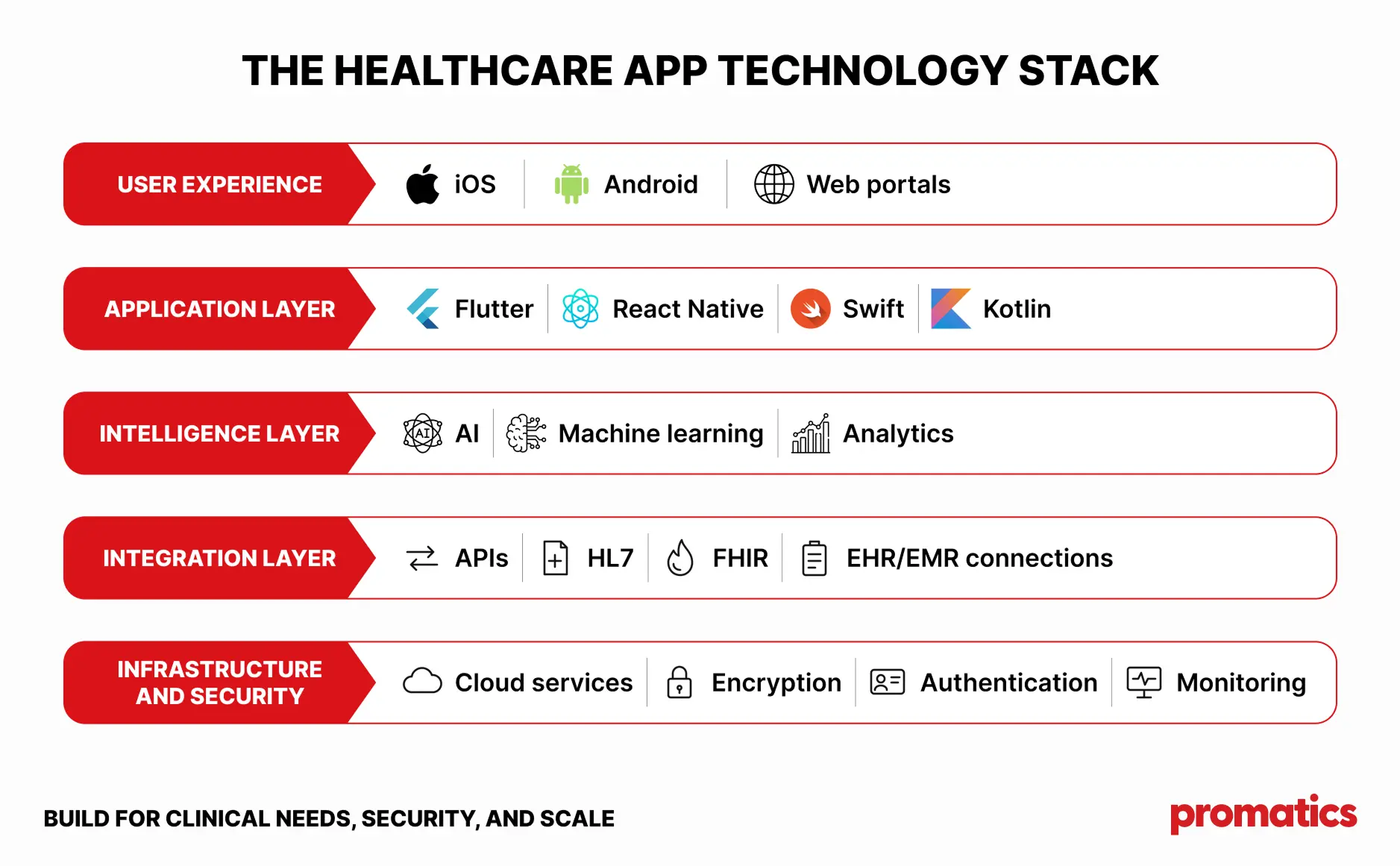
Technologies Used in Healthcare App Development
| Technology | Typical application | Cost consideration |
| AI and machine learning | Virtual assistants and predictive analytics | Evaluation, data preparation, and monitoring |
| Cloud computing | Application hosting and data infrastructure | Hosting, storage, security, and scalability |
| HL7 and FHIR | Healthcare data interoperability | API complexity and system compatibility |
| IoT and wearable APIs | Connected devices and patient monitoring | Device compatibility and synchronization |
| Flutter and React Native | Cross-platform mobile apps | Shared code versus platform-specific requirements |
| Swift and Kotlin | Native iOS and Android apps | Platform-specific development and maintenance |
| Encryption and identity management | Secure access and data protection | Security architecture and operational controls |
| Analytics and data visualization | Dashboards and operational reporting | Data pipelines and reporting complexity |
The technology stack should match the product’s intended purpose, user base, integration needs, and security requirements. Selecting technologies solely because they are popular can lead to unnecessary complexity.
For businesses planning an AI-enabled healthcare solution, the key is to identify a well-defined use case, establish suitable data and security requirements, and evaluate whether AI adds measurable value over a simpler approach.
How to Reduce Healthcare App Development Costs
Managing costs does not mean removing essential security controls or compromising the reliability of healthcare workflows. It means allocating resources to the capabilities that matter most.
1. Start With a Minimum Viable Product
Build the first release around the most important user needs. For example, a doctor appointment app may initially include registration, doctor profiles, scheduling, reminders, and an administrative dashboard.
Additional features can be introduced after the core product has been tested with users.
2. Prioritize Integrations
Not every external system needs to be connected in the first release. Identify which integrations are necessary for core workflows and plan the remaining connections according to business priorities.
3. Select an Appropriate Technology Stack
Choose a development approach that matches the product’s performance, device, integration, and maintenance requirements. Cross-platform development may reduce duplicated work in some cases, while native development may be appropriate for certain platform-specific requirements.
4. Plan Security and Compliance Early
Identify the applicable privacy, security, and regulatory requirements before implementation begins. Early planning can reduce expensive architectural changes and compliance-related rework.
5. Use Established Services Where Appropriate
Third-party services may support video consultations, notifications, payment processing, and identity verification. Evaluate their security, reliability, integration effort, licensing, and recurring fees before adopting them.
6. Budget for Maintenance
Include hosting, monitoring, security updates, support, and third-party service fees in the long-term budget. The lowest initial development estimate may not represent the lowest total cost of ownership.
7. Define Requirements Before Development
A structured discovery phase helps clarify user roles, features, workflows, integrations, technical risks, and acceptance criteria.
Clear requirements make it easier to estimate effort, compare proposals, and avoid unnecessary scope changes during development.

How to Choose a Healthcare App Development Company
Selecting a development partner is an important decision because healthcare applications often involve sensitive information, complex workflows, and long-term operational requirements.
Before choosing a vendor, evaluate the following:
- Relevant experience: Ask about experience building mobile applications, data-intensive platforms, and complex integrations.
- Security practices: Understand how the team approaches authentication, encryption, access controls, testing, and secure development.
- Technical expertise: Evaluate its capabilities across mobile development, backend systems, cloud infrastructure, APIs, and relevant healthcare technologies.
- Project transparency: Look for clear milestones, scope definitions, deliverables, and communication processes.
- Testing strategy: Confirm how the team tests functionality, integrations, performance, accessibility, and security.
- Post-launch support: Discuss maintenance, incident handling, updates, and future enhancements.
- Scalability: Assess whether the proposed architecture can accommodate future users, features, and integrations.
A reliable development partner should be able to explain technical trade-offs, identify risks, and connect implementation decisions to business requirements rather than simply promising the lowest price.
Build a Healthcare App With a Clear Development Roadmap
The cost of healthcare app development depends on more than the number of screens or features. Application complexity, user experience, integrations, technology choices, security requirements, and long-term maintenance all contribute to the total investment.
Businesses can make more informed decisions by defining the intended use case, identifying essential functionality, planning integrations early, and evaluating the total cost of ownership.
A phased development approach can help organizations validate their product, manage investment, and expand functionality as requirements evolve.
Looking to build a healthcare application? Explore Promatics Technologies’ mobile app development services to discuss your application requirements, technical priorities, and development roadmap.