Healthcare App Development Trends Reshaping Digital Healthcare in 2026

TL;DR
- AI is making healthcare applications smarter, faster, and more personalized.
- Telemedicine and remote patient monitoring are becoming standard healthcare services.
- Patient engagement apps and wearable integrations are improving care delivery.
- Security, interoperability, and regulatory compliance remain critical concerns.
- Healthcare organizations investing in AI-powered mobile applications will be better positioned for the future of digital healthcare.
Healthcare App Development Trends Reshaping Digital Healthcare in 2026
Healthcare is undergoing one of its biggest digital transformations, with mobile technology and artificial intelligence changing how patients access care and how providers deliver it. From virtual consultations and remote patient monitoring to AI-powered diagnostics and personalized treatment plans, healthcare apps are becoming the foundation of modern healthcare experiences.
The numbers highlight this rapid shift. According to Grand View Research, the global mHealth market is projected to reach over USD 314 billion by 2030, growing at a CAGR of 14.9%. Meanwhile, AI in healthcare is expected to surpass USD 187 billion by 2030, fueled by increasing investments in intelligent automation, predictive analytics, and digital patient engagement.
As smartphone adoption, wearable devices, and cloud technologies continue to grow, healthcare organizations are accelerating their digital transformation strategies to meet evolving patient expectations.
Today’s healthcare applications are no longer limited to appointment scheduling or prescription management. They are evolving into intelligent ecosystems that integrate telemedicine, AI chatbots, wearable devices, image recognition APIs, and secure electronic health records to deliver faster, smarter, and more personalized care.
Staying ahead in healthcare requires understanding the technologies that are reshaping the industry and developing scalable, compliant, and patient-centric solutions.
In this blog, we’ll explore the top healthcare app development trends for 2026, examine the technologies driving innovation, and discuss how businesses can leverage AI, telemedicine, and digital health solutions to create the next generation of healthcare experiences.
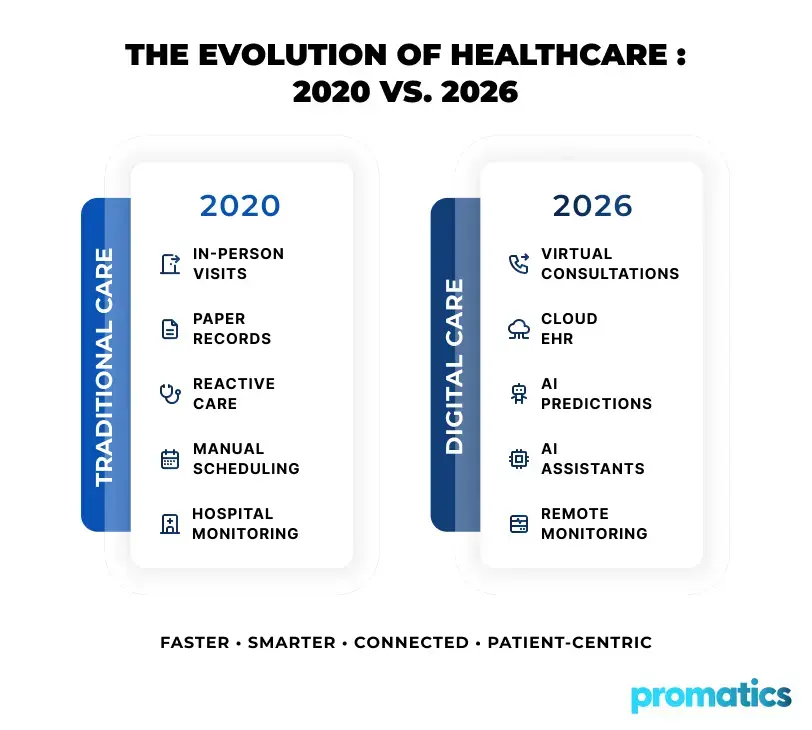
The State of Healthcare App Development in 2026
Healthcare app development has evolved from creating appointment booking applications to building comprehensive digital ecosystems that connect patients, doctors, hospitals, insurers, laboratories, and wearable devices.
Today’s healthcare applications are expected to deliver secure, personalized, and AI-powered experiences while complying with strict regulatory requirements such as HIPAA and GDPR.
The healthcare technology market continues to grow at an impressive pace:
- The global mobile healthcare (mHealth) market is projected to exceed $45.14 billion by 2030, driven by increasing demand for remote healthcare services and connected devices.
- More than 80% of healthcare organizations are investing in AI initiatives to improve diagnostics, automate administrative tasks, and enhance patient care.
- Telemedicine adoption has become mainstream, with millions of virtual consultations conducted every month across hospitals, clinics, and private practices.
- Wearable devices and remote patient monitoring solutions are generating continuous health data, enabling proactive and preventive care models.
These numbers highlight a simple reality: digital healthcare is becoming an essential part of modern medical services rather than an optional convenience.
Why Healthcare Organizations Are Accelerating Digital Transformation
Several factors are driving healthcare providers to invest in mobile applications and AI-powered solutions.
Rising Patient Expectations
Patients expect seamless digital experiences, including online appointment scheduling, virtual consultations, secure messaging, and instant access to medical records.
Operational Efficiency
Healthcare organizations are using automation and AI to reduce administrative workloads, improve resource allocation, and minimize manual processes.
AI-Powered Decision Making
Artificial intelligence enables healthcare professionals to analyze large datasets, identify patterns, support diagnoses, and personalize treatment plans more efficiently.
Remote Care and Accessibility
Telemedicine and remote monitoring solutions make healthcare accessible to patients in rural areas while reducing unnecessary hospital visits.
As healthcare becomes increasingly connected, mobile applications are evolving into intelligent platforms that support both patients and providers throughout the entire care journey.
Top Healthcare App Development Trends in 2026
1. AI-Powered Healthcare Applications Are Becoming the Standard
Artificial intelligence is no longer an experimental feature in healthcare apps. It is becoming the foundation for smarter diagnostics, personalized patient experiences, and automated workflows.
Modern healthcare applications are using AI to:
- Analyze patient symptoms
- Assist in clinical decision-making
- Generate personalized treatment recommendations
- Automate medical documentation
- Identify potential health risks
Rather than replacing healthcare professionals, AI acts as a decision-support system that improves efficiency and accuracy.
Real-World Applications
Healthcare organizations are integrating AI into:
- Virtual health assistants
- Symptom assessment tools
- Medical documentation platforms
- Clinical workflow automation
- Predictive healthcare analytics
As AI models continue to improve, healthcare applications will become increasingly proactive instead of reactive, helping providers detect potential issues before they become critical.
2. Telemedicine Is Becoming the Default Healthcare Experience
Virtual healthcare has transformed from a temporary solution into a long-term strategy for hospitals, clinics, and healthcare startups.
Patients now prefer healthcare platforms that offer:
- Video consultations
- Digital prescriptions
- Online appointment scheduling
- Secure messaging
- Follow-up care through mobile applications
This convenience benefits both patients and healthcare providers by reducing waiting times and improving accessibility.
Benefits of Telemedicine App Development
For healthcare providers:
- Better resource utilization
- Lower operational costs
- Increased patient reach
- Improved appointment management
For patients:
- Faster access to specialists
- Reduced travel time
- Continuous care from home
- Greater convenience
Future telemedicine platforms will combine AI, wearable devices, and remote monitoring technologies to create fully connected digital healthcare experiences.
3. AI Chatbots Are Transforming Patient Engagement
Healthcare organizations receive thousands of repetitive patient queries every day.
Instead of relying entirely on support staff, AI-powered chatbots are now providing instant assistance while improving patient satisfaction.
Healthcare chatbots can:
- Schedule appointments
- Answer frequently asked questions
- Send medication reminders
- Provide symptom guidance
- Assist with insurance information
- Route patients to the appropriate department
Modern AI chatbot frameworks leverage natural language processing and machine learning to deliver human-like conversations while maintaining compliance with healthcare regulations.
Why It Matters
Patients expect immediate responses regardless of the time of day.
AI chatbots provide 24/7 support, reduce administrative workloads, and allow healthcare professionals to focus on delivering quality care rather than handling routine inquiries.
As conversational AI advances, chatbots will evolve into intelligent virtual healthcare assistants capable of supporting patients throughout their treatment journey.
4. Image Recognition APIs Are Revolutionizing Diagnostics
Medical imaging has always been a critical component of diagnosis, but artificial intelligence is making image analysis faster and more accurate.
Image recognition APIs powered by deep learning can analyze:
- X-rays
- CT scans
- MRI images
- Skin conditions
- Ophthalmology scans
- Pathology images
These systems assist healthcare professionals by identifying patterns that may be difficult to detect manually, enabling earlier diagnosis and improved clinical outcomes.
Key Benefits
- Faster image analysis
- Improved diagnostic accuracy
- Reduced manual workload
- Enhanced clinical decision support
- Better patient outcomes
While AI does not replace medical expertise, it provides healthcare professionals with an additional layer of intelligence that supports faster and more informed decision-making.
5. Remote Patient Monitoring and Wearables in Healthcare
Healthcare is moving beyond hospital walls. Patients no longer need to visit clinics for routine monitoring, thanks to wearable devices and Internet of Things (IoT) technologies that provide continuous health insights.
From smartwatches to medical-grade wearables, connected devices are helping healthcare providers track patient health in real time and intervene before conditions worsen.
Common Use Cases
- Heart rate monitoring
- Blood pressure tracking
- Blood glucose monitoring
- Sleep analysis
- Physical activity tracking
- Chronic disease management
Benefits for Healthcare Providers
- Continuous patient monitoring
- Early detection of health risks
- Reduced hospital readmissions
- Improved treatment adherence
- Better long-term patient outcomes
As wearable adoption grows, healthcare apps will increasingly become centralized platforms that collect, analyze, and visualize health data from multiple connected devices.
6. Patient Engagement Apps in Healthcare
Modern healthcare is becoming more patient-centric, and mobile applications are playing a crucial role in keeping patients informed and engaged throughout their healthcare journey.
Rather than serving as simple appointment booking tools, patient engagement apps now provide personalized healthcare experiences that encourage proactive health management.
Essential Features
- Appointment scheduling
- Digital health records
- Medication reminders
- Secure messaging
- Wellness tracking
- Personalized health recommendations
- Lab report access
Why Patient Engagement Matters
Research consistently shows that engaged patients are more likely to follow treatment plans, attend follow-up appointments, and actively participate in managing their health.
Healthcare providers are increasingly investing in patient engagement apps to improve satisfaction while reducing administrative burdens and missed appointments.
7. Predictive Analytics for Preventive Care
One of the biggest advantages of artificial intelligence in healthcare is its ability to identify patterns hidden within massive datasets.
Predictive analytics enables healthcare organizations to anticipate medical events before they occur, improving patient care while optimizing resources.
Applications
- Disease risk prediction
- Hospital resource planning
- Readmission prevention
- Population health management
- Personalized treatment planning
For example, AI models can analyze patient history, lifestyle factors, and diagnostic reports to identify individuals at high risk for chronic conditions, enabling early intervention.
As healthcare continues its digital transformation, predictive analytics will become an essential component of preventive medicine.
8. Voice AI and Virtual Health Assistants Are Simplifying Clinical Workflows
Voice technology is becoming an increasingly valuable tool for healthcare professionals who spend significant time documenting patient interactions.
Voice AI allows clinicians to capture notes, retrieve patient information, and update records using natural language commands.
Popular Applications
- Voice-enabled appointment scheduling
- Clinical documentation
- Medical transcription
- Prescription assistance
- Patient support
Benefits
- Reduced administrative workload
- Faster documentation
- Improved productivity
- Better patient interaction
- Enhanced accessibility
With advances in generative AI and natural language processing, virtual health assistants are evolving into intelligent companions capable of supporting both clinicians and patients.
9. The Rise of Healthcare Interoperability
Healthcare data often exists across multiple systems, making information sharing a significant challenge.
Modern healthcare applications are addressing this issue through interoperability standards that enable secure communication between hospitals, clinics, laboratories, pharmacies, and insurance providers.
Key Standards
- FHIR (Fast Healthcare Interoperability Resources)
- HL7
- Electronic Health Records (EHR)
- Electronic Medical Records (EMR)
Benefits of Connected Healthcare Systems
- Better care coordination
- Reduced duplicate testing
- Faster clinical decisions
- Improved patient experiences
- Seamless information exchange
Organizations that prioritize interoperability can create unified digital ecosystems where healthcare professionals have access to accurate and up-to-date patient information.
10. Data Security and Compliance in Healthcare
Healthcare applications handle highly sensitive patient information, making security and regulatory compliance essential aspects of development.
As cyber threats become more sophisticated, healthcare organizations must adopt proactive security strategies that protect patient data while maintaining regulatory compliance.
Essential Security Measures
- End-to-end encryption
- Multi-factor authentication
- Role-based access control
- Secure cloud infrastructure
- Regular security audits
- Continuous monitoring
Compliance Frameworks
Healthcare applications should comply with regulations such as:
- HIPAA (United States)
- GDPR (Europe)
- HITECH
- SOC 2
- ISO 27001
Building security into the development lifecycle not only protects patient information but also strengthens trust between healthcare providers and their users.
Emerging Technologies Driving Healthcare Innovation
While AI and telemedicine dominate today’s conversations, several emerging technologies are reshaping the future of healthcare app development.
Generative AI
Generative AI is helping healthcare organizations automate documentation, summarize clinical records, create patient education materials, and streamline administrative workflows.
Blockchain
Blockchain technology enhances transparency and security by creating tamper-proof medical records and enabling secure health data sharing across organizations.
IoT and Connected Medical Devices
Smart medical devices continuously collect patient data, providing healthcare professionals with real-time insights that support preventive care and remote monitoring.
Cloud-Native Healthcare Platforms
Cloud infrastructure enables healthcare organizations to scale applications quickly, improve collaboration, and securely manage growing volumes of patient data.
Edge Computing
Processing healthcare data closer to connected devices reduces latency and enables faster decision-making for critical applications such as emergency response systems and remote diagnostics.
Looking Ahead
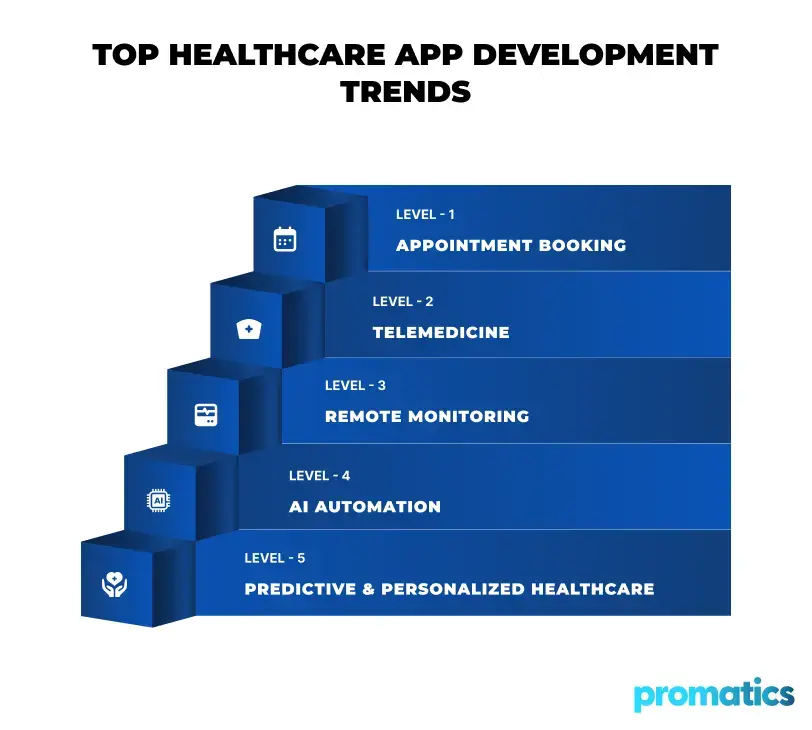
Healthcare app development in 2026 is no longer focused solely on digitizing existing processes. The industry is embracing intelligent, connected, and patient-centric ecosystems powered by AI, automation, wearable technology, and secure data sharing.
Organizations that adopt these technologies today will be better positioned to deliver personalized care, improve operational efficiency, and meet the evolving expectations of patients in an increasingly digital healthcare landscape.
Why Choose Promatics for Healthcare App Development
Building a successful healthcare application requires more than technical expertise—it demands a deep understanding of compliance, user experience, security, and emerging technologies.
At Promatics, we develop future-ready healthcare solutions that empower providers, startups, and enterprises to deliver exceptional digital healthcare experiences.
Our Expertise
- Custom Healthcare App Development
- AI-Powered Healthcare Solutions
- Telemedicine App Development
- Patient Engagement Platforms
- Remote Patient Monitoring Solutions
- Wearable & IoT Integrations
- HIPAA & GDPR-Compliant Applications
- Cloud-Native Healthcare Software Development
From product strategy and UI/UX design to development, integration, testing, and deployment, our team delivers scalable healthcare applications designed for long-term growth.
Looking to build a secure and AI-powered healthcare application? Connect with Promatics to transform your healthcare vision into a digital reality.
Conclusion
Healthcare is no longer just embracing digital transformation—it’s being redefined by it. Artificial intelligence, telemedicine, wearable technology, and connected health ecosystems are enabling healthcare organizations to deliver faster diagnoses, personalized treatments, and seamless patient experiences at scale.
As the industry moves toward preventive, data-driven, and patient-centric care, healthcare applications will become the backbone of modern healthcare delivery. Success will depend on building solutions that combine intelligent automation, robust security, regulatory compliance, and exceptional user experiences.
For healthcare providers, startups, and enterprises, investing in future-ready healthcare applications is no longer a competitive advantage—it’s a strategic necessity. Organizations that adopt these innovations today will be better equipped to improve patient outcomes, streamline operations, and thrive in an increasingly digital healthcare landscape.
Build the Future of Digital Healthcare with Promatics
Whether you’re planning a telemedicine platform, AI-powered healthcare application, patient engagement solution, or remote patient monitoring system, Promatics combines deep industry expertise with cutting-edge technologies to turn your vision into a secure, scalable, and intelligent digital product.
Ready to transform healthcare through innovation? Partner with Promatics to build next-generation healthcare applications that deliver measurable business value and exceptional patient experiences.