Cloud Infrastructure & DevOps: The Backbone of Modern Software Development

TL;DR
- Cloud + DevOps enable scalable, secure, and cost-efficient applications
- Supports faster releases with automation and continuous delivery
- Improves reliability, performance, and reduced system errors
- Allows flexible scaling based on demand and usage
- Drives digital transformation with agile and modern infrastructure
The development approach of modern software has changed significantly. Cloud Infrastructure and DevOps are now considered the main tools for any digital transformation. This change has made Cloud Infrastructure and DevOps not just a technology choice but a necessity for businesses to stay agile and reliable.
By combining Cloud Infrastructure and DevOps, Promatics Technologies ensures continuous delivery as well as the creation of a platform that is both scalable and stable. Cloud infrastructure enabled by DevOps methods is an excellent way of simultaneously locking down the security of the systems and getting them to operate cost-effectively. For example, a SaaS company in Australia scaled to millions of users without adding physical hardware.
Developers and testers gain the freedom to create, test, and launch applications at their own pace by leveraging cloud computing platforms and DevOps tools. With Promatics implementing these modern practices, teams experience a significant reduction in application bugs, faster release cycles, and improved reliability, driving innovation across industries ranging from fintech to healthcare.
Why Cloud Infrastructure is the Foundation of Digital Growth
Cloud infrastructure is the backbone to which modern applications are attached. This device-less IT architecture offers computing power, storage, networking, and security without the requirement of physical servers.
Businesses using professional software development services can respond faster to demand changes. They are able to scale up when there is a surge in traffic and scale down when usage drops, thus saving both time and money.
From On-Premise to Cloud-First Architecture
Traditional on-premise setups entail not only massive upfront investments but also regular maintenance. To scale these setups usually means purchasing new hardware and waiting for the setting up process that takes weeks or months.
Cloud-first architecture removes these barriers. Platforms like AWS, Microsoft Azure, and Google Cloud offer flexible resources and global availability.
Example: A UK fintech scaled from 10,000 to 1,000,000 users without purchasing additional servers.
To understand how cloud computing supports growth, this Gartner overview provides helpful insights.
Direct Benefits of Cloud Infrastructure
Cloud infrastructure offers a slew of benefits for the companies that decide to utilize it in the modern world:
- Elastic scalability to handle peak workloads
- High availability with built-in disaster recovery
- Global data centers for low-latency performance
- Compliance with standards such as GDPR, SOC 2, and ISO
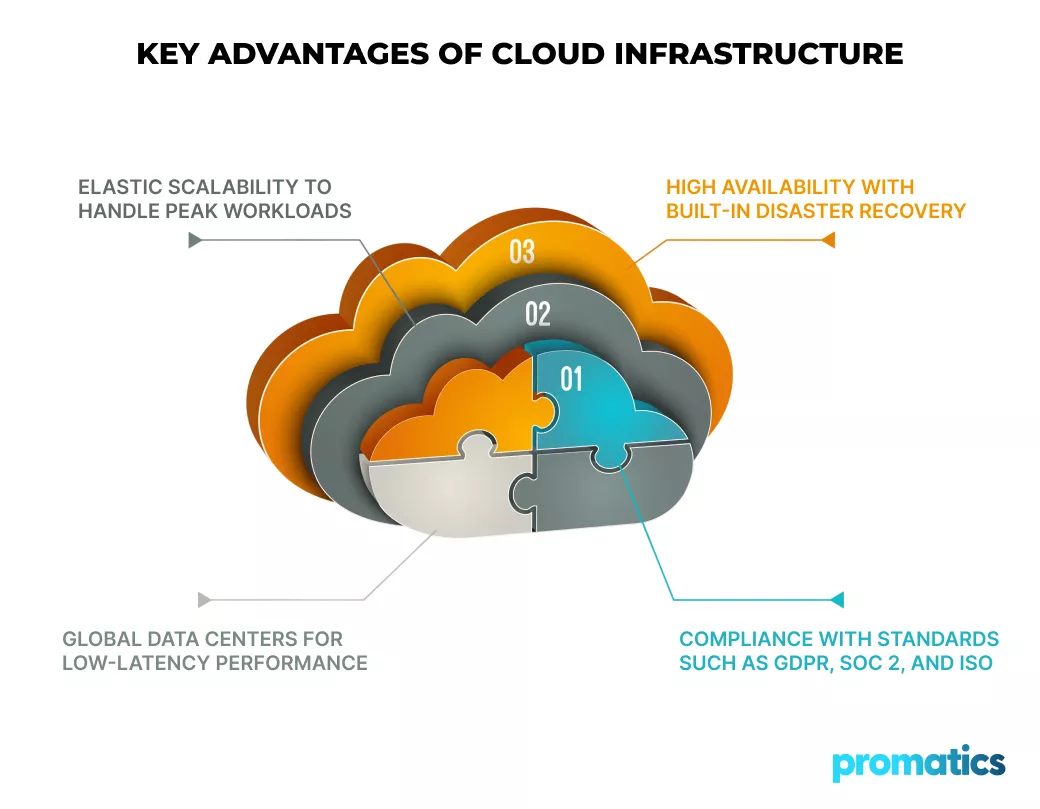
Use case: A Canadian e-commerce platform handled Black Friday traffic smoothly with zero downtime.
You can explore more about cloud-driven solutions on the official Google Cloud solutions page. For businesses planning long-term growth, cloud infrastructure is no longer optional. It is a strategic foundation for digital success.
What Is DevOps and Why It Matters More Than Ever
DevOps keeps the development and operations teams aligned and working towards one goal through automation and continuous process improvement. Thanks to DevOps services, organizations are able to shorten release cycles and do bug fix faster.
DevOps Explained in Simple Terms
DevOps is a combination that connects people, processes, and tools. It also involves automation of tasks that include testing, deployment, and monitoring thereby enabling the teams to dedicate more time to product development.
DevOps teams do not wait for a long time to deliver updates; they deliver incrementally and frequently.
Example: An Australian SaaS startup has successfully transitioned from quarterly releases to weekly deployments. You may check out our case studies to get more info about such success stories.
DevOps Vs. Traditional Development Models
The difference between traditional development and DevOps is clear:
| Traditional Model | DevOps Model |
| Manual deployments | Automated CI/CD pipelines |
| Slow release cycles | Continuous delivery |
| Siloed teams | Cross-functional collaboration |
| Reactive troubleshooting | Proactive monitoring |
DevOps is no longer just a technical trend. It is a business enabler that supports faster innovation.
Key Components of a Modern DevOps Ecosystem
A robust DevOps system is based on the cooperation of many tools and practices. These elements bring uniformity, velocity and dependability.
CI/CD Pipelines
CI/CD pipeline services are automated in terms of building, testing, and deploying code. Manual errors are minimized by such tools as Jenkins, GitHub Actions, and GitLab CI.
Pipelines can be automated to release the development changes of the application fast and this is crucial to a digital company operating in the market.
Infrastructure as Code (IaC)
Infrastructure as code enables the teams to operate code on servers and environments. Terraform and AWS CloudFormation are used to provide consistency.
IaC minimizes configuration error and infrastructure modification becomes repeatable. It also promotes quicker acquisition of new employees.
Containerization and Orchestration
Kubernetes and Docker assist staff in bundling applications in containers. The containers operate in various environments on a regular basis. Organizations often seek to hire dedicated developers to manage these complex orchestrations efficiently.
Cloud and DevOps: Real-World Benefits
With cloud and DevOps collaborating, the businesses experience visible improvements. These advantages transcend beyond IT departments and affect the business performance in general.
The Industries We Serve
Industries that are supported by cloud infrastructure and DevOps include:
- Healthcare (USA): Patient portals that are HIPAA-compliant.
- Banking (UK): Online banking, secure and zero-downtime banking.
- Logistics (Dubai): Fleet monitoring and analytics in real-time.
The above use cases are similar in that they all entail scaling, automation, and security controls.
Business Impact
Organizations adopting cloud migration and DevOps often experience:
- Ready to launch new features in the market at a higher pace.
- Reduced infrastructure and maintenance costs.
- Product reliability has resulted in customer satisfaction and trust.
Challenges and Solutions in Cloud Infrastructure and DevOps
The adoption of cloud and Devops is associated with challenges regardless of the advantages. The awareness of these concerns enables teams to strategize in a better way.
Common Issues
The following are the problems that are often faced by businesses:
- Unexpected cloud spending.
- Misconfiguration security in the cloud.
- Shortage of talented DevOps personnel.
Nevertheless, the solutions to these issues, when introduced at the initial phase of adoption, will not impede the development of business.
Best Practices to Overcome Challenges
Best practices have proved to be:
- Maintaining constant monitoring and reduction of costs.
- Building security by design using DevSecOps.
- Logging and automation of notifications.
Through proper planning, the companies will not make the common mistakes and will receive maximum returns on the investments.
The Future of Cloud Infrastructure and DevOps
Automated processes and smart decisions will greatly define the future of Cloud Infrastructure and DevOps. The manufacturers of the new technological solution will be interested in making things easier and more efficient.
The leading trends are:
- Artificial intelligence infrastructure management.
- Event-driven applications Serverless computing.
- Multi-cloud and hybrid cloud solutions.
The first mover of such changes has a competitive advantage.
How Promatics Supports Cloud Infrastructure and DevOps
Promatics helps businesses successfully adopt Cloud Infrastructure and DevOps through end-to-end consulting and implementation. Our experts design scalable cloud architectures, manage cloud migration, and optimize performance across AWS, Azure, and Google Cloud.
We deliver reliable DevOps services, including CI/CD pipeline automation, infrastructure as code, and containerized deployments using Docker and Kubernetes. This approach improves deployment speed, system stability, and cost efficiency.
From planning to continuous optimization, Promatics ensures secure, agile, and future-ready cloud DevOps solutions aligned with business goals.
Conclusion
Cloud infrastructure and DevOps have become indispensable elements of the development process, resulting in modern, scalable, and dependable digital products. They enable companies to release software rapidly on a global scale whilst keeping operational complexity at bay and ensuring high system availability. Through the adoption of automation, continuous delivery as well as cloud-native practices, enterprises maintain the ability to react promptly to market changes while simultaneously yielding secure and cost-effective systems. With the right strategy and expert guidance, cloud and DevOps initiatives deliver long-term value beyond technology alone. Promatics Technologies supports organizations at every stage of this journey, helping them create resilient, future-ready software infrastructure that drives innovation, growth, and sustained business success.
