Mobile App Development Services: Turning Your AI Product Idea into Reality

TL;DR
- AI-powered mobile apps combine mobile technology with AI, machine learning, generative AI, NLP, and computer vision to create smarter user experiences.
- Mobile app development services help transform an AI idea into a scalable product through strategy, UI/UX, development, AI integration, testing, and deployment.
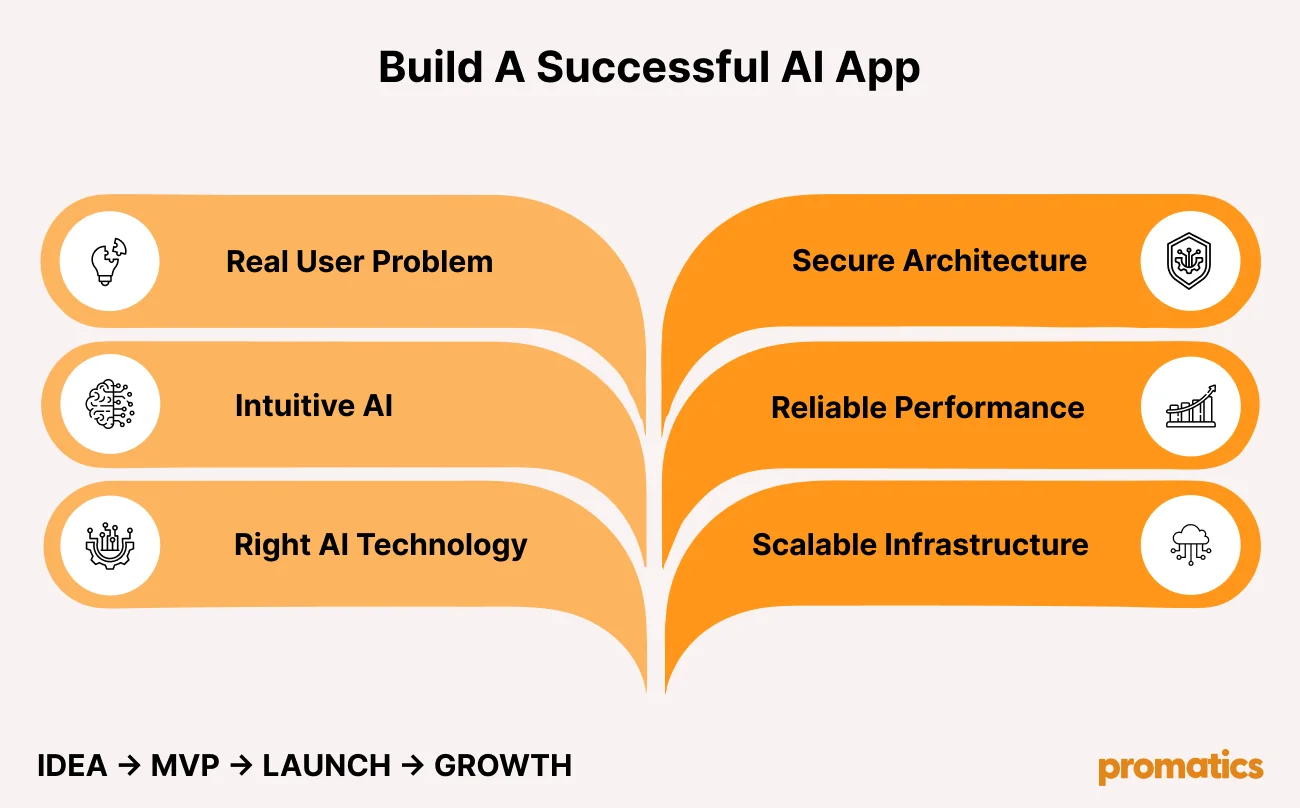
- A successful AI mobile app should solve a real user problem and start with a focused MVP before adding advanced features.
- Choosing the right mobile app development company ensures better technology selection, security, scalability, performance, and long-term support.
- Promatics Technologies helps startups and enterprises turn AI product ideas into secure, scalable, and market-ready mobile applications.
Artificial intelligence is transforming mobile apps from simple digital tools into intelligent, personalized experiences. The global AI software market is projected to exceed $350 billion by 2027, highlighting the growing demand for AI-powered solutions. From chatbots and recommendation engines to voice assistants, predictive analytics, computer vision, and generative AI, businesses are using AI to deliver greater value through mobile applications.
However, turning an AI product idea into a successful mobile app requires more than just an innovative concept. It involves product strategy, UX design, mobile engineering, backend development, AI integration, cloud infrastructure, security, testing, and ongoing optimization.
This is where professional mobile app development services play an important role.
Promatics Technologies combines mobile app development, AI development, UI/UX design, backend engineering, cloud technologies, and product expertise to help businesses transform AI ideas into scalable digital products.
In this guide, we’ll explore how to turn an AI idea into a mobile app, the AI technologies you can integrate, the development process, costs, key challenges, and how to choose the right mobile app development company.
What Are Mobile App Development Services?
Mobile app development services involve the complete process of planning, designing, developing, testing, launching, and maintaining mobile applications for platforms such as iOS and Android.
For an AI-powered product, these services extend beyond traditional application development. The development team must also consider:
- AI and machine learning integration
- Generative AI and LLM integration
- API and third-party AI services
- Data processing and storage
- Cloud infrastructure
- AI model performance
- Security and privacy
- Mobile performance
- Continuous AI monitoring
A modern mobile application development company therefore needs expertise across both mobile engineering and intelligent technologies.
Why Combine AI With Mobile App Development?
Mobile devices are highly personal, constantly connected, and rich in contextual information. AI can use that environment to deliver experiences that are more relevant and responsive.
A traditional application might display the same information to every user. An AI-powered mobile application can analyze user behavior and context to personalize what users see and how they interact with the application.
For example:
- An eCommerce app can recommend products based on customer behavior.
- A healthcare app can provide personalized insights.
- A fintech app can identify potentially suspicious transactions.
- An education app can personalize learning paths.
- A productivity app can summarize documents and automate repetitive tasks.
- A travel app can create personalized recommendations and itineraries.
AI technologies such as machine learning, natural language processing, computer vision, predictive analytics, and generative AI are expanding the capabilities of modern mobile applications.
The objective, however, should not be to add AI simply because it is trending. The technology should solve a specific user or business problem.
What Can AI Do Inside a Mobile Application?
There are many ways businesses can incorporate AI into mobile applications.
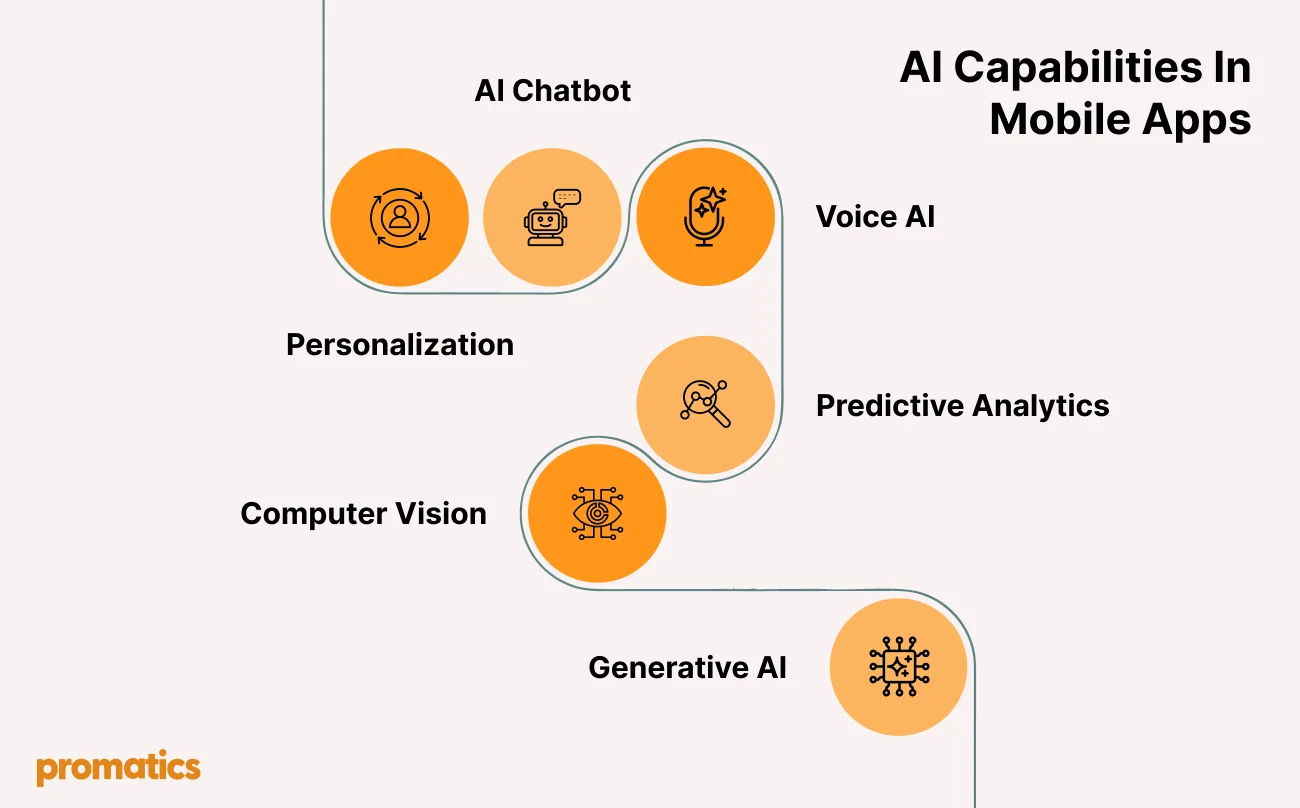
1. AI-Powered Personalization
AI can analyze user behavior, preferences, interactions, and historical data to create personalized experiences.
Applications can provide:
- Personalized content
- Product recommendations
- Customized offers
- Individualized learning experiences
- Personalized notifications
- Behavior-based suggestions
This makes the application more relevant to each individual user.
2. AI Chatbots and Virtual Assistants
AI chatbot development can transform customer support and in-app assistance. Users can communicate with an application through natural language instead of navigating complex menus.
AI assistants can help with:
- Customer support
- Product discovery
- Information retrieval
- Appointment scheduling
- Content generation
- Task automation
- Frequently asked questions
With generative AI and large language models, mobile assistants can become more conversational and context-aware.
3. Voice Recognition
Voice-enabled applications allow users to interact with mobile products using spoken commands.
Examples include:
- Voice search
- Voice-based navigation
- Dictation
- Voice-controlled workflows
- Conversational assistants
Voice interaction can also improve accessibility for users who find traditional interfaces difficult to navigate.
4. Predictive Analytics
Machine learning development can help mobile applications analyze historical and real-time information to identify patterns and predict outcomes.
Businesses can use predictive capabilities for:
- Customer churn prediction
- Fraud detection
- Demand forecasting
- Recommendation systems
- Risk analysis
- Inventory planning
5. Computer Vision
Mobile cameras provide a powerful interface for AI-powered visual experiences.
Computer vision development can support:
- Image recognition
- Object detection
- Facial recognition
- Document scanning
- Visual search
- Image classification
For example, an eCommerce application could allow customers to upload an image and find visually similar products.
6. Generative AI
Generative AI mobile app development is creating new opportunities for businesses to build intelligent assistants and content-driven experiences.
Generative AI can be used for:
- Text generation
- Content summarization
- Document analysis
- Image generation
- Conversational assistance
- Personalized responses
- Knowledge assistants
- Workflow automation
The most effective applications integrate generative AI into meaningful user journeys instead of treating it as an isolated chatbot.
How to Turn an AI Idea Into a Mobile App
Turning an AI concept into a successful application requires a structured approach.
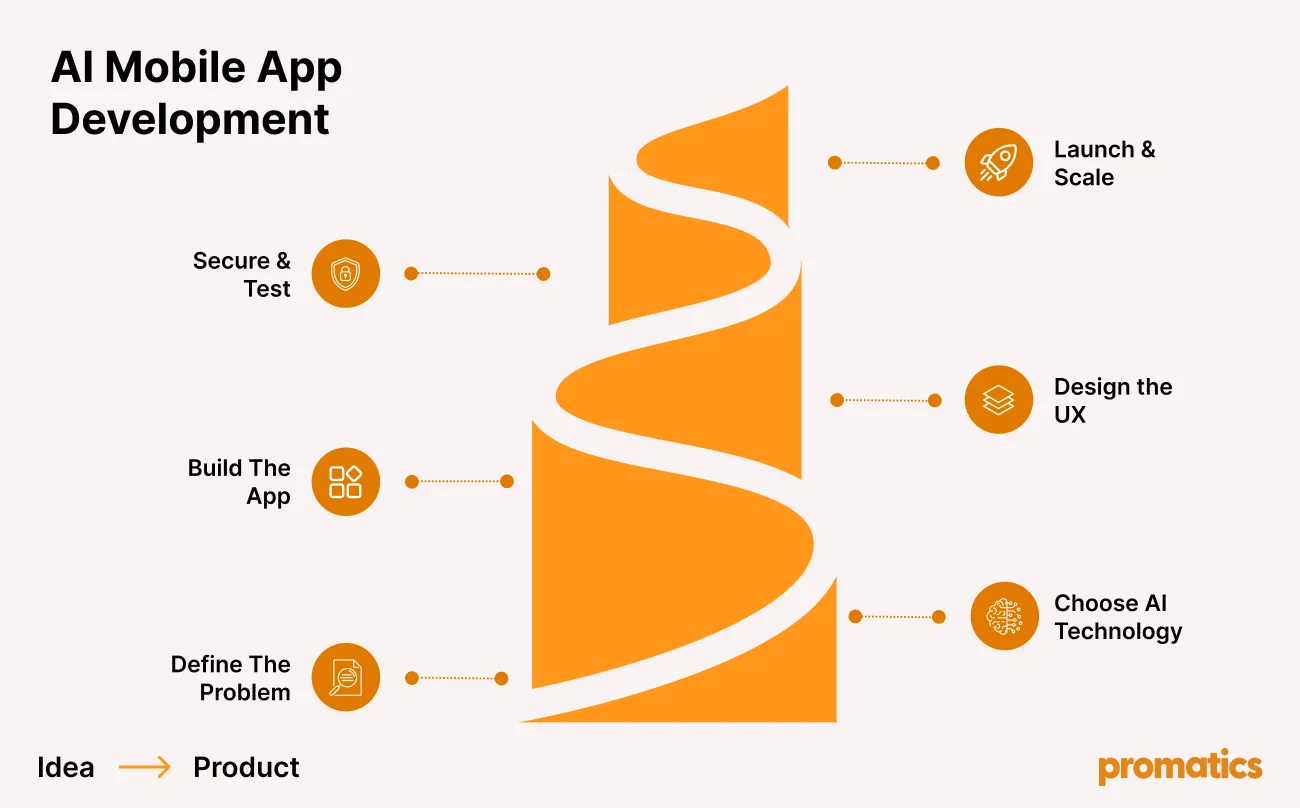
Step 1: Define the Problem
Start with the problem, not the technology.
Before beginning AI mobile app development, answer:
- Who is the target user?
- What problem does the application solve?
- How is the problem currently being solved?
- Why is AI necessary?
- What makes the proposed product different?
- What business outcome should the application achieve?
A clear problem statement creates a strong foundation for product development.
Step 2: Validate the AI Product Idea
Not every AI idea needs a custom AI model.
A feasibility assessment can determine whether the product should use:
- Existing AI APIs
- Open-source models
- Pre-trained models
- Custom machine learning models
- Large language models
- Retrieval-augmented generation (RAG)
- AI agents
- Hybrid AI architecture
Market research, competitor analysis, user research, and technical validation can help determine whether the proposed solution has genuine commercial potential.
Step 3: Define the MVP
A common mistake is trying to build every feature in the first version.
Instead, businesses should identify the minimum viable product (MVP).
An AI mobile app MVP should generally focus on:
- The primary user problem
- The core user journey
- One or more high-value AI capabilities
- Essential mobile features
- Secure backend infrastructure
- Analytics and monitoring
Launching a focused MVP allows businesses to collect real-world feedback before expanding the product.
Step 4: Choose the Right Mobile Development Technology
Technology selection affects performance, scalability, development speed, and maintenance.
- Native Mobile Development
Native iOS and Android development can provide strong platform-specific performance and access to native capabilities.
For iOS, businesses can use technologies such as Swift and SwiftUI. Android applications can be developed using Kotlin and modern Android technologies.
- Cross-Platform Development
Frameworks such as Flutter and React Native can help businesses develop applications for multiple platforms using a shared codebase.
Cross-platform mobile app development may be suitable when businesses want:
- Faster time to market
- Efficient development
- iOS and Android support
- Shared application logic
- Optimized development resources
The best approach depends on the product requirements, performance expectations, budget, target users, and long-term roadmap.
Step 5: Design the AI User Experience
AI functionality should make the application easier not more complicated.
A strong mobile app UI/UX design strategy should make AI interactions intuitive.
For example, instead of requiring users to complete several steps to perform a task, an AI assistant could allow them to describe the desired outcome naturally.
Effective AI UX should include:
- Simple navigation
- Clear user journeys
- Conversational interactions where appropriate
- Transparent AI behavior
- Clear feedback
- Error handling
- Human control over important decisions
Users should also understand when they are interacting with AI and when an action or recommendation has been generated by an intelligent system.
Step 6: Develop the Mobile Application
The mobile interface is only one part of an AI application.
A typical architecture may look like:
Mobile Application → API Layer → Backend → AI Services/Models → Database/Cloud Infrastructure
The development process may include:
- Mobile frontend development
- Backend development
- API development
- Database integration
- Authentication
- Cloud infrastructure
- AI integration
- Third-party integrations
- Analytics
- Security
This is why custom mobile app development for AI products requires collaboration between mobile developers, backend engineers, AI specialists, designers, and QA professionals.
Step 7: Integrate AI Models and APIs
Businesses can choose between several approaches to AI integration services.
- Pre-Trained AI Models
Suitable when businesses need established capabilities without building a model from scratch.
- Third-Party AI APIs
Useful for quickly integrating capabilities such as:
- Natural language processing
- Speech recognition
- Image analysis
- Generative AI
- Translation
- Custom AI Models
Custom AI software development may be appropriate when businesses have specialized datasets or unique requirements that cannot be addressed effectively by existing models.
- Retrieval-Augmented Generation
RAG can connect generative AI with a business’s trusted knowledge sources, allowing applications to retrieve relevant information before generating responses.
- AI Agents
AI agents can be designed to perform multi-step tasks rather than simply respond to user questions.
The appropriate approach depends on the application’s objectives, data, performance requirements, privacy considerations, and budget.
Step 8: Test the AI-Powered Mobile Application
Testing an AI application requires more than conventional mobile testing.
A comprehensive mobile app testing service may cover:
- Functional Testing
Ensures application features work as expected.
- UI/UX Testing
Checks usability and consistency across devices.
- Performance Testing
Measures loading times, responsiveness, memory usage, and overall performance.
- Security Testing
Identifies vulnerabilities related to authentication, APIs, data, and infrastructure.
- AI Testing
Evaluates AI output quality, accuracy, reliability, and consistency.
- Device Testing
Ensures the application works across different screen sizes, operating systems, and hardware configurations.
Testing should continue after launch because AI systems can change as models, data, APIs, and user behavior evolve.
On-Device AI vs. Cloud AI: Which Should You Choose?
One of the key architectural decisions in AI mobile application development is deciding where AI processing should occur.
On-Device AI
AI processing takes place directly on the user’s device.
Potential benefits include:
- Faster responses
- Reduced network dependency
- Offline functionality
- Improved privacy for suitable use cases
Cloud-Based AI
AI processing takes place on cloud infrastructure.
Advantages may include:
- Access to larger models
- Greater computational resources
- Centralized model management
- Easier model updates
- Scalability
Hybrid AI
Many applications can combine both approaches.
For example, lightweight tasks can be handled on-device while computationally intensive AI operations are processed in the cloud.
The right architecture depends on latency, privacy, connectivity, model complexity, cost, and scalability.
Mobile App Development Services for Startups and Enterprises
Startups and enterprises often have different priorities, but both can benefit from professional mobile application development services.
For Startups
Startups typically prioritize:
- MVP development
- Fast validation
- Time to market
- Cost optimization
- Product-market fit
- Scalable architecture
A focused MVP can help startups validate their AI product before making significant investments.
For Enterprises
Enterprises may prioritize:
- Security
- Scalability
- Existing system integration
- Data governance
- Workflow automation
- Enterprise mobility
- Performance
- Long-term support
An experienced enterprise mobile app development company can help integrate AI capabilities into existing business ecosystems.
Industries Benefiting From AI Mobile App Development
AI-powered mobile applications can create opportunities across industries.
Healthcare
Potential applications include:
- Patient engagement
- Health monitoring
- Intelligent assistants
- Document analysis
- Personalized wellness experiences
Fintech
AI can support:
- Fraud detection
- Risk analysis
- Financial insights
- Customer support
- Personalized financial experiences
eCommerce
AI can improve:
- Product recommendations
- Personalized shopping
- Visual search
- Intelligent customer support
- Product discovery
Education
AI-powered education apps can offer:
- Personalized learning
- AI tutors
- Automated assessments
- Learning recommendations
- Interactive assistance
Real Estate
AI can support:
- Property recommendations
- Intelligent search
- Lead qualification
- Virtual assistants
- Market analysis
Logistics
AI-powered mobile solutions can assist with:
- Route optimization
- Demand forecasting
- Delivery tracking
- Fleet management
- Operational insights
Benefits of AI-Powered Mobile Applications
When strategically implemented, AI can provide significant benefits.
Personalized User Experiences
AI can adapt application experiences to individual users.
Increased Automation
Repetitive tasks can be automated, improving productivity.
Better Customer Support
AI assistants can handle routine questions and provide instant assistance.
Data-Driven Decisions
AI can analyze large datasets and identify meaningful patterns.
Improved Engagement
Relevant recommendations and contextual interactions can increase user engagement.
New Revenue Opportunities
AI can enable premium features, intelligent recommendations, subscriptions, and new digital services.
Competitive Advantage
A well-designed AI-powered mobile application can differentiate a business in a crowded market.
What Are the Challenges of AI Mobile App Development?
While the opportunities are significant, businesses should understand the challenges.
Data Quality
AI performance depends heavily on the quality, relevance, and availability of data.
Privacy and Security
Applications processing sensitive information require appropriate security controls and privacy practices.
AI Accuracy
AI-generated responses and predictions can be incorrect. Applications should include validation, monitoring, and appropriate fallback mechanisms.
Mobile Performance
Large AI models and intensive processing can affect response times, memory consumption, and battery usage.
Integration Complexity
Connecting AI models with mobile applications, backend systems, databases, and third-party services requires careful architecture.
Ongoing AI Costs
Businesses may need to account for API usage, model hosting, cloud infrastructure, data processing, monitoring, and maintenance.
Model Maintenance
AI applications require continuous evaluation and optimization to maintain performance as user behavior and data change.
How Much Does It Cost to Build an AI Mobile App?
The cost of AI mobile app development varies significantly depending on the product.
Factors include:
- Application complexity
- Number of platforms
- UI/UX requirements
- AI functionality
- Custom AI model requirements
- Third-party AI APIs
- Backend architecture
- Cloud infrastructure
- Data requirements
- Security requirements
- Integrations
- Testing
- Maintenance
A simple AI application using an existing API may require considerably less investment than an enterprise-grade application involving custom models, complex workflows, real-time processing, and extensive integrations.
Therefore, businesses should evaluate not only initial development cost but also:
Development Cost + AI Infrastructure + Maintenance + Scaling = Total Cost of Ownership
The goal should be to maximize product value and ROI rather than simply minimizing the initial development budget.
How to Choose the Right Mobile App Development Company
Choosing the right mobile app development company can have a direct impact on product quality, scalability, and time to market.
Consider the following factors:
Mobile Development Expertise
Review experience with iOS, Android, cross-platform, and enterprise applications.
AI Expertise
Look for capabilities in:
- Machine learning
- Generative AI
- LLM integration
- Computer vision
- NLP
- Predictive analytics
- AI agents
Product Development Experience
A strong development partner should understand product strategy—not just programming.
UI/UX Capabilities
AI products require thoughtful user experiences that make complex technology easy to use.
Security Expertise
Security should be considered from architecture through deployment and maintenance.
Scalability
The architecture should be capable of supporting increasing users, data, integrations, and AI workloads.
Post-Launch Support
A mobile application requires ongoing maintenance, optimization, monitoring, and feature development.
Why Choose Promatics Technologies for AI Mobile App Development?
Turning an AI idea into a successful mobile application requires a multidisciplinary development team.
Promatics Technologies brings together capabilities across mobile app development, AI, UI/UX, backend engineering, cloud technologies, and custom software development.
Our approach can support businesses across different stages of product development—from early discovery and MVP development to enterprise application development and ongoing product enhancement.
Our capabilities include:
- AI Development Services
- Mobile App Development
- Custom Software Development
- UI/UX Design
- Machine Learning Development
- Generative AI Development
- Web Application Development
- Cloud Application Development
- API Development and Integration
- Quality Assurance and Testing
- Product Development and Support
Instead of treating AI as an isolated feature, the objective is to integrate intelligence into the broader product experience.
For businesses with an AI product concept, this means having a technology partner that can help evaluate the idea, define the MVP, select the right architecture, build the application, integrate AI, test the product, and prepare it for future growth.
The Future of AI in Mobile App Development
The future of AI mobile app development is moving beyond simple chatbots and recommendation engines.
Several developments are likely to shape the next generation of mobile applications.
Generative AI
Generative AI will increasingly become part of everyday mobile workflows, from content creation to intelligent assistance.
AI Agents
AI agents can move applications from answering questions toward performing tasks.
On-Device Intelligence
Advances in mobile hardware and optimized models can enable more AI processing directly on smartphones.
Multimodal AI
Applications can increasingly understand combinations of:
- Text
- Voice
- Images
- Video
- Context
Hyper-Personalization
AI can dynamically adapt content, recommendations, interfaces, and workflows to individual users.
Predictive Experiences
Instead of waiting for users to initiate every action, future applications can anticipate needs and proactively provide assistance.
The mobile app is gradually becoming more than an interface. It is becoming an intelligent layer between users, data, services, and businesses.
Turn Your AI Product Idea Into a Mobile Reality
An AI idea can become a powerful business opportunity but only when technology is connected to a genuine user need.
Successful AI-powered mobile applications combine intelligent technology with intuitive UX, reliable engineering, secure architecture, and a clear product strategy.
Whether you’re a startup validating a new AI product or an enterprise looking to introduce intelligent capabilities into an existing mobile ecosystem, the right mobile app development services can help transform your concept into a scalable digital product.
Promatics Technologies can help you move from idea to MVP, from MVP to launch, and from launch to long-term product growth. Have an AI mobile app idea? Let’s build it together.