Data Modeling for AI: Techniques, Challenges, Statistics and Best Practices

TL;DR
- Data modeling for AI structures business information for machine learning, generative AI, analytics, and AI agents.
- AI-ready data requires structure, context, relationships, accessibility, and governance.
- Key data modeling techniques for AI include relational, dimensional, feature-based, time-series, graph, vector, and hybrid modeling.
- Only a small percentage of organizations currently have data foundations ready to scale advanced AI.
- The right AI data architecture depends on the use case, data type, security requirements, and scalability needs.
What Is Data Modeling for AI?
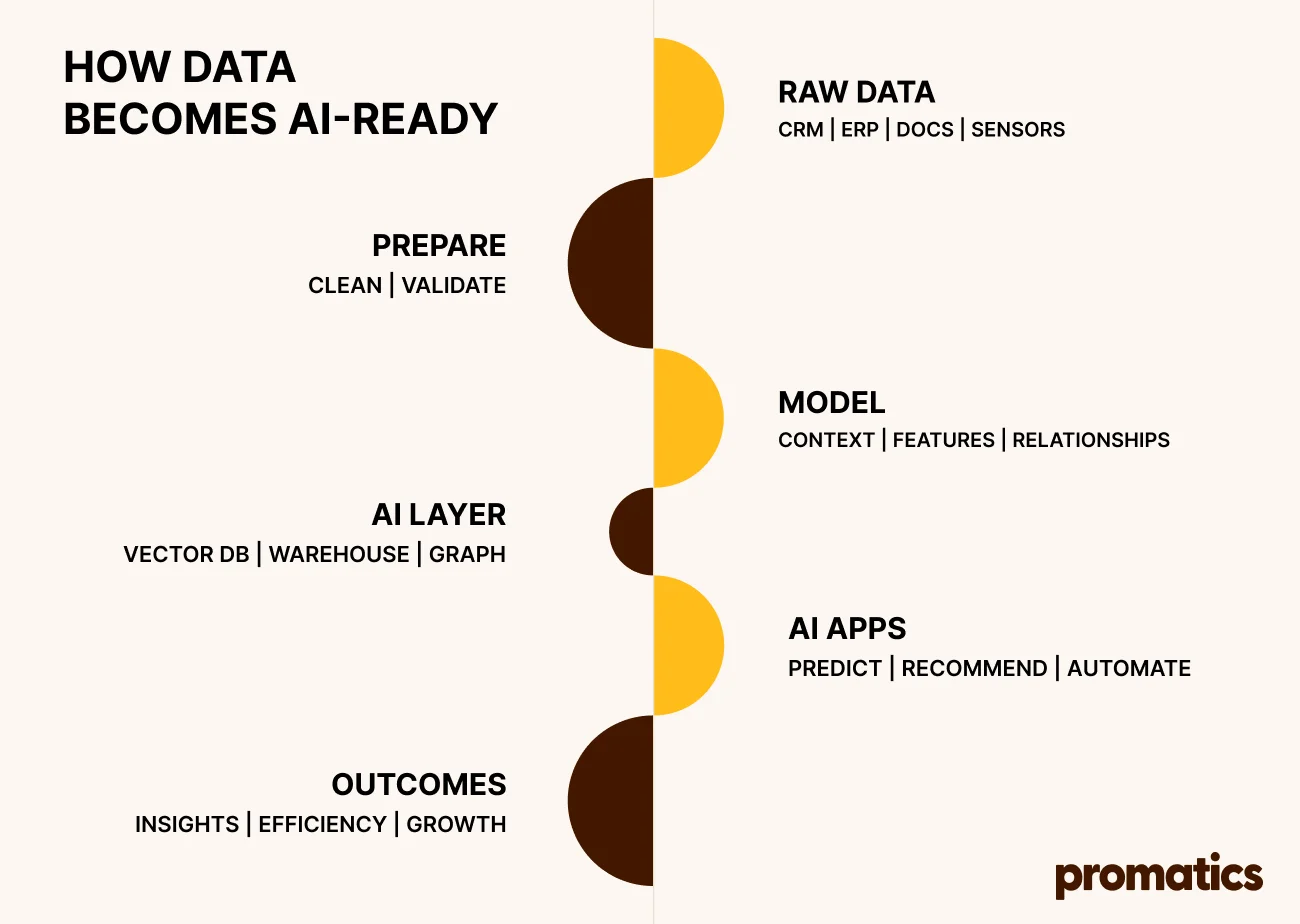
Data modeling for AI is the process of structuring, connecting, transforming, and managing data so it can effectively support artificial intelligence and machine learning applications.
Traditional data modeling focuses on tables, relationships, transactions, and application requirements. AI data modeling adds considerations such as features, metadata, embeddings, unstructured information, data lineage, retrieval, and model requirements.
For example, an eCommerce application may already store customers, products, orders, and payments. An AI recommendation engine may additionally require browsing behavior, product interactions, purchase frequency, preferences, and session context.
The data model must therefore connect traditional business information with the data required by the AI system.
For businesses investing in AI development services, data modeling should be treated as part of the AI architecture rather than a separate database exercise.
Why Is Data Modeling Important for AI?
AI models depend on the quality and structure of the information they receive.
Poorly modeled data can result in:
- Inaccurate predictions
- Weak recommendations
- Irrelevant AI responses
- Poor retrieval
- Data leakage
- Slow processing
- Higher infrastructure costs
A strong data foundation makes AI applications easier to build, test, deploy, and maintain.
Accenture’s 2026 research found that only 7% of surveyed organizations had reached the level of data readiness required to scale advanced AI, highlighting the gap between AI ambitions and enterprise data foundations.
For organizations developing AI software, data architecture needs to evolve alongside the AI application.
Key Data Modeling Techniques for AI
There is no single data model for every AI application. The right approach depends on the data and business problem.
1. Relational Data Modeling
Relational modeling organizes information into structured tables connected through defined relationships.
It remains important for AI applications using:
- Customer records
- Orders
- Products
- Payments
- Employees
- Transactions
For example, a fraud detection system may combine transaction, account, customer, and merchant data stored in relational databases.
2. Dimensional Data Modeling
Dimensional modeling organizes information around facts and dimensions.
A retail system could have:
Facts: Sales, revenue, orders
Dimensions: Customer, product, location, date
This structure supports analytics and AI applications involving forecasting, customer analysis, and business intelligence.
3. Feature-Based Data Modeling
Machine learning models often need engineered features instead of raw business data.
For example:
Raw data: Customer transactions
Features:
- Purchase frequency
- Average order value
- Days since last purchase
- Monthly spending
- Products purchased
These features can support churn prediction, fraud detection, lead scoring, and recommendation systems.
4. Time-Series Data Modeling
Time-series modeling is useful when the sequence and timing of information matter.
Common applications include:
- Demand forecasting
- Predictive maintenance
- IoT analytics
- Energy monitoring
- Sales forecasting
Historical patterns can then be used to identify trends, anomalies, or future outcomes.
5. Graph Data Modeling
Graph modeling represents information through entities and relationships.
For example:
Customer → Purchased → Product
Product → Belongs To → Category
Customer → Reviewed → Product
Graph-based AI data architecture is useful for recommendation engines, fraud detection, knowledge graphs, supply chain analysis, and relationship-based AI.
6. Vector Data Modeling
Generative AI applications often need to understand the semantic meaning of content.
Vector embeddings represent information such as text or images numerically, allowing systems to identify semantically similar information.
A typical flow is:
Document → Chunk → Embedding → Vector Database → Retrieval → AI Model
Vector modeling is particularly useful for:
- RAG applications
- Semantic search
- Enterprise knowledge assistants
- AI copilots
- Document intelligence
Businesses developing AI copilot solutions can combine vector databases with LLMs, enterprise data, APIs, and business workflows.
7. Hybrid Data Modeling
Modern AI applications often combine multiple approaches.
For example:
Relational database → Transactions
Data warehouse → Analytics
Vector database → Semantic knowledge
Knowledge graph → Relationships
Object storage → Documents and media
This hybrid approach can provide AI systems with both structured information and contextual knowledge.
Choosing the Right Data Model for Your AI Application
| AI Requirement | Data Model |
| Transactions | Relational |
| Analytics | Dimensional |
| Predictive ML | Feature-based |
| Forecasting | Time-series |
| Relationships | Graph |
| Semantic Search | Vector |
| Enterprise Knowledge | Hybrid |
How to Build an AI-Ready Data Model
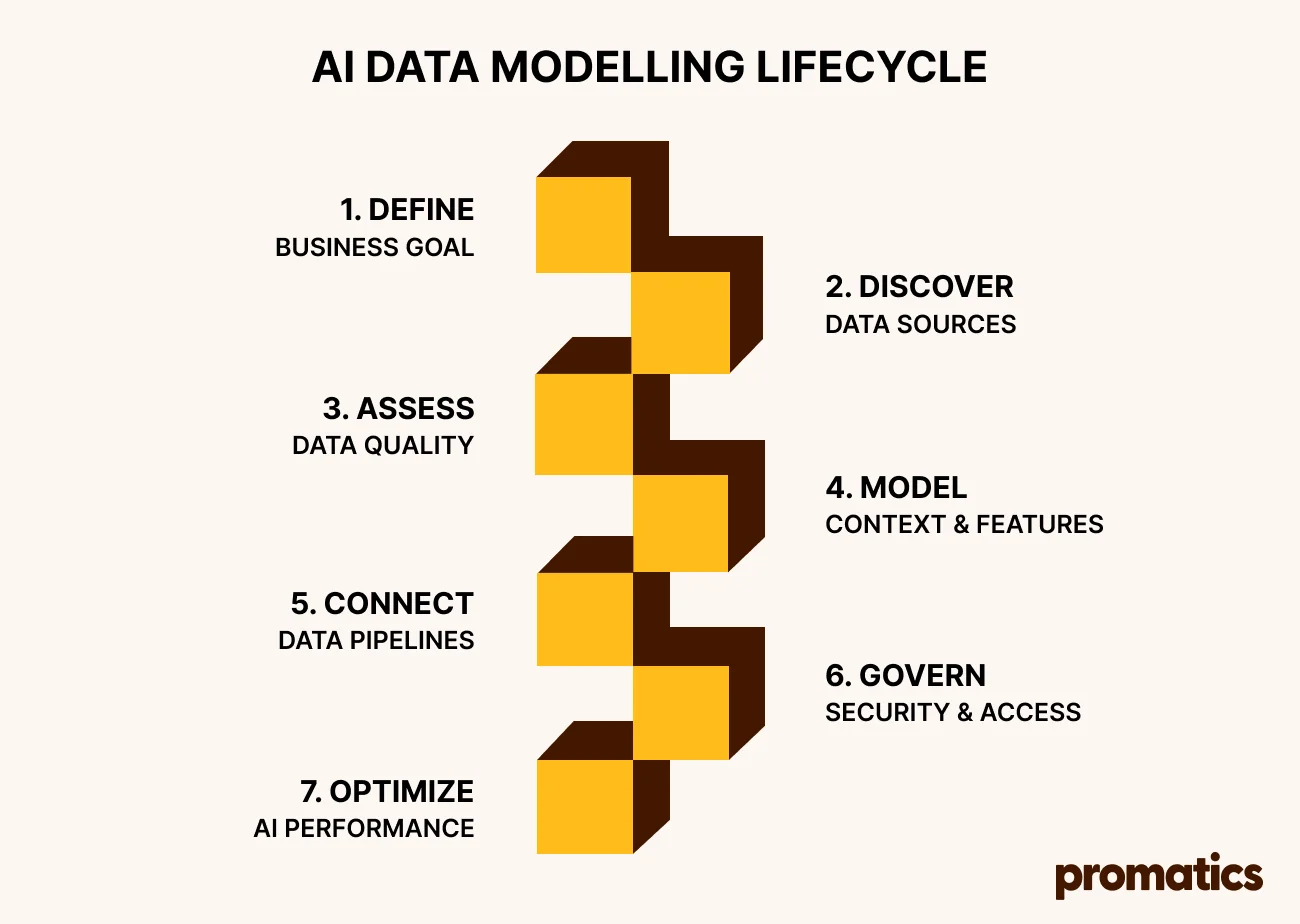
1. Define the AI Use Case
Start with the business objective.
Examples include:
- Predicting customer churn
- Detecting fraud
- Recommending products
- Automating documents
- Building an AI assistant
- Forecasting demand
- Automating workflows
The use case determines the data the AI system needs.
2. Map Data Sources
Identify where information exists:
- CRM
- ERP
- SaaS platforms
- Databases
- APIs
- Documents
- Mobile applications
- IoT devices
- Data warehouses
This process often reveals data silos and duplication.
3. Assess Data Quality
Evaluate:
- Accuracy
- Completeness
- Consistency
- Freshness
- Missing values
- Duplicates
An advanced AI model cannot compensate for fundamentally unreliable data.
4. Establish Context and Relationships
AI systems often need to understand how information connects.
For example:
Customer → Order → Product → Category → Campaign
Relationships provide context that isolated data cannot.
5. Build the AI Data Pipeline
A typical AI data pipeline looks like:
Source → Ingestion → Cleaning → Transformation → Storage → AI Data Layer → Model
Real-time applications may require streaming, while other use cases can use batch processing.
6. Add Governance
Define:
- Data ownership
- Access controls
- Metadata
- Data lineage
- Privacy requirements
- Retention policies
- Audit requirements
This becomes especially important when AI systems process sensitive business information.
7. Validate With Realistic Data
Test AI systems using representative data and evaluate:
- Accuracy
- Retrieval relevance
- Edge cases
- Missing information
- Latency
- Security
- Failure scenarios
Data Modeling for Generative AI and RAG
Generative AI introduces additional requirements for unstructured information.
A traditional document record may contain:
Document ID | Title | Author | Date | Content
A RAG system may additionally require:
Document → Section → Chunk → Embedding → Metadata
Metadata can include:
- Document type
- Department
- Author
- Date
- Access level
- Product
- Version
This information helps retrieval systems identify appropriate context before passing it to the language model.
Therefore, RAG performance depends not only on the LLM but also on how knowledge is prepared, modeled, indexed, retrieved, and maintained.
Data Modeling for AI Agents
AI agents introduce another challenge because they may need both information and controlled access to business actions.
An agent could interact with:
- CRM data
- Customer records
- Product catalogs
- Orders
- Internal documents
- Business APIs
- Workflow systems
A typical workflow could be:
User Request → Retrieve Data → Apply Rules → Call API → Verify → Execute
This requires reliable relationships, permissions, APIs, logging, and governance.
Businesses exploring autonomous workflows can learn more about AI agent development services and how intelligent agents can be integrated into enterprise applications.
Common AI Data Modeling Challenges
Data Silos
Information often exists across disconnected applications, making integration difficult.
Unstructured Data
Important knowledge may exist in PDFs, emails, presentations, images, and other formats that require additional processing.
Data Quality
Missing, inconsistent, outdated, or duplicated information can reduce AI reliability.
Security and Governance
AI applications may process sensitive information, requiring authentication, authorization, encryption, monitoring, and governance.
Scalability
A data architecture that works for a prototype may struggle as data volumes, users, and integrations increase.
Data Drift
Business behavior changes over time. AI pipelines therefore need continuous monitoring and updates.
Best Practices for AI Data Modeling
Start With the Business Problem
Define the outcome before choosing a database or AI technology.
Design for Context
Include relationships, metadata, timestamps, and business context.
Keep the Architecture Modular
Separate data, models, application logic, and integration layers where practical.
Build for Observability
Monitor data quality, pipeline failures, retrieval performance, and AI outputs.
Protect Sensitive Data
Use authentication, authorization, encryption, data minimization, and auditing.
Plan for Scale
Consider future data volumes, users, integrations, and AI requirements.
How Promatics Technologies Can Help
Building an AI-ready data foundation often requires more than database expertise. Businesses need AI engineering, application development, APIs, cloud infrastructure, security, and DevOps working together.
Promatics Technologies combines AI development with full-stack software engineering to help businesses build and integrate intelligent digital products.
Its capabilities include:
- AI and machine learning development
- Generative AI
- AI agents
- AI copilots
- Predictive analytics
- Intelligent automation
- NLP
- Computer vision
- Enterprise AI integration
Promatics supports the broader AI lifecycle, from strategy and proof of concept to development, API integration, cloud deployment, security, testing, and optimization.
Businesses can also explore AI software development services for applications involving predictive analytics, generative AI, RAG, AI agents, intelligent search, and workflow automation.
Final Takeaway
Data modeling for AI is becoming a core component of successful AI development.
The objective is no longer simply to store business information. AI applications need data that is structured, connected, contextual, accessible, secure, and continuously maintained.
Relational and dimensional models remain valuable for structured business data, while feature stores, graph models, vector databases, knowledge graphs, and hybrid architectures support more advanced AI requirements.
A practical AI data journey looks like:
Business Problem → Data Assessment → Data Model → AI Architecture → Integration → Testing → Deployment → Optimization
For businesses moving AI into production, designing the right data foundation alongside the AI architecture can make the difference between an experimental system and a scalable business solution.
If you are planning an AI initiative and need help designing the underlying data or application architecture, connect with Promatics Technologies to discuss your requirements.
