AI Software Development Guide: Process, Cost, Use Cases & Solutions

TL;DR
- AI software development automates tasks, predictions, and personalization.
- Key use cases include support, analytics, search, GenAI, and automation.
- Choose the right AI based on your goals and data.
- Successful projects follow strategy → PoC → development → optimization.
- The right AI partner turns ideas into scalable solutions.
AI software development is the process of building software applications that use artificial intelligence to automate tasks, analyze data, generate content, make predictions, understand information, personalize experiences, or support business decisions.
For businesses, AI software development can range from integrating an AI API into an existing application to building custom machine learning models, generative AI applications, RAG-based knowledge assistants, computer vision systems, or AI agents.
The right approach depends on the business problem, available data, technology requirements, security needs, scalability, and expected return on investment.
This blog explains the most common AI software development use cases, the technologies businesses can choose from, how AI applications are developed, what affects AI development costs, and how to move from an AI idea or proof of concept to a production-ready application.
Quick Answer: What Is AI Software Development?
AI software development is the process of building applications that use artificial intelligence to understand information, generate content, make predictions, personalize experiences, and automate tasks.
Common business applications include:
- Customer support
- Predictive analytics
- Recommendation engines
- Fraud detection
- Intelligent search
- Document processing
- Generative AI
- AI-powered SaaS
- Computer vision
- NLP
- Workflow automation
- AI agents
The right solution depends on the business goal, data, architecture, security, scalability, and ROI.
For businesses seeking an AI development company in India, Promatics Technologies provides AI/ML services across AI consulting, machine learning, generative AI, computer vision, NLP, speech AI, and automation.
Why Is AI Software Development Important for Businesses?
AI is changing both the software businesses build and the way software development teams work.
At the engineering level, AI-assisted development can help teams generate code, analyze requirements, create tests, review code, document applications, and investigate technical issues.
At the product level, AI can automate repetitive processes, improve customer experiences, personalize interactions, and turn large volumes of data into actionable insights.
However, successful AI implementation is about more than adopting the newest model or technology.
The strongest AI projects usually begin with a clearly defined business problem and a measurable outcome.
For example:
- Business problem: Customer support teams spend significant time answering repetitive questions.
- AI solution: An AI assistant connected to approved company knowledge and support information.
- Expected business outcome: Faster responses, reduced repetitive work, and a better customer experience.
This business-first approach helps organizations avoid implementing AI simply because it is trending and instead focus on solutions that can create measurable value.
What Are the Most Common AI Software Development Use Cases?
AI can be integrated into software products in many different ways. The right use case depends on the company’s processes, data, users, and business objectives.
1. AI-Powered Customer Support
AI can automate and assist with customer service by answering common questions, summarizing conversations, classifying support requests, recommending responses, and routing complex issues to human agents.
An AI assistant can also connect with CRM systems, helpdesk platforms, knowledge bases, and internal business systems to provide more contextual responses.
Common applications include:
- Customer support chatbots
- AI-powered helpdesks
- Ticket classification
- Conversation summarization
- Agent assistance
- Automated response generation
- Customer intent detection
The goal should not necessarily be to remove human support. In many cases, AI works best by handling repetitive requests while allowing human agents to focus on complex customer issues.
2. Predictive Analytics
Machine learning can analyze historical data to identify patterns and predict future outcomes.
Common business applications include:
- Customer churn prediction
- Demand forecasting
- Sales forecasting
- Risk assessment
- Fraud detection
- Inventory prediction
- Lead scoring
Predictive analytics is particularly valuable for businesses that already have sufficient historical and structured data.
3. Recommendation Engines
Recommendation systems analyze user behavior, preferences, interactions, and other signals to suggest relevant products, content, services, or actions.
E-commerce platforms, marketplaces, media applications, and SaaS products can use recommendation engines to create more personalized user experiences.
Examples include:
- Product recommendations
- Content recommendations
- Personalized offers
- Similar-product suggestions
- Personalized search results
- Next-best-action recommendations
4. Intelligent Search
Traditional keyword-based search can struggle when users ask questions using natural language or when relevant information is stored across large document collections.
AI-powered search can understand user intent, context, semantic relationships, and natural-language queries to deliver more relevant results.
It is particularly useful for:
- Enterprise knowledge bases
- E-commerce catalogs
- SaaS platforms
- Document repositories
- Customer portals
- Internal company information
For organizations with large amounts of unstructured information, intelligent search can make it easier for employees and customers to find the information they need.
5. Document Intelligence
AI can extract, classify, summarize, and analyze information from large volumes of documents.
Businesses can use document intelligence for:
- Invoices
- Contracts
- Reports
- Forms
- Insurance documents
- Applications
- Compliance documents
Instead of manually reviewing every document, organizations can use AI to identify important information and route documents or extracted data into existing business workflows.
6. Generative AI Applications
Generative AI can create text, summaries, code, images, conversational responses, and other types of content.
Businesses are using generative AI for:
- AI assistants
- Content generation
- Document summarization
- Knowledge management
- Personalized communication
- Software development
- Customer service
Organizations considering this approach can also explore the Promatics guide to generative AI app development for additional context.
7. AI Agents and Workflow Automation
AI agents can go beyond generating a response. They can retrieve information, use tools, interact with software systems, make decisions within defined workflows, and complete multiple steps.
For example, an enterprise AI agent could:
- Receive a service request.
- Understand the user’s requirement.
- Retrieve customer information.
- Check business rules.
- Update a CRM.
- Prepare a response.
- Escalate the request when human approval is required.
This makes AI agents particularly relevant for enterprise workflow automation.
Businesses exploring this approach can also learn more about AI agent development for enterprise automation.
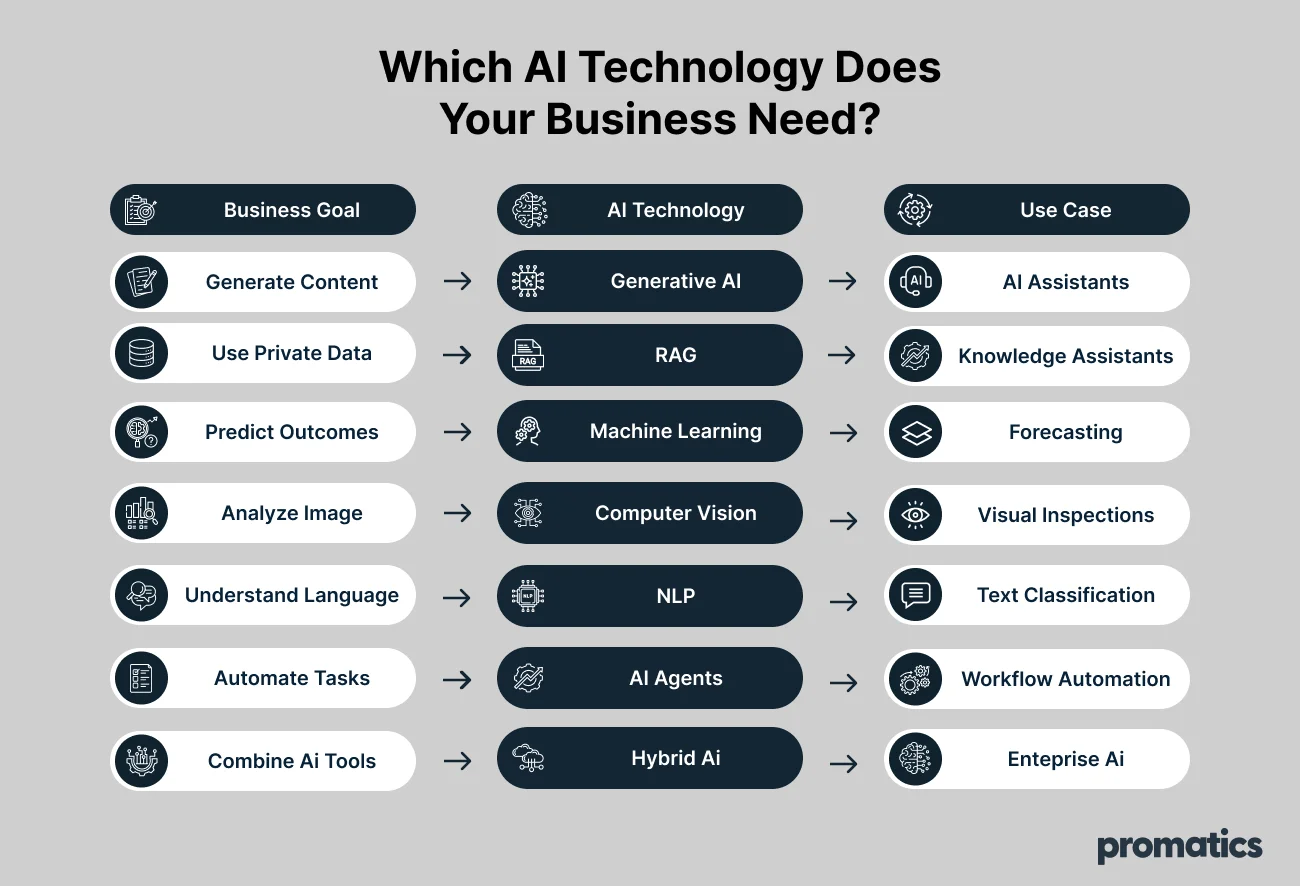
Which AI Technology Should Your Business Choose?
There is no single AI technology that is right for every business application.
The appropriate technology depends on what the application needs to accomplish, the type of data available, the required level of accuracy, and how AI needs to interact with the rest of the software.
| Business requirement | Recommended AI approach | Typical application |
| Generate or summarize text | Generative AI / LLM API | AI assistants, content tools |
| Answer questions using company information | RAG | Enterprise knowledge assistants |
| Predict future outcomes | Machine Learning | Forecasting, churn, fraud |
| Analyze images or video | Computer Vision | Image analysis, inspection |
| Understand and classify language | NLP | Classification, extraction |
| Perform specialized AI tasks | Fine-tuned model | Domain-specific applications |
| Complete multi-step workflows | AI Agents | Business automation |
| Combine multiple AI capabilities | Hybrid AI architecture | Enterprise AI platforms |
AI APIs
AI APIs are often the fastest way to add established AI capabilities to an application.
Depending on the provider and model, APIs can provide capabilities such as:
- Text generation
- Summarization
- Translation
- Speech recognition
- Embeddings
- Image analysis
- Conversational AI
This approach can reduce development time and infrastructure complexity when a business does not need to develop or own a proprietary model.
Machine Learning
Machine learning is useful when businesses need models that can learn patterns from historical data and produce predictions or classifications.
For example:
- An e-commerce business can use machine learning for demand forecasting.
- A financial platform can use it for fraud detection.
- A SaaS business can use it for customer churn prediction.
- A sales platform can use it for lead scoring.
Businesses requiring specialized machine learning model engineering can develop models around specific datasets and business requirements.
Retrieval-Augmented Generation (RAG)
RAG, or Retrieval-Augmented Generation, connects generative AI with external knowledge sources.
Instead of relying entirely on information contained within a language model, a RAG system retrieves relevant information from an approved knowledge base and provides that context to the model before generating a response.
RAG is useful for applications that need to work with private, proprietary, or frequently changing information.
Common applications include:
- Internal knowledge assistants
- Enterprise search
- Customer support
- Policy systems
- Product documentation
- Private company data
AI Agents
AI agents are suitable when an application needs to perform multiple actions rather than simply generate an answer.
An AI agent may:
- Understand the user’s request.
- Retrieve relevant information.
- Determine the required action.
- Use an available tool or software system.
- Complete the workflow.
- Return the result or request human approval.
This makes AI agents particularly relevant for enterprise automation and complex business workflows.
AI API vs. Custom AI Model: Which Should You Choose?
One of the most common questions businesses ask is
Should we build a custom AI model or use an existing AI API?
There is no universal answer. The decision depends on the application’s requirements, data, budget, timeline, and need for customization.
Use an Existing AI API When:
- You need to launch quickly.
- A suitable model already exists.
- Your requirements are relatively general.
- You want to reduce infrastructure complexity.
- You do not need to own the underlying model.
Consider Custom AI or ML Development When:
- Your business has proprietary datasets.
- Existing models do not deliver sufficient performance.
- The use case is highly specialized.
- You require greater control over model behavior.
- AI performance is directly connected to your competitive advantage.
Consider a Hybrid AI Architecture When:
- Different parts of the application require different AI capabilities.
- You need both predictive ML and generative AI.
- Private business data must be connected to an LLM.
- AI needs to interact with existing enterprise systems.
In many real-world applications, the decision is not simply custom model vs. API. A combination of AI technologies can often deliver a more practical solution.
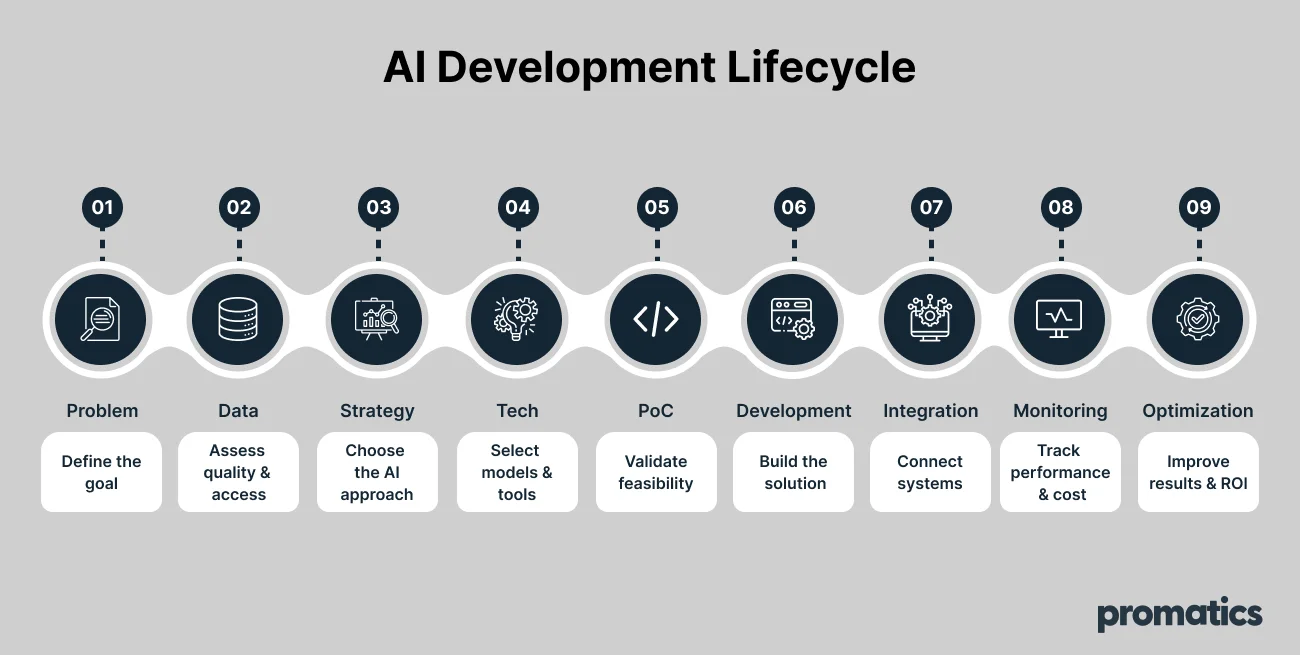
How Does AI Software Development Work?
A successful AI project should follow a structured development process that connects business objectives with data, technology, software engineering, and continuous optimization.
Step 1: Define the Business Problem
Start with the business requirement, not the technology.
Ask:
- What problem are we solving?
- Who experiences the problem?
- How frequently does it occur?
- What does the current process cost?
- What would success look like?
- Which business metric should improve?
A clearly defined problem makes technology selection easier and provides a measurable basis for evaluating the final solution.
Step 2: Identify and Evaluate Data
Data readiness can determine whether an AI project succeeds.
Evaluate:
- Data availability
- Data quality
- Data volume
- Data structure
- Data ownership
- Privacy
- Security
- Integration requirements
If the required data does not exist, is incomplete, or cannot be accessed reliably, the AI strategy may need to change.
Step 3: Select the AI Architecture
Based on business and data requirements, determine whether the solution needs:
- AI APIs
- Machine learning
- Generative AI
- RAG
- Computer vision
- NLP
- AI agents
- A hybrid architecture
This is also where AI strategy consulting can help organizations identify, prioritize, and plan practical AI use cases.
Step 4: Build a Proof of Concept
Before developing the complete application, validate the most important assumptions.
A proof of concept (PoC) can help determine:
- Does the AI approach work?
- Is the output accurate enough?
- Can the required data be processed?
- Is response time acceptable?
- Is the expected cost sustainable?
- Will users actually benefit from the solution?
A PoC reduces the risk of investing heavily in an approach before you establish its technical and business feasibility.
Step 5: Develop the Production Application
A proof of concept is not the same as a production-ready application.
The production phase may include:
- Application development
- API integration
- Database architecture
- Model integration
- Authentication
- Security
- Testing
- Cloud infrastructure
- Monitoring
- Scalability
For businesses looking for end-to-end software development services, AI capabilities can be integrated into new or existing software products.
Step 6: Integrate AI Into the User Experience
AI should solve a user problem without unnecessarily complicating the product.
The interface should make it clear:
- What the AI can do
- What information it uses
- What users can control
- When human review is required
- What happens when the AI is uncertain
For mobile-first products, AI capabilities can also be incorporated into mobile app development.
Step 7: Monitor and Optimize
AI applications require continuous monitoring after deployment.
Important metrics can include:
- Accuracy
- Response quality
- Latency
- API usage
- Infrastructure costs
- User feedback
- Failure rates
- Security
- Data changes
The goal is to continuously improve both AI performance and measurable business outcomes.
How Much Does AI Software Development Cost?
There is no fixed price for AI software development.
The total investment depends on the application’s complexity, AI architecture, data requirements, integrations, infrastructure, security, and ongoing usage.
Important cost factors include:
- Business complexity
- AI model selection
- Data preparation
- Custom ML development
- Fine-tuning
- RAG implementation
- AI agent complexity
- Application development
- Third-party APIs
- Cloud infrastructure
- Security
- Integrations
- Testing
- Maintenance
A simple AI API integration can require significantly less engineering than a large enterprise AI platform involving custom models, multiple integrations, advanced security, governance, scalability, and continuous monitoring.
For this reason, businesses should evaluate total cost of ownership (TCO) rather than looking only at the initial development cost.
What Are the Biggest AI Software Development Mistakes?
Choosing AI Before Defining the Problem
Technology should follow the business requirement.
Starting with a model or trend before identifying the problem can result in unnecessary complexity and poor ROI.
Assuming Every Problem Needs Generative AI
Generative AI is powerful, but it is not the right answer for every use case.
A traditional machine learning model, automation workflow, rules-based system, or conventional software solution may sometimes be more appropriate.
Ignoring Data Quality
AI cannot reliably compensate for poor, incomplete, inconsistent, or inaccessible data.
Data assessment should therefore happen early in the development process.
Treating a PoC as a Finished Product
A successful proof of concept does not automatically mean that the application is ready for production.
Production systems require security, scalability, testing, monitoring, reliability, and maintenance.
Ignoring AI Operating Costs
AI applications can generate ongoing costs through:
- Model usage
- API calls
- Cloud infrastructure
- Data processing
- Monitoring
- Storage
- Maintenance
These costs should be considered during architecture planning.
Over-Automating Sensitive Decisions
Human oversight remains important when AI is used for high-impact or sensitive business decisions.
The application should define when human approval, review, or intervention is required.
How Do You Choose an AI Software Development Company?
Choosing the right AI software development company means looking beyond its tech stack. Look for a partner that can:
- Understand your business goals
- Identify high-value AI use cases
- Assess data readiness
- Recommend the right AI architecture
- Build and integrate secure AI solutions
- Scale and monitor AI systems
- Test performance and provide ongoing support
For businesses seeking an AI development company in India, prioritize both AI expertise and strong software engineering capabilities. The right partner should connect AI strategy, product development, cloud, security, deployment, and long-term optimization to deliver measurable business value.
Why Choose Promatics Technologies for AI Software Development?
Looking for an AI software development company in India? Choose a partner that combines AI expertise with proven software engineering capabilities.
Promatics Technologies has delivered 30+ AI projects, helping businesses build and integrate solutions across machine learning, generative AI, NLP, computer vision, speech AI, and intelligent automation.
AI Expertise Backed by Real Projects
TopGrad – AI-Powered Job Search & Candidate Matching
The TopGrad case study showcases the use of machine learning, NLP, and data analytics to power AI-based job search and candidate matching.
Promatics supports the complete AI development lifecycle, from AI strategy and PoC development to software engineering, API integration, cloud deployment, security, testing, and post-launch optimization.
Explore Promatics case studies to see how its AI and software development expertise has been applied to real-world business requirements.
AI Software Development Checklist
Before starting an AI software development project, businesses should evaluate five key areas.
Business
- What problem are we solving?
- Who is the target user?
- What business metric should improve?
- How will success be measured?
Data
- Do we have the necessary data?
- Is the data accurate and accessible?
- Is the data structured or unstructured?
- Are there privacy or compliance restrictions?
Technology
- Do we need machine learning, generative AI, RAG, AI agents, or another approach?
- Which APIs or systems need to be integrated?
- What level of scalability is required?
- What infrastructure will the solution need?
Product
- How will users interact with AI?
- Where should human approval be required?
- What happens when the AI produces an incorrect result?
- How will users provide feedback?
Financial
- What is the initial development cost?
- What will ongoing AI and infrastructure costs be?
- What measurable ROI can the project deliver?
- How will costs change as usage grows?
If these questions have clear answers, the project has a stronger foundation for moving from experimentation to production.
AI Software Development for Different Business Sizes
AI Software Development for Startups
Startups can use AI to launch differentiated products without necessarily building large proprietary models.
API-based AI, RAG, and cloud infrastructure can help startups validate ideas and deliver AI-powered features without taking on unnecessary infrastructure complexity.
The focus should be on identifying a narrow, valuable use case and validating it quickly.
AI Software Development for Mid-Sized Businesses
Mid-sized organizations can use AI to automate operational processes, improve customer experiences, enhance analytics, and reduce repetitive manual work.
Common opportunities include customer support automation, intelligent document processing, predictive analytics, recommendation systems, and internal knowledge assistants.
AI Software Development for Enterprises
Enterprises often require more complex AI architectures involving:
- Existing enterprise systems
- Large data platforms
- Security controls
- Governance
- Multiple models
- Enterprise workflows
- Advanced integrations
- Scalability
- Monitoring
The technology should therefore be selected according to the organization’s business requirements, data maturity, technical environment, and AI goals—not simply its size.
Final Takeaway
AI software development delivers the most value when the right technology is applied to the right business problem.
Whether you need generative AI, machine learning, RAG, computer vision, AI agents, or intelligent automation, the right strategy can help you move from experimentation to a secure, scalable, production-ready solution.
A successful AI journey typically follows:
Business Problem → AI Strategy → Technology Selection → PoC → Development → Integration → Optimization
The key is having the right technology partner to turn that strategy into measurable business results.
With 30+ AI projects delivered, Promatics Technologies helps businesses build and integrate AI solutions tailored to their products, data, workflows, and growth goals.
Have an AI idea or are you looking to add AI to an existing product? Talk to Promatics Technologies to discuss your requirements and identify the right AI development approach for your business.
