Software Development Market: Trends and Future Outlook
TL;DR
- The software development industry is evolving as businesses invest in digital transformation
- artificial intelligence
- cloud computing
- and custom application development. Organizations across industries are adopting cloud-native solutions
- intelligent automation
- enterprise software
- and modern development approaches to improve efficiency and meet changing customer expectations. This blog explores the key segments shaping the industry
- emerging software development trends
- major growth drivers
- regional opportunities
- and challenges businesses should consider when planning their technology investments.
Software development is no longer limited to building applications that perform specific business functions. It has become a strategic investment that influences how organizations operate, interact with customers, manage information, and compete in their respective industries.
From enterprise resource planning (ERP) systems and customer relationship management (CRM) platforms to AI-powered applications and cloud-native products, businesses increasingly depend on software to manage complex operations and deliver better digital experiences.
As businesses become more technology-dependent, the software development industry continues to evolve. Organizations are moving beyond traditional application development and investing in intelligent automation, scalable cloud infrastructure, interconnected systems, and customized digital products.
This growing demand is clearly reflected in the expansion of the global software development industry. According to Mordor Intelligence, the market is projected to grow from an estimated $720 billion in 2027 to $1.28 trillion by 2032, at a CAGR of 12.14%.
For software development companies, this growth creates opportunities across several areas, including custom application development, AI engineering, cloud migration, enterprise software, and ongoing application management.
But what is driving this expansion, which technologies are influencing development strategies, and where will businesses find the greatest opportunities?
Let’s explore the market outlook, major industry trends, growth drivers, and challenges shaping the future of software development.
1. Understanding the Growth of the Global Software Development Market
The software development market is expanding as organizations increase their spending on digital products, enterprise applications, and technology services.
According to Mordor Intelligence, the market is estimated at $640 billion in 2026, with the following projections:
| Market Indicator | Estimated Value |
| Market size (2026) | $640 billion |
| Market size (2027) | $720 billion |
| Projected market size (2032) | $1.28 trillion |
| CAGR (2027–2032) | 12.14% |
| Largest regional market | North America |
| Fastest-growing regional market | Asia-Pacific |
The projected growth highlights the increasing importance of software across business operations.
Several factors contribute to this expansion:
- Growing adoption of cloud-based applications.
- Increasing demand for custom enterprise software.
- Integration of artificial intelligence into business applications.
- Expansion of mobile and web-based digital products.
- Modernization of legacy software infrastructure.
- Greater reliance on software services and application maintenance.
One important development is that businesses are increasingly looking for complete software solutions rather than isolated development services. They need applications that integrate with existing systems, support changing workloads, and remain adaptable as business requirements evolve.
This is creating opportunities for development companies that can provide end-to-end engineering capabilities.
2. Software Development Market: Key Segments and Opportunities
The software development industry includes different product categories, deployment models, customer segments, and end-user industries.
Understanding these segments helps explain where demand is coming from and which areas are expected to grow faster.
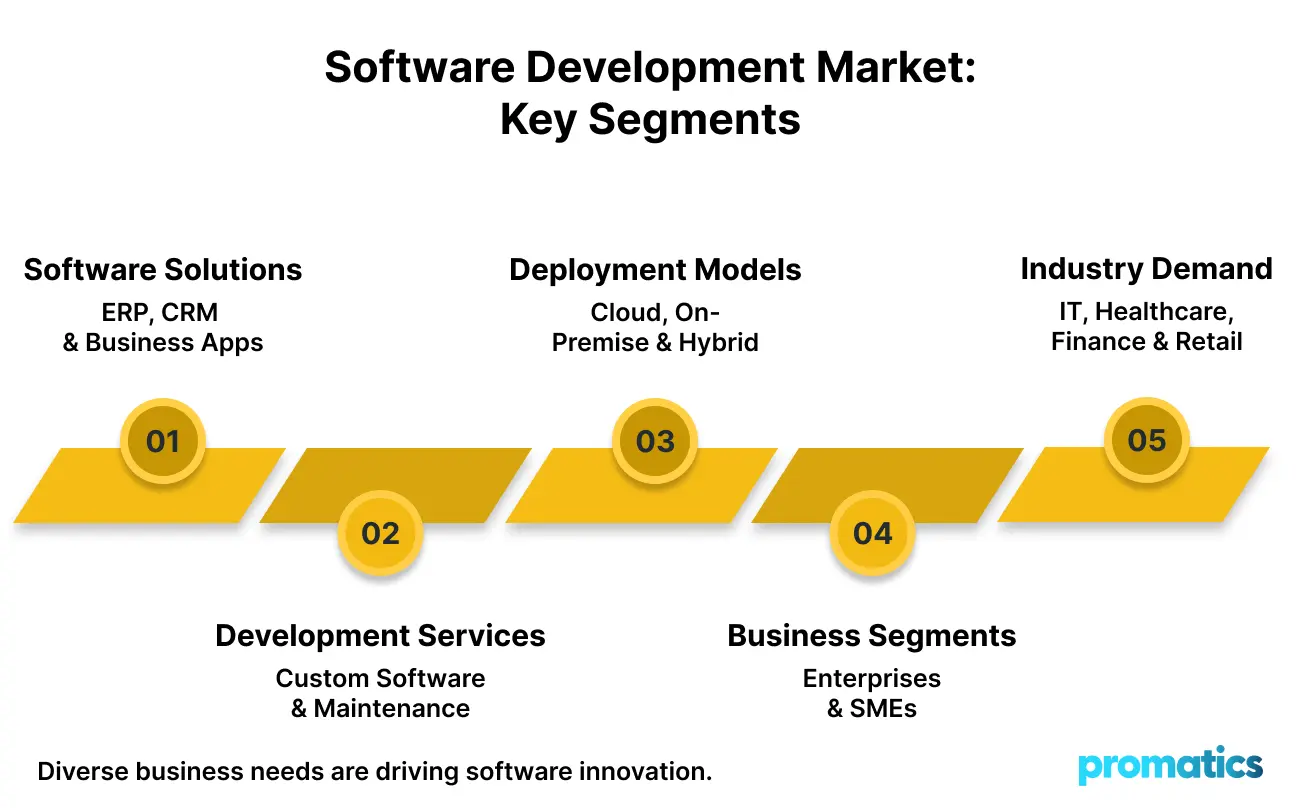
A. Software Solutions vs. Development Services
The market includes two broad categories: software solutions and software development services.
Software solutions
Software solutions include ready-to-use or customized software products designed to address specific business requirements.
Examples include:
- Enterprise resource planning systems.
- Customer relationship management platforms.
- Human resource management software.
- Business intelligence applications.
- Workflow automation platforms.
- Industry-specific software products.
According to Mordor Intelligence, software solutions accounted for approximately 57.53% of the market in 2026.
Software development services
Software development services cover the activities involved in designing, building, integrating, maintaining, and improving applications.
These services include custom software engineering, application modernization, quality assurance, cloud development, and ongoing maintenance.
The services segment is projected to grow at a CAGR of 13.7% between 2027 and 2032, according to the same report.
This indicates that businesses are increasingly looking beyond software purchases and seeking specialized development expertise to build and maintain applications around their requirements.
For software development companies, this creates opportunities to support clients throughout the complete software lifecycle.
B. Cloud-Based vs. On-Premise Software Development
Cloud computing has changed how businesses develop, deploy, and maintain applications.
Instead of relying entirely on local infrastructure, organizations can use cloud platforms to host applications, manage databases, process information, and scale resources according to demand.
Mordor Intelligence estimates that cloud deployment accounted for approximately 71.5% of the software development market in 2026. Demand for cloud-based development is projected to increase at a CAGR of 12.5% through 2032.
Some of the major reasons behind cloud adoption include:
- Flexible infrastructure and resource allocation.
- Easier application scaling.
- Improved accessibility across distributed teams.
- Integration with managed databases and development services.
- Support for cloud-native and serverless architectures.
- Simplified infrastructure management.
However, on-premise development continues to serve organizations with specific infrastructure, security, regulatory, or operational requirements.
Many businesses also follow hybrid approaches, combining cloud services with on-premise systems.
The choice depends on application architecture, data sensitivity, compliance requirements, infrastructure investments, and long-term maintenance needs.
C. Large Enterprises vs. Small and Medium-Sized Businesses
Large enterprises have historically accounted for a significant portion of software development spending because of their complex technology environments and extensive operational requirements.
Mordor Intelligence estimates that large enterprises represented 61.78% of the software development market in 2026.
These organizations often invest in:
- Enterprise application development.
- Legacy system modernization.
- Cloud infrastructure.
- AI-powered business automation.
- Enterprise API development.
- Data management and analytics.
However, small and medium-sized businesses are becoming an important growth segment.
As cloud infrastructure, development frameworks, and subscription-based software become more accessible, smaller organizations can invest in digital solutions without maintaining large internal IT departments.
This creates demand for affordable MVP development, custom business applications, SaaS products, and workflow automation.
D. Industry-Wise Software Development Demand
Software development demand extends across nearly every industry, but certain sectors are investing more heavily in digital technologies.
According to Mordor Intelligence, IT and telecommunications accounted for approximately 21.28% of the market in 2026, making it the largest end-user segment.
Healthcare, however, is expected to be the fastest-growing end-user segment, with a projected CAGR of 13.7% between 2027 and 2032.
Other important industries include:
- Banking and Financial Services
Financial institutions use custom software for digital banking, payment processing, fraud detection, financial analytics, and automated operations.
- Healthcare
Healthcare providers are investing in electronic health records, telemedicine platforms, patient management applications, healthcare analytics, and remote monitoring systems.
- Retail and E-commerce
Retail businesses use software to manage inventory, customer experiences, payments, order processing, and personalized recommendations.
- Manufacturing
Manufacturers depend on enterprise applications, supply chain management systems, production monitoring, and industrial automation software.
- Education
Educational institutions and EdTech businesses are adopting learning management systems, virtual classrooms, student management applications, and AI-assisted learning platforms.
Industry-specific requirements are creating demand for software development companies with relevant domain knowledge and integration expertise.
3. Seven Major Trends Shaping the Software Development Industry
The software development industry is evolving as businesses adopt new technologies and rethink traditional development approaches.
The following trends are particularly important for organizations planning their software investments.
1. Artificial Intelligence Is Changing Software Development
Artificial intelligence is influencing both how software is developed and what modern applications can accomplish.
AI-powered coding assistants can help developers generate code, identify potential errors, explain unfamiliar codebases, and automate repetitive development tasks.
However, the impact of AI extends beyond developer productivity.
Businesses are also integrating intelligent capabilities directly into their applications through:
- AI-powered chatbots and virtual assistants.
- Predictive analytics and recommendation engines.
- Intelligent document processing.
- Natural language interfaces.
- AI agents and multi-agent systems.
- Retrieval-augmented generation (RAG).
- Automated business workflows.
Generative AI is also creating opportunities for applications that can understand business information, interact with databases, and support decision-making.
For software development companies, the opportunity is no longer limited to integrating an AI model through an API. It increasingly involves building secure, reliable, and scalable applications around AI capabilities.
This requires expertise in model selection, data pipelines, application architecture, evaluation, security, and monitoring.
2. Cloud-Native and Serverless Development Are Expanding
Businesses are increasingly building applications designed to operate within modern cloud environments.
Cloud-native development uses approaches such as microservices, containers, orchestration, and automated deployment to create applications that can scale and evolve independently.
Serverless computing takes this approach further by allowing developers to run application logic without directly managing the underlying server infrastructure.
Some of the commonly used technologies and platforms include:
- Amazon Web Services (AWS).
- Microsoft Azure.
- Google Cloud Platform.
- Docker.
- Kubernetes.
- AWS Lambda.
- Azure Functions.
These technologies can help organizations improve deployment flexibility, manage variable workloads, and reduce infrastructure administration.
However, cloud adoption also requires careful planning around architecture, costs, security, data management, and vendor dependencies.
3. Low-Code and No-Code Platforms Are Accelerating Application Development
Low-code and no-code platforms are making application development more accessible to businesses without requiring every application to be built entirely through traditional programming.
These platforms provide visual development environments, reusable components, workflow builders, and preconfigured integrations.
Businesses can use them to create internal applications, automate repetitive processes, and build basic digital solutions.
Microsoft’s Power Platform is one example of this development approach.
However, low-code tools are not a complete replacement for custom software engineering.
Applications with complex business logic, specialized integrations, advanced security requirements, or large-scale workloads may still require conventional development.
A combination of low-code platforms and custom engineering can help businesses balance development speed with flexibility.
4. AI Agents and Intelligent Automation Are Gaining Momentum
Traditional automation generally follows predefined rules and workflows. AI agents introduce a more flexible approach by allowing applications to interpret information, make decisions within defined boundaries, and execute tasks using connected tools.
For example, an enterprise AI agent could retrieve information from internal systems, summarize customer requests, update records, and initiate specific business workflows.
Potential applications include:
- Customer support automation.
- Sales and lead qualification.
- IT service management.
- Financial document processing.
- Supply chain coordination.
- Enterprise knowledge management.
Building these solutions requires more than connecting a language model to an application.
Developers must consider permissions, tool access, data retrieval, workflow orchestration, human approval, error handling, and performance monitoring.
As businesses explore agentic AI, demand for software development companies with AI engineering and enterprise integration capabilities is likely to expand.
5. Software Modernization Is Becoming a Business Priority
Many organizations continue to depend on legacy applications that were developed years ago.
Although these systems may support important business operations, they can become difficult to maintain as technologies, security requirements, and customer expectations change.
Legacy software modernization involves improving existing applications without necessarily replacing the entire system.
Common approaches include:
- Rewriting outdated application components.
- Migrating legacy systems to cloud infrastructure.
- Introducing APIs and modern integrations.
- Moving toward microservices architecture.
- Updating databases and programming frameworks.
- Improving application security and performance.
Modernization allows organizations to extend the useful life of existing software while introducing capabilities required for future growth.
For enterprises with complex technology environments, this is an important area of software development investment.
6. Cybersecurity Is Becoming Part of the Development Lifecycle
As applications handle increasing volumes of sensitive information, security cannot remain a final-stage testing activity.
Development teams are increasingly integrating security practices throughout the software development lifecycle.
This approach is commonly known as DevSecOps.
It combines development, security, and operations practices to identify vulnerabilities earlier and improve application protection.
Important practices include:
- Secure coding standards.
- Automated vulnerability scanning.
- Identity and access management.
- Encryption of sensitive information.
- API security testing.
- Continuous security monitoring.
- Dependency and software supply chain management.
Security is particularly important for healthcare, fintech, enterprise, and government applications, where data protection and regulatory requirements can influence development decisions.
7. API-First and Integration-Focused Development Is Expanding
Modern businesses rarely operate through a single software application.
They use multiple platforms for customer management, payments, analytics, inventory, communication, and internal operations.
APIs allow these systems to exchange information and work together.
API-first development focuses on designing application interfaces early in the development process, making integration an important part of the overall architecture.
This approach can help businesses:
- Connect existing enterprise applications.
- Develop mobile and web applications using shared backend services.
- Integrate third-party platforms.
- Automate information exchange.
- Support partner and customer-facing integrations.
As organizations continue to expand their digital ecosystems, API development and integration will remain important areas of software engineering.
4. What Is Driving Growth in the Software Development Market?
Several broader business and technology developments are contributing to the industry’s expansion.
Increasing Digital Transformation Investments
Businesses are investing in technology to improve operational efficiency, automate processes, and create new digital revenue opportunities.
Software development supports these initiatives by providing the applications and integrations needed to translate digital strategies into practical business solutions.
Growing Demand for Business-Specific Applications
Off-the-shelf software cannot always accommodate specialized workflows or industry requirements.
Organizations increasingly require custom applications that align with their operations, integrate with existing systems, and provide greater control over functionality.
This is driving demand for custom software development services.
Expansion of Digital Products and SaaS Businesses
The growth of subscription-based business models has increased demand for SaaS platforms, multi-tenant applications, cloud infrastructure, and ongoing product engineering.
Startups and established businesses are investing in scalable software products that can serve customers across different markets.
Increased AI Adoption
Organizations are exploring AI to improve customer experiences, automate repetitive work, and extract insights from business data.
This creates demand for software development services that combine traditional engineering with AI integration, data infrastructure, and application modernization.
Growing SME Technology Adoption
Smaller businesses are investing in digital applications that were previously more accessible to large enterprises.
Cloud platforms, flexible development models, and reusable technologies have lowered some barriers to building custom digital products.
5. Challenges Affecting the Software Development Industry
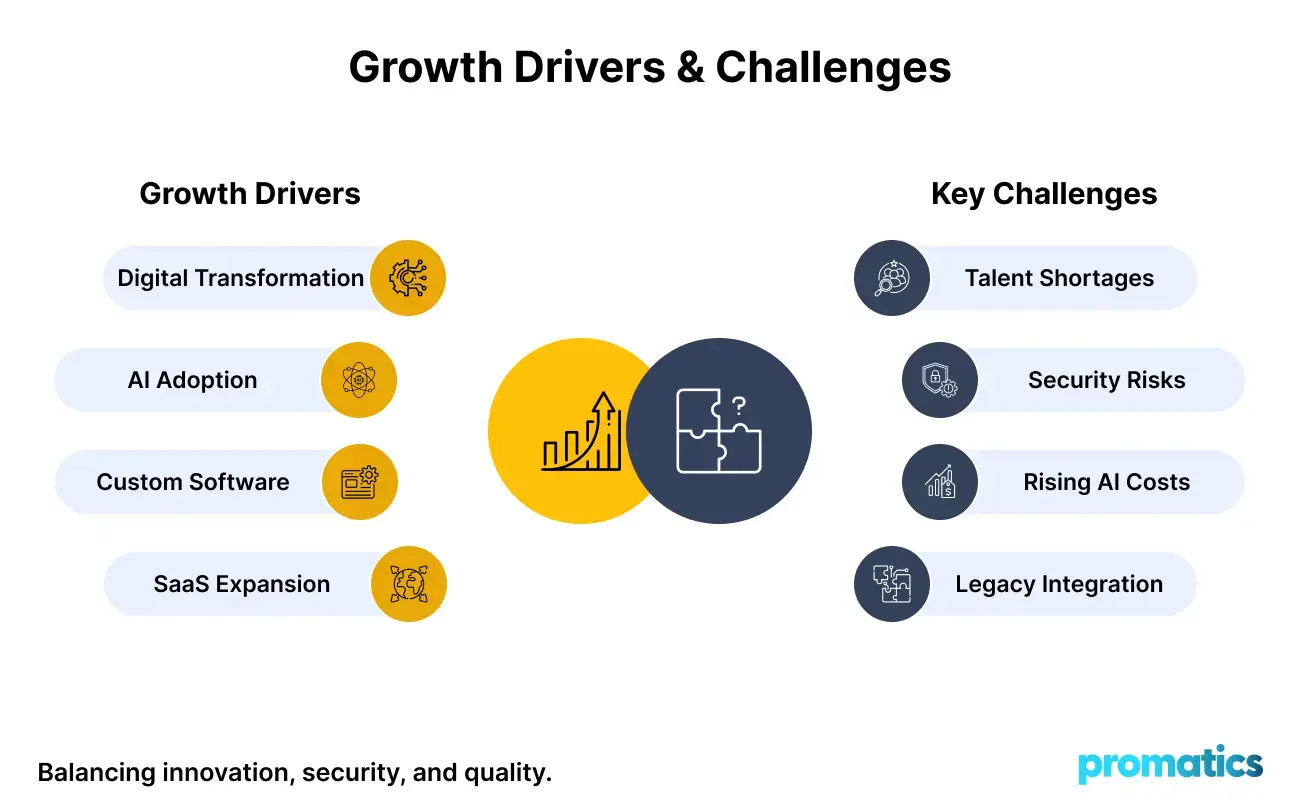
Despite strong growth opportunities, software development companies and businesses face several challenges.
Shortage of Experienced Developers
Access to skilled engineering talent remains a concern for technology organizations.
According to ManpowerGroup’s 2025 research, 76% of employers worldwide reported difficulty finding the skilled talent they needed.
The challenge is particularly relevant for specialized roles involving AI engineering, cloud architecture, cybersecurity, and enterprise systems.
Businesses must therefore consider how they will access the right expertise, whether through internal recruitment, outsourcing, or a hybrid development model.
Increasing Cybersecurity Risks
As applications become more interconnected, the potential attack surface also expands.
Data breaches, insecure APIs, vulnerable dependencies, and poor access controls can expose businesses to operational and financial risks.
Security must be considered during architecture design, development, testing, and deployment.
Rising AI Infrastructure Costs
AI-powered applications may require significant computing resources, depending on model selection, inference volume, data processing requirements, and application complexity.
Businesses need to evaluate infrastructure costs, model performance, and operational requirements before choosing an AI architecture.
Smaller models, optimized inference, caching, and efficient retrieval systems can help manage costs in appropriate use cases.
Integration with Existing Systems
Many enterprises depend on legacy applications and fragmented technology environments.
Integrating new software with these systems can involve complex data structures, outdated APIs, compatibility issues, and operational dependencies.
A well-planned architecture and phased integration strategy can reduce these challenges.
Balancing Development Speed and Quality
AI coding assistants and low-code platforms can accelerate certain development activities, but faster code generation does not automatically produce reliable software.
Applications still require architecture planning, code reviews, testing, security validation, and ongoing maintenance.
Businesses must focus on successful software delivery rather than development speed alone.
6. Regional Outlook: Where Is Software Development Growing?
Software development demand is increasing across different geographical markets, although growth patterns vary by region.
North America
North America remains the largest regional software development market. Mordor Intelligence estimates that the region accounted for 38.02% of the global market in 2026.
The region benefits from established technology companies, strong enterprise software spending, cloud adoption, and continued investments in AI and digital transformation.
The United States, in particular, represents an important market for custom software development, SaaS products, enterprise applications, and AI-powered solutions.
Businesses operating in this market increasingly require development partners that can deliver secure, scalable, and integration-ready applications.
Asia-Pacific
Asia-Pacific is projected to be the fastest-growing regional market, with an expected CAGR of 12.9% between 2027 and 2032, according to Mordor Intelligence.
Growth is supported by digital transformation initiatives, expanding technology businesses, cloud adoption, and increased software services demand.
India is an important contributor to the region’s software development ecosystem, with a large engineering workforce and established IT services industry.
Its software development companies also serve international businesses through offshore development, dedicated teams, and project-based engagements.
Europe
European businesses continue to invest in enterprise applications, cloud infrastructure, digital transformation, and data-driven services.
However, software providers must also consider data protection, cybersecurity, and applicable regulatory requirements when developing applications for European customers.
Middle East
Government-led digital transformation, smart city initiatives, financial technology, and cloud investments are creating opportunities for software development providers across the Middle East.
Businesses and public organizations are increasingly investing in digital platforms that improve service delivery and operational efficiency.
7. What Does Software Development Market Growth Mean for Businesses?
The expanding software development market creates opportunities, but businesses need to make thoughtful technology decisions to benefit from it.
Rather than investing in technology simply because it is trending, organizations should identify the operational challenges they want to solve.
Here are some practical considerations.
- Invest in scalable software architecture. Build applications that can accommodate additional users, features, integrations, and workloads as the business grows.
- Prioritize AI where it delivers measurable value. Identify workflows where AI can improve productivity, customer experience, or decision-making instead of adding AI features without a clear purpose.
- Modernize existing applications strategically. Evaluate legacy systems and prioritize modernization based on business impact, technical risk, and maintenance requirements.
- Strengthen software security. Include security controls, testing, and monitoring throughout the application development lifecycle.
- Choose development partners carefully. Work with teams that understand your industry, technology requirements, integration needs, and long-term product goals.
The right software development strategy should connect technology investments with measurable business outcomes.
8. How Promatics Technologies Helps Businesses Navigate the Changing Software Development Landscape
As the software development industry moves toward AI-powered applications, cloud-native architectures, and connected digital ecosystems, businesses need development partners capable of addressing both current and future technology requirements.
Promatics Technologies helps businesses build and improve digital products through a range of software engineering and technology services.
Its capabilities cover multiple areas of modern software development.
Custom Software Development
Promatics develops software solutions around specific business requirements, operational workflows, and product objectives.
From enterprise applications and SaaS platforms to internal business systems, custom development helps organizations build software that aligns with their requirements.
AI Application and Agent Development
Businesses exploring artificial intelligence need applications that can integrate AI capabilities with real business processes.
Promatics supports AI application development, AI agent engineering, machine learning integration, and RAG-based solutions.
These capabilities can help organizations develop intelligent applications, automate workflows, and make business information more accessible.
Web and Mobile Application Development
Promatics helps businesses build web and mobile applications designed around user needs and business objectives.
Its development capabilities include responsive web applications, enterprise portals, SaaS products, and mobile applications for iOS and Android.
Cloud Development and Engineering
Cloud infrastructure plays an important role in application scalability, deployment, and ongoing operations.
As an AWS Partner, Promatics supports businesses looking to build, improve, and manage cloud-enabled applications.
Its cloud engineering capabilities also help organizations evaluate infrastructure requirements and develop applications suited to their operational needs.
Legacy System Modernization
Businesses that depend on older applications may need to improve performance, security, integration, and maintainability.
Promatics helps organizations approach modernization through application redevelopment, technology upgrades, API integration, and cloud migration strategies.
By combining software engineering with modern technologies, Promatics helps businesses build digital products that can evolve alongside changing market requirements..
Conclusion
The software development market is entering a period of substantial growth, driven by cloud adoption, artificial intelligence, enterprise modernization, and increasing demand for custom digital solutions.
With the market projected to reach $1.28 trillion by 2032, businesses will continue to invest in software that improves operations, supports digital products, and creates better customer experiences.
However, the future of software development will not be determined by technology adoption alone. Application quality, security, integration, scalability, and long-term maintainability will remain equally important.
For businesses planning their next technology investment, the priority should be to identify the right solutions, choose suitable development approaches, and work with engineering partners who can turn business requirements into reliable software.
The organizations that approach software development as a long-term business capability, rather than a one-time technical project, will be better positioned to adapt to the changing digital landscape.
Looking to develop a custom software solution or modernize an existing application? Explore Promatics Technologies to discuss your software development requirements
