How Low-Code/No-Code Is Impacting Software Development
TL;DR
- Mobile App Development Services for Scalable Business Growth promaticsindia.com/blog/custom-mobile-app-development-services Thumbnail preview for the linked URL. Explore custom mobile app development services designed for scalability
- security
- and growth. Learn why global businesses choose tailored mobile solutions. TL;DR 1. Low-code uses minimal coding; no-code requires zero coding
Software development is evolving rapidly. Processes that once required long development cycles, large engineering teams, and complex technical coordination can now be delivered more efficiently through modern development approaches. One of the key drivers of this change is the growing adoption of low-code and no-code platforms.
For businesses working with a modern software development company, understanding where low-code and no-code fit into today’s development landscape is essential. These platforms are not intended to replace traditional software engineering. Instead, they are reshaping how applications are planned, built, and scaled when used as part of a structured development strategy.
In this blog, we explore how low-code and no-code platforms are influencing software development, their benefits and limitations, and what this means for businesses building scalable, reliable, and future-ready digital products.
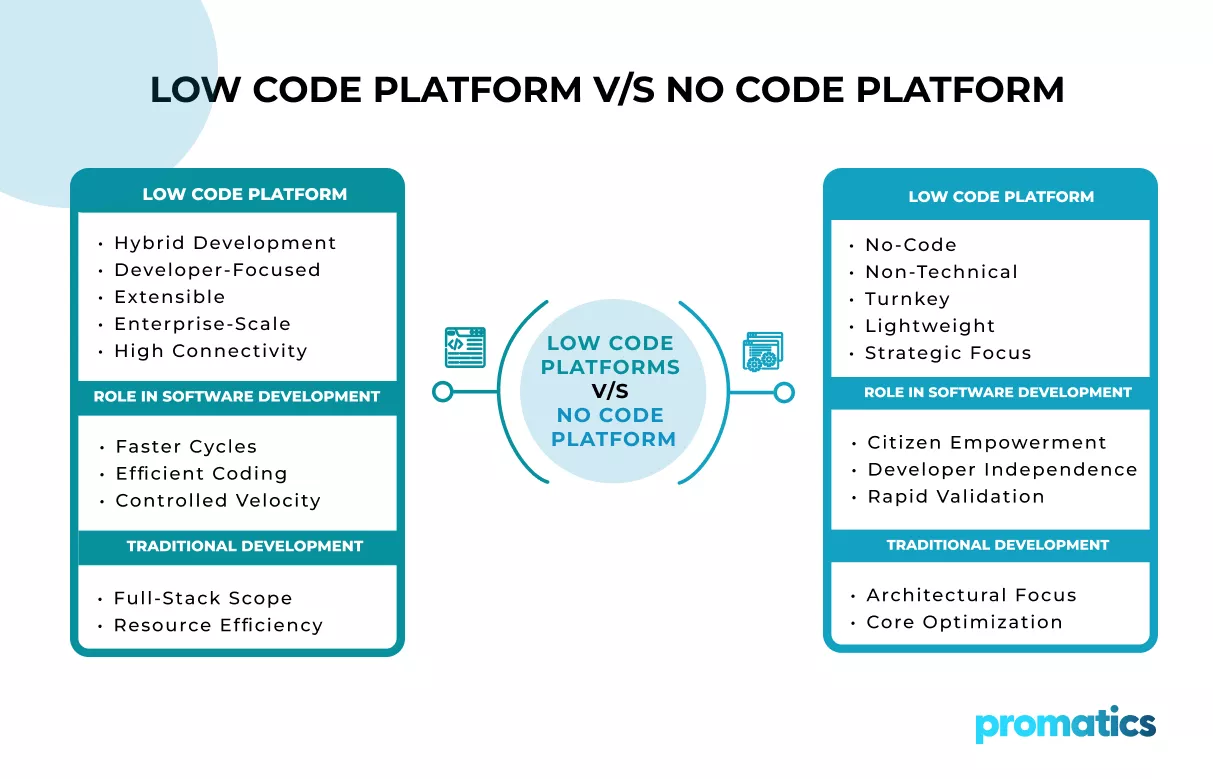
Low-Code vs No-Code: A Practical Comparison
The Growing Role of Low-Code and No-Code in Software Development
Low-code and no-code platforms are gaining momentum because they address several real-world challenges faced by growing businesses.
- Faster Development Cycles
Applications move from idea to deployment faster compared to traditional development models, allowing companies to respond quickly to market changes.
- Cost Efficiency
Reduced manual coding lowers development costs, especially for internal systems, automation tools, and MVPs.
- Improved Business Agility
Applications built on low-code/no-code platforms can be updated and refined easily as business needs evolve.
- AI-Driven Capabilities
Modern platforms use AI to automate workflows, suggest logic, simplify integrations, and reduce development errors.
- Reduced Dependency on Engineering Teams
Business users can handle basic application needs, allowing developers to focus on complex, high-impact projects.
The Role of AI in Low-Code/No-Code Development
AI has become a key driver behind the evolution of low-code and no-code platforms. Instead of functioning as simple visual builders, today’s platforms embed intelligence directly into the development process.
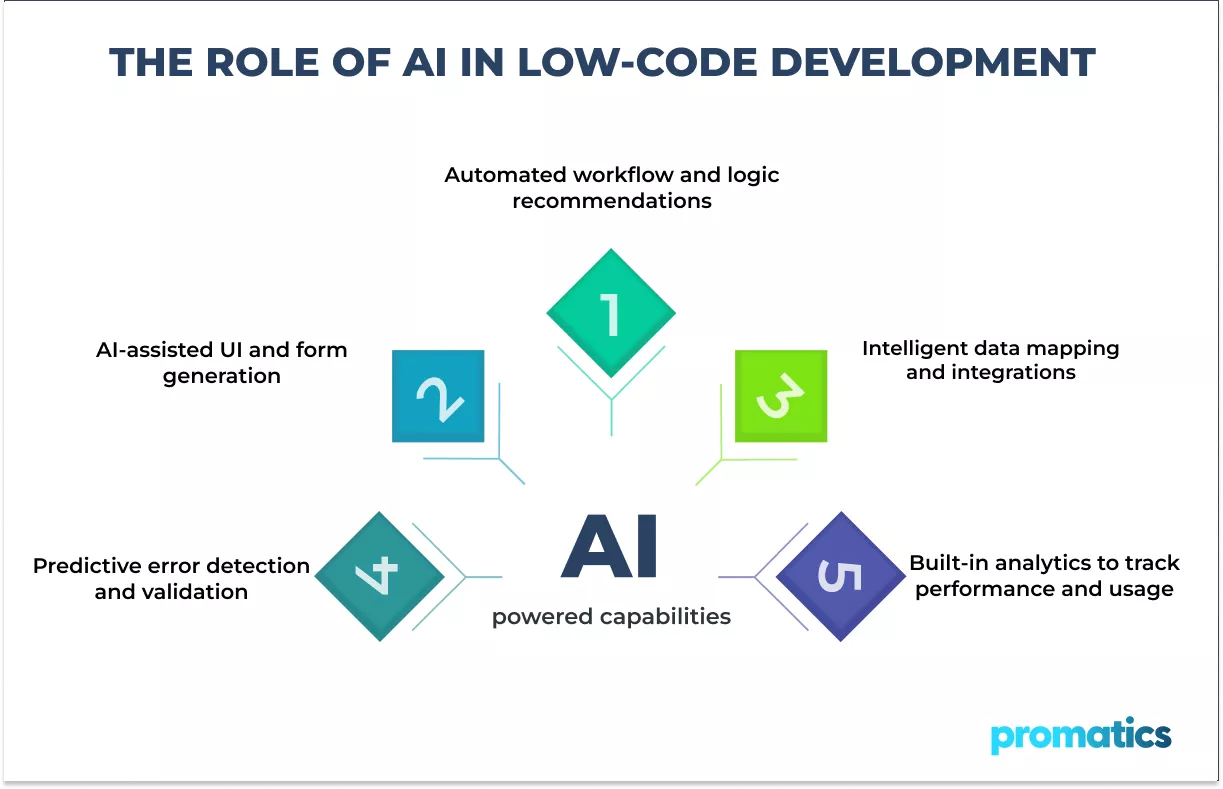
AI-powered capabilities typically include:
- Automated workflow and logic recommendations
- AI-assisted UI and form generation
- Intelligent data mapping and integrations
- Predictive error detection and validation
- Built-in analytics to track performance and usage
For software development companies, this means fewer repetitive tasks and more time spent on architecture, scalability, security, and optimization.
How Low-Code/No-Code Is Changing Traditional Development
Evolving Developer Roles
Developers are shifting away from repetitive implementation work and focusing more on:
- System architecture and design
- Performance and scalability
- Security and compliance
- API and system integrations
- Long-term maintainability
This shift strengthens the role of developers rather than replacing it.
Hybrid Development Models
Most modern applications now follow a hybrid approach:
- Low-code tools for UI development and workflows
- Custom code for business logic, integrations, and scaling
A software development company that adopts this model can deliver faster while maintaining quality, flexibility, and long-term performance.
Business Opportunities Enabled by Low-Code/No-Code
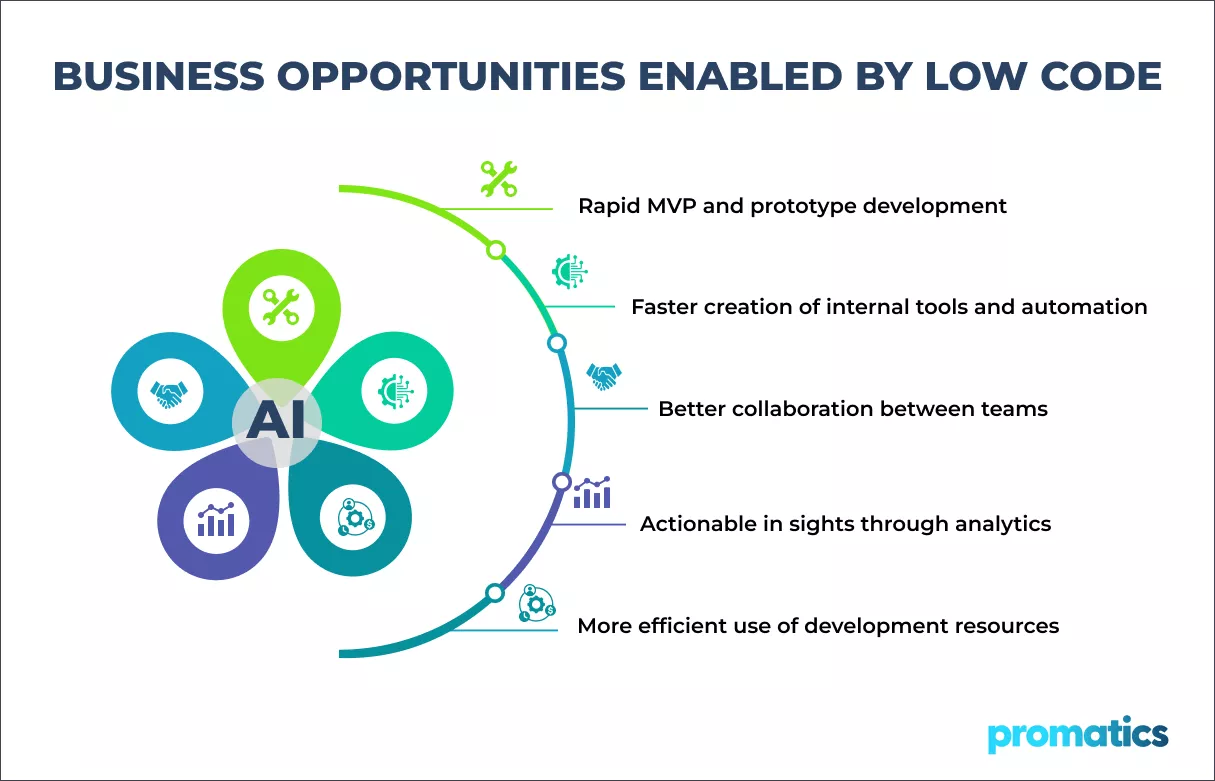
When combined with AI, low-code and no-code platforms enable:
- Rapid MVP and prototype development
- Faster creation of internal tools and automation
- Better collaboration between teams
- Actionable insights through analytics
- More efficient use of development resources
These advantages help businesses innovate faster without compromising technical stability.
Limitations Businesses Should Consider
While low-code and no-code platforms offer clear benefits, they are not suitable for every project.
- Customization Limits
Highly complex workflows, advanced business logic, and specialized integrations often require custom development.
- Scalability Challenges
Pure no-code solutions may struggle with high user volumes or complex data processing.
- Security and Compliance
Enterprise applications often demand strict governance, data protection, and regulatory compliance that require experienced engineering oversight.
- Platform Dependency
Vendor lock-in can impact flexibility and long-term costs if platform choices are not carefully evaluated.
For durable, scalable, and secure applications, professional software development services remain essential.
When Low-Code/No-Code Is the Right Fit
Low-code and no-code approaches work best for:
- MVPs and proof-of-concepts
- Internal dashboards and automation
- Short-term or experimental applications
- Process optimization tools
For customer-facing platforms, enterprise systems, and long-term digital products, traditional or hybrid development models are usually more effective.
The Role of a Custom Software Development Company
Rather than competing with low-code/no-code platforms, modern software development companies use them strategically.
At Promatics Technologies, technology decisions are driven by:
- Business goals and growth plans
- Performance and scalability requirements
- Security and compliance standards
- Seamless system integrations
- Long-term maintainability and support
The focus is always on choosing the right development approach for each project while maintaining strong engineering foundations.
The Future of Software Development
The future of software development lies in the collaboration between skilled developers, low-code/no-code platforms, and AI-powered automation. As AI becomes more deeply embedded into development tools, businesses will be able to move from idea to execution faster than ever.
However, experienced developers will continue to play a critical role in:
- Designing scalable architectures
- Managing AI-driven systems responsibly
- Ensuring security, reliability, and compliance
Trusted software development companies will remain key partners in navigating this evolving landscape.
Conclusion
Low-code and no-code platforms, combined with AI, are reshaping how modern software is built. While they bring speed and flexibility, their real impact depends on how well they are integrated into a thoughtful development strategy.
Partnering with an experienced software development company helps businesses balance rapid innovation with long-term scalability, security, and performance.If you’re planning a new software initiative or modernizing an existing system, Promatics Technologies can help you choose the right mix of low-code, AI, and custom engineering to build solutions aligned with your business goals.
