How to Find Expert AI App Developers for Custom Mobile Solutions

TL;DR
- Define the business goal first: Identify the workflow, customer experience, or operational challenge AI needs to solve.
- Choose proven AI expertise: Look for developers experienced in AI, mobile development, backend systems, APIs, and enterprise integrations.
- Select the right AI approach: Existing AI models may be enough for common use cases, while specialized requirements may justify custom AI development.
- Prioritize scalability and security: Make sure the application can handle growing usage while protecting business and customer data.
- Evaluate partners beyond price: Review relevant case studies, technical capabilities, development methodology, support, and total project cost before hiring.
Looking to turn an AI app idea into a scalable digital product? Choosing the right development partner can directly influence your application’s performance, security, user experience, and long-term growth.
Artificial intelligence is becoming an important part of modern application development. According to Rocket.new, 68% of technology companies use AI in application development, while predictive analytics and customer support are among the major application areas.
For organizations, the opportunity goes far beyond adding a chatbot. AI can help automate repetitive processes, analyze business data, improve customer interactions, personalize digital experiences, and support faster decision-making.
However, developing an AI-powered application requires more than conventional mobile development. Your project may involve AI models, APIs, cloud infrastructure, proprietary data, enterprise integrations, security controls, and complex workflows.
That is why selecting the right AI app development company is an important business decision.
Whether you want to build an AI-powered SaaS product, modernize an existing application, automate internal workflows, or develop a new enterprise solution, the right technology partner can help transform your idea into a reliable, scalable product.
What Is AI App Development and Why Does It Matter?
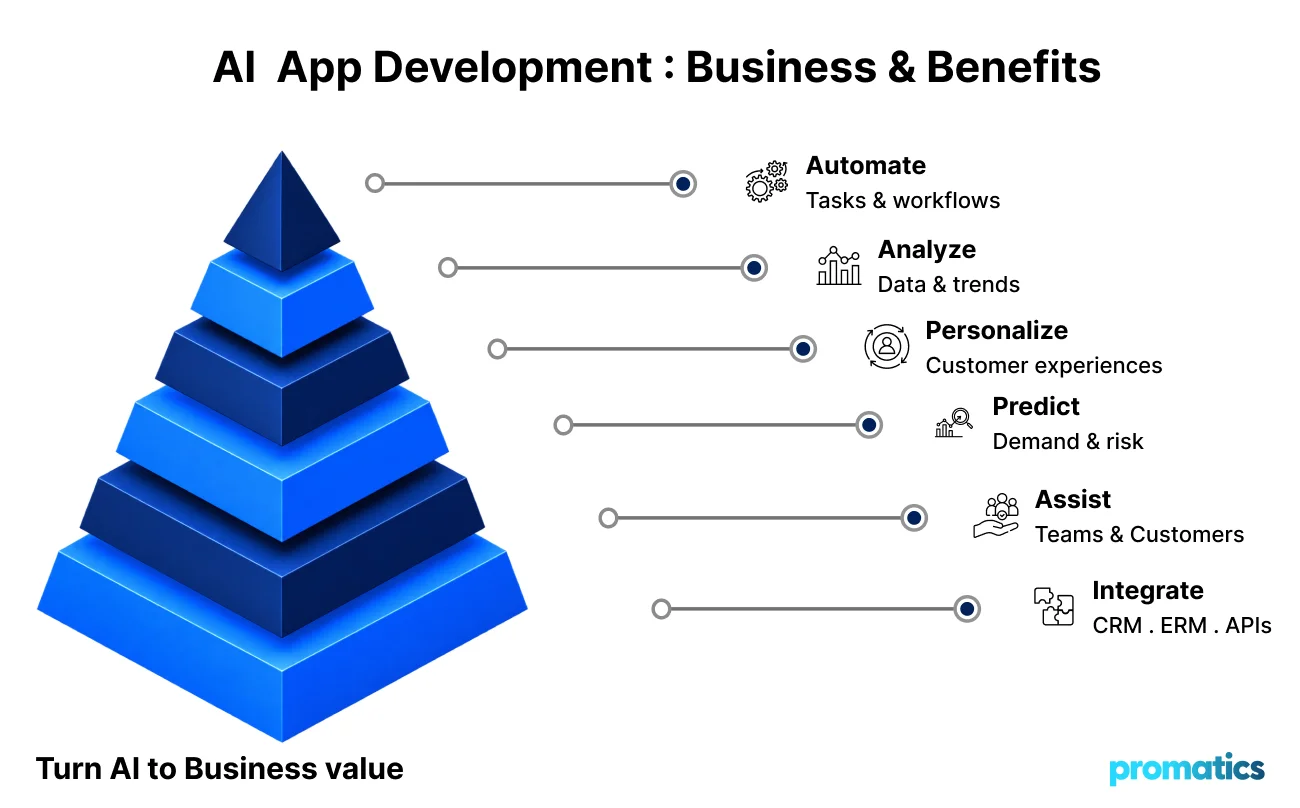
AI app development combines mobile or web development with artificial intelligence to make applications smarter, more automated, and data-driven. Businesses can use AI to:
- Automate repetitive workflows
- Improve employee productivity
- Personalize customer experiences
- Analyze business data
- Support sales and customer service
- Improve forecasting and decision-making
Depending on the use case, developers may use generative AI, large language models, machine learning, NLP, computer vision, predictive analytics, AI agents, intelligent search, and document intelligence.
AI applications can also integrate with CRM, ERP, databases, analytics platforms, and other business systems to fit existing workflows.
For example, AI can summarize customer interactions for sales teams, identify potential delays in logistics, or automate candidate matching and screening in recruitment.
The right solution depends on your business goals, data, and existing technology. An experienced AI development company can help identify valuable use cases and build a solution around them.
AI Use Cases for Business Applications
AI can be applied across industries and workflows. The right use case depends on your business objectives, available data, and existing technology infrastructure.
- AI-Powered Business Assistants
Employees often spend hours searching through documents, databases, reports, and internal systems.
An AI assistant can provide a natural-language interface for retrieving information, summarizing documents, answering questions, and supporting routine tasks.
For example, a sales representative could ask an internal assistant to summarize an account’s recent activity before a client meeting.
- Intelligent Customer Support
AI-powered assistants can handle common questions, search knowledge bases, summarize support requests, and route complex issues to the appropriate team.
This can help organizations reduce repetitive support work while giving customers faster access to information.
- Predictive Analytics
Machine learning can analyze historical and real-time data to identify patterns and generate predictions.
Potential applications include:
- Demand forecasting
- Customer churn prediction
- Sales forecasting
- Fraud detection
- Risk analysis
- Predictive maintenance
- Inventory planning
The real value comes from connecting these insights to actual business decisions and workflows.
- Document Intelligence
Organizations process contracts, invoices, proposals, reports, forms, and other documents every day.
AI can help extract information, classify documents, summarize content, identify important details, and move information into existing workflows.
- Sales and CRM Automation
AI can support sales teams by analyzing customer interactions, summarizing calls, preparing account briefs, scoring leads, and identifying potential opportunities.
This allows sales professionals to spend less time on administrative work and more time on customer relationships.
- AI-Powered Workflow Automation
AI can also become part of a broader business workflow.
Instead of simply generating an answer, an AI system can interpret information, make recommendations, retrieve relevant data, and trigger predefined actions.
This can be particularly valuable for organizations looking to reduce manual processes across departments.
What Should You Look for in AI App Developers?
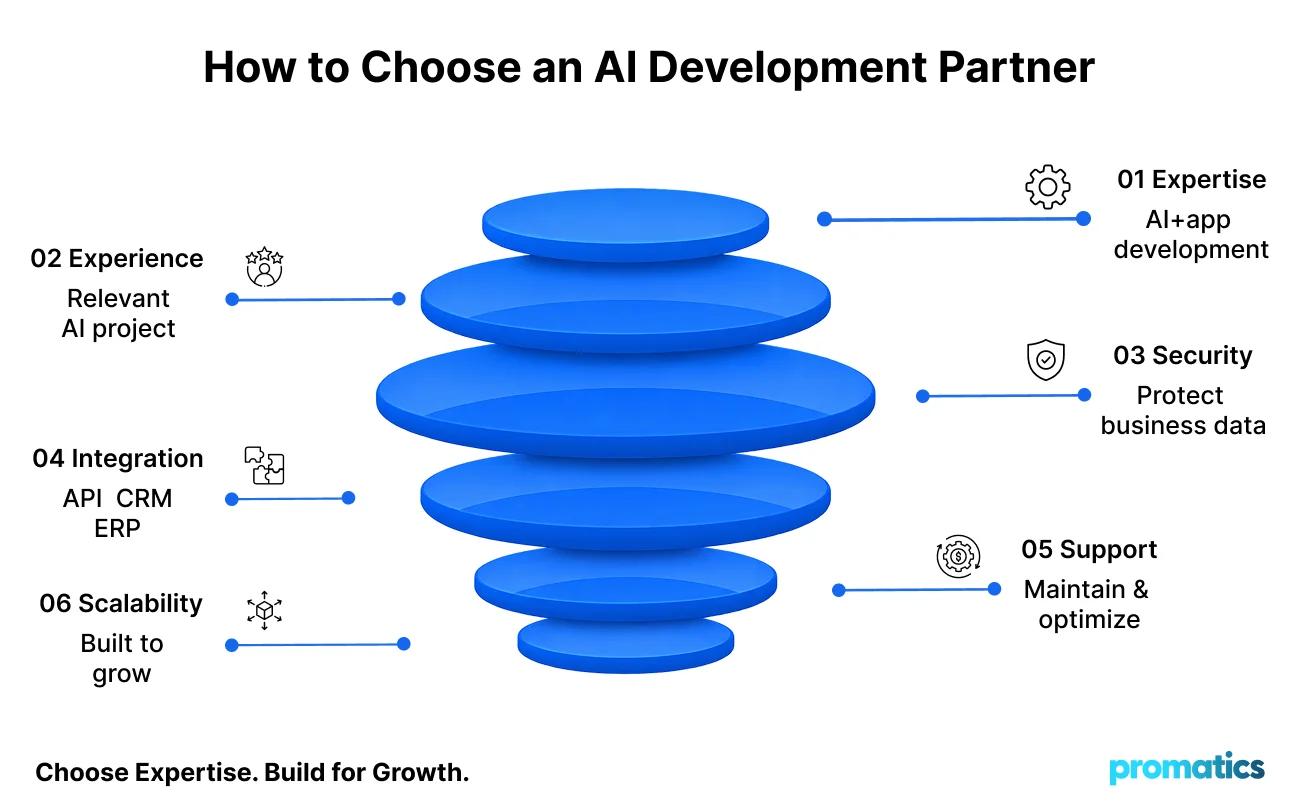
Hiring the right developer requires more than checking whether they mention artificial intelligence in their portfolio.
Look for a combination of technical expertise and real-world product experience.
Mobile Development Expertise
If your solution requires mobile access, your development partner should have experience with iOS, Android, or cross-platform technologies.
Depending on the project, this may include:
- Swift
- Kotlin
- Flutter
- React Native
The technology should be selected according to your application’s requirements, expected performance, target users, and long-term maintenance needs.
Businesses exploring mobile app development services should also confirm that the team can support the application after its initial launch.
AI and Machine Learning Expertise
Your development team should understand the AI technologies relevant to your use case.
This may include:
- Generative AI
- Large language models
- Machine learning
- Natural language processing
- Computer vision
- Predictive analytics
- AI agents
- Recommendation systems
The number of technologies listed by a company is less important than its ability to recommend the right technology for your specific problem.
Backend and API Development
AI applications depend heavily on backend systems.
The backend may manage:
- APIs
- Databases
- Authentication
- Business logic
- AI requests
- Third-party integrations
- Data processing
- Analytics
- Access controls
A development partner should understand how these components work together rather than treating AI as an isolated feature.
Enterprise Integration Experience
Business applications often need to connect with existing CRM, ERP, HR, finance, analytics, or customer support systems.
Your development team should understand how to securely integrate these systems while maintaining performance and reliability.
Security and Data Protection
AI applications can process sensitive customer and business information.
Ask potential developers how they plan to protect:
- User data
- Business information
- API credentials
- Database records
- AI prompts
- AI-generated responses
- Authentication systems
Security should be incorporated into the architecture from the beginning.
How to Choose the Right AI App Development Company
Once you have shortlisted potential development partners, evaluate them systematically.
1. Define the Business Objective
Start with the outcome rather than the technology.
Instead of saying:
We want an AI-powered app.
Define the problem:
We want to reduce the time our sales team spends preparing customer reports.
This gives developers a measurable objective and allows them to recommend an appropriate solution.
2. Identify Your Users
Understand who will use the application.
Your users could include:
- Employees
- Sales teams
- Managers
- Customers
- Partners
- Administrators
- Executives
Different user groups may require different interfaces, permissions, and workflows.
3. Map Your Existing Systems
Identify which systems the new application needs to connect with.
For example:
Mobile App → API → Business Systems → Data Layer → AI Services
Understanding these dependencies early can help developers create a more reliable architecture.
An API-first development approach can also help organizations manage integrations across mobile applications, web platforms, AI services, and third-party systems.
4. Prioritize AI Features
Don’t try to automate everything in the first release.
Identify the one or two use cases that could deliver the greatest value and build around them.
5. Review Case Studies
A development company’s portfolio should demonstrate more than attractive interfaces.
Look for projects involving similar:
- AI functionality
- Business processes
- Integrations
- User volumes
- Security requirements
- Technical complexity
For example, the TopGrad case study demonstrates a platform that incorporated an AI-based job search engine, AI matching, candidate screening, application tracking, and employer workflows.
The project is a useful example of how AI can be integrated into a broader business platform rather than being implemented as a standalone feature.
You can also review case studies to explore examples across mobile applications, SaaS products, enterprise solutions, and other digital platforms.
6. Compare Technical Proposals
Ask shortlisted companies to explain their approach to:
- AI architecture
- Mobile technology
- Backend development
- Data management
- Enterprise integrations
- Security
- Scalability
- Testing
- Deployment
- Maintenance
Don’t simply compare the final project price. Compare what each proposal actually includes.
Should You Build a Custom AI Solution?
Not every application requires a custom AI model.
Existing AI Models
Third-party AI models and APIs can be effective for:
- Conversational assistants
- Content generation
- Summarization
- Classification
- Natural-language search
- General document processing
They can help organizations launch AI capabilities without the complexity of training and maintaining their own models.
Custom AI Development
A custom solution may make more sense when you require:
- Proprietary datasets
- Specialized predictions
- Industry-specific intelligence
- Complex business logic
- Advanced workflows
- Greater control over AI behavior
- Deep integration with internal systems
A good development partner should explain the advantages, limitations, costs, and maintenance requirements of each approach.
For organizations that require tailored AI capabilities, AI development services can help address use cases involving intelligent automation, predictive analytics, generative AI, and other business applications.
How Much Does AI App Development Cost?
The cost of developing an AI-powered application depends on the scope and technical complexity.
Factors that can influence the investment include:
- AI functionality
- Number of platforms
- Backend architecture
- Third-party integrations
- Data requirements
- Security requirements
- UI/UX complexity
- Custom model development
- Cloud infrastructure
- Testing
- Maintenance
A basic AI assistant using an existing model will have a very different development scope from an enterprise platform integrating multiple systems and supporting sophisticated AI workflows.
You should also account for recurring expenses such as AI API usage, cloud infrastructure, data storage, monitoring, and ongoing optimization.
When requesting a quote, ask for a detailed breakdown so you can compare development proposals based on scope rather than price alone.
How to Reduce AI Development Risk
AI projects don’t have to begin with a large-scale investment.
A phased approach can help organizations validate the concept before expanding it.
Start With an MVP
Focus on the most valuable workflow first.
For example, you could start with an AI-powered document assistant before expanding into broader workflow automation.
Test the AI Use Case
Evaluate whether the AI produces sufficiently accurate and useful results for your users.
Measure Business Outcomes
Depending on your application, useful metrics may include:
- Time saved
- Reduction in manual tasks
- Faster response times
- Employee productivity
- Support workload
- Customer satisfaction
- Operational costs
Expand After Validation
Once the first use case demonstrates value, you can introduce additional AI capabilities and integrations.
This approach can help control costs while creating a stronger business case for further investment.
Questions to Ask Before Hiring AI Developers
Before choosing an AI app development company, ask:
- Have you built AI-powered applications similar to ours?
- Can you show relevant case studies or live products?
- Which AI technology would you recommend for our use case?
- Why is that approach suitable?
- Can you integrate the application with our existing systems?
- How will you protect proprietary and customer data?
- How will AI outputs be tested?
- How will AI API and infrastructure costs be controlled?
- How will the application scale?
- What support will you provide after launch?
- Who owns the source code and intellectual property?
- Can you provide a detailed development roadmap and estimate?
The answers can help you distinguish between a company with genuine AI implementation experience and one that simply markets itself as an AI provider.
Common Mistakes to Avoid
- Choosing Only on Price
The lowest quote may not provide the architecture, security, testing, or long-term support required for a reliable application.
- Focusing on Technology Instead of Outcomes
Using the latest AI model does not automatically create business value.
Start with the problem and determine how AI can solve it.
- Ignoring Existing Infrastructure
Your new application should work with your existing technology wherever practical instead of creating another disconnected system.
- Overbuilding the First Version
Trying to implement every possible AI feature can increase costs and delay your launch.
- Underestimating Security
Sensitive business and customer information requires appropriate access controls, data protection, and secure architecture.
- Forgetting Ongoing Costs
AI applications can have recurring expenses related to model usage, infrastructure, monitoring, maintenance, and optimization.
Why the Right Development Partner Matters
AI technology is evolving quickly, but successful application development still depends on strong engineering and product strategy.
Rocket.new’s research highlights the importance of factors such as AI-tool usage, data quality, developer expertise, and human-AI collaboration in achieving better development outcomes.
For businesses, the takeaway is simple: AI alone does not create a successful application.
The development partner needs to understand your business requirements, data, users, existing systems, and long-term goals.
The ideal development process brings these capabilities together:
Discovery → Strategy → UI/UX → AI Architecture → Development → Integration → Testing → Deployment → Optimization
This approach allows you to build an application that is useful today while remaining flexible enough to support future AI capabilities.
Build Your AI-Powered Application With Confidence
Whether you’re developing an AI-powered SaaS product, employee application, customer portal, intelligent search platform, predictive analytics solution, or workflow automation tool, selecting the right technology partner can make the development process significantly more predictable.
Look for a team that combines AI development, mobile engineering, backend expertise, enterprise integrations, security, and product thinking.
Most importantly, choose a partner that is willing to understand your business problem before recommending a technology stack.
Ready to Build Your AI Application?
Have an application idea that could benefit from artificial intelligence?
Discuss your business objectives, target users, existing systems, required AI capabilities, timeline, and budget with an experienced development team.
A qualified partner can help you evaluate the idea, define the MVP, select the right AI architecture, estimate development requirements, and create a roadmap for future growth.
Ready to turn your AI application idea into a working product? Contact an experienced AI development team to discuss your requirements and request a tailored project estimate.
