API First Development: Future-Proofing Your Web and Mobile Applications
TL;DR
- API-first development builds apps by designing APIs first
- Enables faster development with parallel frontend and backend work
- Improves scalability with modular, reusable architecture
- Simplifies integration across web, mobile, and third-party systems
- Ensures flexibility, performance, and future-ready applications
Digital transformation has fundamentally changed how businesses build and scale technology. Applications are no longer isolated systems serving a single interface. Today, a digital product may simultaneously power a web platform, mobile apps, internal dashboards, partner ecosystems, analytics tools, AI engines, and third-party integrations.
In such an interconnected environment, traditional development approaches often struggle to keep pace. Systems become tightly coupled. Scaling becomes expensive. Integrations create unexpected friction. Innovation slows down due to architectural rigidity.
To compete in the USA and global technology market, companies need scalable and adaptable systems. This is where API First development becomes critical.
API-first architecture is not simply a technical preference. It is a strategic approach that ensures scalability, adaptability, and long-term resilience across web and mobile ecosystems.
This guide explains what API First development truly means, why it matters, and how it future-proofs modern applications.
Understanding API-First Development
API First development is a methodology where application programming interfaces are designed and defined before the implementation of application logic.
Instead of building backend systems first and exposing APIs later, teams begin with a structured API contract. This contract defines:
- Available endpoints
- Data models and structures
- Request and response formats
- Authentication and authorization methods
- Error handling standards
- Versioning strategy
This specification becomes the foundation of the system. All development efforts, including frontend, backend, testing, and integrations, align with this contract.
In practical terms, APIs are treated as products rather than technical afterthoughts. They become the central interface through which every part of the system communicates.
This architectural discipline enables predictable growth and structured evolution.
Why Traditional Development Approaches Fall Short
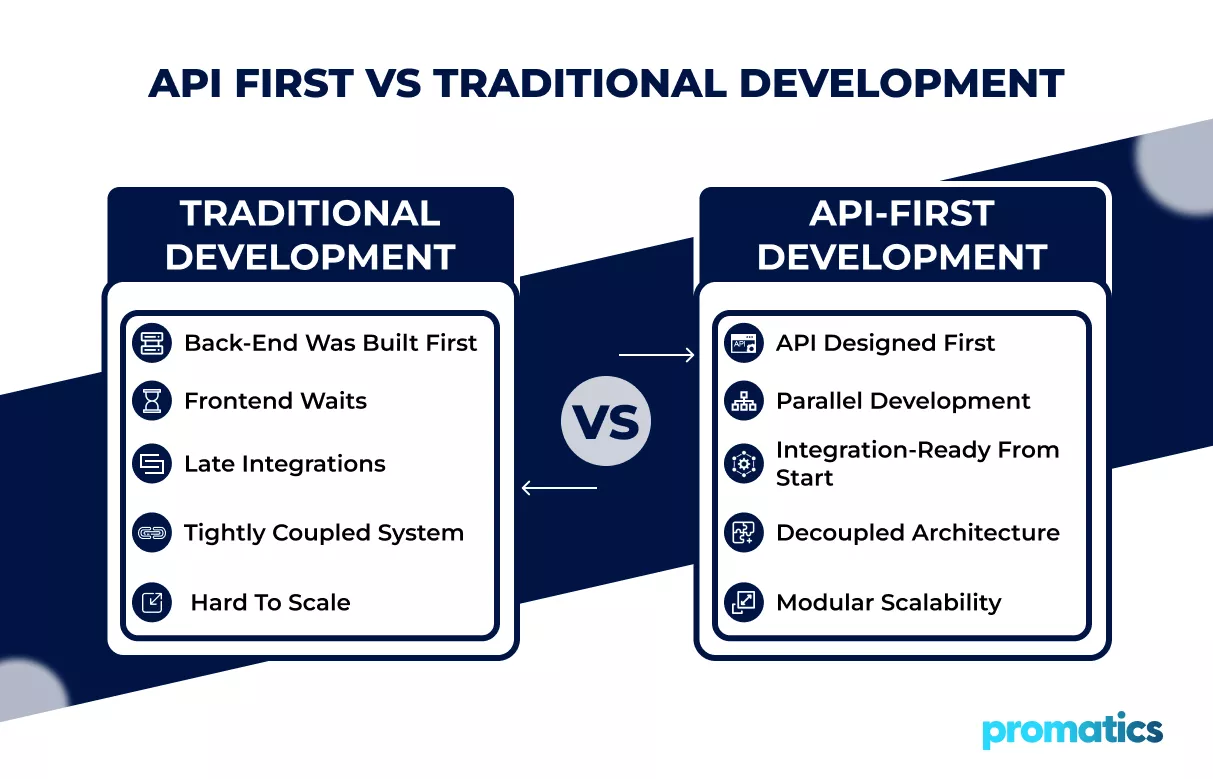
Historically, applications were developed using a code-first or monolithic approach. Backend logic was created first, and APIs were added later to expose functionality.
While this approach worked for smaller systems, it presents several challenges in modern digital environments:
- Frontend teams must wait for backend completion
- Integrations are implemented late in the lifecycle
- Documentation is inconsistent
- Changes to backend logic can disrupt client applications
- Scaling requires significant restructuring
Modern platforms require flexibility across multiple touchpoints. They must support web interfaces, mobile apps, cloud services, automation systems, and third-party tools simultaneously.
Without a structured API strategy, systems become fragile under this complexity.
API-driven architecture solves these issues by embedding modularity, interoperability, and scalability into the foundation of the application.
How API-First Development Future-Proofs Applications
1. Enables Parallel Development and Faster Delivery
When APIs are clearly defined at the beginning of the project, frontend and backend teams can work simultaneously.
Frontend teams use API specifications and mock services to begin building user interfaces. Backend teams implement services independently. Quality assurance teams validate API contracts early in the lifecycle.
This parallel workflow reduces bottlenecks and accelerates time to market.
For businesses operating in competitive industries, the ability to release features quickly without sacrificing stability becomes a critical advantage.
2. Supports Multi-Platform Expansion
Modern users interact with businesses across devices and platforms. A single backend system may need to support:
- Web applications
- Native mobile applications
- Cross-platform mobile apps
- Progressive web apps
- Internet of Things devices
- Third-party integrations
API First architecture ensures that the backend is platform agnostic. Any client that adheres to the API contract can interact with the system.
This allows businesses to expand into new digital channels without rewriting core functionality.
At Promatics Technologies, we design API-driven platforms that enable seamless cross-platform experiences from the start.
3. Aligns with Microservices and Cloud-Native Architecture
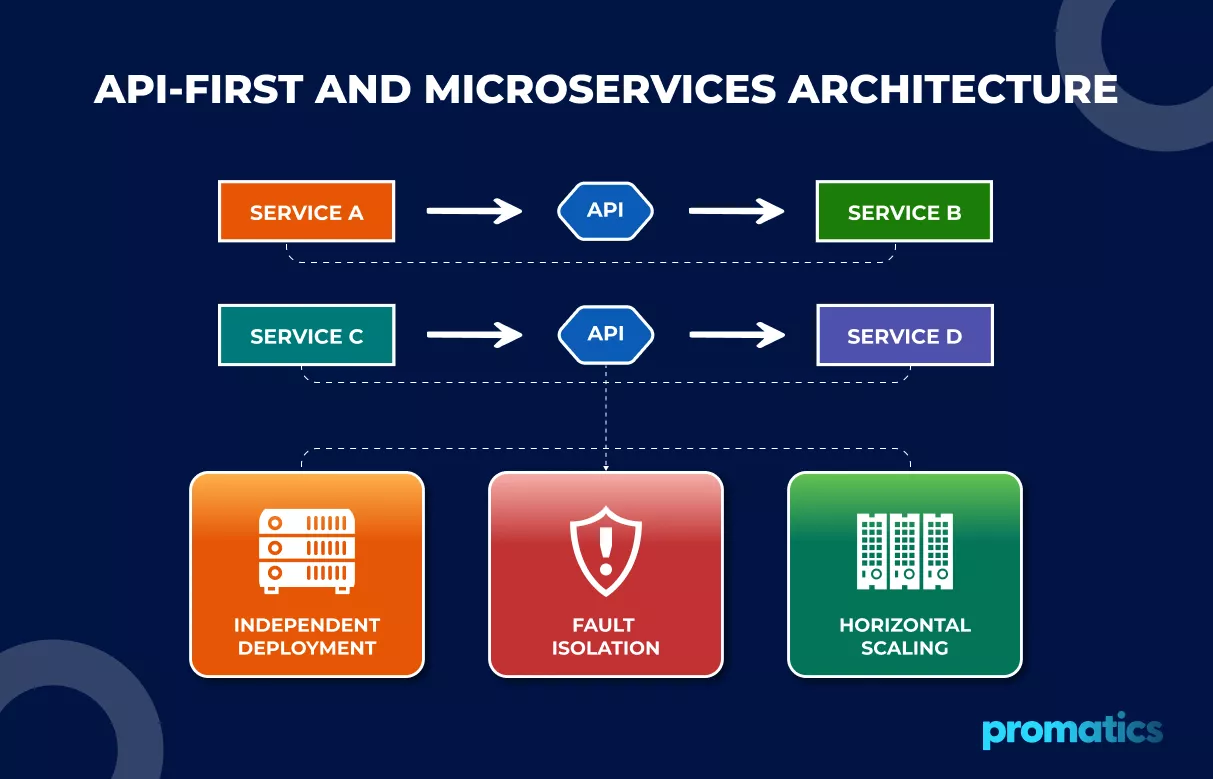
API First development integrates naturally with a microservices architecture.
In a microservices model, each service exposes well-defined APIs. Services can be deployed, scaled, and updated independently. This modular structure increases flexibility and resilience.
Cloud-native environments further enhance these capabilities by enabling:
- Horizontal scaling
- Containerized deployment
- Independent service optimization
- Continuous integration and deployment
When APIs are central to system design, applications can evolve incrementally rather than requiring full-scale rewrites.
4. Simplifies Integrations and Ecosystem Growth
Digital ecosystems rely heavily on integrations. Organizations must connect with:
- Payment gateways
- Customer relationship management systems
- Marketing automation platforms
- Enterprise resource planning systems
- Analytics tools
- Artificial intelligence services
API First systems are designed with interoperability in mind. Clean and well-documented endpoints reduce friction when integrating with external services.
This capability enables businesses to expand partnerships, automate workflows, and build connected digital ecosystems efficiently.
5. Improves Security and Compliance Readiness
Because APIs expose business logic and sensitive data, security must be embedded into the architecture.
API The first design incorporates security considerations at the specification stage, including:
- Token-based authentication
- OAuth protocols
- Role-based access control
- Encryption in transit and at rest
- Rate limiting
- Monitoring and logging mechanisms
By integrating security at the API level, organizations reduce vulnerabilities and improve compliance readiness.
This proactive approach strengthens overall system integrity.
6. Reduces Technical Debt and Maintenance Costs
Technical debt accumulates when systems grow without structure. Inconsistent endpoints, undocumented changes, and hidden dependencies create long-term maintenance challenges.
API First development enforces discipline through:
- Structured documentation
- Clear versioning strategies
- Backward compatibility planning
- Governance policies
This structured evolution reduces unexpected disruptions and simplifies maintenance over time.
As a result, businesses can focus more on innovation and less on firefighting.
API First in Web Application Development
For web applications, API First architecture enables rapid iteration and scalability.
Frontend frameworks such as React, Angular, and Vue operate effectively in decoupled environments where APIs serve as the communication layer. This separation of concerns allows frontend teams to enhance user experiences without impacting backend logic.
Benefits include:
- Faster feature deployment
- Improved maintainability
- Independent UI experimentation
- Simplified performance optimization
- Better integration with analytics and personalization tools
Promatics Technologies builds web platforms using API First principles to ensure flexibility and long-term adaptability.
API First in Mobile Application Development
Mobile applications depend entirely on APIs for backend communication. A well-designed API directly impacts performance, reliability, and user experience.
API First ensures:
- Stable endpoints across app versions
- Efficient payload structures optimized for mobile networks
- Secure authentication flows
- Real-time synchronization
- Scalable backend support
Whether building native applications or cross-platform solutions, API-driven architecture ensures consistency and scalability.
As mobile ecosystems evolve, API First systems remain adaptable.
Governance and API Lifecycle Management
A successful API First implementation requires governance.
Organizations must establish:
- API design standards
- Documentation protocols
- Version management strategies
- Deprecation policies
- Monitoring and analytics systems
- Compliance auditing procedures
Without governance, API proliferation can create complexity. With governance, APIs become strategic business assets.
At Promatics Technologies, we implement structured API lifecycle management to ensure sustainable and scalable growth.
Business Impact of API-First Development
API First development delivers measurable business outcomes.
It enables:
- Faster product launches
- Lower integration costs
- Increased operational efficiency
- Enhanced customer experiences
- Greater agility in responding to market changes
- Improved collaboration between teams
- Long-term cost savings through reduced rework
Organizations that adopt API First architecture position themselves for continuous innovation.
Why Choose Promatics Technologies for API First Development
At Promatics Technologies, we combine architectural expertise with business strategy.
Our API First services include:
- API strategy consulting
- API design and documentation
- Secure API development
- Microservices implementation
- Cloud-native deployment
- Third-party integrations
- Performance optimization
- Ongoing support and maintenance
We focus on building scalable digital ecosystems rather than short-term solutions.
Build a Future-Ready Digital Platform
If your organization is planning to scale web or mobile applications, modernize legacy systems, or integrate with complex digital ecosystems, API First development is the foundation for long-term success.
Promatics Technologies helps you design resilient, scalable, and integration-ready architectures that evolve with your business goals.
Connect with our team to define your API First strategy and build digital platforms that are prepared for the future.Let us help you transform your applications into scalable, adaptable systems that grow without limits.
