Enterprise API Development: Architecture, Security, Integration, and Scalability

Modern enterprises rely on interconnected applications to manage customer data, process transactions, automate workflows, and deliver digital experiences. Enterprise API development enables these systems to exchange information securely and consistently.
But building an API that works is not enough. Enterprise APIs must handle increasing traffic, protect sensitive data, maintain availability, and integrate with evolving business systems.
According to a REST API performance statistics report, average API uptime declined from 99.66% in Q1 2024 to 99.46% in Q1 2025. The report also states that 95% of organizations experienced production API security issues in 2024.
These findings highlight the importance of building APIs with security, performance, and reliability in mind from the beginning.
This guide explores enterprise API architecture, integration strategies, security best practices, scalability, and the process of selecting an API development partner.
What Is Enterprise API Development?
Enterprise API development is the process of designing, building, securing, integrating, and maintaining application programming interfaces that connect business applications, databases, cloud platforms, and third-party services.
Unlike basic APIs built for a single application, enterprise APIs often support multiple systems, business units, and external consumers. They require consistent documentation, access controls, monitoring, and lifecycle management.
Common applications include:
- Connecting CRM, ERP, and financial platforms.
- Powering mobile and web applications.
- Integrating payment, shipping, and eCommerce systems.
- Connecting legacy software with cloud applications.
- Enabling AI applications and automated workflows.
- Sharing data with business partners through controlled interfaces.
For example, an enterprise retailer can use APIs to connect its online store with inventory, payments, shipping, and customer management systems.
Businesses developing connected digital products can explore web development services.
Why Is Enterprise API Development Important?
Enterprise API development creates a foundation for connected, adaptable, and maintainable software systems.
- Improved integration: APIs reduce data silos by allowing applications to exchange information through defined interfaces.
- Faster development: Reusable APIs help teams build new applications without duplicating existing business logic.
- Better scalability: Well-designed APIs support growing traffic, additional integrations, and expanding product requirements.
- Workflow automation: APIs connect business software with automation platforms, analytics tools, and AI services.
- Simpler modernization: APIs can expose selected functions of older applications, allowing businesses to integrate modern systems without replacing everything at once.
Organizations planning technology upgrades can explore legacy system modernization.
Enterprise API Architecture: Choosing the Right Approach
Enterprise API architecture determines how applications, services, and data sources communicate. The right approach depends on system complexity, performance requirements, security, and future growth.
| Architecture pattern | Best suited for | Main consideration |
| Monolithic | Applications with closely connected functionality | Individual components may be difficult to scale independently |
| Microservices | Complex platforms with independently deployable services | Requires service coordination and monitoring |
| API gateway | Applications exposing multiple backend services | Needs secure routing and traffic controls |
| Event-driven | Asynchronous workflows and real-time updates | Requires reliable event delivery |
| Layered architecture | Systems needing clear separation of responsibilities | Additional layers can increase complexity |
These patterns can work together. For example, microservices may operate behind an API gateway while event-driven messaging handles background processes.
REST vs. GraphQL vs. gRPC
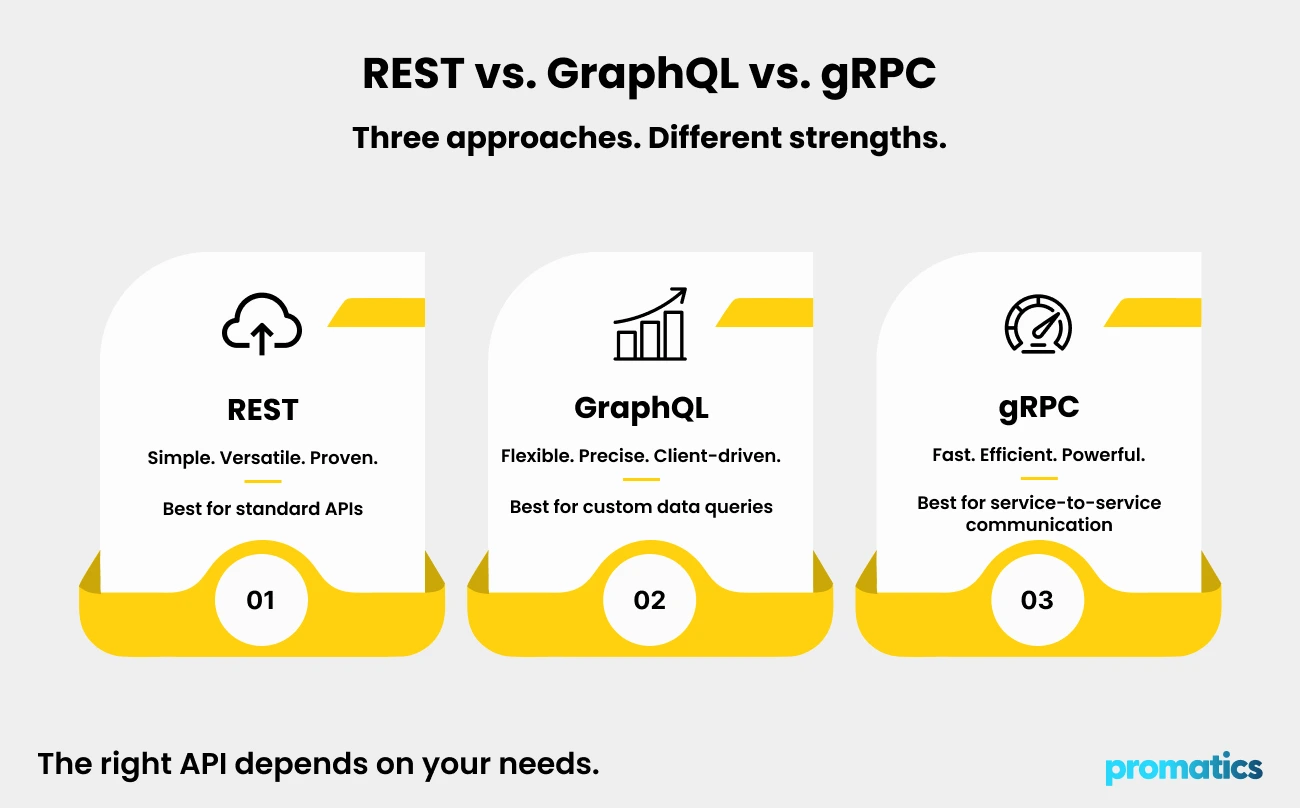
Choosing an API technology affects performance, flexibility, and integration complexity.
| Technology | Key strength | Common use case |
| REST | Broad compatibility and resource-based design | Web, mobile, and partner APIs |
| GraphQL | Flexible data retrieval | Data-intensive applications |
| gRPC | Efficient service-to-service communication | Internal enterprise services |
The REST API performance report states that 93% of developers use REST APIs as their primary architecture in its referenced research. This indicates broad adoption, but the best choice for an enterprise depends on its technical and business requirements.
Enterprise API Security Best Practices
Enterprise API security protects the data, users, and systems exposed through APIs. It should be integrated into design, development, deployment, and ongoing maintenance.
The cited API performance and security report states that 95% of organizations experienced production API security issues in 2024. The statistic reflects the report’s underlying research and should be interpreted within its stated scope.
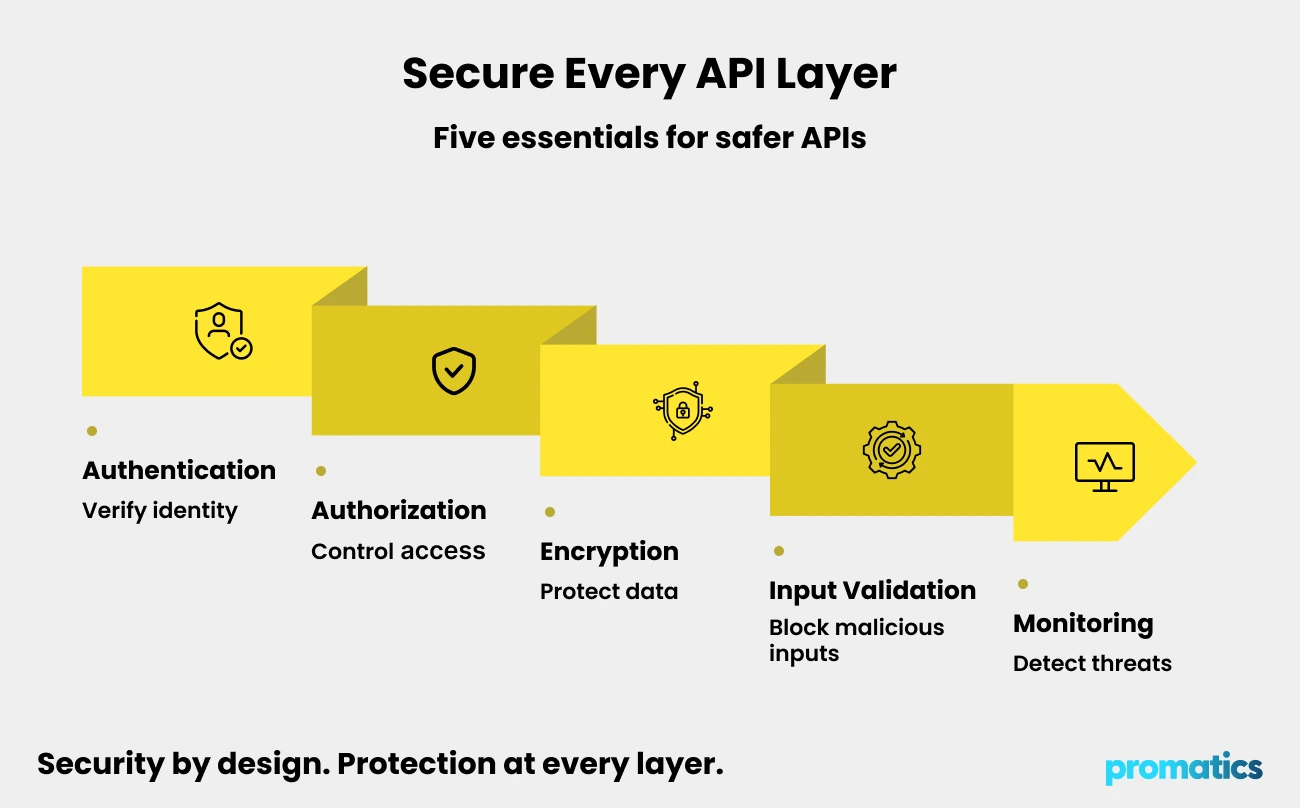
Key API security practices include:
- Authentication: Verify users and applications using appropriate identity standards.
- Authorization: Restrict access according to roles, permissions, and resource ownership.
- Encryption: Protect data in transit and sensitive information at rest.
- Input validation: Validate request parameters and payloads.
- Rate limiting: Control excessive traffic and reduce abuse.
- Secrets management: Store keys and credentials securely.
- Monitoring and testing: Detecting suspicious activity and regularly assessing vulnerabilities.
Use the OWASP API Security Project as a reference when identifying common API risks.
Enterprise API Integration: Connecting Business Systems
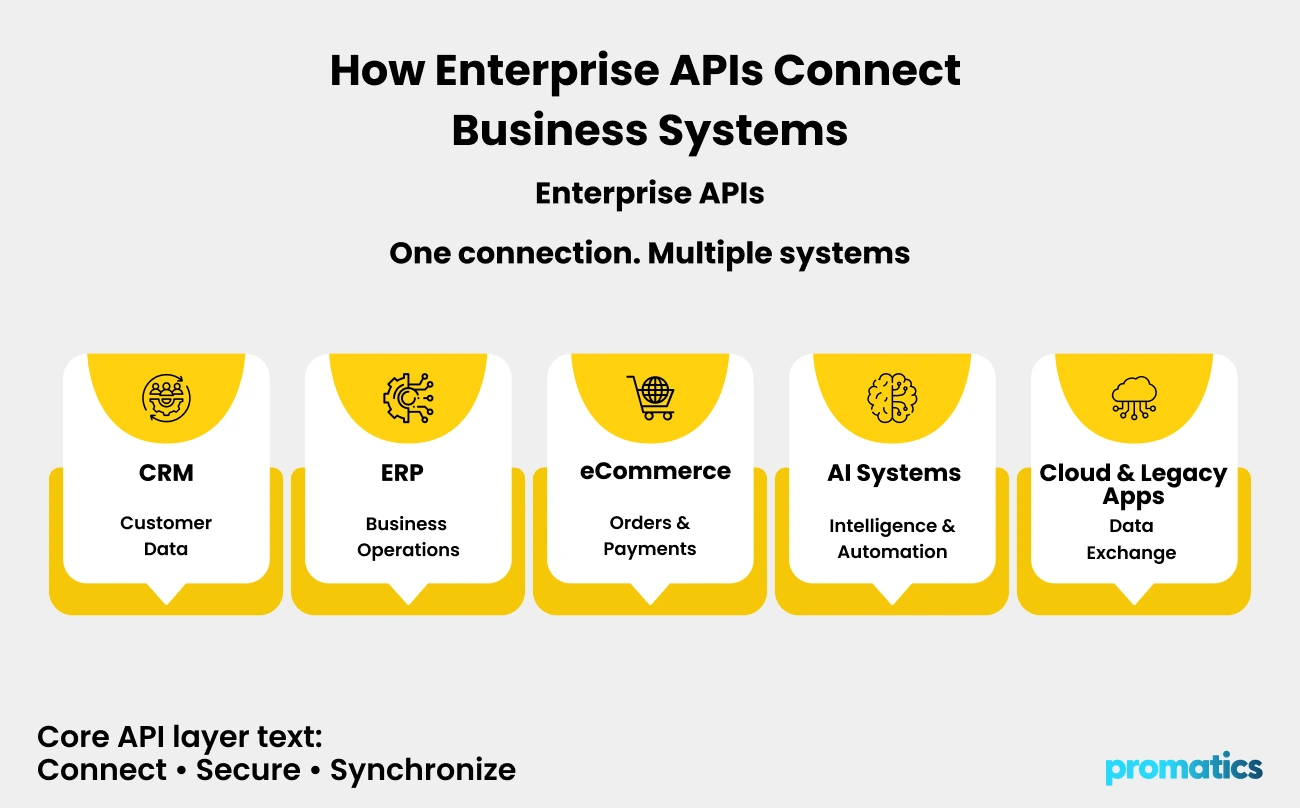
Enterprise API integration connects applications, databases, cloud services, and third-party platforms so that information can move between systems reliably.
Common use cases include:
- CRM and ERP synchronization.
- Payment and order management integration.
- Inventory and shipping updates.
- Cloud and legacy application connectivity.
- AI services integrated with enterprise workflows.
Successful integration requires clear data formats, authentication, error handling, retry policies, and system ownership.
For example, an online retailer can connect its storefront to inventory, payment, shipping, and customer management platforms. This can reduce manual work and improve data consistency.
Explore eCommerce web development services for connected commerce solutions. Businesses integrating older infrastructure can also consider modernization and migration services.
How to Build Scalable Enterprise APIs
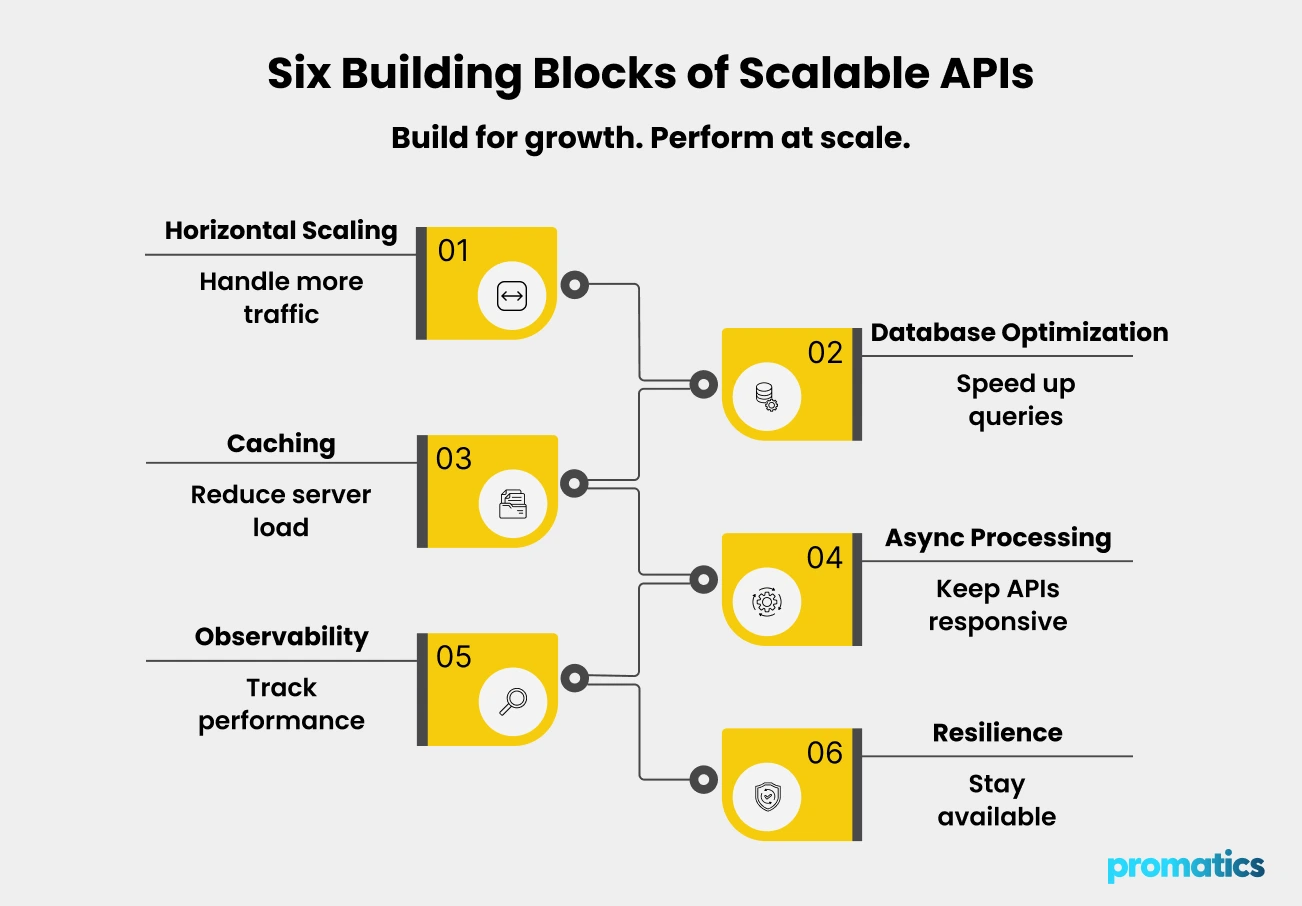
Scalable API development enables services to handle increasing traffic while maintaining acceptable response times, reliability, and security.
Key practices include:
- Design for independent scaling. Use stateless services where appropriate and scale components according to their workload.
- Optimize databases. Improve queries, indexing, connection pooling, and pagination.
- Use caching strategically. Reduce repeated processing while respecting data freshness and access requirements.
- Move lengthy tasks to asynchronous workflows. Queues and event-driven processes can prevent slow operations from blocking user requests.
- Plan for failures. Apply sensible timeouts, bounded retries, circuit breakers, and graceful error handling.
- Monitor availability and latency. Track service health, error rates, and infrastructure utilization to identify bottlenecks.
The reported change in API uptime from 99.66% to 99.46% demonstrates why availability needs continuous monitoring. Uptime alone, however, cannot explain service interruptions. Teams must investigate response times, dependencies, and failure patterns.
API Performance Monitoring and Governance
API performance optimization depends on continuous measurement. Enterprise teams should monitor:
- Latency: Average and percentile response times, including p95 and p99.
- Availability: Whether endpoints remain accessible.
- Error rate: The percentage of failed requests.
- Throughput: Requests processed over a given period.
- Resource utilization: CPU, memory, database, and network consumption.
- Business outcomes: Failed transactions and incomplete workflows.
Governance is equally important. Establish documentation standards, naming conventions, versioning policies, API ownership, and deprecation procedures.
Automated tests and CI/CD pipelines help teams validate changes before deployment. Monitoring and governance should continue after launch as traffic and business requirements evolve.
For AI-enabled applications, also consider model-service latency, data permissions, and third-party dependency failures. Learn more about AI development services.
Enterprise API Development Process
A structured lifecycle helps reduce integration risks and improve maintainability.
- Requirements analysis: Define business goals, API consumers, data sources, and integration needs.
- Architecture design: Select protocols, service boundaries, authentication, and deployment models.
- API specification: Document endpoints, request formats, responses, and error handling.
- Development and integration: Build APIs and connect the required systems.
- Testing: Validate functionality, security, compatibility, and load handling.
- Deployment: Release through a controlled pipeline with monitoring and rollback procedures.
- Maintenance: Review performance, address vulnerabilities, and manage versions.
Review the project delivery approach to understand how structured development practices support software projects.
How to Choose an Enterprise API Development Company
When evaluating an enterprise API development company, assess its ability to design and maintain systems around your business requirements.
Look for experience in:
- Enterprise API architecture and integration.
- REST, GraphQL, and gRPC where appropriate.
- API security and performance testing.
- Cloud platforms and legacy system connectivity.
- Documentation, governance, and lifecycle management.
- Post-launch monitoring and support.
Review relevant software development case studies to assess project experience and technical delivery.
The right partner should explain the trade-offs behind its recommendations and align architecture decisions with your existing systems, expected traffic, security requirements, and budget.
Enterprise API Development Services
Businesses developing connected digital platforms need APIs that support their current requirements while leaving room for future changes.
Enterprise API development projects may include backend services, third-party integrations, cloud-based systems, application connectivity, and legacy modernization. Architecture and technology choices should be based on functional requirements, integration complexity, security, and long-term maintenance.
Explore web development capabilities and learn more about the team’s background and expertise.
Planning an API integration, a new enterprise application, or a modernization project? Discuss your requirements with the development team.
Conclusion
Enterprise API development provides the foundation for connected applications, automated workflows, and scalable digital products. A strong strategy combines suitable architecture, secure access controls, reliable integration, performance monitoring, and clear governance.
By addressing these areas from the start, enterprises can reduce integration complexity and build systems that are easier to maintain and extend.
For businesses planning new software or modernizing existing platforms, the right API development partner can help translate technical decisions into a practical solution aligned with long-term business goals.
