Autonomous AI Agents: How Businesses Are Building Self-Operating Systems in 2026

TL;DR
- Autonomous AI Agents are transforming businesses into self-operating systems.
- Businesses use AI-powered workflows to improve efficiency and scale faster.
- Autonomous systems combine AI, memory, APIs, and workflows to automate tasks.
- Industries like healthcare, finance, retail, and manufacturing are rapidly adopting AI agents.
- The future of enterprise AI is shifting from automation to autonomous execution.
Imagine arriving at work and discovering that customer support tickets were resolved overnight, marketing campaigns optimized automatically, sales opportunities prioritized, and operational issues fixed before anyone even noticed them. What once sounded futuristic is quickly becoming reality.
Businesses are increasingly adopting Autonomous AI Agents to build intelligent, self-operating systems capable of managing workflows with minimal human intervention. As operational complexity grows, organizations are investing in Enterprise AI Solutions, Custom Software Development Services, and Business Process Automation to improve efficiency and scale faster.
For years, businesses relied on automation tools, chatbots, and workflow platforms to streamline operations. While these technologies improved productivity, they still depended heavily on human oversight and manual coordination.
Today, organizations are moving beyond simple automation toward intelligent ecosystems powered by Autonomous AI Agents, AI Powered Applications, and Workflow Automation Solutions capable of reasoning, planning, executing tasks, and continuously optimizing operations.
This shift marks the rise of AI-powered digital workforces, where businesses are building scalable AI Driven Business Solutions and intelligent systems designed for the future. Read on to discover how Autonomous AI Agents are reshaping industries and accelerating Digital Transformation Solutions across enterprises.
What Are Autonomous AI Agents and How Do They Work?
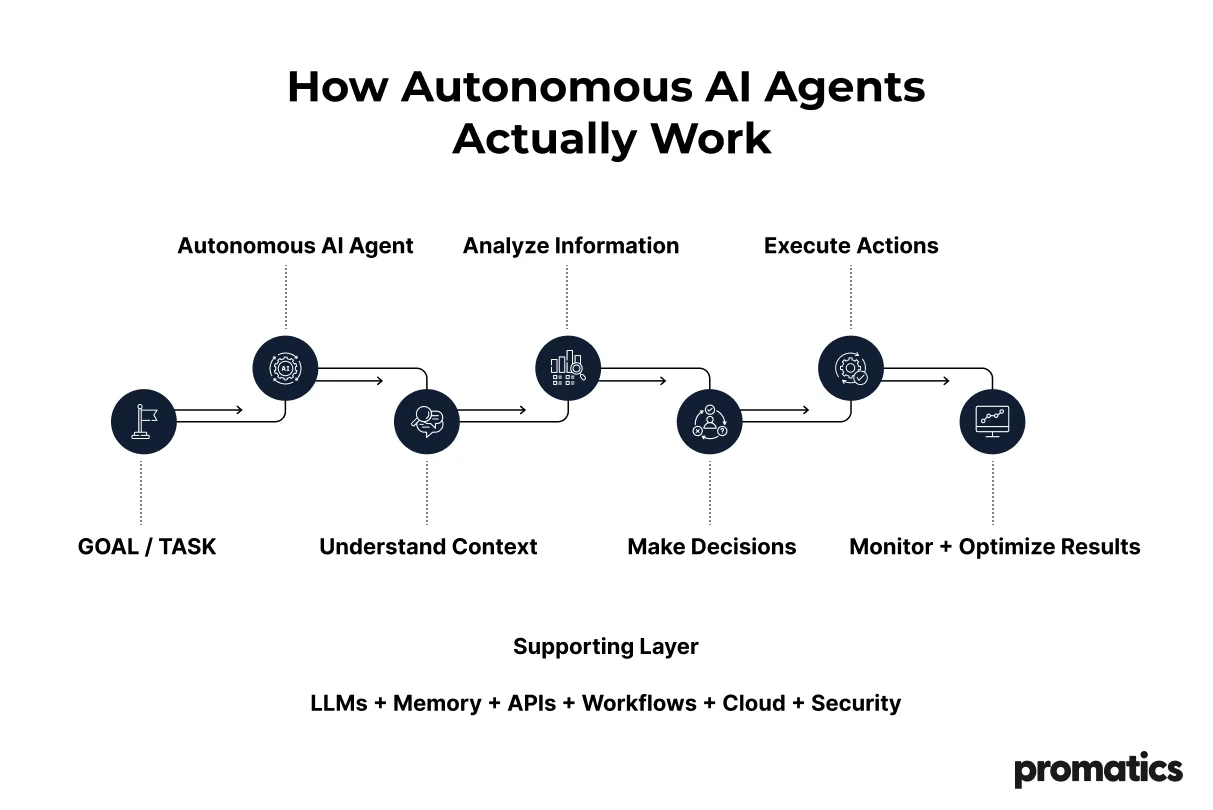
Autonomous AI agents are intelligent systems capable of planning, reasoning, making decisions, and executing tasks with minimal human intervention. Unlike traditional AI systems that primarily respond to prompts or predefined workflows, autonomous agents can analyze goals, understand context, take actions independently, and continuously improve performance through feedback and data.
The growing interest in autonomous systems is rapidly transforming enterprise AI adoption. The global AI agents market is projected to grow from $7.84 billion in 2025 to $52.62 billion by 2030, reflecting the increasing demand for intelligent systems capable of automating complex workflows and business operations.
Businesses are also increasingly recognizing their strategic value. Studies suggest that nearly 90% of businesses view AI agents as a competitive advantage, while organizations continue expanding investments in intelligent automation and digital workforces.
Rather than functioning as isolated tools, autonomous AI agents increasingly behave like digital workers capable of managing operational workflows, collaborating across systems, and executing business processes independently. This shift represents one of the biggest transformations in enterprise AI as organizations move from AI-generated outputs toward AI-driven outcomes.
Why Businesses Are Building Self-Operating Systems
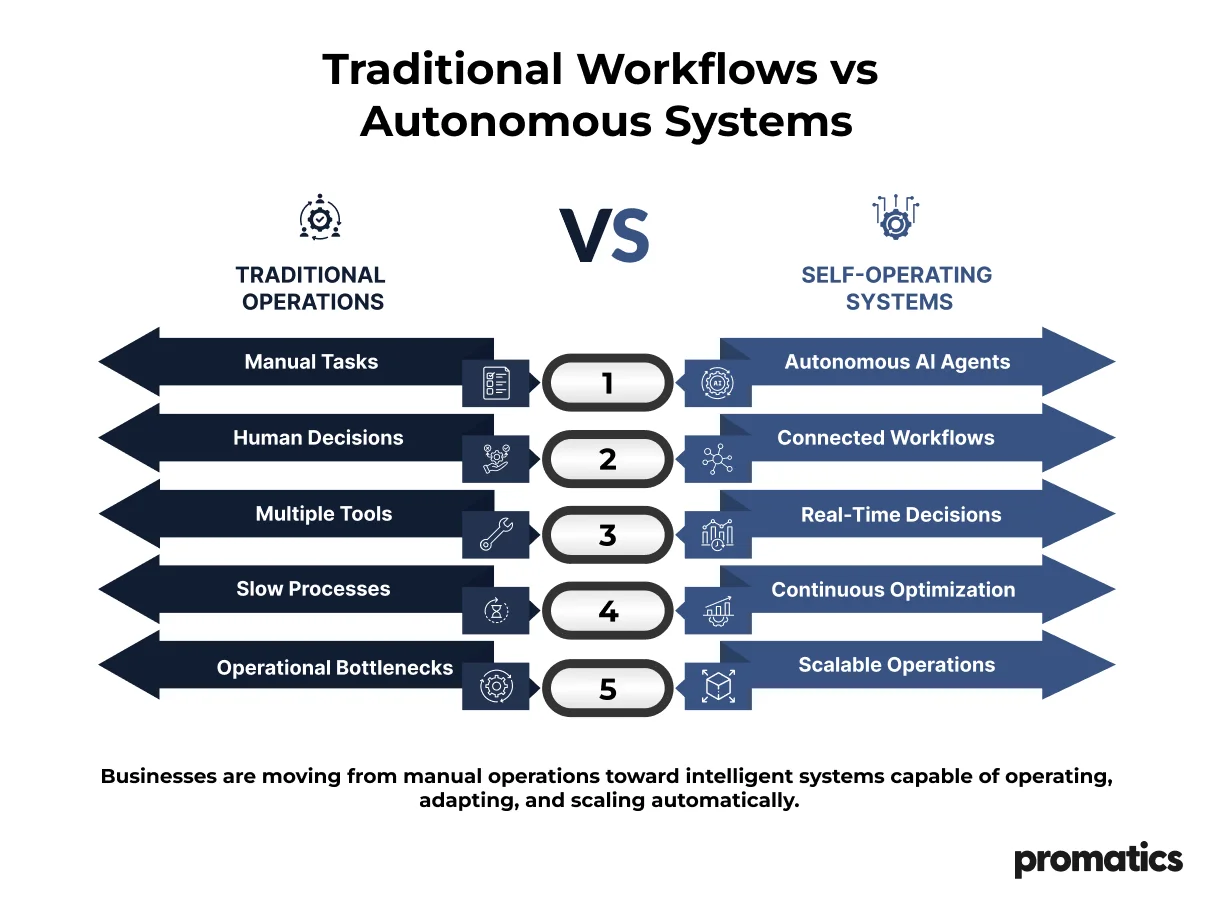
Businesses are moving beyond traditional automation and adopting self-operating systems to work faster, smarter, and more efficiently. Today, companies manage multiple teams, software tools, customer interactions, and daily operations, making manual work slower, more expensive, and harder to manage.
The shift toward autonomous systems is happening because traditional workflows can no longer keep up with growing business needs. Companies are now looking for smarter systems that can reduce repetitive work, speed up decision-making, and improve efficiency with less human involvement.
Self-operating systems help solve these problems by using autonomous agents that can analyze information, manage workflows, take actions, and improve operations automatically. Instead of employees spending hours moving data between platforms, checking dashboards, approving tasks, or handling repetitive work, intelligent systems can manage many of these processes on their own.
More importantly, businesses are realizing that success no longer depends only on using AI tools. It depends on building smarter systems that can grow faster, adapt quickly, and continuously improve performance.
This shift is more than just another step in automation. It marks the move from human-managed workflows to AI-powered digital workforces that are changing how businesses operate, compete, and grow.
Why 2026 Represents a Turning Point
Several technological shifts have converged simultaneously to make autonomous systems commercially viable. Large language models have dramatically improved reasoning capabilities. Enterprise APIs have improved connectivity. Workflow orchestration platforms have matured. Vector databases introduced better memory systems. Monitoring tools improved observability. Cloud infrastructure reduced deployment complexity.
Together, these technologies created the foundation required for autonomous systems to move from experimentation toward enterprise deployment.
Businesses are increasingly realizing that competitive advantage may no longer depend simply on using AI tools. Competitive advantage increasingly depends on how effectively organizations orchestrate autonomous systems across workflows.
Top Autonomous AI Agents and Real-World Examples in 2026
Autonomous Marketing Agents
Marketing is becoming increasingly agent-driven. Modern marketing agents can create content, optimize campaigns, analyze customer behavior, manage social channels, perform SEO optimization, and continuously improve strategies based on real-time performance metrics.
Businesses increasingly deploy these systems to scale marketing activities, improve Workflow Automation Solutions, strengthen AI Powered Applications, and accelerate Digital Transformation Solutions.
Customer Support and CRM Agents
Customer service agents are evolving beyond chatbots into systems capable of understanding intent, resolving issues independently, escalating complex cases, and maintaining contextual awareness across interactions.
Organizations use these systems to improve customer experiences while reducing operational costs and response times.
Sales and Revenue Agents
Sales agents increasingly automate prospecting, customer outreach, qualification, meeting scheduling, and CRM management. These systems enable sales teams to spend less time on repetitive administrative work and more time building customer relationships.
Enterprise Workflow Agents
Organizations increasingly deploy workflow agents as part of larger Business Process Automation and Enterprise AI Solutions strategies. These systems reduce bottlenecks while improving operational efficiency across departments.
Development and Engineering Agents
Software engineering teams increasingly adopt autonomous agents capable of generating code, performing testing, reviewing documentation, identifying bugs, and accelerating release cycles.
Core Technologies Powering Autonomous AI Agents
Behind every autonomous AI agent exists a sophisticated ecosystem of technologies working together to enable intelligent decision making, workflow execution, and continuous optimization. Unlike traditional automation systems that depend heavily on predefined rules and fixed workflows, autonomous systems require multiple layers of intelligence, infrastructure, and connectivity to operate effectively at scale.
Large Language Models (LLMs): The Intelligence Layer
At the core of autonomous systems are Large Language Models (LLMs), which provide reasoning, contextual understanding, planning, and decision making capabilities. These models allow autonomous agents to interpret goals, understand complex situations, generate responses, and execute increasingly advanced workflows.
However, reasoning alone is not enough. Truly autonomous systems require additional layers that allow them to remember information, collaborate across systems, and continuously improve performance.
Memory Systems and Vector Databases: Building Context and Continuity
Autonomous agents require memory to function effectively across long workflows and multiple interactions. Memory systems and vector databases allow agents to store contextual information, retrieve historical knowledge, and maintain continuity across tasks.
This enables autonomous systems to learn from previous actions, understand long term objectives, personalize responses, and make more informed decisions rather than treating every interaction as an isolated event.
Workflow Orchestration Frameworks: Coordinating Intelligent Workflows
Autonomous systems rarely operate in isolation. Most enterprise deployments involve multiple agents working together across workflows and business functions.
Workflow orchestration frameworks coordinate multi step processes, manage dependencies, trigger actions, and enable multiple agents to collaborate efficiently. This orchestration layer transforms AI from simple task automation into systems capable of executing complete workflows independently.
APIs and Enterprise Integrations: Connecting AI With Business Systems
Autonomous agents become significantly more valuable when connected with enterprise infrastructure through AI Integration Services, Enterprise Software Development, and scalable Custom AI Development Services. APIs and integration layers allow agents to communicate with CRMs, ERP systems, databases, analytics platforms, customer support software, communication tools, and other business applications.
These integrations transform autonomous agents from standalone AI tools into operational systems capable of interacting with entire business ecosystems and executing real world tasks automatically.
Cloud Infrastructure: Scaling Autonomous Systems
Large scale deployment requires significant computing power, storage, and flexibility. Cloud infrastructure provides the scalability necessary to deploy autonomous systems across complex environments while supporting real time processing and increasing workloads.
As businesses move from isolated experiments toward enterprise adoption, scalable infrastructure becomes increasingly important for supporting intelligent operational systems.
Monitoring, Governance, and Security Frameworks
As autonomous systems gain access to critical workflows and sensitive enterprise data, visibility and governance become essential. Monitoring and observability frameworks help organizations understand how agents behave, make decisions, and interact with enterprise systems.
Security layers, access controls, compliance frameworks, and governance mechanisms further ensure that autonomous agents operate safely and reliably across business environments.
Why Technology Ecosystems Matter
Research shows organizations are increasingly moving beyond isolated AI experimentation toward larger scale deployments focused on measurable business outcomes and operational efficiency. This shift is driving greater investment in AI infrastructure, governance frameworks, integrations, and enterprise deployment strategies.
Ultimately, autonomous AI agents are not powered by a single technology. They rely on interconnected ecosystems where intelligence models, memory systems, orchestration frameworks, enterprise integrations, cloud infrastructure, and governance mechanisms work together to create intelligent, scalable, and self operating systems.
How Businesses Are Building Autonomous Systems and Digital Workforces
Businesses are not becoming autonomous overnight. Instead, organizations are taking strategic, step-by-step approaches to build intelligent systems that solve real operational challenges while creating measurable business value. The journey toward self-operating systems often begins not with massive transformation projects but with identifying repetitive workflows, operational bottlenecks, and areas where teams spend significant time on manual tasks.
For many companies, the first stage of adoption starts with functions such as customer support, marketing operations, reporting, sales processes, documentation management, and workflow automation. These areas provide ideal opportunities because they involve repetitive processes that can be optimized without significantly disrupting business operations. By introducing autonomous agents into these workflows, organizations can reduce manual effort, improve efficiency, accelerate decision-making, and free employees to focus on higher-value activities.
As businesses gain confidence and begin seeing measurable results, they gradually expand automation beyond isolated use cases. Multiple specialized agents are increasingly deployed across departments where they collaborate, exchange information, and execute workflows together. What starts as individual automation initiatives slowly evolves into interconnected ecosystems where autonomous systems manage increasingly complex operations across the organization.
The most successful organizations understand that implementing autonomous systems is not simply about adopting new technology. It is about building smarter operational models capable of improving productivity, increasing scalability, reducing operational costs, and creating faster, more adaptive business environments. Businesses are not simply implementing autonomous agents. They are building scalable AI Driven Business Solutions capable of supporting long-term growth. They are redesigning how work itself gets done.
Key Trends Shaping Autonomous AI Agents in 2026
Multi-Agent Systems Become Standard
Organizations increasingly move beyond isolated AI systems toward ecosystems where multiple specialized agents collaborate together.
Enterprise Governance Becomes Critical
As agents gain access to sensitive systems and critical workflows, organizations increasingly prioritize security, monitoring, compliance, audit trails, and governance frameworks.
Agentic Workflows Replace Traditional Automation
Businesses increasingly transition from static workflows toward systems capable of adapting dynamically to changing conditions and objectives.
Challenges Slowing Enterprise Adoption
Despite enormous enthusiasm surrounding autonomous systems, significant challenges remain.
Reliability remains a major concern because agents occasionally generate incorrect outputs or behave unpredictably in unfamiliar situations.
Security and governance present additional challenges because autonomous systems increasingly access sensitive business infrastructure and customer information.
Organizations must also address cultural challenges because shifting from human-managed workflows toward AI-driven operations often requires substantial organizational change.
How Autonomous AI Agents Are Transforming Industries
Autonomous AI agents are no longer limited to experimental projects or technology companies. Businesses across industries are increasingly adopting intelligent systems to automate workflows, improve decision-making, reduce operational costs, and create more efficient business operations. As autonomous technologies continue evolving, organizations are discovering new ways to integrate AI-driven workflows into everyday processes.
Healthcare
Healthcare organizations are increasingly adopting autonomous systems to streamline administrative workflows, improve patient communication, automate documentation, and reduce operational burdens. These systems help healthcare providers improve efficiency while allowing teams to focus more on patient care.
Financial Services
Financial institutions use autonomous AI agents for fraud detection, risk assessment, transaction monitoring, compliance management, and operational automation. These systems help organizations analyze large volumes of data faster while improving accuracy and reducing manual intervention.
Retail and Ecommerce
Retail businesses are using autonomous systems for inventory management, customer personalization, demand forecasting, pricing optimization, and customer support automation. Intelligent systems enable retailers to deliver better customer experiences while improving operational efficiency across multiple channels.
Manufacturing and Supply Chain
Manufacturing companies increasingly deploy autonomous agents for predictive maintenance, production monitoring, quality control, and supply chain optimization. These systems help organizations reduce downtime, improve operational visibility, and create more resilient production environments.
The Bigger Picture
The impact of autonomous AI agents extends far beyond individual industries. From healthcare and finance to retail, manufacturing, and enterprise operations, businesses across sectors are increasingly experimenting with autonomous workflows to build faster, smarter, and more scalable organizations.
The Future of Autonomous Enterprises
The rise of autonomous AI agents may fundamentally reshape how organizations operate.
Future businesses may increasingly consist of hybrid workforces where human employees collaborate directly with specialized digital coworkers. Teams may manage collections of autonomous agents alongside traditional teams.
Organizations capable of building scalable digital workforces may gain significant advantages in speed, operational efficiency, and customer experience.
The question is no longer whether autonomous AI agents will reshape enterprise operations. The question is how quickly businesses can adapt.
Conclusion
Businesses are moving beyond simply using AI tools and beginning to build intelligent systems capable of automating workflows, making decisions, and improving operations with minimal human involvement. Autonomous AI Agents are no longer just another technology trend. They are changing how businesses operate, scale, and compete.
While challenges around implementation, security, and governance still exist, organizations investing in autonomous systems today are building the foundation for faster, smarter, and more scalable operations tomorrow.
The future of AI is no longer just about assistance. It is about execution, automation, and intelligent digital workforces.
At Promatics Technologies, we help businesses build scalable AI solutions, autonomous systems, and future-ready digital products.
Ready to build smarter AI-powered business systems? Connect with Promatics Technologies and discover how Autonomous AI Agents can transform your business operations.
