The Future of Software Development in India: AI, Startups & Industry Leaders

TL;DR
- India is shifting from outsourcing hub to global innovation and R&D leader
- AI, cloud-native, and automation are driving next-gen software development
- Strong talent pool and cost efficiency attract global businesses
- Rise of SaaS, startups, and deep-tech innovation ecosystems
- Key challenges: talent gaps, cybersecurity, and evolving tech demands
Over the past two decades, India has evolved from a cost-effective IT outsourcing destination into a global hub for software development and digital innovation. Today, the country plays a leading role in generative AI adoption, supported by a rapidly growing startup ecosystem and increasing global investment.
At the same time, artificial intelligence is reshaping the future of software development. The conversation is no longer about competition between humans and machines but about collaboration and the evolution of developer roles. As AI becomes more capable of handling complex tasks, one question continues to emerge: Will AI eventually replace developers?
The answer lies in the transformation already underway. AI is changing how software is built, tested, and deployed, redefining developer responsibilities and shaping the future of work. The global artificial intelligence market is expected to grow at a CAGR of 36.8% and reach $150.2 billion by 2030, highlighting AI’s expanding role in software development.
With over 5 million developers, a fast-growing startup ecosystem, and a rapidly expanding digital economy, India has become a strategic technology partner for organizations worldwide. Businesses across North America, Europe, the Middle East, and Asia increasingly collaborate with Indian software development companies to build scalable digital platforms and AI-powered solutions.
As global industries accelerate digital transformation, India’s technology ecosystem continues to play a key role in building the intelligent systems and digital infrastructure powering the next generation of businesses.
India’s Software Development Industry: Key Statistics
India’s IT and software industry continues to expand rapidly and has become one of the largest technology ecosystems in the world.
According to industry NASSCOM, the Indian technology sector is expected to remain a major driver of global digital innovation
Key Industry Insights
| Industry Metric | Data |
| Total Developers in India | 5+ Million |
| IT Industry Revenue | $245+ Billion |
| Number of Startups | 90,000+ |
| AI Startups in India | 4,000+ |
| Projected SaaS Market | $50 Billion by 2030 |
These numbers highlight why global companies increasingly partner with Indian software development companies to build scalable digital products.
Why This Question Matters: The Real Impact of AI on Developers
The conversation about AI replacing developers is no longer theoretical; it is already shaping the industry. Industry leaders and research reports have offered valuable insights into how AI is influencing the future of development.
Some experts believe AI could automate a significant portion of coding tasks. Others emphasize that AI will enhance human capability rather than replace it.
Large companies such as Walmart continue to hire software engineers even while investing heavily in AI agents and automation systems. This clearly demonstrates the ongoing need for human expertise in designing, managing, and improving digital systems.
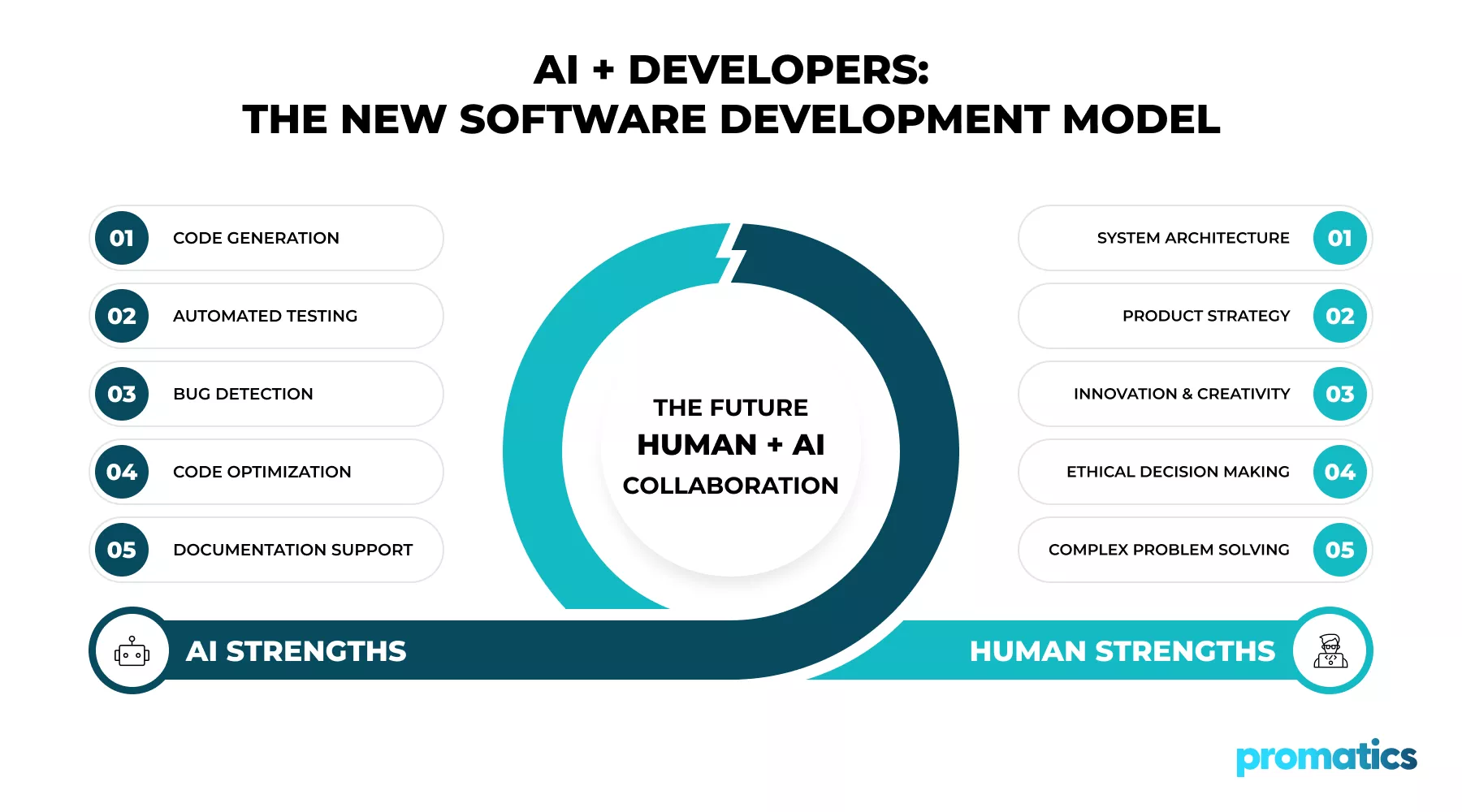
AI assistants are reshaping development workflows, but humans still make strategic decisions about product requirements, system architecture, ethical considerations, and long-term business impact.
What is becoming increasingly clear is that the future of work is not a battle between developers and AI, it is a collaborative partnership.
Section 1: What AI Can and Cannot Do in Software Development
The Strengths of AI in Coding
Artificial intelligence has made remarkable progress in software development. Modern AI-powered tools can:
- Generate boilerplate code and templates
AI can quickly produce repetitive code structures, saving developers significant time. - Provide intelligent code suggestions
Tools like GitHub Copilot and other generative AI models offer contextual suggestions while developers write code.
- Create test cases and documentation
AI can automatically generate test scenarios, documentation drafts, and integration components that speed up development workflows.
- Analyze code for patterns and performance issues
Machine learning systems can detect common bugs and performance bottlenecks faster than traditional manual reviews.
These capabilities are dramatically improving productivity. In some organizations, a significant portion of code is now AI-assisted or AI-generated, allowing developers to focus on more complex tasks.
Section 2: Will AI Replace Developers by 2030? A Balanced Reality Check
The short answer is no AI will not completely replace developers by 2030. However, the nature of the developer’s role will evolve significantly.
What Will Likely Change
- AI will increasingly handle repetitive and rule-based coding tasks, generating large sections of code that previously required weeks of manual effort.
- Developers will spend more time guiding AI systems, designing effective prompts, supervising outputs, and focusing on higher-level problem solving.
- Software roles will gradually shift toward system architecture, strategic planning, cross-disciplinary collaboration, and product innovation.
- Developers may also take on responsibilities such as auditing AI-generated code, optimizing models, and integrating AI systems into enterprise solutions.
In this evolving landscape, AI does not replace developers, it redefines what being a developer means.
What Will Remain Human-Driven
Despite rapid AI advancement, several capabilities remain fundamentally human.
- Critical thinking and creativity
Developers generate innovative ideas, anticipate future challenges, and design novel solutions beyond existing data patterns. - Ethical reasoning
Humans evaluate ethical trade-offs, ensure fairness in algorithms, and assess social implications of technology. - Communication and empathy
Software professionals collaborate with teams, translate technical concepts into business strategies, and align development with organizational goals. - Accountability and leadership
Human oversight ensures that AI systems operate responsibly and align with business and societal values.
These are not tasks machines can fully handle on their own—at least not in ways that deliver meaningful outcomes and build human trust.
Emerging Roles in the AI-Driven Future
The integration of AI into development workflows is already creating new career opportunities. At the same time, low-code and no-code platforms are reshaping how software is built, creating demand for new roles focused on automation, AI integration, and solution architecture. The low-code development market is expected to reach $65 billion by 2027, reflecting the growing need for faster and more accessible software development.
This shift is driving demand for professionals who can work across AI tools, automation platforms, and modern development frameworks.
AI Model Trainer / Fine-Tuner
Specialists who refine AI systems for specific organizational needs by selecting training data, defining evaluation criteria, and improving model performance.
Prompt Engineer
Professionals who design prompts and workflows that guide AI models toward accurate and reliable results.
AI Code Validator / Safety Reviewer
Developers who review AI-generated code for security, performance, compliance, and maintainability.
Hybrid Technical Roles
New roles such as AI-Ops engineers, automation architects, and ethical technology strategists are emerging at the intersection of software engineering and AI governance.
The Future Developer Skill Set: What You Need to Succeed
As AI reshapes development workflows, successful developers will be those who adapt quickly.
Embrace AI as a Partner
Forward-thinking developers will treat AI tools as productivity accelerators rather than threats.
This includes:
- Learning to write effective AI prompts
- Integrating AI into debugging and testing workflows
- Using AI feedback to accelerate learning and experimentation
Developers who master AI collaboration will become even more valuable.
Cultivate Higher-Order Technical Skills
The future of development requires expertise beyond basic coding.
Key skills include:
- System architecture and scalability design
- Distributed systems and cloud infrastructure
- AI ethics and governance
- Leadership and strategic thinking
The more developers can think beyond code implementation, the more indispensable they become.
Lifelong Learning Is Non-Negotiable
Technology evolves rapidly, especially in artificial intelligence.
Developers who continually upgrade their skills will remain competitive.
Areas worth learning include:
- Artificial intelligence and machine learning fundamentals
- Prompt engineering best practices
- Cybersecurity and compliance
- Cross-domain knowledge such as product strategy and UX design
Curiosity and continuous learning are no longer optional—they are essential for long-term career growth.
The Broader Impact on the Future of Work
AI is transforming not only software development but the entire workplace.
Productivity Redefined
AI enables teams to complete routine tasks faster and with greater accuracy, allowing organizations to innovate at unprecedented speed.
The Human-AI Partnership
Rather than replacing humans, AI is embedding itself into workflows that combine machine intelligence with human judgment.
From healthcare diagnostics to financial systems and regulatory compliance platforms, humans and AI will increasingly co-create solutions together.
The Outsourcing Era: Building the Global IT Backbone
During the late 1990s and early 2000s, India became the world’s leading hub for IT outsourcing and software development services.
Global enterprises across the United States and Europe outsourced engineering, testing, and IT support to Indian technology firms.
Several factors contributed to this growth:
- Cost-efficient development services
- A large pool of highly skilled engineers
- Strong English communication capabilities
- Scalable offshore delivery models
This era saw the rise of major technology providers such as TCS, Infosys, Wipro, and HCL, which helped establish India as a trusted partner for global technology development.
However, outsourcing was only the first phase of India’s technology evolution.

The Product and SaaS Revolution
Over the past decade, India has moved from service-driven outsourcing to product-driven innovation.
A new generation of startups began building software platforms designed for global markets.
Key innovations emerged in areas such as:
- SaaS platforms for global businesses
- Fintech solutions transforming digital payments
- Cloud-based enterprise productivity tools
- Developer infrastructure platforms
- AI-powered analytics systems
Companies like Zoho and Freshworks demonstrate how Indian technology firms can successfully compete in the global software market.
The Rise of AI and Deep-Tech Innovation
Artificial intelligence now sits at the center of India’s technology transformation.
Startups, research institutions, and enterprises are heavily investing in:
- Machine learning models
- Generative AI platforms
- Intelligent automation systems
- Data engineering pipelines
- Predictive analytics systems
AI is no longer just a feature in digital products—it has become a core component of modern software development.
Accelerated Digital Transformation Across Industries
Businesses worldwide are undergoing massive digital transformation.
Organizations are redesigning their operations around software-driven platforms and digital infrastructure.
Major trends include:
- Migration from legacy systems to cloud-native architectures
- Integration of seamless digital customer experiences
- AI-powered analytics and decision-making systems
- Software platforms creating new revenue opportunities
Industries such as fintech, healthcare, manufacturing, logistics, and education increasingly rely on reliable software development services to power innovation.
Key Technologies Shaping the Future of Software Development
Several emerging technologies are redefining how modern software companies build digital platforms. One of the most significant shifts is toward data-driven development, which is shaping modern software architecture. The Big Data Analytics market is projected to reach $103 billion by 2027, highlighting how critical data processing has become for building future-ready software solutions.
Artificial Intelligence and Machine Learning
AI enables intelligent automation, predictive analytics, natural language processing, recommendation engines, and generative AI solutions.
Cloud Computing
Cloud platforms such as AWS, Microsoft Azure, and Google Cloud power scalable and secure digital applications.
Blockchain and Web3
Blockchain technology enables decentralized applications, smart contracts, digital identity systems, and transparent supply chain solutions.
Internet of Things (IoT)
IoT platforms connect software systems with physical devices across industries such as manufacturing, healthcare, and smart cities.
Low-Code and No-Code Platforms
These platforms enable faster application development, although enterprise-level solutions still require experienced software development companies.
Leading Software Development Companies in India
India’s technology ecosystem includes a wide range of organizations.
Enterprise IT Service Providers
Large enterprises delivering global technology solutions, including:
- TCS
- Infosys
- Wipro
- HCLTech
Product Development Companies
Companies building globally competitive SaaS products, such as:
- Zoho
- Freshworks
Digital Engineering Companies
Agile technology firms like Promatics Technologies focus on delivering modern custom software development services for startups and enterprises.
Promatics Technologies specializes in:
- Custom software development
- AI and machine learning solutions
- Mobile and web application development
- SaaS platform development
- Cloud-native architecture
By combining modern engineering practices with scalable technologies, Promatics Technologies helps organizations transform innovative ideas into powerful digital products.
Why Businesses Choose India for Software Development
Global enterprises choose Indian development partners for several reasons:
- Access to a large pool of skilled developers
- Cost-efficient development models
- Expertise in emerging technologies
- Proven offshore delivery frameworks
- Experience delivering large-scale enterprise solutions
These advantages make India one of the most attractive destinations for software development services.
Challenges Facing the Software Development Industry
Despite its rapid growth, the industry faces several challenges.
Talent Gap in Emerging Technologies
Demand for AI engineers, cloud architects, and cybersecurity experts continues to rise.
Cybersecurity Risks
As digital systems grow more complex, organizations must strengthen security practices.
Global Competition
Countries in Eastern Europe and Southeast Asia are expanding their technology ecosystems and competing for global clients.
The Future of Software Development in India
AI-driven development is accelerating productivity, with AI coding assistants increasing developer productivity by up to 55%, reshaping how software teams build and deploy applications.
Key trends include:
- AI-first software architectures
- Growth of deep-tech startups
- Automation in development workflows
- Expansion of India’s SaaS ecosystem
- Stronger collaboration between global enterprises and Indian technology firms
India is well positioned to remain one of the most influential technology ecosystems in the world.
Conclusion
India’s software industry has evolved far beyond its origins as an outsourcing destination. Today, it stands as a global hub for digital innovation, powered by artificial intelligence, a thriving startup ecosystem, and a vast pool of world-class engineering talent.
As businesses across industries accelerate their digital transformation, India continues to play a crucial role in building the platforms, applications, and intelligent systems that power modern enterprises. From AI-powered automation to scalable cloud-native architectures, Indian technology companies are helping organizations worldwide turn ambitious ideas into impactful digital products.
For businesses looking to develop scalable platforms, launch innovative applications, or modernize legacy systems, partnering with an experienced software development company in India offers access to advanced technical expertise, flexible development models, and highly skilled engineering teams.
Whether you’re building a new digital product, expanding your SaaS platform, or integrating AI into your business operations, working with a trusted custom software development company can significantly accelerate your innovation journey.
Promatics Technologies partners with startups, enterprises, and global organizations to design and develop scalable digital platforms, AI-driven applications, and future-ready software solutions.
Ready to turn your idea into a powerful digital product? Connect with the Promatics team today and start building the technology that drives your business forward.
