Multi-Tenant SaaS Development: Architecture, Security, Scalability, and Best Practices

TL;DR
- Architecture models: Choose between a shared database and schema, separate schemas, dedicated databases, or a hybrid approach based on your scalability, security, and customization requirements.
- Security and data isolation: Implement tenant-aware authorization, backend access controls, encryption, audit logging, and cross-tenant security testing.
- Scalability: Use database optimization, tenant-aware caching, resource limits, automated provisioning, and monitoring to maintain performance as customer numbers grow.
- React implementation: Use React for tenant-specific interfaces while enforcing access permissions and data isolation on the backend.
- Multi-tenant vs. single-tenant: Multi-tenancy can improve resource efficiency, while single-tenant deployments may suit customers requiring dedicated environments or specialized controls.
The best multi-tenant SaaS architecture balances development costs, security, performance, and future growth. Promatics Technologies helps businesses plan and develop scalable software solutions aligned with their product and business requirements.
Building a SaaS product is only the first step toward creating a scalable software business. As customer numbers grow, businesses must manage increasing data volumes, maintain consistent performance, protect customer information, and deliver new features without disrupting existing users. The architecture behind the product plays a critical role in making this possible.
Multi-tenant SaaS development offers a practical approach to these challenges. Instead of maintaining a separate application instance for every customer, businesses can serve multiple customers through a shared application while keeping their data, permissions, configurations, and business environments logically separated.
This approach can reduce infrastructure duplication, simplify product updates, and support faster customer onboarding. However, it also introduces important engineering considerations, particularly around tenant isolation, authorization, database design, performance, and compliance.
For startups launching a new SaaS product and enterprises modernizing existing software, choosing the right architecture early can influence long-term development costs and product flexibility.
At Promatics Technologies, we help businesses plan and build digital products with an emphasis on scalability, security, and long-term maintainability. In this blog, we explore how multi-tenant SaaS architecture works, which deployment models to consider, and the best practices for building a platform that can grow with your business.
What Is Multi-Tenant SaaS Architecture?
Multi-tenant SaaS architecture is a software design model in which a single application serves multiple customers, known as tenants. Each tenant may represent a company, organization, department, or individual business account.
Although tenants use the same underlying application and may share infrastructure, their data and access permissions must remain appropriately separated.
For example, consider a SaaS-based customer relationship management platform used by three companies. Each company can manage its own contacts, sales pipeline, users, reports, and subscription settings. All three use the same product, but one company’s users should not be able to access another company’s customer records.
A properly designed multi-tenant system achieves this separation through tenant-aware authentication, authorization, data access controls, and application logic.
What Is Multitenancy in SaaS?
Multitenancy is the underlying concept that allows multiple tenants to use a shared software environment while maintaining separate logical workspaces.
Depending on the product, tenants may have their own:
- User accounts and role-based permissions
- Customer records and business data
- Subscription plans and billing information
- Feature access and configuration settings
- Reports, dashboards, and integrations
- Audit trails and administrative controls
The exact level of separation depends on the application’s architecture and security requirements.
For a deeper look at architectural decisions, read Promatics Technologies’ guide to multi-tenant SaaS architecture and best practices.
How Does Multi-Tenant SaaS Architecture Work?
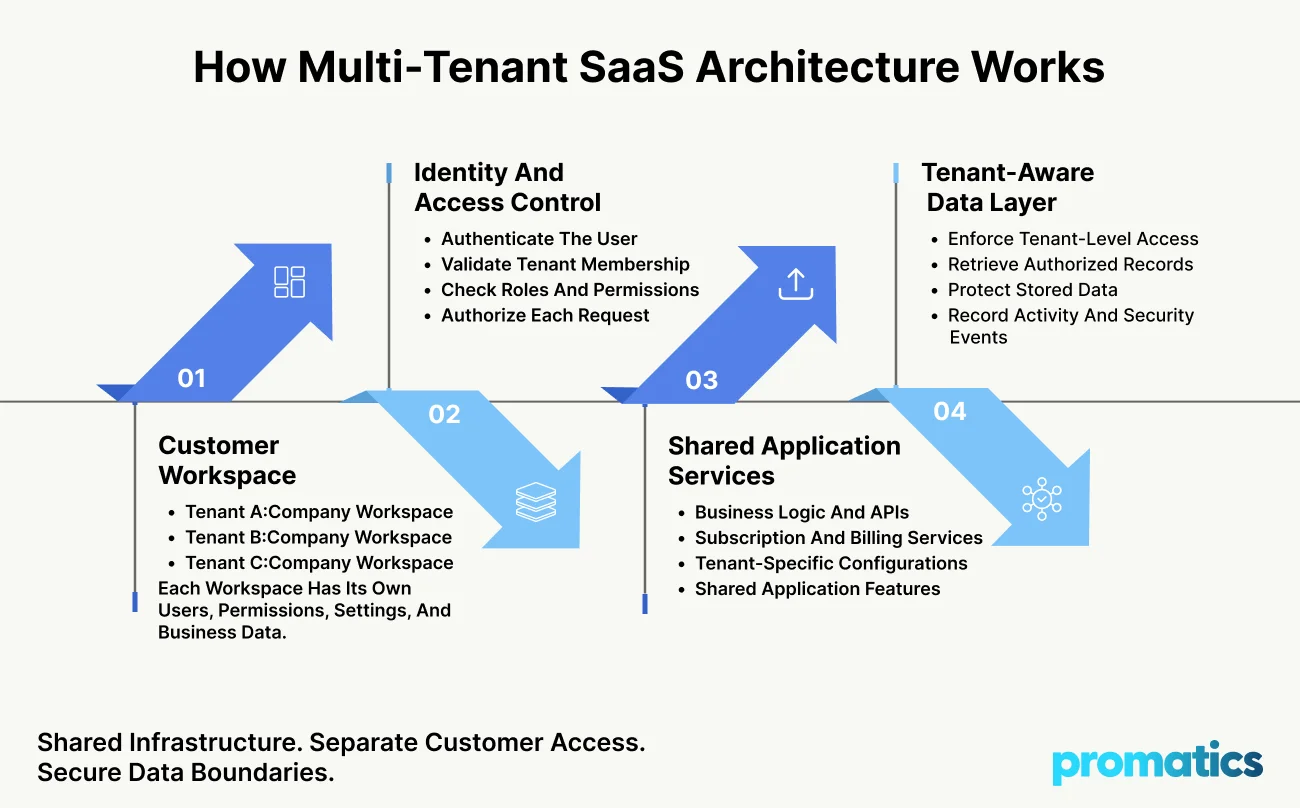
A multi-tenant SaaS platform typically includes several connected layers.
- Tenant onboarding: A new customer creates an account or is provisioned by an administrator.
- Identity and access management: The system authenticates the user and establishes the tenant context.
- Application services: The user accesses features permitted by their role, subscription, and tenant configuration.
- Data access layer: Queries and operations are restricted to the appropriate tenant’s data.
- Infrastructure and monitoring: Shared services handle hosting, logging, backups, performance monitoring, and scaling.
Tenant context must be established and validated throughout the request lifecycle. It should never be trusted merely because a tenant identifier appears in a browser request or API payload.
Multi-Tenant vs. Single-Tenant Architecture
One of the first decisions in SaaS product development is whether to use a multi-tenant or single-tenant architecture. The right choice depends on customer expectations, compliance requirements, customization needs, and operational costs.
| Comparison Factor | Multi-Tenant Architecture | Single-Tenant Architecture |
| Application environment | Multiple tenants use a shared application environment | Each tenant has a separate application environment or instance |
| Infrastructure costs | Often lower per tenant at scale | Usually higher due to dedicated resources |
| Data separation | Enforced through logical controls or isolated data stores | Often supported by dedicated data stores and environments |
| Updates and maintenance | Shared releases can simplify maintenance | Updates may need to be deployed across individual environments |
| Customization | Usually configuration-driven | Can support greater tenant-specific customization |
| Resource management | Requires controls to prevent one tenant affecting others | Resources can be managed separately for each tenant |
| Best suited for | Standardized SaaS products serving many customers | Customers needing dedicated environments or specialized controls |
Neither model is automatically more secure in every implementation. A well-designed multi-tenant platform can provide strong isolation, while a poorly configured single-tenant deployment can still contain vulnerabilities.
Businesses should evaluate the complete operating model rather than choosing architecture based on cost alone.
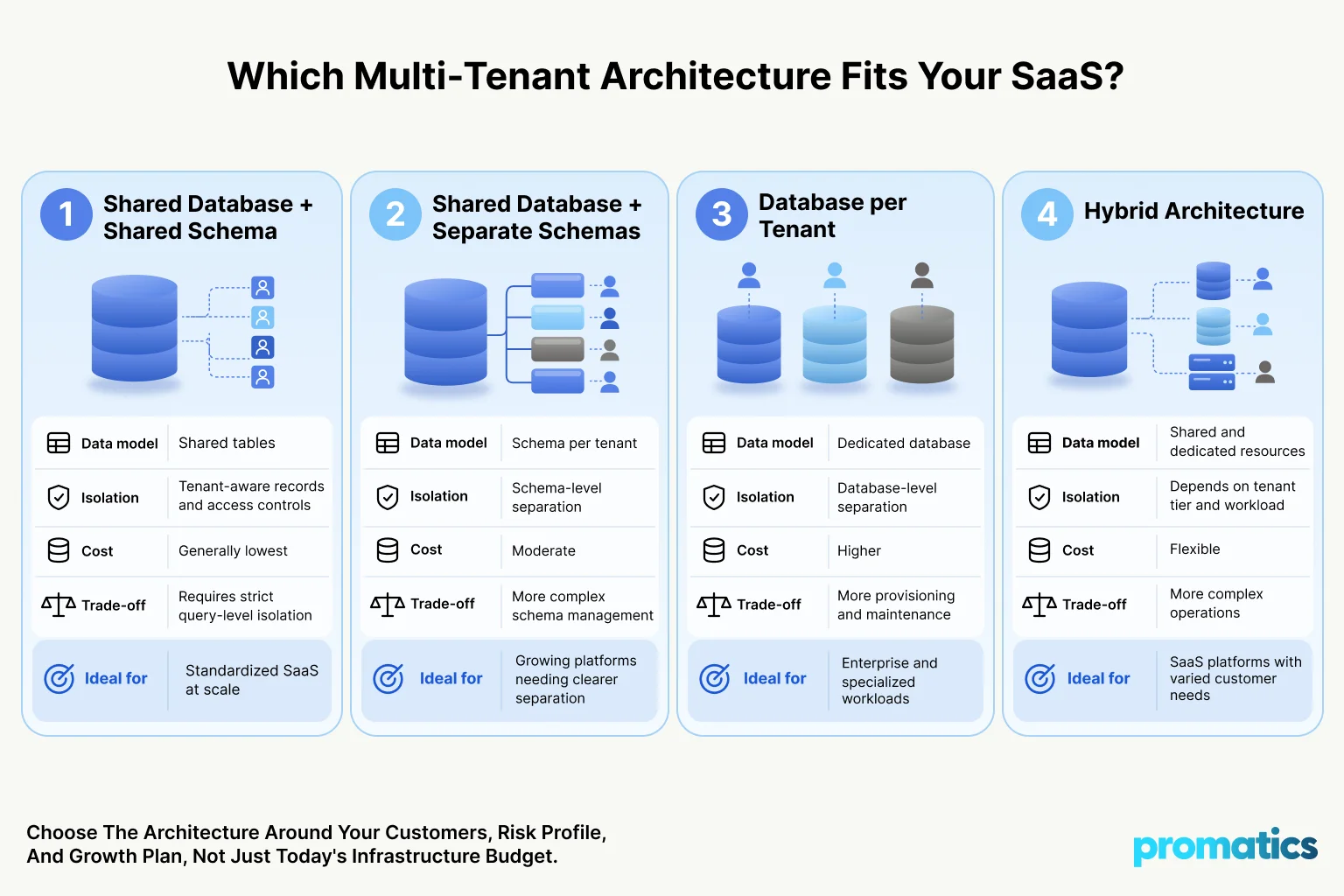
Common Multi-Tenant SaaS Architecture Models
There is no single architecture that fits every SaaS product. The choice of data storage and application deployment model determines how tenant data is separated, how the platform scales, and how much operational complexity the development team must manage.
1. Shared Database and Shared Schema
All tenants use the same database tables. Records include a tenant identifier that determines which customer owns the data.
For example, a customers table might contain records for multiple organizations, with each record associated with a tenant_id.
Advantages:
- Lower infrastructure and database management costs
- Straightforward provisioning for new tenants
- Efficient use of database resources
- Centralized schema changes and maintenance
Challenges:
- Every relevant query must enforce tenant boundaries.
- A missing tenant filter can expose another customer’s records.
- High-volume tenants can compete for database resources.
- Tenant-specific backup and restoration can be more complicated.
Best for: SaaS products with relatively standardized workflows, a large number of customers, and strong requirements for cost efficiency.
2. Shared Database With Separate Schemas
A single database contains separate schemas for different tenants. This creates an additional organizational boundary while allowing the platform to share the database infrastructure.
Advantages:
- Clearer separation of tenant data structures
- Potentially simpler tenant-specific data administration
- Shared infrastructure without fully independent databases
Challenges:
- Schema management becomes more complicated as tenants increase.
- Database limits and shared-resource constraints still apply.
- Migration and reporting processes require careful planning.
Best for: SaaS platforms that need more tenant-level separation than a shared schema provides without managing a completely independent database for every customer.
3. Separate Database for Each Tenant
Each tenant receives a dedicated database. The application may still share common services, but customer data is stored separately.
Advantages:
- Stronger database-level separation
- More control over tenant-specific backups and restoration
- Independent database tuning and capacity planning
- Greater flexibility for customers with specialized requirements
Challenges:
- Higher infrastructure and administration costs
- More complex database provisioning and migrations
- Additional monitoring and maintenance overhead
Best for: Enterprise SaaS products, customers with strict data separation requirements, and workloads requiring independent database management.
4. Hybrid Multi-Tenant Architecture
A hybrid approach combines shared and dedicated resources. Standard customers might use a shared database, while enterprise customers receive dedicated databases or isolated application environments.
Advantages:
- Balances cost efficiency and customer-specific requirements
- Supports multiple subscription tiers
- Provides a migration path for high-volume tenants
- Allows different isolation levels for different workloads
Challenges:
- Requires consistent provisioning and deployment automation
- Increases architectural and operational complexity
- Needs clear policies for moving tenants between environments
Best for: SaaS businesses serving a mix of startups, small businesses, and enterprise customers.
How to Choose the Right Architecture for Your SaaS Product
Selecting an architecture requires balancing technical requirements with commercial priorities. An approach that works for an early-stage product may become inefficient when the platform serves thousands of tenants or supports enterprise-level workloads.
Evaluate these factors before committing to a model.
Customer Profile and Workload
Understand how customers will use the platform. A lightweight project management tool may have relatively predictable workloads, while an analytics platform may process large datasets for a small number of tenants.
Consider the number of tenants, average activity, peak usage, data volume, and the likelihood of large customers requiring dedicated resources.
Security and Compliance Requirements
Determine whether your customers require specific data residency, retention, audit, encryption, or isolation controls. Requirements vary by industry, geography, contract, and data type.
Dedicated databases may simplify some isolation requirements, but they do not automatically guarantee regulatory compliance. The full system and its operational processes must meet the applicable obligations.
Customization Requirements
A scalable SaaS product usually benefits from a common core application with controlled tenant-level configuration.
For example, customers might customize branding, workflows, notification preferences, or feature access without requiring separate codebases. If customers need fundamentally different application behavior, the architecture may need additional modularity or dedicated deployment options.
Cost and Operational Capacity
Compare the total cost of ownership, including hosting, database management, monitoring, security, backups, support, and engineering effort.
Shared resources can improve cost efficiency, but only if the platform has sufficient controls to manage workloads and isolate failures. Dedicated environments increase costs but may be justified for particular customers.
Future Growth
Think beyond initial launch requirements. The system should support increasing data volumes, new integrations, regional expansion, and changes to subscription plans.
For more context on designing systems for long-term growth, explore SaaS application architecture for multi-tenancy and scale.
Security Best Practices for Multi-Tenant SaaS Development
Security is one of the most important considerations in multi-tenant SaaS development. A vulnerability affecting tenant isolation can expose one customer’s information to another, damage trust, and create legal or commercial consequences.
Security must be designed into the architecture and verified throughout the development lifecycle.
1. Enforce Tenant Isolation at the Backend
Do not rely on frontend checks to protect customer data. A user can modify a request, manipulate a URL, or call an API directly.
The backend should derive or validate the tenant context from a trusted authentication and authorization process. Every data access operation must verify that the user is allowed to access the requested resource within that tenant.
Depending on the technology stack, controls may include:
- Tenant-scoped repository and service methods
- Database row-level security
- Schema or database separation
- Tenant-aware authorization middleware
- Explicit access policies for background jobs and integrations
2. Implement Role-Based Access Control
Authentication establishes who a user is. Authorization determines what that user can do.
Role-based access control (RBAC) can define permissions for owners, administrators, managers, and standard users. More complex platforms may also require attribute-based access control (ABAC), which considers factors such as resource ownership, department, or other contextual attributes.
Tenant membership should be checked independently of the user’s role. An administrator in one organization should not automatically gain administrative access to another.
3. Encrypt Sensitive Data
Use encryption in transit and at rest, supported by secure key management. Protect backups and sensitive exported files as well as primary database records.
For customers with stronger isolation requirements, consider tenant-specific encryption keys or dedicated key-management policies where appropriate.
Encryption is one layer of protection. It does not replace access controls, secure application logic, or monitoring.
4. Secure APIs and Integrations
SaaS platforms frequently integrate with payment providers, CRMs, analytics systems, and other business applications. Each integration creates additional access paths that must be controlled.
Best practices include:
- Validating all incoming requests
- Applying authorization checks to every protected endpoint
- Using scoped API keys or OAuth permissions
- Limiting request rates where appropriate
- Rotating credentials and storing secrets securely
- Avoiding exposure of sensitive tenant information in error messages
For products with multiple frontend clients and integrations, an API-first development approach can help establish consistent interfaces and security rules across the application.
5. Test for Cross-Tenant Data Leakage
Testing should explicitly verify that tenant boundaries hold under normal use and attempted misuse.
For example, if a user from Tenant A changes a record identifier to reference a record belonging to Tenant B, the request should be denied. Similar tests should cover reports, search results, file downloads, exports, administrative tools, and background processing.
Include cross-tenant authorization tests in automated test suites and run security assessments before significant releases.
6. Maintain Audit Logs and Monitoring
Record security-relevant events such as login attempts, permission changes, administrative actions, data exports, and suspicious access patterns.
Logs should provide enough context to investigate incidents without unnecessarily storing passwords, tokens, or sensitive customer data.
Monitoring should help teams distinguish system-wide incidents from tenant-specific issues and identify unusual activity early.
Scalability Best Practices for Multi-Tenant SaaS Applications
As the number of customers increases, a multi-tenant application must handle growing workloads without creating unacceptable latency, service interruptions, or infrastructure costs.
Scalability depends on the application, database, infrastructure, and operational model working together.
Design Stateless Application Services
Where practical, keep application instances stateless so they can be added or removed as demand changes. Store durable application state in appropriate databases or external services rather than relying on an individual application instance.
This makes load balancing and horizontal scaling easier to implement.
Optimize Database Performance
Database performance often becomes a bottleneck as tenants accumulate more records and generate more concurrent requests.
Use indexing, query analysis, connection pooling, and caching where appropriate. Partitioning or sharding may help at larger scales, but these techniques introduce additional complexity and should be justified by measured workload requirements.
Monitor query performance and database resource consumption by tenant where feasible.
Prevent the Noisy Neighbor Problem
The noisy neighbor problem occurs when one tenant’s heavy usage affects the performance of others sharing the same infrastructure.
Potential controls include:
- Per-tenant request and resource limits
- Workload prioritization
- Queue-based processing for expensive operations
- Database query and connection limits
- Separate resources for high-volume tenants
- Usage monitoring and automated alerts
A hybrid architecture can provide an upgrade path when a tenant consistently outgrows the shared environment.
Use Tenant-Aware Caching
Caching can reduce repeated database queries and improve response times. However, cache keys must account for the relevant tenant and authorization context.
A cache that returns data without the correct tenant scope can become a security risk. Define cache invalidation policies carefully, particularly when users, roles, or tenant settings change.
Automate Tenant Provisioning
Manual onboarding becomes difficult as the customer base grows. Automated provisioning can create tenant records, apply default settings, configure permissions, establish database resources where required, and activate subscription features.
Provisioning workflows should be repeatable, observable, and safe to retry. Failed onboarding steps should not leave tenants in partially configured or insecure states.
Build Observability Into the Platform
Monitor system-level indicators such as latency, error rates, CPU, memory, and database performance. Add tenant-level metrics to identify which customers or workloads contribute to unusual traffic or resource consumption.
This helps teams detect problems earlier and make evidence-based decisions about infrastructure upgrades.
React Multi-Tenancy Implementation Best Practices
React is commonly used to build SaaS dashboards, customer portals, and administrative interfaces. However, React itself does not provide tenant isolation. The backend and data layer must enforce security, while the frontend should present the correct tenant experience.
When implementing multi-tenancy in React, consider the following practices.
Establish Tenant Context Carefully
The application may use a selected workspace, a tenant-specific subdomain, or tenant membership associated with the authenticated user.
The frontend can use this context to display the correct workspace and configuration, but the server must independently validate tenant access on every protected request.
Separate Configuration From Authorization
Tenant-specific branding, navigation, feature flags, and preferences can be managed through configuration.
Do not use frontend feature flags as the only control for restricted functionality. Sensitive operations must also be protected by backend authorization.
Scope Client-Side Data and Cache Keys
When using client-side data-fetching or caching libraries, include the appropriate tenant context in cache keys. Clear or invalidate relevant cached data when a user signs out or switches tenants.
This reduces the risk of showing stale information from a previously selected workspace.
Handle Tenant Switching Securely
If users can belong to multiple organizations, tenant switching should update the active context safely and trigger the necessary data refreshes.
The backend must confirm that the user is a member of the selected tenant. The interface should not assume that knowing a tenant ID grants access.
Test Tenant Boundaries Across the User Journey
Test login, workspace switching, search, reporting, exports, file uploads, and administrative actions. Include cases where a user tries to access resources belonging to another tenant.
These checks should cover both the React interface and the APIs it calls.
Multi-Tenant SaaS for Managed Service Providers (MSPs)
Managed service providers often use centralized software to manage multiple client organizations. Multi-tenant architecture can support this operating model by providing a shared administrative platform with controlled separation between customers.
Common use cases include:
- IT service management and ticketing
- Endpoint monitoring and management
- Cloud infrastructure administration
- Backup and disaster recovery
- Identity and access management
- Reporting, billing, and service-level monitoring
For MSP platforms, access hierarchy is particularly important. An MSP administrator may need access to multiple client environments, while each client administrator should remain restricted to their own organization.
The architecture should support delegated administration, auditable actions, tenant-specific configuration, and clear boundaries for privileged access.
Cloud desktop management introduces similar considerations. Shared management tools can improve operational efficiency, but each customer’s identities, desktop sessions, policies, and data must be protected through the appropriate controls.
Common Challenges in Multi-Tenant SaaS Development
Although multitenancy can improve operational efficiency, it introduces challenges that must be addressed during architecture planning.
- Data leakage between tenants: Inadequate tenant filtering or authorization can expose customer information. Use layered access controls and automated cross-tenant tests.
- Uneven resource consumption: A high-volume tenant can affect others. Apply quotas, workload controls, monitoring, and dedicated resources where necessary.
- Complex upgrades and migrations: Schema changes become harder when many tenants share a platform. Use versioned migrations, staged rollouts, and rollback plans.
- Customization limits: Too much tenant-specific code can undermine the benefits of a shared platform. Prefer configuration and modular features, reserving dedicated environments for requirements that justify them.
- Operational visibility: System-wide metrics alone may not identify which tenant is experiencing problems. Track relevant usage, latency, and error indicators at both system and tenant levels.
The goal is not to eliminate every trade-off. It is to make these trade-offs explicit and design controls that match the product’s risks and growth plans.
How Much Does Multi-Tenant SaaS Development Cost?
The cost of multi-tenant SaaS development depends on the product’s scope, architecture, security requirements, integrations, and expected workload. There is no single price that applies to every platform.
Key cost drivers include:
- Product complexity and number of features
- Shared versus dedicated database architecture
- Web and mobile application requirements
- Third-party integrations and API development
- Authentication, authorization, and compliance controls
- Cloud hosting, monitoring, and backup requirements
- Automated testing and deployment pipelines
- Ongoing maintenance and support
A shared database may reduce initial infrastructure expenses, but it still requires careful engineering to enforce tenant isolation. A dedicated database model may increase operational costs while providing greater separation and control for specific customers.
Businesses should evaluate the total cost of ownership, including development, hosting, maintenance, support, and future architectural changes.
For organizations planning a new platform, Promatics Technologies’ guide to SaaS application development services explains what to evaluate when choosing a development partner.
How Promatics Technologies Can Help Build Scalable SaaS Platforms
Building a successful multi-tenant SaaS product requires more than selecting a database model or deploying an application to the cloud. It requires coordinated decisions across product planning, architecture, software engineering, security, testing, and infrastructure.
Promatics Technologies works with businesses to develop digital products aligned with their technical requirements and commercial goals. For SaaS initiatives, this can include:
- Architecture planning: Evaluating shared, isolated, and hybrid approaches based on product requirements.
- Custom SaaS development: Building application features, user workflows, dashboards, and tenant-specific configurations.
- API and integration development: Connecting the platform with external systems through structured interfaces.
- Security-focused engineering: Implementing authentication, authorization, and tenant-aware data access controls.
- Cloud and DevOps support: Planning deployment, monitoring, and scaling practices for ongoing operations.
- Testing and maintenance: Verifying functionality, performance, and security as the product evolves.
The right approach depends on your stage of growth. An MVP may benefit from a simpler architecture with clear tenant boundaries, while an established platform may require database optimization, workload isolation, or a hybrid deployment model.
Conclusion
Multi-tenant SaaS development can help businesses deliver software efficiently, simplify updates, and support a growing customer base. Its success, however, depends on choosing the right architecture and implementing reliable controls for tenant isolation, security, performance, and operations.
The best architecture is not necessarily the one with the lowest initial cost or the most isolated infrastructure. It is the one that fits the product’s requirements today while providing a practical path to future growth.
For businesses building or modernizing a SaaS product, investing in architecture planning early can reduce avoidable complexity and create a stronger foundation for long-term development.
Looking to build a secure, scalable SaaS product? Connect with us to explore a development approach aligned with your product vision, customer requirements, and growth goals.
