SaaS Application Architecture: Designing for Multi-Tenancy and Scale in 2026
TL;DR
- SaaS architecture uses multi-tenancy to serve multiple users from one system
- Ensures scalability, cost efficiency, and optimized resource usage
- Supports data isolation, customization, and secure access
- Designed for high performance, reliability, and growth
- Key challenge: balancing scale, security, and complexity
SaaS is no longer just a software delivery model; it is the infrastructure powering today’s digital economy. From fintech platforms processing millions of transactions to AI-driven systems shaping enterprise decisions, modern SaaS applications sit at the heart of mission-critical operations. As adoption accelerates, architectural pressure intensifies.
The global SaaS market is projected to exceed $1 trillion in annual revenue by 2027, while nearly 80% of organizations are expected to deploy AI-enabled applications by 2026. These trends signal more than growth; they mark an architectural reset.
Today’s platforms must support intelligent multi-tenant architecture, seamless scalability, AI workloads, and enterprise-grade security at the same time. Performance cannot slow as tenants grow. Costs cannot spike as AI expands.
Compliance cannot be an afterthought. In 2026, the difference between a SaaS product that scales and one that struggles comes down to one factor: SaaS application architecture.
So how do you design a scalable SaaS architecture that supports multi-tenancy, AI readiness, and long-term resilience without creating technical debt? Let’s break it down.
What is Multi-Tenant SaaS Architecture?
In simple terms, multi-tenancy means a single instance of your software runs on shared infrastructure and serves multiple customers, known as tenants. Instead of creating separate environments for each client, the application shares core resources while keeping every tenant’s data, configurations, and access controls logically separated.
Although the infrastructure is shared, each tenant experiences the platform as secure and independent. This differs from single-tenant setups, where every customer operates in a completely isolated environment with dedicated infrastructure and application instances.
While single-tenancy offers maximum isolation, it increases cost and operational complexity. Multi-tenancy, when designed correctly, balances efficiency, scalability, and secure data separation making it fundamental to modern SaaS application development.
Why Most SaaS Companies Prefer Multi-Tenant Architectures
Multi-tenancy has become the preferred architecture for most SaaS platforms because it enables:
- Lower infrastructure and maintenance costs
- Faster updates and seamless deployments
- Simplified onboarding for new customers
- Centralized monitoring and operational efficiency
- Better resource utilization at scale
However, multi-tenancy is not without trade-offs. A poorly designed multi-tenant system can result in performance bottlenecks, security vulnerabilities, compliance risks, or complex customization challenges.
The key lies in deliberate architectural planning, something every professional SaaS product development company must prioritize from day one.
Understanding Multi-Tenant SaaS Architecture
Multi-tenant SaaS architecture allows multiple customers (tenants) to share a single application infrastructure while maintaining strict isolation of their data, configurations, and user permissions.
Instead of creating separate application instances for every client, a well-designed multi-tenant system:
- Shares core application logic
- Shares infrastructure resources
- Isolates tenant data logically or physically
- Enforces tenant-scoped authentication and authorization
- Maintains performance boundaries between tenants
This design enables economies of scale, centralized upgrades, faster feature rollouts, and lower infrastructure costs without compromising reliability.
However, multi-tenancy must be engineered with precision. Improper implementation can lead to cross-tenant data exposure, noisy neighbor performance issues, or compliance failures.
Key Considerations When Designing a Multi-Tenant SaaS Architecture
At Promatics Technologies, we help startups and enterprises design SaaS architectures that scale from day one. During our SaaS product architecture consulting sessions, we focus on the following critical factors:
- Data Isolation vs. Shared Schemas
Choosing the right database isolation model is critical in SaaS software development services:
- Shared database & shared schema: Fast and cost-efficient, but requires strong logical isolation controls.
- Shared database & separate schema: Provides better separation and moderate complexity.
- Separate database per tenant: Offers maximum isolation but increases operational overhead and cost.
Your decision should align with:
- Security and compliance requirements
- Expected user growth
- Performance requirements
- Tenant-level customization needs
Choosing the wrong model early can create long-term scaling challenges.
- Authentication & Authorization
A multi-tenant SaaS platform must support tenant-level access control and role hierarchies.
This includes integrating:
- OAuth-based authentication
- JWT token systems
- Third-party identity providers (SSO, SAML, OpenID Connect)
Security architecture cannot be layered later. It must be embedded into your SaaS software foundation from the beginning.
- Scalability Strategy
Scalability is not just about supporting more users. It is about scaling intelligently.
Modern SaaS scalability architecture involves:
- Horizontal scaling across regions
- Intelligent load balancing
- Distributed service deployment
- Auto-scaling policies based on real-time demand
- Performance monitoring at the tenant level
Scalable architecture ensures performance remains stable as tenant volume increases.
- Customizations Without Chaos
Enterprise tenants often request custom workflows, UI modifications, integrations, or additional fields.
If your SaaS multi-tenant architecture is not modular, configurable, or plugin-based, such requests can destabilize your core product.
Think long-term:
How can you enable flexibility without disrupting your core system?
A modular architecture allows controlled extensibility while protecting the integrity of the base application.
- Billing, Meeting, and Usage Tracking
Architecture must align tightly with your monetization model.
If you charge based on:
- API usage
- Number of users
- Storage consumption
- Transaction volume
Your system must track usage accurately at the tenant level in real time.
A scalable billing engine requires architectural planning, not post-launch fixes.
SaaS Architecture Patterns That Work
Over the years, we have built scalable SaaS platforms using proven architecture patterns tailored to business maturity levels:
Microservices with Shared Authentication Layer
Ideal for large-scale SaaS applications requiring independent service scaling and strong modular boundaries.
Modular Monolith with Tenant-Aware Layers
Perfect for startups launching quickly while maintaining long-term flexibility.
Event-Driven Systems for Integration and Automation
Essential for SaaS platforms integrating with third-party tools, APIs, and enterprise ecosystems.
Not sure which model suits your product stage?
That is where our SaaS architecture design services come in. We do not just advise; we architect and implement solutions aligned with your growth roadmap.
Common Mistakes to Avoid
Before finalizing your SaaS products, watch for these common pitfalls:
- Overengineering for a hypothetical future scale
- Underestimating tenant-level security requirements
- Hardcoding tenant-specific logic into the core codebase
- Ignoring backup and disaster recovery planning per tenant
- Using tools that lack tenant-aware analytics and reporting
Balanced architectural decisions prevent expensive rework later.
When Should You Hire SaaS Product Architecture Experts?
The honest answer: as early as possible.
Founders often attempt to build early product versions independently to reduce initial costs. However, a flawed architectural foundation often leads to rebuilding later, which is significantly more expensive and risky.
You should consider professional SaaS consulting services if you are:
- Launching a new SaaS product
- Re-architecting due to scale or compliance challenges
- Migrating from single-tenant to multi-tenant architecture
- Preparing for enterprise expansion
Early architectural clarity reduces long-term technical debt.
Multi-Tenancy Architecture Models & Trade-Offs
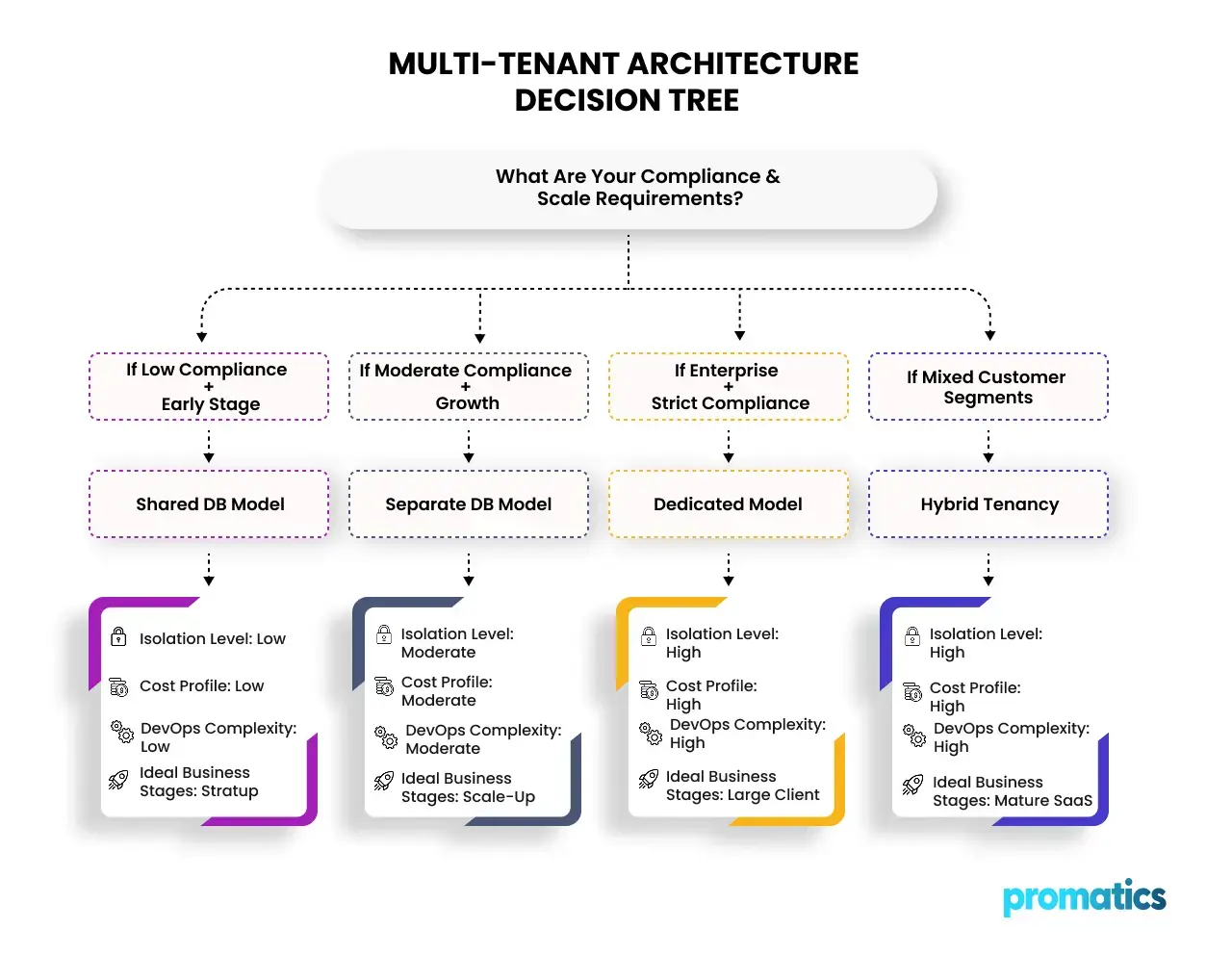
There is no universal architecture model. The right choice depends on business goals and regulatory requirements.
Shared Application, Shared Database
Low cost and simple management, but requires strict isolation logic.
- Shared Application, Separate Database
Stronger data isolation and compliance alignment.
- Dedicated Application & Database
Maximum security and customization for enterprise-grade SaaS.
- Hybrid Tenancy
Shared infrastructure for smaller tenants and dedicated environments for enterprise clients, balancing scalability and cost optimization.
At Promatics Technologies, hybrid multi-tenancy is often recommended for SaaS businesses targeting diverse customer segments.
Designing for Horizontal Scalability
Scalability cannot be retrofitted. It must be embedded into architectural design from the beginning.
Modern SaaS platforms prioritize horizontal scaling by:
- Deploying stateless application services
- Using distributed caching systems
- Leveraging container orchestration frameworks
- Implementing auto-scaling infrastructure policies
Horizontal scaling improves resilience, uptime, and elasticity under unpredictable demand.
Security, Observability, and Operational Maturity
Security must be embedded into the core architecture:
- Tenant-scoped authorization
- Role-based access control
- Encryption at rest and in transit
- Continuous vulnerability testing
- Audit logging and monitoring
- Compliance alignment (GDPR, HIPAA, SOC2)
Operational maturity requires:
- Centralized logging
- Distributed tracing
- Real-time performance metrics
- Intelligent alerting systems
Scalable SaaS architecture combines technical design with operational visibility.
Why Promatics Technologies?
As a global SaaS development company, Promatics Technologies delivers secure, scalable, and future-ready SaaS software development services for startups and enterprises worldwide.
- End-to-end SaaS application development
- Scalable custom SaaS development
- Cloud-native enterprise SaaS solutions
- Strategic SaaS consulting services
We build SaaS systems designed not just to launch but to scale.
Conclusion
The SaaS landscape is moving fast, AI is accelerating innovation, enterprise expectations are rising, and scalability is no longer optional. In this environment, architecture defines success. Multi-tenancy drives cost efficiency, scalability ensures reliability, security builds trust, and operational maturity sustains growth.
There is no universal blueprint, but one truth remains clear: SaaS platforms built on strong architectural foundations scale smarter and compete stronger. At Promatics Technologies, we design secure, scalable, multi-tenant SaaS platforms engineered for long-term performance.
Ready to build your SaaS product the right way? Connect with us today, and let’s architect a solution built to scale with confidence.
