When Should Businesses Invest in SaaS Application Development?
TL;DR
- Invest in SaaS when product needs continuous updates and evolution
- Ideal for scaling users, markets, and global access
- Enables faster MVP launches and quicker time-to-market
- Supports predictable revenue with subscription models
- Requires readiness in market demand, tech, and operations
Software as a Service (SaaS) has evolved beyond a simple software delivery mechanism. It now represents a fundamental shift in how digital products are architected, scaled, and monetized. For modern enterprises, SaaS is no longer just a technology choice—it is a strategic growth model that enables elastic scalability, operational agility, and predictable recurring revenue streams.
However, adopting a SaaS model is not merely a response to market trends. Many organizations accelerate SaaS application development under competitive or investor pressure, only to face challenges such as escalating infrastructure costs, architectural complexity, and early customer churn. Conversely, delaying SaaS adoption can limit innovation velocity and allow more agile competitors to capture market share.
This creates a critical decision point for founders and business leaders: when is the right time to invest in SaaS application development? The answer extends beyond budget or tooling. It requires evaluating product maturity, validated market demand, operational readiness, and alignment with long-term business objectives. This blog examines the key technical and business indicators that signal SaaS readiness and guide organizations toward an informed transition.
Understanding SaaS Application Development Beyond the Basics
SaaS application development involves building cloud-native software that is centrally hosted and delivered to users over the internet through a subscription-based model. Unlike traditional software, SaaS applications are designed for continuous evolution, multi-tenant usage, and high availability.
Modern SaaS development emphasizes:
- Multi-tenant or hybrid-tenant architecture
- API-first and microservices-based design
- Continuous deployment and automated updates
- Centralized security and compliance management
What distinguishes SaaS products from simple web applications is their ability to scale users, features, and data without linear increases in cost or complexity. This architectural requirement is why SaaS development is as much a business strategy decision as it is a technical one.
Why Businesses Are Shifting Toward SaaS Development Models
Insights from leading SaaS development frameworks show that businesses adopt SaaS not merely for convenience, but for structural advantages.
- SaaS applications support recurring revenue models, which improve financial predictability and valuation. Subscription-based SaaS products create ongoing customer relationships rather than one-time transactions.
- SaaS platforms enable faster innovation cycles. Because updates are deployed centrally, businesses can release features continuously, respond to customer feedback faster, and adapt to market changes without disruptive upgrade processes.
- SaaS development aligns with modern user expectations. Customers increasingly expect instant access, minimal setup, automatic updates, and consistent performance across devices and locations.
Clear Signals That Indicate It’s Time to Invest in SaaS Application Development
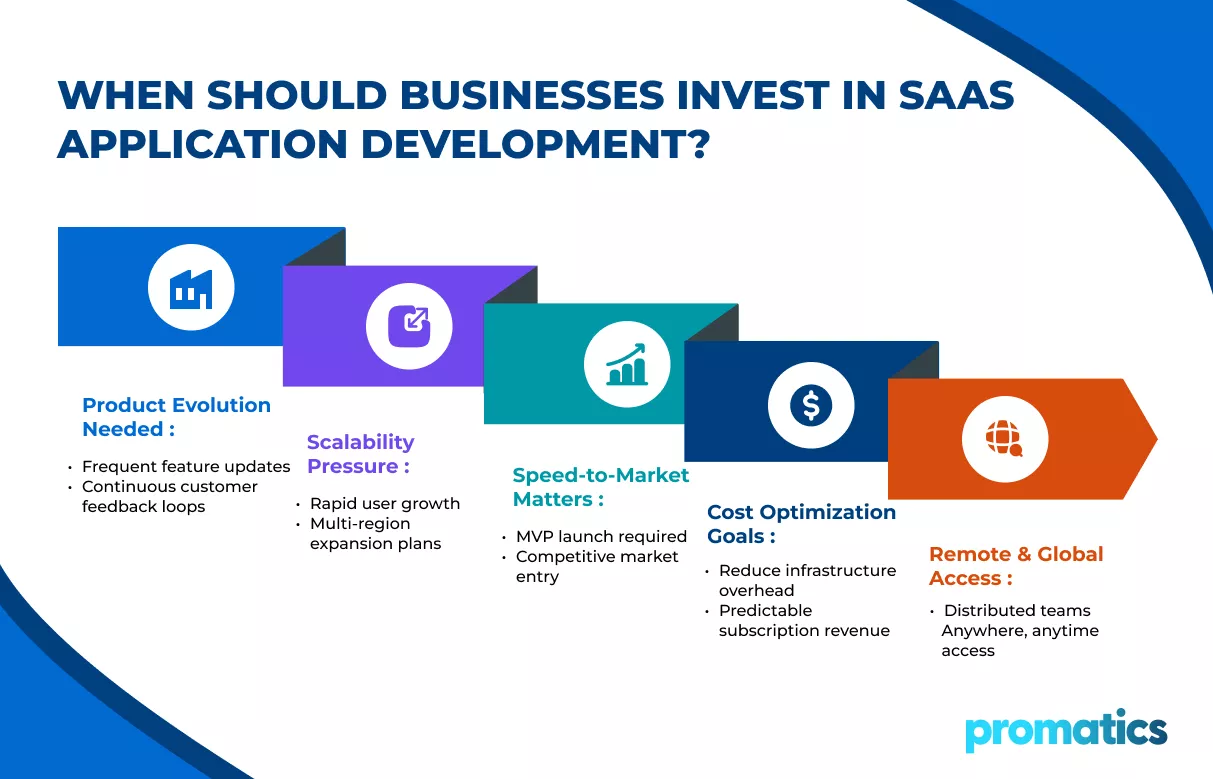
Product Evolution Needed
- Frequent feature updates
- Continuous customer feedback loops
Scalability Pressure
- Rapid user growth
- Multi-region expansion plans
Speed-to-Market Matters
- MVP launch required
- Competitive market entry
Cost Optimization Goals
- Reduce infrastructure overhead
- Predictable subscription revenue
Remote & Global Access
- Distributed teams
- Anywhere, anytime access
SaaS is not just a technology choice, it’s a growth strategy.
When Your Product or Service Needs Continuous Evolution
If your business operates in a market where customer needs change frequently, SaaS development becomes essential. Traditional software struggles with frequent updates, while SaaS applications are built for ongoing iteration.
This is especially relevant when:
- User feedback directly shapes feature development
- Competitive differentiation depends on rapid innovation
- Regulatory or compliance requirements change regularly
SaaS architecture allows features to be deployed incrementally without disrupting the user experience, making it ideal for evolving products.
When Scaling Users or Customers Is a Core Business Goal
One of the strongest indicators for SaaS investment is scalability pressure. As user numbers grow, traditional software models often face performance bottlenecks, infrastructure strain, and rising maintenance costs.
SaaS applications are designed to:
- Handle variable workloads efficiently
- Support onboarding of new users without infrastructure redesign
- Scale storage, computing, and analytics dynamically
If growth projections show rapid user acquisition or geographic expansion, SaaS application development becomes a necessity rather than an option.
When Time-to-Market Directly Impacts Business Success
Many businesses lose market advantage not because of poor ideas, but because of delayed execution. SaaS development supports MVP-driven launches, allowing companies to validate ideas early and refine products based on real usage data.
SaaS development frameworks emphasize:
- Launching core functionality first
- Iterative feature expansion
- Data-driven product decisions
This approach reduces upfront risk while enabling faster market entry—particularly valuable for startups and innovation-driven enterprises.
When Cost Predictability and Operational Efficiency Matter
SaaS development shifts software costs from capital expenditure to operational expenditure. Instead of large upfront investments in infrastructure and licensing, businesses adopt usage-based or subscription-driven cost models.
From an operational perspective, SaaS products reduce:
- Hardware dependency
- Manual maintenance and upgrades
- Fragmented system management
For organizations seeking cost efficiency without sacrificing performance, SaaS application development offers a financially sustainable path.
When Remote Access and Global Availability Are Business Requirements
Modern businesses are increasingly distributed. SaaS applications enable centralized access to data, workflows, and services regardless of location.
This is particularly relevant for:
- Remote or hybrid workforces
- Global customer bases
- Multi-region operations
SaaS platforms ensure consistency, availability, and collaboration without requiring complex local installations or VPN-heavy systems.
SaaS Products vs Traditional Custom Software: Strategic Considerations
A common misconception is that SaaS replaces custom software. In reality, SaaS is a form of custom software designed for scale and reuse.
Traditional custom software works well for internal, static workflows. SaaS products are better suited when:
- Multiple customers or departments use the same platform
- Ongoing feature delivery is required
- Monetization depends on subscriptions or usage
In many cases, businesses adopt custom-built SaaS applications combining tailored functionality with scalable SaaS architecture.
Industry Use Cases Where SaaS Applications Deliver Maximum ROI
SaaS application development is especially impactful in industries where data, compliance, and scalability intersect:
- Healthcare: SaaS platforms enable secure patient data access, telehealth services, and regulatory compliance.
- Fintech: SaaS applications support real-time transactions, analytics, and risk management.
- Education: Learning management systems and virtual learning platforms rely heavily on SaaS delivery.
- Retail & E-commerce: Inventory, CRM, and analytics SaaS products improve operational visibility.
- Logistics: SaaS applications enable real-time tracking, demand forecasting, and workflow optimization.
Vertical SaaS products, built for specific industries, often outperform generic solutions due to deeper domain alignment.tems that improve performance over time while maintaining instant responsiveness at the device level.
Key Benefits of SaaS Application Development for Businesses
From a strategic standpoint, SaaS development delivers:
- Long-term scalability without proportional cost increases
- Faster feature rollout and innovation cycles
- Centralized security, monitoring, and compliance
- Improved customer retention through continuous value delivery
- Actionable insights through centralized data analytics
These benefits explain why SaaS products consistently demonstrate higher lifetime value compared to traditional software models.
Challenges Businesses Must Address Before Investing in SaaS Development
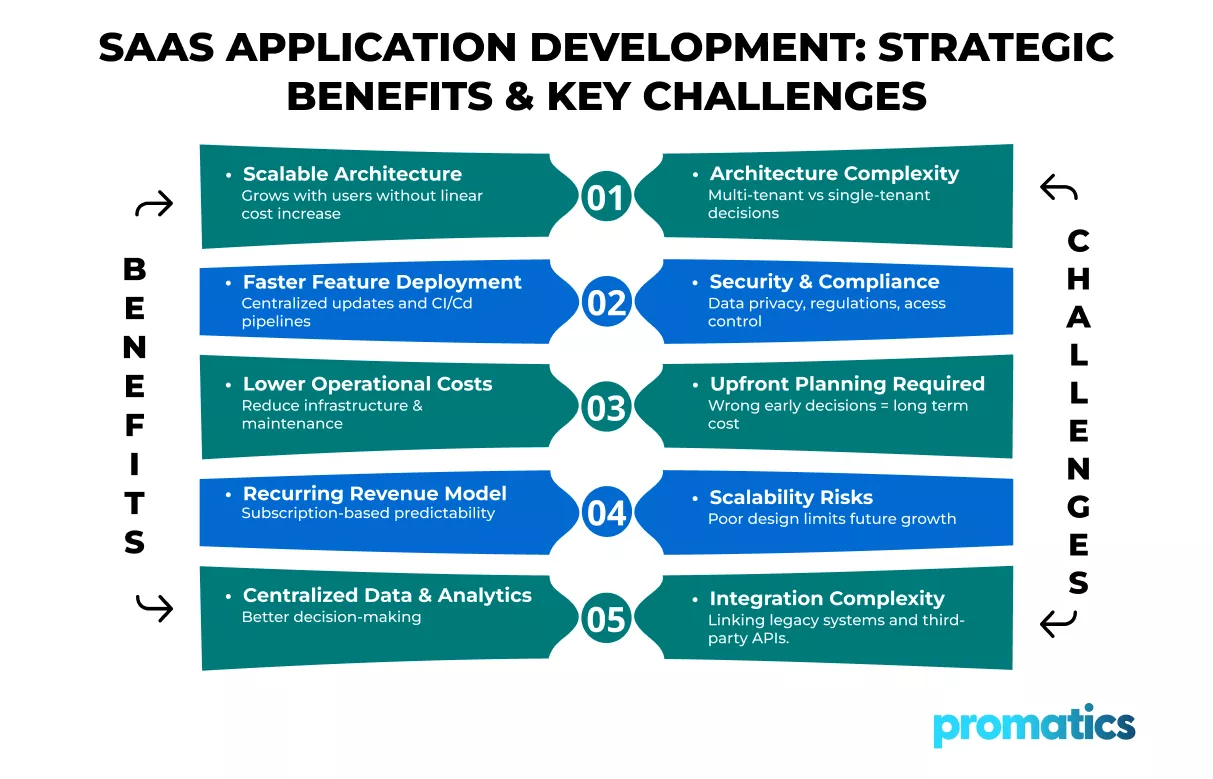
Despite its advantages, SaaS application development requires careful planning.
Key challenges include:
- Selecting the right architecture (single-tenant vs multi-tenant)
- Designing for data security and privacy from day one
- Avoiding technical debt during early MVP stages
- Ensuring performance consistency at scale
Businesses that underestimate these challenges often face scalability issues later, making early architectural decisions critical.
Best Practices for Building Successful SaaS Applications
Based on proven SaaS development methodologies, successful products follow these principles:
- Build cloud-native, modular architectures
- Prioritize performance, UX, and reliability early
- Implement strong authentication and access controls
- Use analytics to guide feature prioritization
- Plan for scalability, not just initial launch
These practices ensure SaaS applications remain resilient as user demands grow.
How Businesses Can Evaluate SaaS Readiness
Before committing to SaaS application development, organizations should evaluate:
- Whether the product requires continuous updates
- If the target market supports subscription pricing
- Long-term growth and scalability goals
- Technical and operational readiness for cloud infrastructure
Clear alignment between business strategy and SaaS architecture is essential for long-term success.
Conclusion
Investing in SaaS application development is not about following trends, but about aligning technology with long-term business goals. When scalability, continuous innovation, and predictable growth become priorities, SaaS enables organizations to move faster, operate efficiently, and evolve digital products without infrastructure constraints.
Successful SaaS products require more than a strong idea. They depend on the right architecture, a deep understanding of user needs, and an execution strategy that balances performance, security, and future scalability. Businesses that invest at the right time and with the right approach can transform SaaS platforms into lasting competitive advantages.
For organizations building future-ready digital products, SaaS application development is a strategic investment in resilience, scalability, and innovation.Ready to explore if SaaS is the right next step for your business? Promatics Technologies helps organizations assess SaaS readiness, design scalable architectures, and build secure, high-performance SaaS applications. Connect with our SaaS experts to plan your SaaS journey with confidence
