Designing Multi-Tenant SaaS Platforms: Architecture and Best Practices
TL;DR
- Multi-tenant SaaS uses one system for multiple users with isolated data
- Reduces cost and improves resource efficiency
- Enables scalability and faster updates
- Supports data isolation, security, and customization
- Key challenge: balancing performance, security, and complexity
The growing adoption of multi-tenant architecture is closely aligned with the rapid expansion of cloud computing and SaaS-driven business models. As organizations continue to shift toward cloud-based applications, the need for scalability, cost efficiency, and centralized management has become increasingly critical.
Industry insights highlight this momentum, with the global multi-tenant SaaS architecture market projected to grow at a strong CAGR over the coming years. This reflects a clear shift toward scalable, flexible, and cost-optimized software solutions that can support modern business demands.
In a SaaS environment, multi-tenancy enables multiple customers or organizations to operate on a shared application instance while maintaining strict data isolation. This approach maximizes cloud resource utilization, minimizes infrastructure redundancy, and streamlines updates. New features, enhancements, and security patches can be deployed simultaneously across all tenants, ensuring consistency and efficiency. Compared to single-tenant systems, this model significantly improves operational efficiency, scalability, and speed of deployment.
So, how do you successfully build a multi-tenant SaaS application? If you are looking for best practices and key considerations, this guide will walk you through everything you need to know. From selecting the right architecture to implementing scalable and secure systems, you will gain practical insights to help you build a robust SaaS platform. Let’s get started.
What is Multi-Tenant SaaS Architecture?
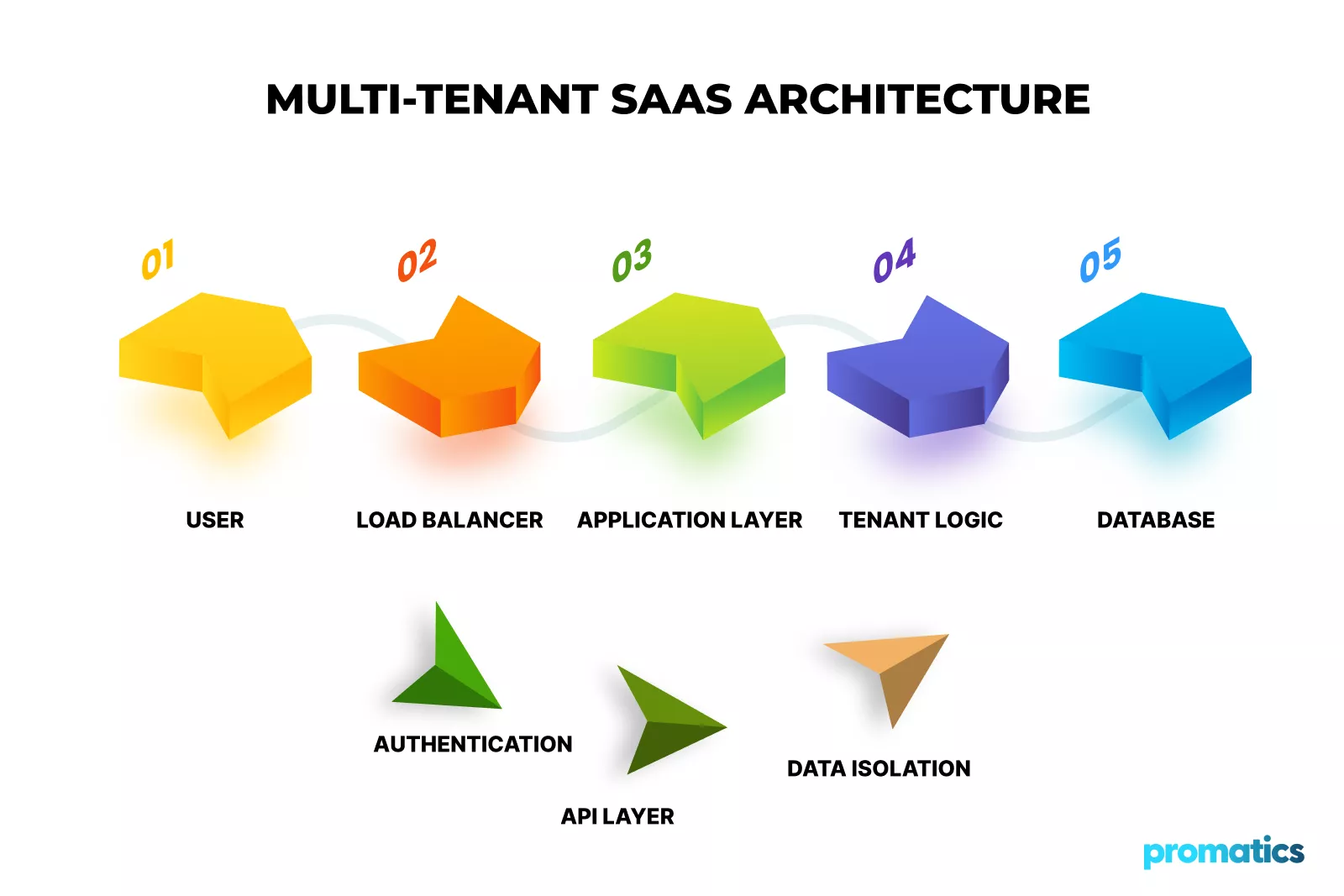
Multi-tenant SaaS architecture is a software design approach in which a single application instance serves multiple customers, also known as tenants. Each tenant operates within the same system but experiences it as a separate and secure environment.
The SaaS provider manages infrastructure, updates, and security, while users access the application through web browsers or mobile devices. This eliminates the need to deploy separate instances for each customer, making the system highly efficient and easier to maintain.
Leading platforms such as Slack, Salesforce, Amazon Web Services, and Zendesk rely on multi-tenant architecture to deliver services at scale while ensuring strict data isolation.
Multi-Tenant SaaS in Action: Real-World Examples
Platforms you use daily are powered by multi-tenant architecture.
- Slack provides individual workspaces for organizations, where each company can access its own conversations and users, even though everything runs on a shared backend.
- Salesforce enables thousands of businesses to manage their customer relationships on a unified platform without exposing data across tenants.
- Zendesk allows organizations to build customized support systems while sharing the same infrastructure.
- Even Amazon Web Services operates on a multi-tenant model, where resources may run on shared physical hardware but are logically isolated to ensure security.
This model allows companies to deliver scalable, reliable, and cost-efficient software without managing separate systems for every customer.
Key Multi-Tenant SaaS Architectures and Deployment Strategies
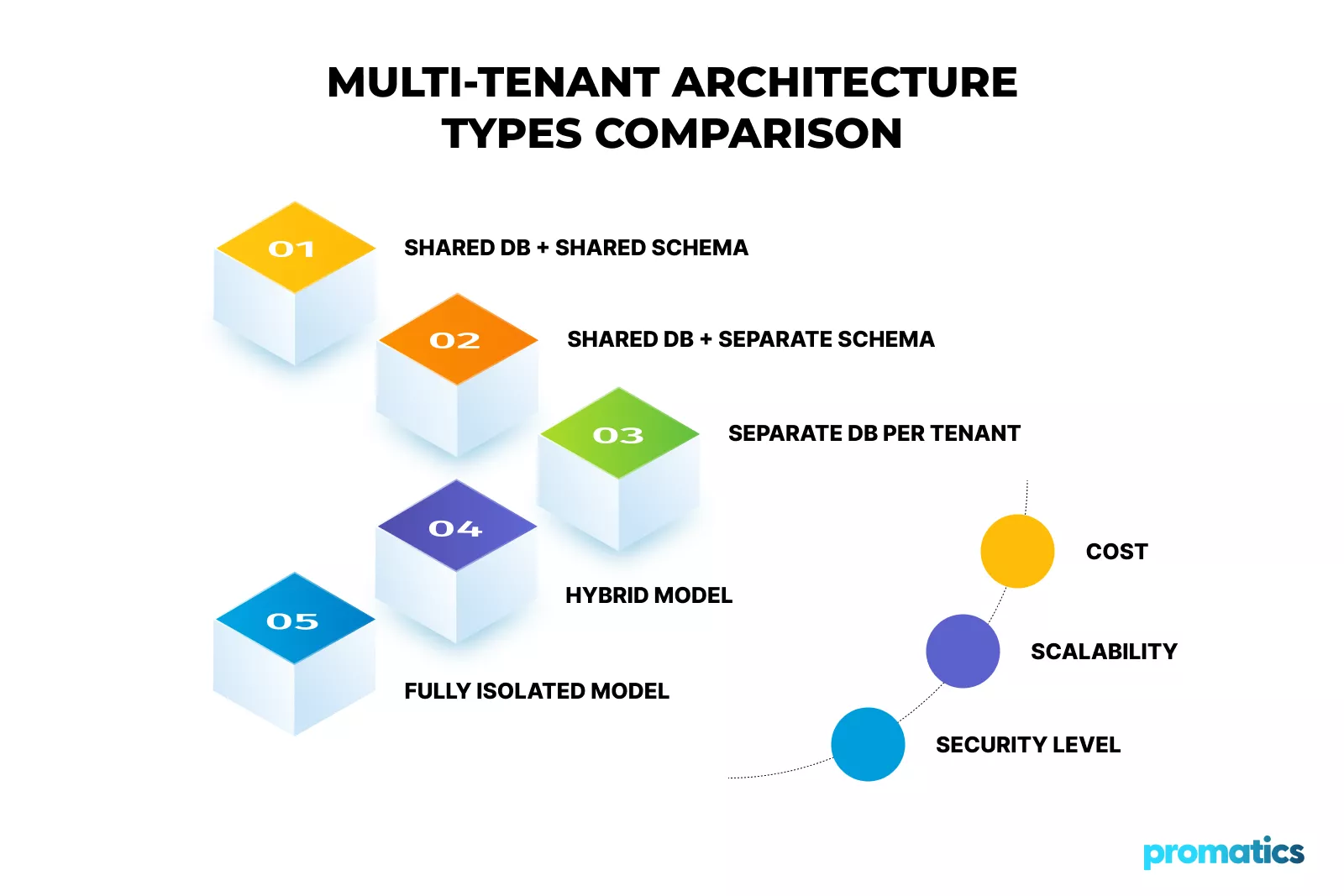
Choosing the right architecture is a critical decision that directly impacts scalability, performance, cost, and customization capabilities.
1. Shared Database, Separate Schemas
- Uses a single database, but creates individual schemas for each tenant
- Provides better data isolation and organization compared to the fully shared model
- Allows moderate customization at the schema level without fully separating infrastructure
- Slightly more complex to manage due to multiple schemas within one database
- Still maintains a good balance between cost savings and control
Ideal for: Growing SaaS businesses that need more flexibility without significantly increasing costs
2. Separate Databases (Database per Tenant)
- Each tenant is assigned a dedicated database, ensuring strong separation of data
- Enhances data security, privacy, and compliance, making it suitable for regulated industries
- Allows greater customization, including database tuning per tenant
- Simplifies backup, recovery, and data management for individual clients
- Comes with higher infrastructure, maintenance, and operational overhead
Ideal for: Enterprise clients, fintech, healthcare, or any application dealing with sensitive data
3. Hybrid Multi-Tenant Architecture
- Combines elements of both shared and isolated models to create a flexible, scalable system
- Smaller or standard clients are placed in a shared environment, while premium clients get dedicated resources
- Optimizes cost efficiency while maintaining performance and customization where needed
- Allows SaaS platforms to scale strategically as customers grow or upgrade plans
- Adds complexity in managing multiple architectural layers but delivers strong business value
Ideal for: SaaS companies serving a mix of SMBs and enterprise customers with varying needs
5. Fully Isolated Architecture (Application + Database per Tenant)
- Each tenant operates in a completely independent environment, including both application and database layers
- Offers the highest level of security, control, and customization
- Eliminates risks of data leakage or performance impact between tenants
- Supports deep customization, including feature variations and integrations
- Significantly increases cost, deployment effort, and maintenance complexity
Ideal for: High-value clients, government systems, or industries with strict compliance requirements
How to Select the Best Deployment Model for Your SaaS
Choosing the right deployment model is critical for balancing scalability, security, and cost. Each approach offers a different level of flexibility and control depending on your business stage and requirements.
| Model Type | Data Isolation | Flexibility | Cost Efficiency | Scalability | Best Fit For |
| Single App, Single DB | Low | Low | High | Easy to scale initially | Startups, MVPs |
| Single App, Multiple DB | High | Medium | Moderate | Moderate | Growing SaaS, regulated industries |
| Multi-App, Multi-DB | Very High | Very High | Low | Complex but powerful | Large enterprises, high-security use cases |
| Hybrid / Virtual Tenancy | Flexible | High | Balanced | Highly scalable | Scaling SaaS platforms with diverse users |
Key Challenges in Multi-Tenant SaaS Architecture
While multi-tenant architecture offers clear advantages in scalability and cost efficiency, it also introduces a set of technical and operational challenges that must be addressed carefully. Understanding these challenges early helps in designing a more resilient and future-ready SaaS platform.
Data Security and Isolation Risks
Ensuring that each tenant’s data remains completely isolated is one of the most critical challenges. Since multiple tenants share the same infrastructure, even a small vulnerability in access control or logic can lead to data leakage or unauthorized access.
To mitigate this, platforms must implement robust authentication, authorization, and data isolation mechanisms, along with regular security audits and testing.
Noisy Neighbor Effect
In a shared environment, resource consumption by one tenant can directly impact the performance experienced by others. This is commonly known as the noisy neighbor problem.
Without proper resource allocation strategies, high-traffic tenants can cause latency, slower response times, and degraded user experience for others. Addressing this requires resource quotas, workload isolation, and intelligent scaling mechanisms.
Limited Customization Flexibility
Multi-tenant systems are designed for standardization, which can limit how much customization can be offered to individual tenants. Businesses often struggle to balance product consistency with client-specific requirements.
Excessive customization can increase complexity, while limited flexibility may impact customer satisfaction. A well-designed architecture should support configurable features without breaking the shared model.
Increased Architectural Complexity
Designing and maintaining a multi-tenant system is inherently more complex than single-tenant setups. Developers must account for data partitioning, tenant-aware logic, scaling strategies, and fault isolation.
As the platform grows, managing multiple tenants with different usage patterns adds further complexity, requiring advanced system design and monitoring capabilities.
Compliance and Regulatory Challenges
Different tenants may operate in industries with varying regulatory requirements such as GDPR, HIPAA, or PCI-DSS. Ensuring compliance across a shared system can be challenging, especially when handling data residency, auditing, and reporting requirements.
This requires implementing compliance-ready infrastructure, detailed logging, and region-specific controls.
Performance Optimization at Scale
As the number of tenants grows, maintaining consistent performance becomes increasingly difficult. Query optimization, database design, and efficient resource utilization are critical to avoid bottlenecks.
Without proper optimization, systems may experience performance degradation, increased latency, and scalability limitations.
Operational and Monitoring Complexity
Monitoring a multi-tenant system requires visibility at both system-level and tenant-level metrics. Identifying which tenant is causing an issue or experiencing performance drops can be difficult without proper observability tools.
This challenge can be addressed through centralized monitoring, real-time analytics, and automated alerting systems.
Key Insight
Multi-tenant architecture is powerful, but it demands careful planning and execution. The key to success lies in balancing scalability with security, performance with cost, and standardization with flexibility. By proactively addressing these challenges, businesses can build SaaS platforms that are both efficient and resilient.
Understanding Deployment Models in Multi-Tenant SaaS
Choosing the right deployment model is just as important as selecting the right architecture. It directly impacts security, scalability, performance, and compliance. Each model offers a different balance between control and cost, and the ideal choice depends on your business requirements, target customers, and regulatory needs.
Public Cloud Deployment
In this model, applications are hosted on shared infrastructure provided by cloud platforms such as Amazon Web Services, Microsoft Azure, or Google Cloud Platform.
- Highly scalable and cost-efficient
- No need to manage physical infrastructure
- Faster deployment and global accessibility
- Built-in support for auto-scaling and high availability
However, since infrastructure is shared, businesses must rely on strong logical isolation and cloud security practices.
Ideal for startups and SaaS companies aiming for rapid growth and cost optimization
Private Cloud Deployment
Private cloud environments are dedicated to a single organization and can be hosted either on-premises or through a cloud provider.
- Greater control over infrastructure and data
- Enhanced security and compliance capabilities
- Customizable environments tailored to specific business needs
The trade-off is higher cost and maintenance overhead, as resources are not shared.
Ideal for enterprises handling sensitive data or operating in regulated industries such as healthcare and finance
Hybrid Cloud Deployment
Hybrid cloud combines both public and private cloud environments, allowing businesses to leverage the benefits of each.
- Critical workloads and sensitive data can run in a private cloud
- Less sensitive operations can scale on the public cloud
- Offers a balance between cost efficiency, flexibility, and compliance
This model requires careful orchestration and integration between environments but provides strong adaptability for growing businesses.
Ideal for organizations with diverse workloads and evolving scalability needs
Multi-Cloud Deployment
In a multi-cloud approach, businesses use multiple cloud providers instead of relying on a single vendor.
- Reduces vendor lock-in risks
- Improves availability and redundancy
- Allows businesses to choose the best services from different providers
However, managing multiple environments increases operational complexity and integration challenges.
Ideal for large enterprises requiring high availability and strategic flexibility
Key Insight
There is no one-size-fits-all deployment model. The right choice depends on your business scale, customer expectations, compliance requirements, and long-term growth strategy.
Many modern SaaS platforms start with a public cloud setup for speed and cost efficiency, then evolve into hybrid or multi-cloud environments as they scale and require greater control.
Security, Performance, and Operational Best Practices
Building a reliable multi-tenant SaaS platform requires more than just scalability. It also depends on strong security, consistent performance, and efficient operations to ensure a smooth and secure experience for all tenants.
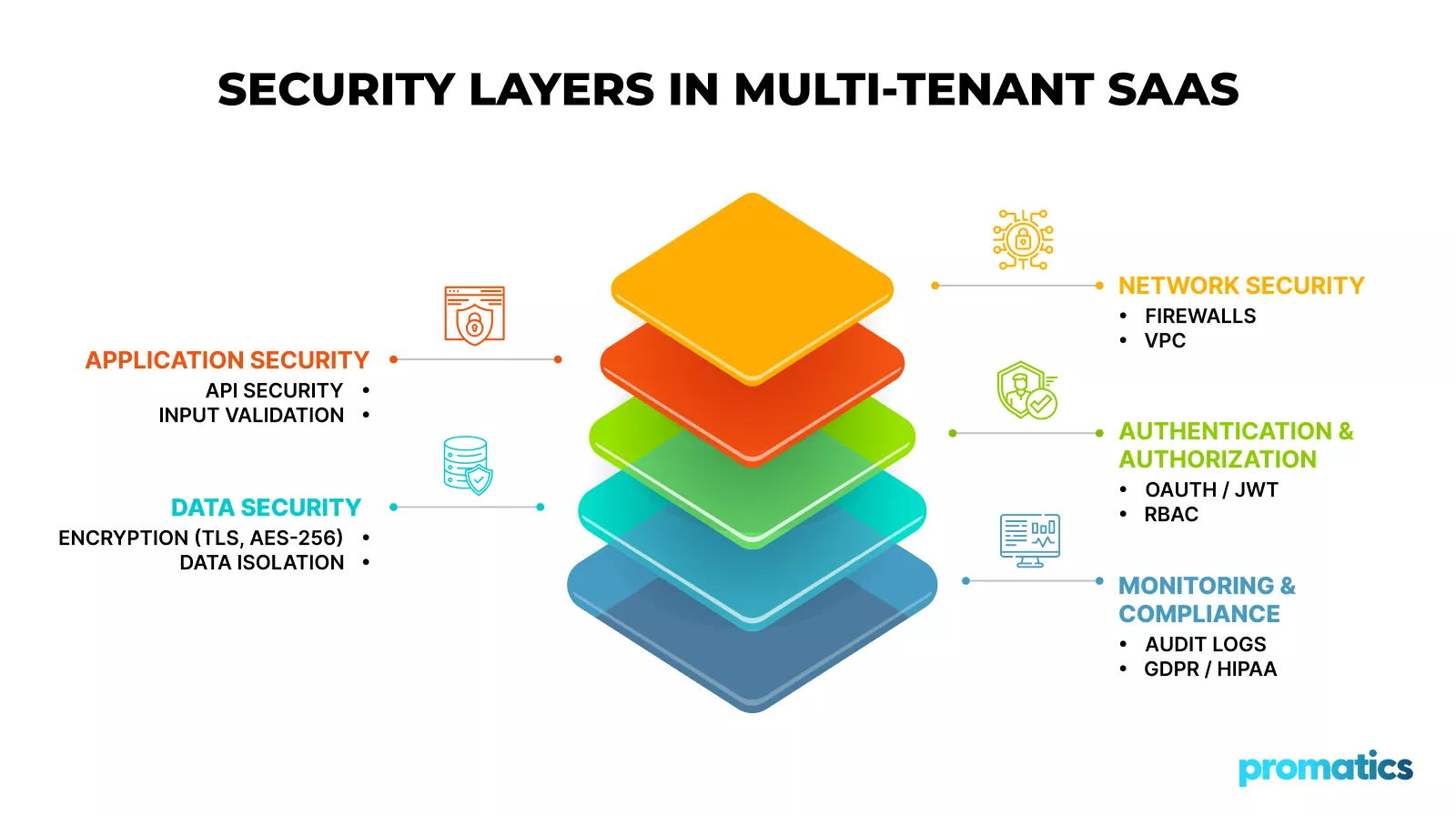
Data Isolation and Encryption
- Ensure strict data isolation using access controls like row-level security
- Implement tenant-aware authentication and authorization
- Follow layered security practices to minimize risks
- Encrypt data both in transit (TLS) and at rest (AES-256)
- Secure and rotate encryption keys using proper key management systems
- Extend encryption to backups and logs
Compliance and Security Standards
- Follow regulations such as GDPR, HIPAA, and PCI-DSS
- Maintain audit logs and monitoring systems
- Conduct regular security assessments and vulnerability scans
Performance and Scalability
- Use auto-scaling to handle varying workloads
- Allocate resources efficiently to avoid performance issues
- Reduce the noisy neighbor effect through proper workload isolation
- Implement load balancing to ensure high availability and stability
Monitoring and Operations
- Track system and tenant performance using monitoring tools
- Set up real-time alerts to detect issues early
- Analyze system behavior to identify and fix bottlenecks
Automated Onboarding
- Use API-driven provisioning to onboard tenants quickly
- Reduce manual effort and minimize errors
- Enable faster deployment with standardized configurations
Key Insight
A successful multi-tenant SaaS platform is built by balancing security, performance, and operational efficiency, ensuring it remains reliable and scalable as it grows.
Advanced Best Practices for Scaling
Scaling a multi-tenant SaaS platform is not just about adding more servers. It requires a thoughtful combination of architecture design, resource management, and operational efficiency to ensure consistent performance as your user base grows. Below are key best practices that help build a scalable and resilient system.
Adopt a Microservices-Based Architecture
Breaking your application into smaller, independent services allows each component to scale individually. Instead of scaling the entire system, you can scale only the services experiencing high demand.
- Enables independent deployments and faster releases
- Improves fault isolation, reducing system-wide failures
- Supports flexible scaling based on usage patterns
This approach is essential for handling complex, high-growth SaaS platforms.
Design with an API-First Approach
An API-first strategy ensures that all functionalities are accessible through well-defined APIs. This improves flexibility and makes integration with third-party services seamless.
- Simplifies integration with external tools and platforms
- Enhances developer experience and productivity
- Enables automation and faster feature expansion
API-driven systems are easier to scale and adapt as business needs evolve.
Implement Smart Resource Management
Efficient resource allocation is critical in multi-tenant environments where multiple users share infrastructure.
- Use orchestration platforms like Kubernetes for dynamic scaling
- Allocate resource quotas per tenant to prevent overuse
- Optimize CPU, memory, and storage usage to maintain cost efficiency
This helps reduce the risk of performance issues such as the noisy neighbor effect.
Optimize Database Performance
The database layer often becomes the biggest bottleneck at scale. Proper optimization ensures smooth performance as data grows.
- Use indexing and query optimization for faster data retrieval
- Implement database sharding or partitioning for large datasets
- Separate read and write workloads using replicas
- Monitor query performance continuously
A well-optimized database ensures consistent performance across tenants.
Enable Auto-Scaling and Load Balancing
Scaling should be dynamic and responsive to real-time demand.
- Implement auto-scaling to handle traffic spikes efficiently
- Use load balancers to distribute traffic evenly
- Ensure high availability by avoiding single points of failure
This ensures stable performance even during peak usage periods.
Build Strong Observability and Monitoring
As systems grow, visibility becomes critical for maintaining performance and reliability.
- Use monitoring tools like Prometheus and Grafana
- Track tenant-level and system-level metrics
- Implement real-time alerts and logging systems
- Use analytics to identify bottlenecks and optimize performance
Observability helps teams detect and resolve issues before they impact users.
Implement Tenant Segmentation Strategies
Not all tenants have the same usage patterns or requirements. Segmenting tenants allows for better resource allocation and performance management.
- Group tenants based on usage, size, or subscription tier
- Allocate dedicated resources for high-value or high-usage tenants
- Customize scaling strategies per segment
This ensures a balanced system while maintaining performance for all users.
Automate Infrastructure and Deployment
Automation reduces manual effort and ensures consistency across environments.
- Use Infrastructure as Code (IaC) tools for deployment
- Automate CI/CD pipelines for faster releases
- Enable automated provisioning and scaling
Automation improves efficiency and reduces the risk of human errors.
Focus on Resilience and Fault Tolerance
At scale, failures are inevitable. Systems must be designed to handle them gracefully.
- Implement failover mechanisms and redundancy
- Use circuit breakers and retries for service stability
- Design systems for graceful degradation instead of complete failure
This ensures uninterrupted service and better user experience.
Key Insight
Scaling a multi-tenant SaaS platform is a continuous process that requires balancing performance, cost, and user experience. By combining the right architectural patterns, automation, and monitoring strategies, businesses can build systems that not only scale efficiently but also remain reliable and secure as they grow.
Future Trends in Multi-Tenant SaaS
Multi-tenant SaaS architecture continues to evolve as new technologies reshape how applications are built, deployed, and scaled. The future is not just about handling more users, but about building systems that are intelligent, adaptive, and highly efficient. Below are the key trends shaping the next generation of multi-tenant SaaS platforms.
AI-Driven Optimization and Personalization
Artificial Intelligence is becoming a core component of modern SaaS platforms. Instead of relying on static rules, systems are now using AI to dynamically optimize performance and user experience.
- Predict resource usage and traffic patterns
- Automate scaling decisions based on real-time demand
- Deliver personalized experiences for each tenant
- Detect anomalies and potential security threats
AI enables SaaS platforms to become more proactive, efficient, and user-centric.
Serverless and Event-Driven Architectures
Serverless computing is transforming how applications are deployed and managed. Instead of provisioning servers, developers can focus purely on code while the cloud handles scaling automatically.
- Eliminates the need for infrastructure management
- Enables automatic scaling based on events
- Reduces operational costs by charging only for actual usage
- Improves development speed and agility
Serverless is especially useful for handling unpredictable workloads in multi-tenant environments.
Edge Computing for Low Latency
As SaaS platforms expand globally, delivering fast and consistent performance becomes critical. Edge computing addresses this by processing data closer to the end user.
- Reduces latency and response times
- Improves user experience for geographically distributed tenants
- Supports real-time applications and analytics
This is particularly important for applications requiring instant data processing.
Rise of Vertical SaaS (Industry-Specific Solutions)
The market is shifting from generic SaaS platforms to industry-specific (vertical) SaaS solutions. These platforms are tailored for specific industries such as healthcare, finance, and logistics.
- Built with domain-specific workflows and compliance requirements
- Offers deeper customization and value for niche markets
- Requires more flexible multi-tenant architectures
Vertical SaaS is driving demand for more adaptable and configurable systems.
Multi-Cloud and Distributed Architectures
Organizations are increasingly adopting multi-cloud strategies to avoid vendor lock-in and improve resilience.
- Use multiple providers like Amazon Web Services, Microsoft Azure, and Google Cloud Platform
- Improve availability and disaster recovery
- Optimize performance by selecting the best services from each provider
This approach enhances flexibility but requires advanced orchestration and management.
Enhanced Security with Zero Trust Architecture
Security models are evolving toward a Zero Trust approach, where no user or system is automatically trusted.
- Continuous identity verification and access validation
- Stronger protection against internal and external threats
- Fine-grained access control for multi-tenant environments
Zero Trust is becoming essential as SaaS platforms handle more sensitive data.
Low-Code and No-Code SaaS Platforms
The rise of low-code and no-code platforms is enabling faster application development and customization.
- Allows businesses to build and modify applications without deep technical expertise
- Accelerates product development and deployment cycles
- Enables tenants to customize workflows independently
This trend increases accessibility while reducing development time.
Data-Driven SaaS and Advanced Analytics
Modern SaaS platforms are increasingly focused on leveraging data for insights and decision-making.
- Real-time analytics and reporting dashboards
- Data-driven product improvements and user insights
- Integration with AI for predictive analytics
Data is becoming a key differentiator for SaaS platforms.
Key Insight
The future of multi-tenant SaaS lies in building systems that are not just scalable, but also intelligent, flexible, and highly responsive to user needs. Businesses that adopt these emerging trends early will be better positioned to deliver superior performance, enhanced user experiences, and long-term competitive advantage.
Final Thoughts
Multi-tenant SaaS architecture is no longer just a technical choice. It has become a strategic foundation for building products that scale efficiently, reduce operational costs, and deliver consistent user experiences across a growing customer base. When implemented thoughtfully, it empowers businesses to move faster, adapt to evolving demands, and stay competitive in a cloud-first landscape.
The real impact comes from getting the architecture right from the beginning. That is what separates a system that simply functions from one that scales seamlessly and performs reliably under growth. This is where Promatics Technologies adds value. We design and build secure, high-performance, and scalable multi-tenant SaaS solutions tailored to real-world business challenges.
From architecture planning to full-cycle development, our approach focuses on creating systems that are not only efficient today but also prepared for future expansion.
If you are planning to build or scale a SaaS platform, this is the right time to do it strategically. Partner with Promatics Technologies to turn your idea into a scalable, future-ready product.
