SaaS Application Development Services: What Businesses Should Expect From a Development Partner

TL;DR
- Choose a SaaS development partner with proven expertise and relevant industry experience.
- Prioritize scalable, secure, and flexible technology that supports long-term growth.
- Evaluate partners through real case studies, technical capabilities, and client outcomes.
- Consider expertise in AI, cloud, APIs, integrations, and modern SaaS technologies.
- Select a partner that can support your product from concept to continuous growth.
SaaS has moved from being an alternative software delivery model to becoming a core part of how businesses buy and use technology.
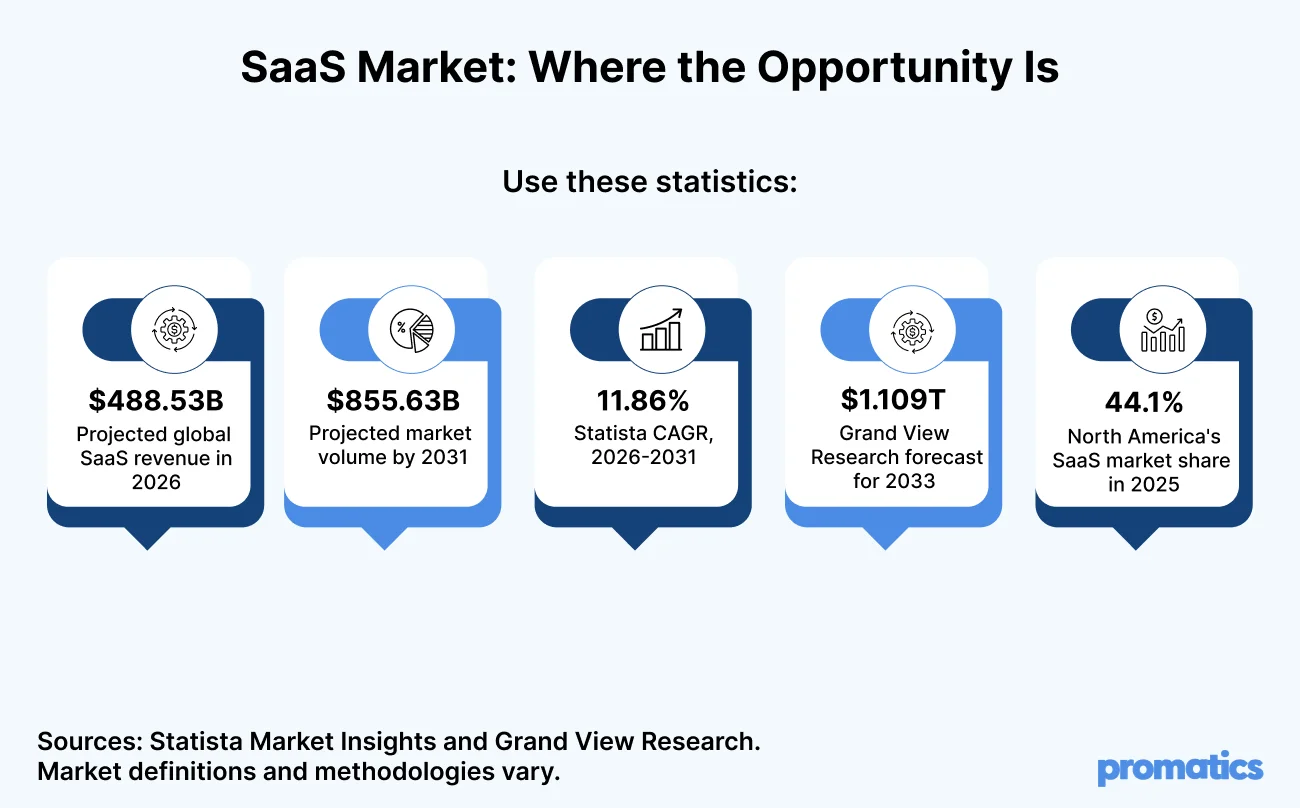
According to Statista, worldwide SaaS revenue is projected to reach $488.53 billion in 2026, with a forecast CAGR of 11.86% between 2026 and 2031, taking the market to approximately $855.63 billion by 2031.
The opportunity is significant, but building a successful SaaS product requires more than putting software in the cloud.
Businesses need a product that solves a real problem, provides a smooth user experience, protects customer data, integrates with existing systems, and can scale as adoption grows.
That makes choosing the right SaaS application development services partner a strategic decision.
SaaS Market Is Growing, but Expectations Are Changing
The SaaS market is expanding rapidly, but growth is no longer simply about putting more applications online.
Dodo Payments’ 2025 SaaS report highlights a shift toward efficient growth, vertical SaaS, AI-powered functionality, retention, and usage-based or hybrid pricing models. The report also notes that more than 80% of business applications are expected to be SaaS-based.
Market forecasts also point to continued expansion. Grand View Research estimates the global SaaS market at $464.7 billion in 2025, growing to $530 billion in 2026 and $1.109 trillion by 2033, representing an 11.1% CAGR from 2026 to 2033.
Because market reports use different definitions and methodologies, businesses should focus less on a single market-size number and more on what the growth means for their product strategy.
For development teams, that means building SaaS products that are:
Scalable + Secure + Integrated + Data-driven + Adaptable
What Are SaaS Application Development Services?
SaaS application development services cover the complete lifecycle of cloud-based software, from product discovery and design to development, deployment, maintenance, and scaling.
Depending on the product, services can include:
- Product strategy
- UX/UI design
- SaaS architecture
- Custom software development
- API development
- Third-party integrations
- Cloud infrastructure
- QA and testing
- Security
- DevOps
- Maintenance and support
SaaS products can include B2B platforms, CRM systems, healthcare applications, financial software, analytics products, AI platforms, education technology, and industry-specific business applications.
The key difference is that SaaS development is not a one-time project. The product needs to continue delivering value as customers, technology, and business requirements change.
What Should You Expect From a SaaS Development Partner?
1. Product Discovery Before Development
A strong partner should understand the product before writing code.
Discovery should clarify:
- Target users
- Business objectives
- Core workflows
- MVP requirements
- Technical constraints
- Integration needs
- Product roadmap
Promatics’ Product Discovery Workshops help businesses define product requirements, user flows, specifications, estimates, and development roadmaps.
The goal is to reduce uncertainty before major development resources are committed.
2. Focused MVP and Product Strategy
SaaS products can easily become overloaded with features.
A good development partner should help prioritize what users actually need for the first release.
A practical roadmap can follow:
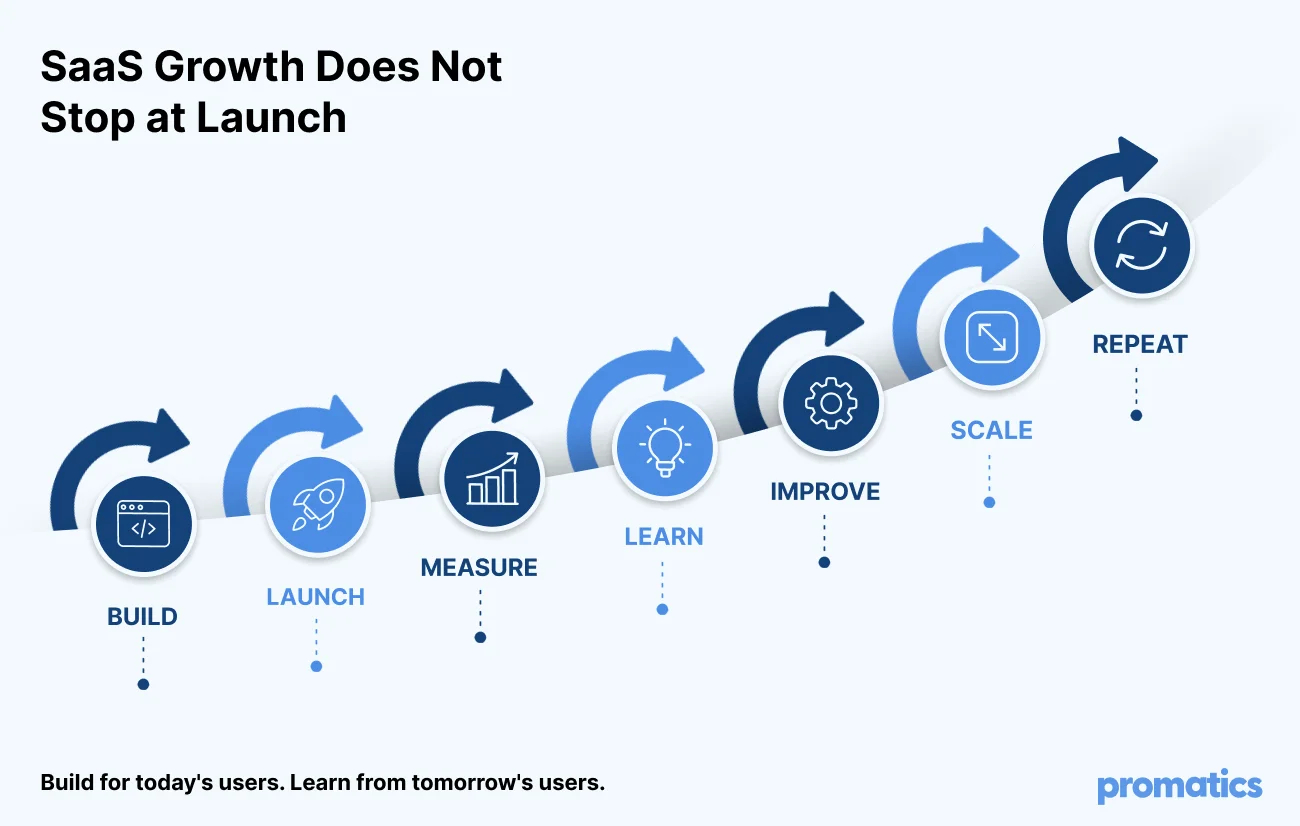
Discovery → MVP → Launch → Feedback → Improve → Scale
This approach allows businesses to validate the product before expanding its functionality.
3. User-Centered UX/UI
A technically sophisticated product can still struggle if users find it difficult to navigate.
Your partner should consider:
- User journeys
- Wireframes
- Prototypes
- Information architecture
- Dashboards
- Responsive design
- Usability
Promatics combines UI/UX design and product strategy with development to create products around business and user requirements.
4. Scalable SaaS Architecture
Architecture determines how easily a SaaS product can evolve.
Depending on the application, important considerations include:
- Multi-tenancy
- Data isolation
- Database architecture
- APIs
- Authentication
- Authorization
- Caching
- Cloud infrastructure
- Monitoring
Businesses planning multi-tenant products can explore Promatics’ guide to SaaS application architecture.
5. Custom SaaS Development
Off-the-shelf platforms are useful for standardized requirements. Custom SaaS development becomes more valuable when the product needs unique workflows, proprietary functionality, or specialized integrations.
A capable partner should be able to build:
- Frontend applications
- Backend systems
- APIs
- Databases
- Dashboards
- Admin panels
- User management
- Business workflows
The technology stack should be selected around the product, not simply because a technology is popular.
6. API Development and Integrations
Modern SaaS applications rarely operate alone.
They may need to connect with:
- Payment gateways
- CRM systems
- Analytics platforms
- Communication tools
- AI services
- Cloud platforms
- Enterprise applications
An API-first development approach can make integrations easier to extend as the product grows.
7. Security and Quality Assurance
Security should be built into the development process.
Depending on the product, this can include:
- Authentication
- Role-based access
- Encryption
- API security
- Data isolation
- Secure cloud configuration
- Vulnerability testing
- Backup and recovery
QA should also cover functionality, integrations, performance, security, compatibility, and user acceptance.
8. Cloud and DevOps
The infrastructure supporting a SaaS application needs to handle changing workloads reliably.
Depending on requirements, a development partner may support:
- Cloud infrastructure
- CI/CD
- Deployment automation
- Monitoring
- Logging
- Backups
- Disaster recovery
Promatics’ cloud computing services guide covers cloud infrastructure, DevOps, Kubernetes, serverless technologies, monitoring, and recovery.
9. Analytics and Product Intelligence
After launch, businesses need to understand how customers use the product.
Product analytics can reveal:
- Feature adoption
- User engagement
- Drop-off points
- Conversion behavior
- Customer retention
- Performance issues
This creates a feedback loop between product usage and future development decisions.
10. Post-Launch Support
A SaaS product does not end at launch.
Security updates, new integrations, customer feedback, performance requirements, and market changes can all create new development needs.
Your partner should have a clear plan for:
- Bug fixes
- Maintenance
- Security updates
- Performance optimization
- Feature enhancements
- Infrastructure support
- Version upgrades
How Does the SaaS Development Process Work?
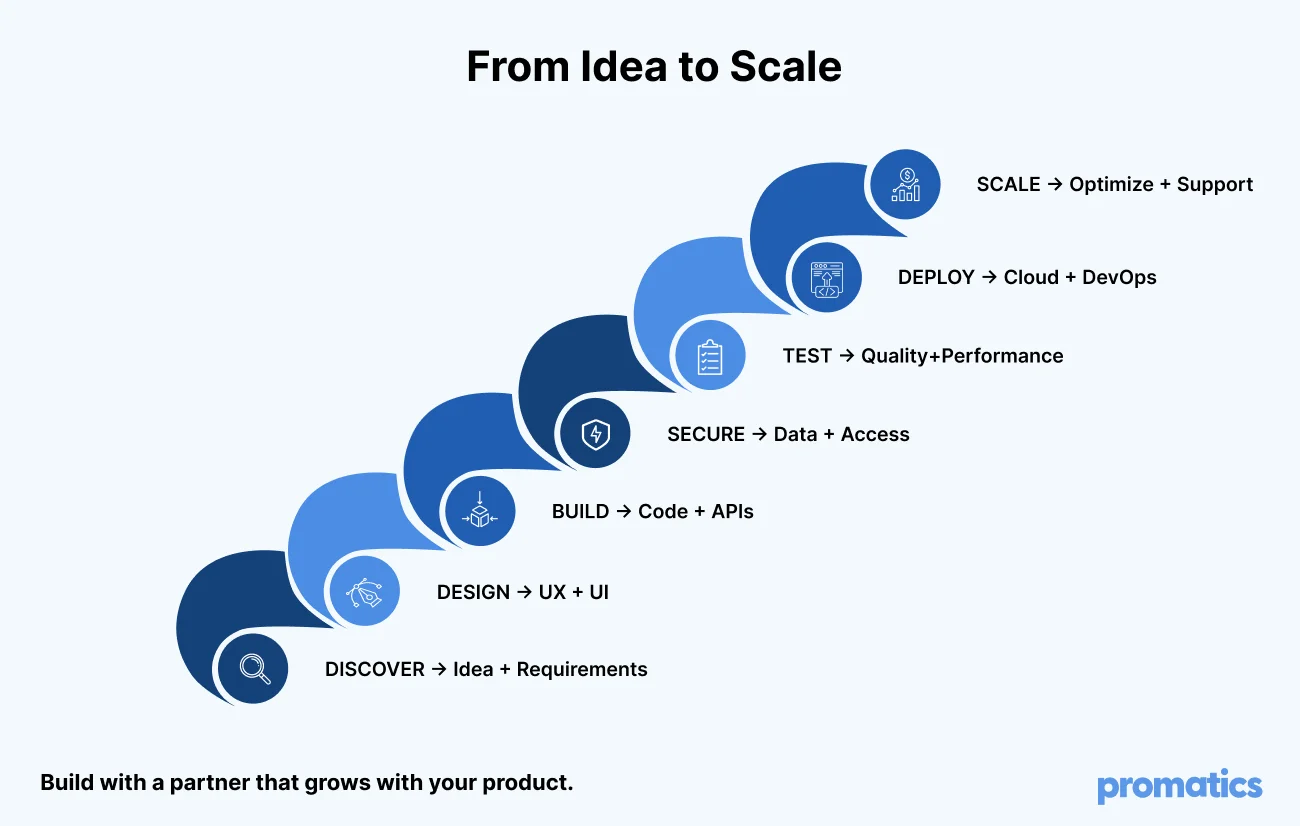
A typical SaaS development lifecycle includes:
1. Discovery
Define business goals, users, requirements, and MVP scope.
2. Planning
Establish the roadmap, technology direction, and architecture.
3. Design
Create user journeys, prototypes, interfaces, and design systems.
4. Development
Build the frontend, backend, APIs, integrations, and workflows.
5. Testing
Validate functionality, security, performance, and usability.
6. Deployment
Launch the application and establish monitoring and infrastructure processes.
7. Optimization
Use product data and customer feedback to guide improvements.
How to Choose a SaaS App Development Company
Choosing a development partner requires looking beyond pricing.
Check Relevant Experience
Ask whether the company has built products with similar:
- Industries
- Users
- Business models
- Integrations
- Technical complexity
Review Case Studies
Look at the original problem, solution, technology, functionality, and outcome rather than simply reviewing screenshots.
Evaluate Technical Depth
Look for expertise across development, APIs, databases, cloud, DevOps, QA, security, and AI where relevant.
Assess Communication
Clarify project reporting, documentation, meetings, tools, and scope management.
Understand Post-Launch Support
Ask about maintenance, bug fixing, infrastructure, security updates, and future development.
Real SaaS Experience at Promatics
A portfolio can tell you more about a development partner than a list of technologies.
Promatics’ case studies include SaaS and digital products across recruitment, ESG, consumer technology, marketing, ecommerce, and other industries.
TopGrad: AI-Powered Recruitment Platform
TopGrad is an Australia-based recruitment and job platform developed by Promatics.
The platform includes job search, candidate assessment, application functionality, personalized recommendations, and AI-powered recruitment capabilities.
Explore the TopGrad case study.
NetZero Hub: B2B SaaS
NetZero Hub is listed in the Promatics portfolio as a B2B SaaS product in the ESG and cleantech space.
It demonstrates experience building specialized SaaS products around industry-specific requirements.
SuperNanny: Consumer SaaS
SuperNanny is listed as a consumer technology and on-demand SaaS product built with Flutter.
It adds consumer-focused SaaS experience to the Promatics portfolio.
One Step Service: Marketing SaaS
One Step Service is listed as a B2C SaaS marketing and advertising solution.
The project demonstrates experience developing specialized platforms around marketing workflows and business processes.
When Should You Hire a SaaS Development Company?
A SaaS development partner can be valuable when:
- You are building a new SaaS product.
- Existing software needs modernization.
- Off-the-shelf tools cannot meet your requirements.
- Your application requires complex integrations.
- You need scalable architecture.
- Your internal team lacks specialized expertise.
- You want to introduce AI or automation.
- You need ongoing engineering support.
If you’re evaluating whether SaaS is the right model, explore when to invest in SaaS application development.
Custom SaaS vs Off-the-Shelf Software
| Factor | Off-the-Shelf | Custom SaaS |
| Setup | Faster | Requires development |
| Customization | Limited | High |
| Integrations | Available options | Built around requirements |
| UX | Standardized | Customizable |
| Differentiation | Limited | Greater flexibility |
| Roadmap | Provider-driven | Business-driven |
If the software itself is a competitive advantage, custom SaaS development can provide greater control over functionality and future product direction.
Why Choose Promatics for SaaS Development?
SaaS development requires product, design, engineering, infrastructure, and support capabilities to work together.
Promatics brings together:
- Product strategy
- UI/UX
- Web and software development
- AI development
- API integration
- Cloud and DevOps
- QA
- Product support
For businesses exploring AI-powered SaaS, Promatics also provides AI software development, including AI-powered applications, automation, machine learning, and AI APIs.
The focus is on building products that solve real business problems while creating a foundation for future growth.
Final Thoughts
The growth of SaaS creates significant opportunities for businesses, but a successful product requires more than a development team that can write code.
The right SaaS application development services partner should combine product thinking, technical expertise, security, scalable architecture, strong UX, and long-term support.
Market forecasts reinforce the opportunity. Statista projects SaaS revenue of $488.53 billion in 2026, while Grand View Research forecasts the market to reach $1.109 trillion by 2033.
For businesses entering this market, the bigger question is not simply “Who can build our SaaS product?”
It is:
“Who can help us build, launch, improve, and scale it?”
Promatics’ experience across SaaS and digital products such as TopGrad, NetZero Hub, SuperNanny, and One Step Service provides a foundation for businesses looking for a technology partner beyond initial development.
Ready to build your SaaS product? Talk to Promatics Technologies about your product idea, technology requirements, and development roadmap.
