How To Hire Mobile App Developers In India

TL;DR
- Hiring mobile app developers in India offers cost-effective, high-quality solutions
- Access to skilled talent across iOS, Android, and cross-platform development
- Supports custom app development aligned with business goals
- Ensures scalability, security, and post-launch support
- Ideal for startups and enterprises seeking faster time-to-market
Mobile applications are no longer optional for businesses; they are strategic assets that drive customer engagement, operational efficiency, and long-term growth. From startups launching innovative products to enterprises modernizing legacy systems, mobile apps now play a central role in digital transformation strategies. However, the success of any mobile initiative begins with one crucial decision: hiring the right mobile app developer.
India has emerged as a leading global destination for mobile app development, offering a strong combination of technical expertise, scalable talent, cost efficiency, and experience serving international clients. Indian developers are skilled across native, cross-platform, and cloud-integrated technologies, making them well-suited for diverse business needs.
This blog will help you understand how to hire mobile app developers in India strategically, evaluate the right talent, and make a confident, well-informed decision for your business.
India’s Mobile App Development Market: A Complete Industry Overview
India’s mobile app development industry has expanded significantly, earning global recognition for both its technical capability and market growth. The India mobile application market generated an estimated USD 10,591.2 million in revenue in 2024 and is projected to grow to USD 27,675.5 million by 2030, representing a robust 17.8% compound annual growth rate (CAGR) over the forecast period.
This rapid expansion reflects not only increased domestic adoption but also rising global demand for sophisticated mobile solutions built by Indian developers. India’s contribution to the global mobile app ecosystem is further strengthened by widespread smartphone penetration, a digitally engaged population, and continued uptake of advanced technologies all of which fuel opportunities for businesses seeking scalable mobile products.
Why Global Companies Prefer Hiring Mobile App Developers in India
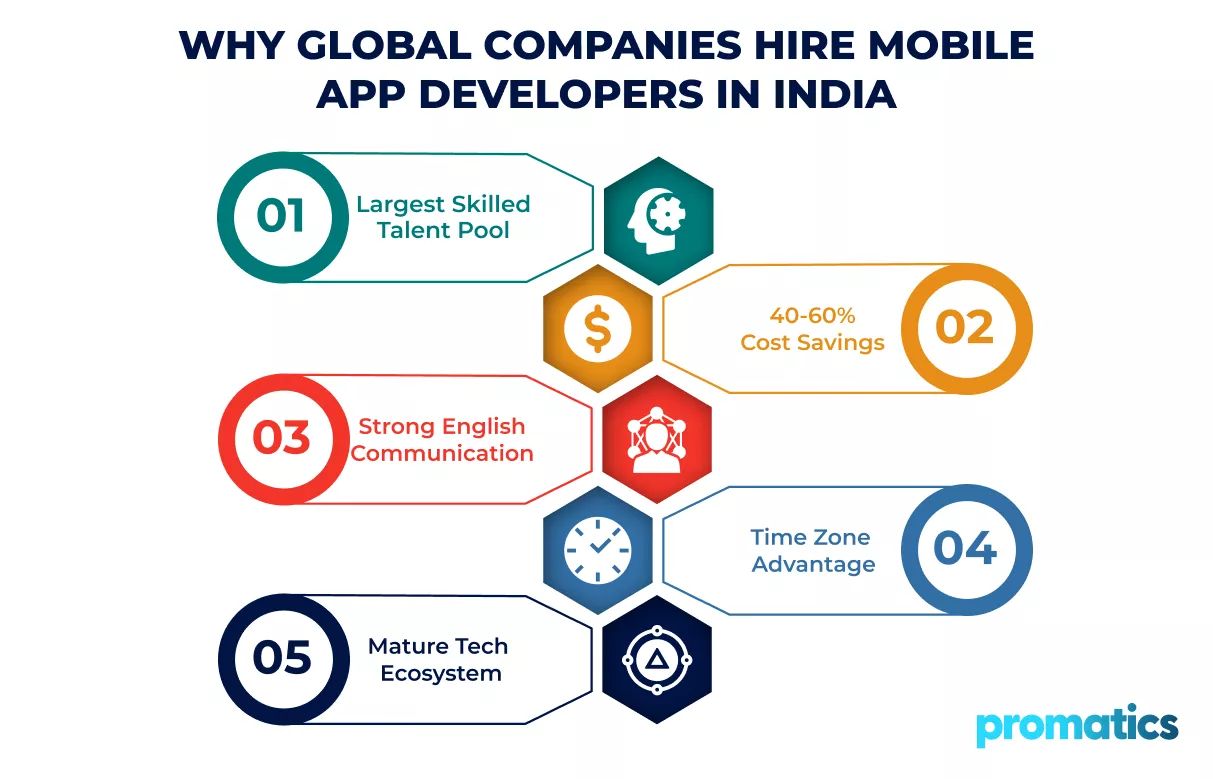
India has become one of the most trusted destinations for building mobile applications. Companies across the United States, Europe, the Middle East, and Australia consistently engage Indian development teams for high-performance, scalable, and cost-efficient digital solutions. Several factors contribute to this global preference.
- Vast and Highly Skilled Talent Pool
India hosts one of the world’s largest pools of software professionals, with thousands of engineering graduates entering the workforce each year. Developers are highly skilled in technologies such as Swift, Kotlin, Java, Flutter, and React Native, and many have experience working with international clients. This combination of technical expertise and global exposure makes India a reliable source of scalable mobile app development talent.
- Cost-Effective Development With High Quality Standards
Cost efficiency is a key reason businesses hire mobile app developers in India. Compared to markets like the US and UK, development costs are significantly more competitive. Despite lower pricing, Indian firms deliver enterprise-grade applications built with secure, scalable architecture and strong engineering standards, ensuring quality is never compromised.
- Strong English Proficiency and Clear Communication
India’s IT workforce demonstrates strong English proficiency, enabling smooth collaboration with global clients. Developers and project managers are comfortable handling documentation, structured reporting, and client discussions. This clarity reduces communication gaps and improves project transparency across borders.
- Time Zone Advantage for Global Clients
India’s time zone offers operational flexibility for international businesses. European and Middle Eastern clients benefit from overlapping hours, while US companies gain extended productivity cycles. This allows faster iterations and improved turnaround times.
- Established IT Infrastructure and Technology Ecosystem
Major tech hubs such as Bangalore, Hyderabad, Chennai, Gurgaon, and Chandigarh support a mature and innovation-driven ecosystem. Backed by global tech firms, incubators, and digital initiatives, India provides a stable and competitive environment for large-scale mobile app development.
Different Types of Mobile App Developers
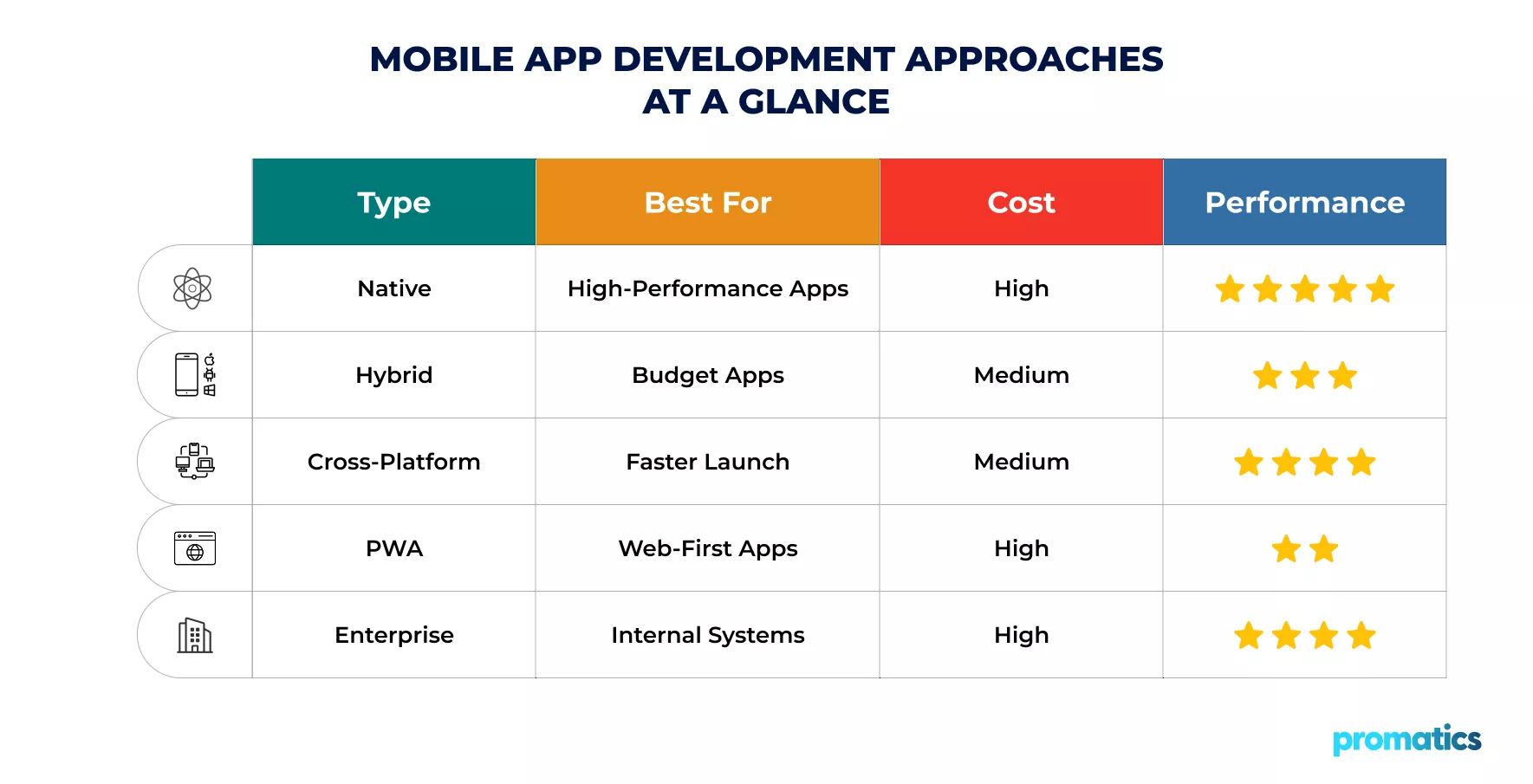
Native Mobile App Development
Native mobile applications are designed and developed specifically for a single operating system, such as iOS or Android. These applications are built using platform-specific programming languages Swift or Objective-C for iOS, and Kotlin or Java for Android. Because they are engineered exclusively for one platform, native apps are optimized to leverage the full capabilities of that ecosystem.
Advantages
- High Performance:
Native applications deliver superior speed and responsiveness since they are optimized directly for the underlying operating system and hardware. - Enhanced User Experience:
They follow platform-specific design guidelines, resulting in smoother navigation, intuitive interfaces, and consistent user interactions. - Full Access to Device Capabilities:
Native apps can seamlessly integrate with hardware features such as GPS, camera, microphone, biometric authentication, push notifications, and background services.
Limitations
- Higher Development Costs:
Since separate codebases must be developed and maintained for iOS and Android, overall development investment can increase significantly. - Longer Development Timelines:
Building and managing two independent applications typically extends production schedules compared to unified development approaches.
Best Suited For
Native development is ideal when application performance, user experience precision, and deep device integration are mission-critical. It is particularly recommended for high-performance consumer apps, fintech platforms, enterprise systems, and applications with complex functionalities.
Hybrid Mobile App Development
Hybrid mobile applications are developed using web technologies such as HTML, CSS, and JavaScript, and then encapsulated within a native container that allows them to operate across multiple platforms. By combining web-based code with native deployment capabilities, hybrid apps can function on both iOS and Android from a single codebase.
Advantages
- Cross-Platform Deployment: A single codebase can be deployed across multiple operating systems, reducing duplication of effort and simplifying updates.
- Cost Efficiency: Since developers do not need to build separate native applications for each platform, overall development costs are typically lower.
- Accelerated Development Timeline: Unified development enables faster build cycles and quicker time to market compared to managing independent native projects.
Limitations
- Performance Constraints: Hybrid apps may not match the speed and responsiveness of fully native applications, particularly in graphics-intensive or highly interactive environments.
- Restricted Hardware Integration: Access to advanced device features can be limited or may require additional plugins and workarounds.
Best Suited For
Hybrid development is appropriate for projects with moderate complexity, limited budgets, or shorter timelines. It works well for content-driven applications or products that do not demand intensive hardware integration or high-performance processing.
Progressive Web Apps (PWAs)
A Progressive Web App (PWA) is a web-based application that delivers an app-like experience directly through a browser. Unlike traditional mobile applications, PWAs do not require installation through app stores. They are built using standard web technologies such as HTML, CSS, and JavaScript, but are enhanced with modern capabilities that allow them to function similarly to native mobile apps.
Advantages
- No App Store Dependency: PWAs bypass app store submission and approval processes, enabling faster deployment and easier updates.
- Universal Accessibility: They can run on any device with a compatible web browser, ensuring broad cross-platform reach without platform-specific builds.
- Offline Functionality: Through service workers and caching mechanisms, PWAs can operate with limited or no internet connectivity.
Limitations
- Restricted Hardware Access: PWAs have limited access to advanced device features compared to native applications.
- Performance Constraints: Because they operate within a browser environment, PWAs may not deliver the same level of speed and responsiveness as fully native apps.
Best Suited For
PWAs are ideal for businesses seeking to provide an app-like experience without requiring users to download an application. They work well for content-driven platforms, lightweight applications, and projects requiring rapid, cost-effective cross-platform deployment.
Cross-Platform Mobile App Development
Cross-platform mobile app development enables developers to create a single codebase that can be deployed across both iOS and Android platforms. Modern frameworks such as Flutter, React Native, and Xamarin have significantly streamlined this approach, making it a practical and widely adopted solution for businesses seeking efficiency without completely compromising performance.
Advantages
- Unified Codebase: A single application codebase supports multiple platforms, simplifying development, updates, and long-term maintenance.
- Cost Efficiency: By eliminating the need to build separate native applications, cross-platform development reduces engineering overhead and overall project costs.
- Accelerated Time to Market: With shared logic and reusable components, development cycles are generally shorter compared to fully native builds.
Limitations
- Performance Trade-Offs: Although frameworks like Flutter and React Native have narrowed the performance gap, highly complex or graphics-intensive applications may still perform better when built natively.
- Partial Access to Native Features: Some advanced platform-specific capabilities may require additional native modules or custom integrations.
Best Suited For
Cross-platform development is ideal for businesses that need presence on both iOS and Android while optimizing time and budget. It works particularly well for applications with moderate complexity that do not demand intensive hardware-level performance.
Backend-as-a-Service (BaaS) Mobile App Development
Backend-as-a-Service (BaaS) is a cloud-based solution that provides ready-to-use backend infrastructure for mobile applications. It typically includes services such as database management, user authentication, cloud storage, push notifications, and server hosting. By leveraging BaaS platforms, development teams can avoid building and maintaining complex server-side architecture, as infrastructure management is handled by the service provider.
Advantages
- Automatic Scalability: BaaS platforms are designed to scale dynamically based on application demand, ensuring stable performance during traffic spikes.
- Reduced Development Time: Pre-built backend components eliminate the need to develop server infrastructure from scratch, accelerating overall project timelines.
- Real-Time Data Synchronization: Many BaaS solutions support real-time database updates, making them well-suited for interactive and data-driven applications.
Limitations
- Vendor Dependency: Application performance and availability may be affected if the BaaS provider experiences downtime or service disruptions.
- Limited Backend Customization: Compared to fully custom backend development, BaaS platforms may restrict architectural flexibility and advanced customization options.
Best Suited For
BaaS is ideal for teams that want to focus primarily on frontend design and user experience while leveraging pre-built backend capabilities. It works particularly well for applications requiring real-time functionality, such as messaging platforms, collaboration tools, or social networking apps, and for projects where faster deployment is a priority.
Enterprise Mobile App Development
Enterprise mobile app development focuses on designing and building applications tailored to the operational needs of large organizations. These apps are typically developed to enhance internal workflows, improve cross-department communication, integrate with existing enterprise systems, and increase overall productivity. Unlike consumer-facing apps, enterprise applications prioritize functionality, security, scalability, and system integration.
Advantages
- Operational Efficiency: Enterprise apps streamline business processes, automate repetitive tasks, and improve collaboration across teams and departments.
- High Level of Customization: These applications are built to align with specific organizational requirements, workflows, and compliance standards.
- Enhanced Security Frameworks: Enterprise mobile apps are designed with advanced security protocols to safeguard sensitive business data and ensure regulatory compliance.
Limitations
- Higher Development Investment: Enterprise applications often require significant time, resources, and architectural planning, which increases overall development costs.
- Technical Complexity: They frequently involve system integrations, large user bases, data synchronization, and scalable infrastructure, making development more complex.
Best Suited For
Enterprise mobile development is ideal for organizations seeking customized solutions to manage internal operations, optimize productivity, or enable secure mobile access to corporate systems. It is particularly relevant for large businesses that require scalable, secure, and integration-ready mobile platforms for employees or stakeholders.
Game Development Applications
Mobile game development involves creating applications specifically designed for interactive gaming experiences. These apps can be developed using native technologies for iOS and Android or through cross-platform engines such as Unity or Unreal Engine, which are widely used in modern mobile game production. Game applications demand specialized expertise in graphics rendering, animation, performance optimization, and user engagement design.
Advantages
- High Performance Capabilities: Native or engine-optimized game development enables advanced graphics processing, smooth animations, and responsive gameplay.
- Immersive User Experience: Mobile games are designed to deliver interactive, visually engaging, and highly engaging experiences that drive strong user retention.
Limitations
- Higher Development Investment: Producing high-quality mobile games often requires substantial budget allocation for design, development, testing, and ongoing optimization.
- Technical Complexity: Game development involves specialized skills in game mechanics, physics engines, animation frameworks, and performance tuning.
Best Suited For
Game development is appropriate for organizations aiming to enter the mobile gaming market or leverage gamified experiences to increase brand engagement. It is particularly relevant for businesses seeking highly interactive and entertainment-focused mobile products.
Augmented Reality (AR) and Virtual Reality (VR) Mobile App Development
Augmented Reality (AR) and Virtual Reality (VR) represent some of the most advanced and transformative technologies in mobile application development. AR enhances the real-world environment by overlaying digital elements onto physical surroundings, while VR creates a fully immersive virtual experience that transports users into simulated environments. These technologies are increasingly adopted across industries such as gaming, education, healthcare, retail, real estate, and training simulations.
Advantages
- Highly Immersive Engagement: AR and VR applications deliver interactive and visually rich experiences that significantly enhance user engagement and retention.
- Competitive Differentiation: By integrating immersive technologies, businesses can offer innovative features that distinguish their products in competitive markets.
Limitations
- Significant Development Investment: AR and VR applications require specialized technical expertise, advanced design capabilities, and sophisticated development tools, which can increase overall costs.
- Hardware Compatibility Requirements: Users may need AR-supported smartphones or dedicated VR headsets, potentially limiting accessibility for broader audiences.
Best Suited For
AR and VR development is ideal for organizations aiming to deliver immersive, interactive digital experiences. It is particularly valuable in sectors such as gaming, education, healthcare, retail, and training environments where experiential engagement enhances user value.
On-Demand Mobile App Development
On-demand mobile applications are built to deliver products or services to users in real time. These platforms connect customers with service providers instantly, enabling seamless transactions and immediate fulfillment. Common examples include ride-sharing platforms, food delivery services, home service marketplaces, and logistics applications. On-demand apps are typically driven by real-time data processing, location tracking, and secure payment integration.
Advantages
- Immediate User Access: On-demand applications provide instant service availability, enhancing user convenience and improving customer satisfaction.
- High Scalability Potential: When supported by robust backend infrastructure, these platforms can efficiently scale to accommodate growing user demand and geographic expansion.
Limitations
- Complex Backend Architecture: On-demand platforms require sophisticated backend systems to manage live requests, payment processing, real-time tracking, notifications, and database synchronization.
- Regulatory and Compliance Risks: Depending on the region and industry, these applications may face legal, licensing, or regulatory challenges that require careful planning and compliance management.
Best Suited For
On-demand development is ideal for businesses aiming to provide real-time access to services or products. It is particularly relevant for organizations targeting the rapidly expanding on-demand economy, where speed, convenience, and operational scalability are critical success factors.
Hiring Models For Hiring A Mobile App Developers in India
India offers a range of flexible engagement models that allow businesses to align development strategy with budget, project complexity, and long-term goals. Whether an organization requires short-term technical support or a full-scale product development partner, these models provide scalability, cost control, and operational transparency.
Freelance Mobile App Developers
Hiring freelance developers can be a practical option for small projects, feature enhancements, or early-stage MVP development. Freelancers typically offer lower upfront costs and faster onboarding for limited-scope tasks.
Advantages:
Lower initial investment and quick hiring for well-defined assignments.
Limitations:
Limited accountability, reduced scalability, and potential risks when managing complex or long-term projects without structured oversight.
Freelancers are best suited for narrowly scoped tasks rather than enterprise-grade applications requiring structured governance.
Dedicated Development Teams
The dedicated team model involves hiring a group of developers who work exclusively on your project and function as an extension of your internal team.
Advantages:
High project transparency, consistent communication, long-term product alignment, and easy scalability as business needs evolve.
This model is particularly effective for startups building scalable products and enterprises executing multi-phase digital transformation initiatives.
Full-Service Mobile App Development Companies
Engaging an established mobile app development company provides access to end-to-end capabilities under one structured framework. These firms typically offer project managers, UI/UX designers, QA engineers, DevOps specialists, and long-term support teams to ensure seamless execution across the entire product lifecycle.
For example, Promatics Technologies delivers integrated mobile app development services, combining strategy, design, engineering, testing, and post-launch optimization under a single, accountable delivery model. This structured approach enhances transparency, quality control, and scalability for growing digital products.
Advantages:
Complete development lifecycle management, structured processes, quality assurance protocols, and enhanced security frameworks.
This approach is ideal for businesses seeking reliability, accountability, and enterprise-level execution standards.
In-House vs. Remote Indian Developers
Building an in-house development team requires significant investment in recruitment, salaries, infrastructure, and long-term employment commitments. In contrast, remote Indian developers provide access to highly skilled talent while reducing overall development costs by approximately 40–60 percent compared to many Western markets.
Organizations benefit from cost efficiency, access to diverse technical expertise, and faster project turnaround without sacrificing quality or scalability.
How Much Does It Cost to Hire Mobile App Developers in India in 2026?
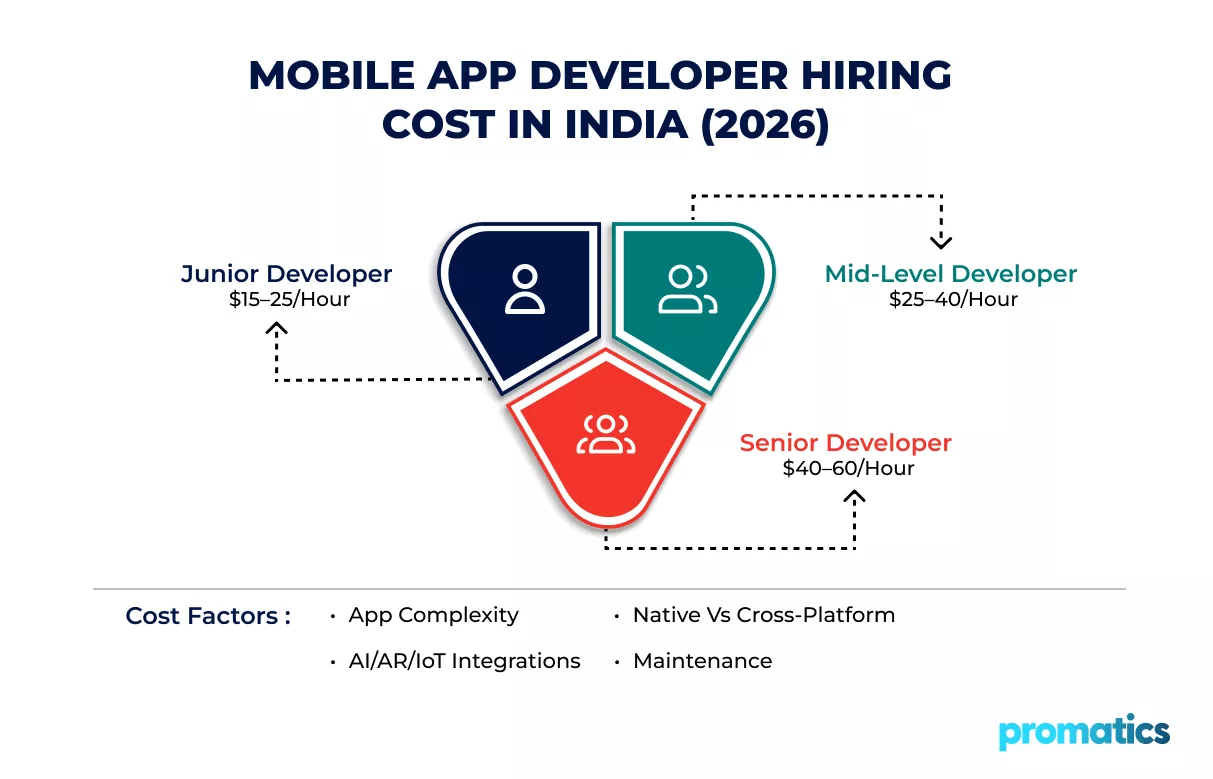
The cost of hiring mobile app developers in India varies based on experience level, engagement model, technical complexity, and long-term project requirements. Pricing can range from cost-effective junior developer rates to premium senior-level or team-based engagements for complex, enterprise-grade mobile applications.
While India remains significantly more affordable than many Western markets, final costs depend heavily on project scope and architectural demands.
For projects requiring full teams including developers, designers, QA engineers, and project managers pricing will scale accordingly.
Key Factors That Influence Cost
- Application Complexity and Feature Set: Apps with advanced functionality, high user concurrency, or complex workflows require more development time and architectural planning.
- Native vs. Cross-Platform Development: Building separate native apps for iOS and Android increases cost compared to unified cross-platform frameworks.
- Advanced Integrations: Incorporating AI, AR/VR capabilities, IoT connectivity, payment gateways, or third-party APIs can significantly impact development effort.
- Post-Launch Support and Maintenance: Ongoing updates, performance monitoring, infrastructure scaling, and security management contribute to long-term investment.
For US businesses, hiring in India often delivers a strategic balance between cost optimization and technical quality, enabling capital allocation toward growth, marketing, and innovation initiatives.
Step-by-Step Process to Hire Mobile App Developers in India
Hiring mobile app developers in India requires a structured and strategic approach. Rather than making decisions based solely on cost or availability, organizations should follow a disciplined evaluation process to ensure alignment with long-term product goals. A clear framework reduces hiring risks, improves collaboration, and increases the likelihood of successful project execution.
Step 1: Define Your Application Requirements
The hiring process should begin with clearly documented project requirements. This ensures alignment between business objectives and technical execution from the outset. Decision-makers should outline core features, user journeys, monetization strategy, compliance needs, and long-term scalability expectations.
Clarify the target platform — whether Android, iOS, or both — along with realistic timelines and budget parameters. A well-prepared project brief minimizes ambiguity and accelerates the onboarding process.
Step 2: Shortlist Qualified Developers or Development Companies
Careful shortlisting ensures that you engage with professionals who match your technical needs and industry requirements. Review portfolios to evaluate real-world applications, assess case studies for measurable results, and examine client testimonials for credibility.
Look for experience relevant to your industry and application complexity. This increases the probability of smoother execution and better architectural decisions.
Step 3: Conduct Technical and Strategic Interviews
Interviews should go beyond surface-level discussions. Assess technical depth, problem-solving ability, communication clarity, and understanding of development workflows.
Discuss previous projects, architectural decisions, scalability strategies, and testing methodologies. This stage helps determine whether the developer or team can handle real-world technical challenges and evolving project demands.
Step 4: Initiate a Trial Phase and Finalize Engagement Terms
Before committing to full-scale development, consider initiating a paid trial task or milestone-based engagement. This allows you to evaluate code quality, delivery speed, documentation standards, and communication consistency.
Once performance expectations are met, finalize contractual terms, including scope definition, payment structure, intellectual property ownership, and support agreements.
Step 5: Structured Onboarding and Development Execution
Successful onboarding sets the foundation for long-term collaboration. Establish clear communication channels, define sprint cycles and milestones, and implement transparent project tracking tools.
Regular progress reviews, documented updates, and structured feedback loops ensure that development remains aligned with business objectives and delivery timelines.
Why Choose Promatics Technologies for Hiring Mobile App Developers in India?
When hiring mobile app developers in India, credibility and experience matter as much as technical skills. Promatics Technologies brings nearly two decades of proven expertise, making it a trusted technology partner for global startups and enterprises.
Proven Track Record of Excellence
- 700+ Mobile Apps Delivered across iOS, Android, and cross-platform ecosystems
- 18+ Years of Industry Experience in building scalable digital products
- 20+ Industries Served, including fintech, healthcare, logistics, eCommerce, education, and on-demand platforms
- ISO 27001 Certified, ensuring internationally recognized information security standards
These numbers reflect not just volume, but consistency in delivering secure, high-performance, and business-driven mobile applications.
Deep Technical Expertise
Promatics offers skilled mobile app developers proficient in:
- Native iOS (Swift) and Android (Kotlin) development
- Cross-platform technologies like Flutter and React Native
- Robust backend architectures and cloud integrations
- AI-enabled and enterprise-grade mobile solutions
This ensures businesses receive modern, scalable, and future-ready applications.
Structured & Secure Development Approach
As an ISO 27001-certified organization, Promatics follows strict data security, confidentiality, and compliance protocols. From NDA protection to secure coding standards and app store compliance, every project is handled with enterprise-grade governance.
Flexible Hiring Models
Businesses can:
- Hire dedicated mobile app developers
- Augment existing teams
- Choose fixed-cost project execution
This flexibility allows startups and enterprises to scale efficiently while maintaining cost control.
End-to-End Partnership
From idea validation and UI/UX design to development, testing, deployment, and post-launch optimization, Promatics provides complete lifecycle support. The focus is not just on building an app, but on building a product that drives measurable business growth.
Conclusion
Hiring a mobile app developer in India is not just a tactical decision, it is a strategic move that influences your product’s scalability, performance, and long-term success. The right development partner will help you validate ideas, optimize user experience, build secure architecture, and accelerate time to market while maintaining quality standards.
A structured hiring process ensures you minimize risks, control costs, and build a solution that aligns with your business objectives. When chosen carefully, your development partner becomes an extension of your team, contributing not just technical expertise but strategic insight.
If you are planning to hire mobile app developers in India and want to move forward with clarity and confidence, now is the time to take the next step.
Connect with Promatics Technologies to discuss your app requirements and explore how we can help turn your vision into a scalable, high-performing mobile product.