AI Trends in FinTech 2026: Intelligent Automation and AI Agents

TL;DR
- AI is transforming fintech with intelligent automation and real-time decision-making
- AI agents automate complex workflows and financial operations
- Predictive analytics improves risk assessment and forecasting accuracy
- Real-time fraud detection enhances security and compliance
- Hyper-personalization improves customer experience and engagement
Artificial Intelligence is rapidly transforming the financial industry, and AI in FinTech is becoming the driving force behind innovation, efficiency, and smarter decision-making. From AI fraud detection to FinTech AI solutions, financial institutions worldwide are adopting intelligent technologies to improve operations and enhance customer experiences.
In 2026, AI in financial services is expected to accelerate significantly as businesses deploy AI agents in FinTech, intelligent automation, and predictive analytics. These technologies are enabling organizations to automate workflows, improve fraud prevention, and deliver personalized financial services. This capability is transforming everything from fraud detection and credit scoring to customer service and investment management.
According to industry reports, over 70% of financial institutions are expected to adopt AI-driven automation by 2026. Additionally, AI is projected to generate up to $1 trillion in annual value for global banking through improved operations, better risk management, and personalized financial services. These numbers highlight the growing importance of AI in the financial sector.
AI agents represent the next major advancement in FinTech. Unlike traditional automation tools, AI agents can perform complex tasks independently. They can monitor transactions, assess risks, approve loans, manage portfolios, and even provide financial advice. These systems continuously learn from data, improving their performance over time.
From self-learning fraud detection systems to autonomous financial advisors, AI is reshaping how FinTech companies operate, compete, and innovate. As we move into 2026, intelligent automation and AI agents are no longer optional technologies. They are becoming the foundation of the future financial ecosystem.
Read on to discover the top AI trends in FinTech for 2026 and how intelligent automation and AI agents are transforming financial services.
Key Points
- AI improves forecasting and risk assessment accuracy
- Intelligent automation reduces operational costs
- AI agents automate complex financial tasks
- Real-time fraud detection improves security
- Hyper-personalized services enhance customer experience
- Predictive analytics improves decision-making
- AI increases financial inclusion
Understanding AI in FinTech
AI in FinTech refers to the use of machine learning, natural language processing, and predictive analytics to automate financial processes and enhance decision-making. Financial institutions generate massive amounts of data every day. This includes transaction records, customer data, market trends, and behavioral patterns. AI helps process this data quickly and efficiently, enabling organizations to gain valuable insights and make better decisions.
Key applications of AI in financial services include:
Digital Banking
AI in banking enables faster onboarding, automated customer support, and personalized financial services. Chatbots and virtual assistants handle customer queries, while AI-powered analytics recommend financial products.
Payments and Transactions
AI helps detect fraudulent transactions in real time and improves payment security.
Investment Management
AI-powered systems analyze market data and provide investment recommendations.
Lending and Credit Scoring
AI evaluates borrower risk using alternative data sources.
Fraud Detection
AI identifies suspicious patterns and prevents fraud.
Insurance Technology
AI automates claims processing and risk assessment.
Wealth Management
AI-powered advisors provide personalized investment strategies.AI is becoming the backbone of modern financial services, enabling faster, smarter, and more secure solutions. In fact, banks leveraging AI report up to a 25% improvement in customer satisfaction, driven by personalized experiences and real-time support.
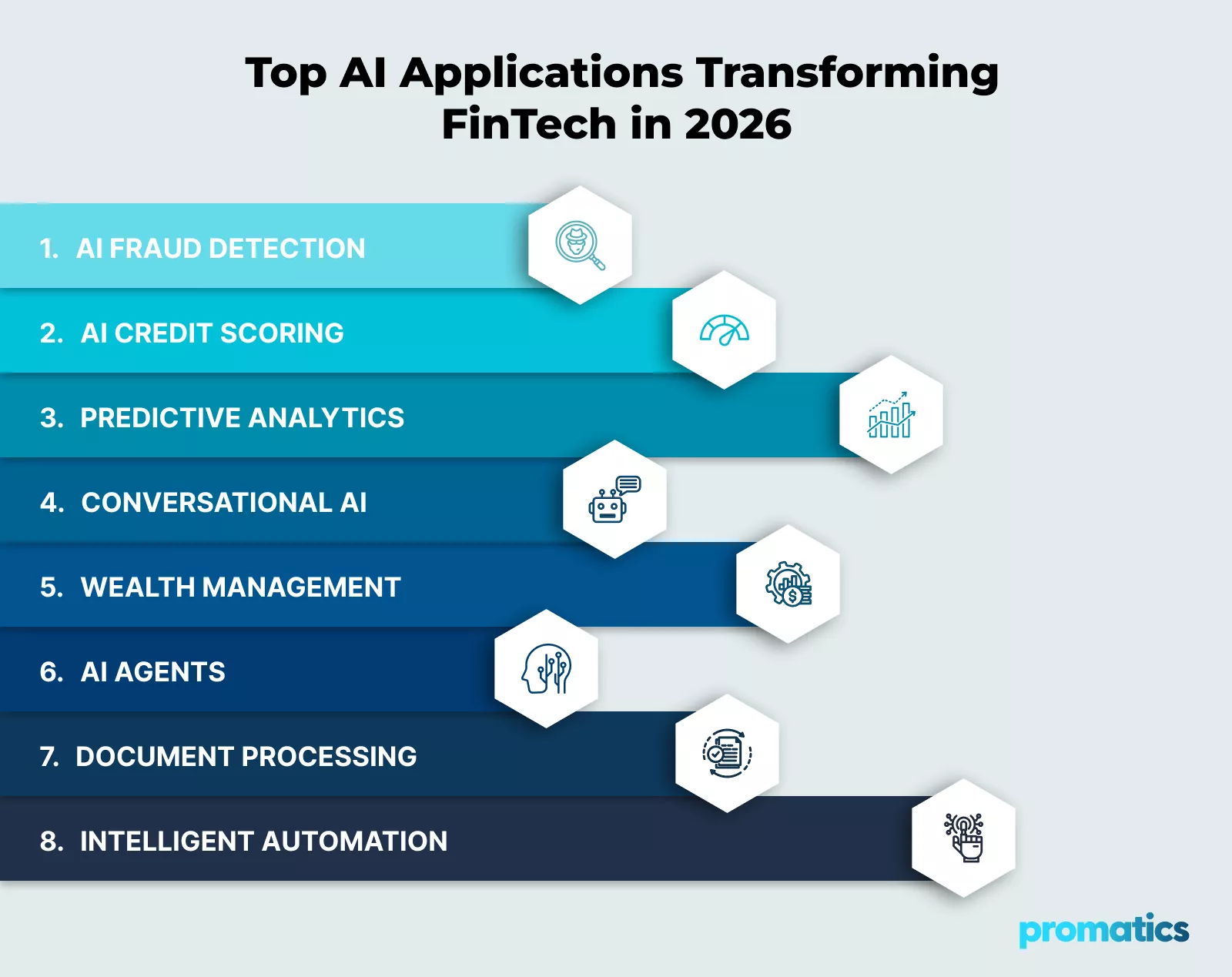
AI Breakthroughs in FinTech
Artificial Intelligence is transforming financial services by improving efficiency and enabling smarter decision-making.
1. Agentic AI for Autonomous Financial Operations
Agentic AI represents a major advancement in FinTech. These AI agents can perform tasks independently, including:
- Portfolio monitoring
- Risk analysis
- Compliance checks
- Fraud detection
- Loan approvals
Businesses adopting AI-powered FinTech solutions benefit from improved efficiency and reduced operational costs.
2. Hyper-Personalized Banking
AI analyzes customer behavior and provides personalized recommendations.
Benefits include:
- Improved customer engagement
- Better financial planning
- Increased customer satisfaction
3. Fraud Detection with Behavioral Biometrics
AI analyzes user behavior to detect fraud.
This includes:
- Typing patterns
- Device usage
- Transaction behavior
Financial institutions worldwide are adopting AI fraud detection for banks to improve transaction security.
4. Predictive Analytics
Predictive analytics helps financial institutions forecast trends and reduce risks.
Use cases include:
- Investment forecasting
- Credit risk assessment
- Customer behavior analysis
5. AI-Driven Credit Scoring
Traditional credit scoring relies on credit history and income data, often excluding individuals with limited financial records such as gig workers, freelancers, and small business owners. AI-driven credit scoring solves this by using alternative data sources to assess creditworthiness more accurately.
AI analyzes data such as:
- Transaction patterns
- Digital payment history
- Mobile usage behavior
- Utility bill payments
This broader analysis helps lenders make smarter decisions and expand access to credit. Studies show AI-powered credit scoring can reduce loan approval time by up to 70% and improve risk prediction accuracy by 30–40%.
Key benefits include:
- Faster loan approvals
- Better risk assessment
- Reduced default rates
- Increased financial inclusion
As AI evolves, credit scoring will become more accurate, inclusive, and efficient.
6. Blockchain and AI Integration for Secure Transactions
The integration of blockchain and AI is creating more secure and transparent financial systems. Blockchain technology provides decentralized and tamper-proof transaction records, while AI enhances security by detecting anomalies and fraudulent activities.
Key benefits of combining AI and blockchain include:
- Improved transaction security
- Enhanced transparency
- Faster cross-border payments
- Reduced fraud risks
- Efficient settlement processes
AI can monitor blockchain transactions in real time, identifying suspicious patterns and preventing fraudulent activities. This combination improves trust and reliability in digital financial ecosystems.
Financial institutions are increasingly adopting AI and blockchain integration for:
- Digital payments
- Smart contracts
- Cross-border transactions
- Compliance monitoring
This integration is expected to play a major role in the future of FinTech.
7. Intelligent Document Processing
Financial institutions handle large volumes of documents, including loan applications, compliance reports, identity verification documents, and financial statements. Manual document processing is time-consuming and prone to errors.
AI-powered intelligent document processing automates these tasks using:
- Optical Character Recognition (OCR)
- Natural Language Processing (NLP)
- Machine learning
AI systems extract information from documents, validate data, and automate workflows. This significantly reduces processing time and improves accuracy.
Benefits of intelligent document processing include:
- Faster loan approvals
- Reduced operational costs
- Improved accuracy
- Enhanced compliance
- Better customer experience
AI-driven document processing is transforming financial operations and improving efficiency across organizations.
8. AI and IoT for Smart Financial Services
The combination of AI and Internet of Things (IoT) is creating new opportunities in FinTech. Connected devices generate real-time data that AI systems analyze to deliver personalized financial services.
Examples include:
- Wearable devices tracking spending habits
- Smart payment devices enabling automated transactions
- IoT-enabled insurance models
- Real-time financial alerts
This integration enhances customer experiences and enables proactive financial management.
AI and IoT together enable:
- Automated payments
- Real-time financial insights
- Personalized financial recommendations
- Improved customer engagement
As connected devices become more common, AI-driven financial services will continue to evolve.
Emerging AI Trends in FinTech 2026
1. Autonomous AI Agents
Autonomous AI agents are becoming central to FinTech innovation. These agents can perform complex tasks independently, including:
- Risk assessment
- Fraud detection
- Compliance monitoring
- Customer service
AI agents improve efficiency and reduce operational costs.
2. Conversational AI for Financial Services
Conversational AI is transforming customer support in FinTech. AI-powered chatbots and virtual assistants handle customer queries instantly.
Benefits include:
- 24/7 customer support
- Reduced operational costs
- Faster response times
Conversational AI improves customer satisfaction and operational efficiency.
3. Real-Time Fraud Detection
AI-powered fraud detection systems analyze transactions in real time. These systems identify suspicious activities and prevent fraud.
Benefits include:
- Improved security
- Reduced financial losses
- Enhanced customer trust
4. Predictive Financial Analytics
Predictive analytics helps financial institutions forecast trends and improve decision-making.
Use cases include:
- Investment forecasting
- Risk management
- Customer behavior analysis
5. AI-Powered Wealth Management
AI-powered advisors provide personalized investment strategies.
Benefits include:
- Personalized recommendations
- Improved investment performance
- Enhanced customer experience
Benefits of AI in FinTech
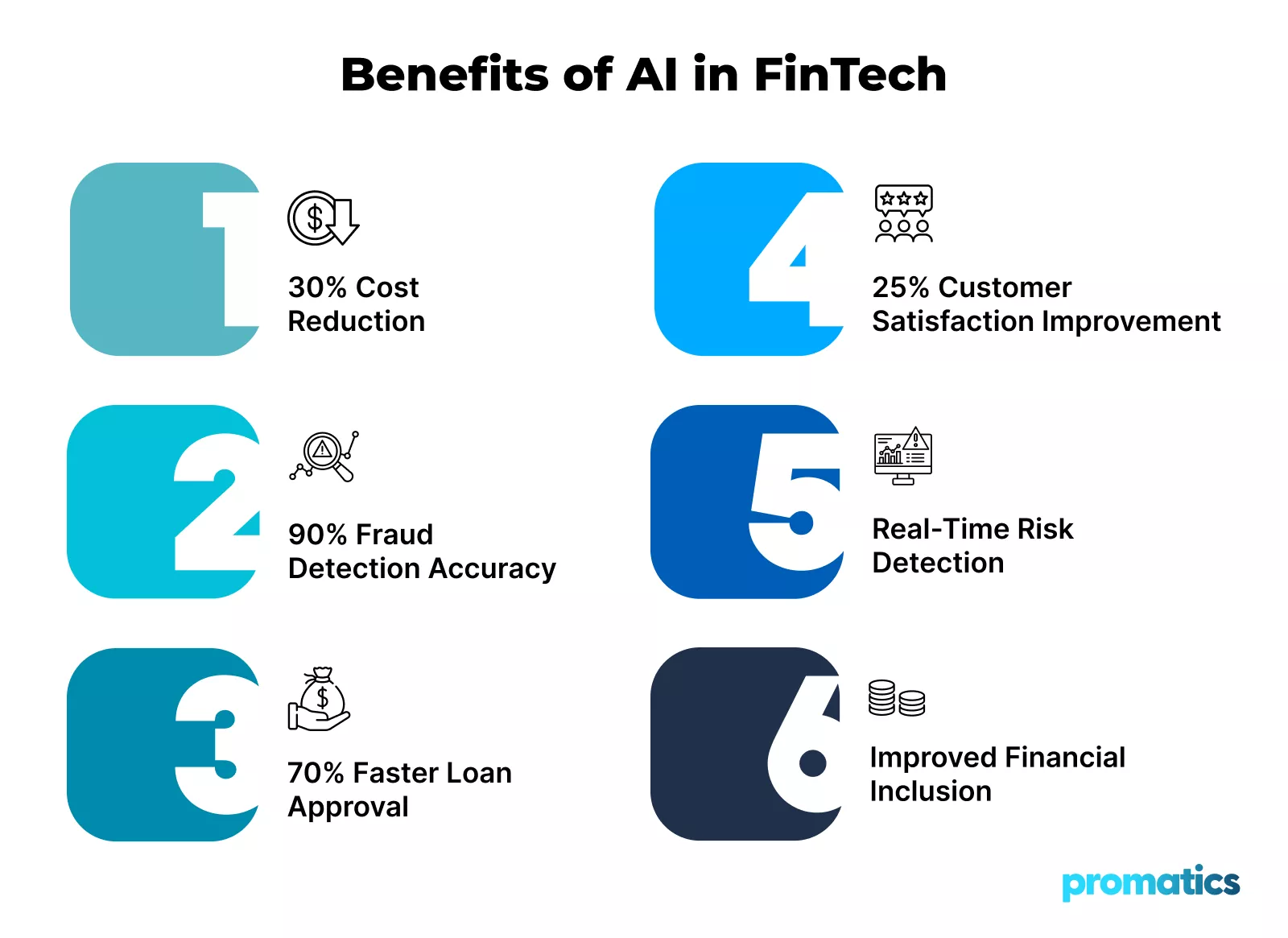
AI-powered FinTech solutions automate repetitive tasks, reducing manual workloads and improving operational efficiency.
Improved Efficiency
AI fraud detection improves cybersecurity and protects sensitive financial data. By reducing manual workloads, financial institutions can streamline operations, minimize human errors, and improve overall productivity. This allows teams to focus on strategic decision-making and innovation rather than routine operational tasks.
Enhanced Security
AI significantly improves security by detecting suspicious activities and preventing fraud in real time. Machine learning models analyze transaction patterns, user behavior, and anomalies to identify potential threats before they cause damage. AI-driven cybersecurity systems also help protect sensitive financial data, reduce fraud risks, and strengthen overall financial infrastructure.
Better Customer Experience
AI enables financial institutions to deliver personalized and seamless customer experiences. By analyzing customer behavior, preferences, and transaction history, AI systems can recommend relevant financial products, provide instant support through chatbots, and offer proactive financial insights. This improves customer satisfaction, engagement, and loyalty.
Cost Reduction
Automation powered by AI reduces operational costs by minimizing manual processes, reducing errors, and improving efficiency. Financial institutions can lower administrative costs, optimize resource allocation, and reduce the need for extensive manual intervention. Over time, AI-driven automation helps organizations achieve significant cost savings.
Improved Decision-Making
AI provides data-driven insights that help financial institutions make informed decisions. Predictive analytics and machine learning models analyze historical data, market trends, and customer behavior to forecast outcomes and reduce risks. This enables better financial planning, risk management, and strategic decision-making.
Financial Inclusion
AI helps expand access to financial services for underserved and unbanked populations. By using alternative data sources such as mobile usage and transaction history, AI-driven credit scoring models can assess creditworthiness more accurately. This allows financial institutions to offer loans, insurance, and other financial services to individuals who previously lacked access to traditional banking systems.
Challenges and Ethical Considerations
While AI offers many benefits, it also presents challenges that financial institutions must address.
Data Privacy and Security
AI-driven FinTech platforms handle large volumes of sensitive financial data. This makes them targets for cyberattacks.
Organizations must implement:
- Strong encryption
- Data protection policies
- Secure infrastructure
Ensuring data privacy is critical for maintaining trust.
Algorithm Bias and Fairness
AI models trained on biased data may produce unfair outcomes. This can impact loan approvals and credit scoring.
Financial institutions must:
- Use diverse datasets
- Monitor AI models
- Ensure fairness
Regulatory Compliance Complexity
FinTech companies must comply with evolving regulations like GDPR and India’s DPDP Act while handling sensitive financial data. As AI adoption grows, managing compliance across multiple regions becomes complex.
Key challenges include:
- Cross-border regulations
- Data privacy compliance
- Governance frameworks
- Regulatory updates
Strong compliance helps build trust and scale AI-driven FinTech solutions.
Lack of Transparency and Explainability
Many AI models operate as “black boxes,” meaning their decision-making processes are difficult to understand. This lack of transparency creates challenges for both customers and regulators.
Explainable AI is becoming increasingly important in FinTech. Financial institutions must provide clear explanations for decisions such as loan approvals, credit scoring, and fraud detection.
Explainable AI helps:
- Improve transparency
- Build customer trust
- Meet regulatory requirements
- Reduce risks
Financial institutions are investing in explainable AI technologies to ensure responsible AI adoption.
Ethical Use of AI
Responsible AI usage is essential in FinTech. Financial institutions must implement governance frameworks and ethical guidelines to prevent misuse.
Ethical AI practices include:
- Fair decision-making
- Transparency
- Data privacy
- Responsible automation
Organizations must also address concerns related to job displacement and customer impact.
Dependence on Data Quality
AI systems rely heavily on high-quality data. Poor data quality can lead to incorrect predictions and poor decisions.
Financial institutions must invest in:
- Data governance
- Data validation
- Data cleaning
Maintaining high-quality data improves AI performance and reduces risks.
Operational and Implementation Challenges
Implementing AI in FinTech requires significant investment in technology, infrastructure, and skilled talent. Integrating AI with legacy systems can be complex.
Organizations must:
- Upgrade infrastructure
- Train employees
- Manage change
These challenges require long-term planning.
Building Customer Trust
Customer trust is essential for AI adoption. Financial institutions must ensure transparency, security, and fairness.
Organizations must:
- Communicate AI usage clearly
- Protect customer data
- Ensure fairness
Building trust encourages adoption of AI-driven financial services.
Future of AI in FinTech
AI will continue transforming financial services through:
Autonomous Financial Systems
AI agents will automate end-to-end financial processes.
Real-Time Decision Making
AI will enable instant decisions.
Hyper-Personalized Banking
AI will deliver tailored services.
Intelligent Automation
Automation will improve efficiency.
Financial Inclusion
AI will expand access to financial services.
The future of FinTech is intelligent, autonomous, and AI-driven.
How Can Promatics Technologies Help You in the AI-Driven FinTech World?
Promatics Technologies provides FinTech AI solutions designed to help businesses scale globally. We specialize in:
Promatics Technologies builds intelligent FinTech platforms powered by machine learning, predictive analytics, and automation. These solutions help organizations streamline operations, improve decision-making, and enhance customer experiences.
Promatics develops autonomous AI agents for:
- Fraud detection
- Customer support
- Compliance monitoring
- Financial operations
These agents reduce manual workloads and improve efficiency.
Advanced Fraud Detection & Risk Management
Promatics implements AI-driven security solutions that detect suspicious activities in real time and strengthen financial data protection.
Hyper-Personalized Customer Experiences
Promatics delivers personalized financial services using AI-powered insights and behavioral analytics.
Predictive Analytics & Intelligent Insights
Promatics helps organizations forecast trends and optimize financial strategies.
Legacy System Modernization
Promatics integrates AI into existing financial systems, improving scalability and performance.
Regulatory Compliance & Data Security
Promatics builds secure solutions aligned with financial regulations and data protection standards.
End-to-End FinTech Development
From strategy to deployment, Promatics provides complete AI-driven FinTech solutions.
Conclusion
Artificial Intelligence is redefining the FinTech landscape in 2026, transforming how financial institutions operate, innovate, and deliver value to customers. e. From AI fraud detection to AI agents in FinTech, intelligent technologies are transforming financial services. Organizations that embrace AI-driven innovation today will gain a competitive advantage, improve operational efficiency, and deliver smarter, faster, and more secure financial solutions.
As the demand for intelligent financial systems continues to grow, businesses need a trusted technology partner to successfully implement AI and scale their FinTech solutions. This is where Promatics Technologies comes in.
At Promatics Technologies, we help FinTech companies leverage AI to build intelligent, scalable, and secure financial platforms. Whether you’re looking to develop AI-powered automation, deploy autonomous AI agents, enhance fraud detection, or deliver personalized customer experiences, our team provides end-to-end AI-driven FinTech solutions tailored to your business needs.
Ready to transform your FinTech platform with AI? Partner with Promatics Technologies and unlock the full potential of intelligent automation, AI agents, and next-generation financial innovation.
