Cloud-Native Application Development: Why Enterprises Are Moving to Modern Cloud Architecture

TL;DR
- Learn what cloud-native application development means and why it matters.
- Discover how microservices, containers, and Kubernetes improve scalability.
- Explore the business benefits of modern cloud architecture.
- Understand cloud infrastructure best practices for enterprise applications.
- Find out how cloud-native development accelerates innovation and digital transformation.
Cloud technology has evolved far beyond simply hosting applications online. Today, enterprises are rethinking how software is designed, built, deployed, and managed to keep pace with rapidly changing customer expectations and business demands. As organizations embrace digital transformation, cloud-native application development has become the preferred approach for building scalable, resilient, and future-ready software.
The shift is well underway. According to the Cloud Native Computing Foundation (CNCF), 89% of organizations now use cloud-native techniques in at least some of their application development and deployment, demonstrating that cloud-native has become the industry standard rather than an emerging trend. Additionally, cloud-native technologies are now used by 15.6 million developers worldwide, reflecting their growing role in modern software engineering.
Unlike traditional applications, cloud-native applications are designed specifically for modern cloud environments. They leverage technologies like microservices, containers, Kubernetes, and DevOps to deliver faster updates, better performance, and improved operational efficiency. This enables businesses to innovate more quickly while maintaining the flexibility to scale as demand grows.
Whether you’re modernizing legacy systems or building a new enterprise platform, adopting cloud-native architecture can help reduce infrastructure costs, improve reliability, and accelerate time-to-market.
In this guide, you’ll learn what cloud-native application development is, why enterprises are making the shift, and the best practices for building high-performing enterprise cloud applications.
Why Enterprises Are Moving to Cloud-Native Architecture
Businesses today operate in an environment where customer expectations change rapidly, applications receive continuous updates, and digital services must remain available around the clock. Traditional monolithic applications often struggle to keep up because even small updates can require significant development effort, testing, and deployment time.
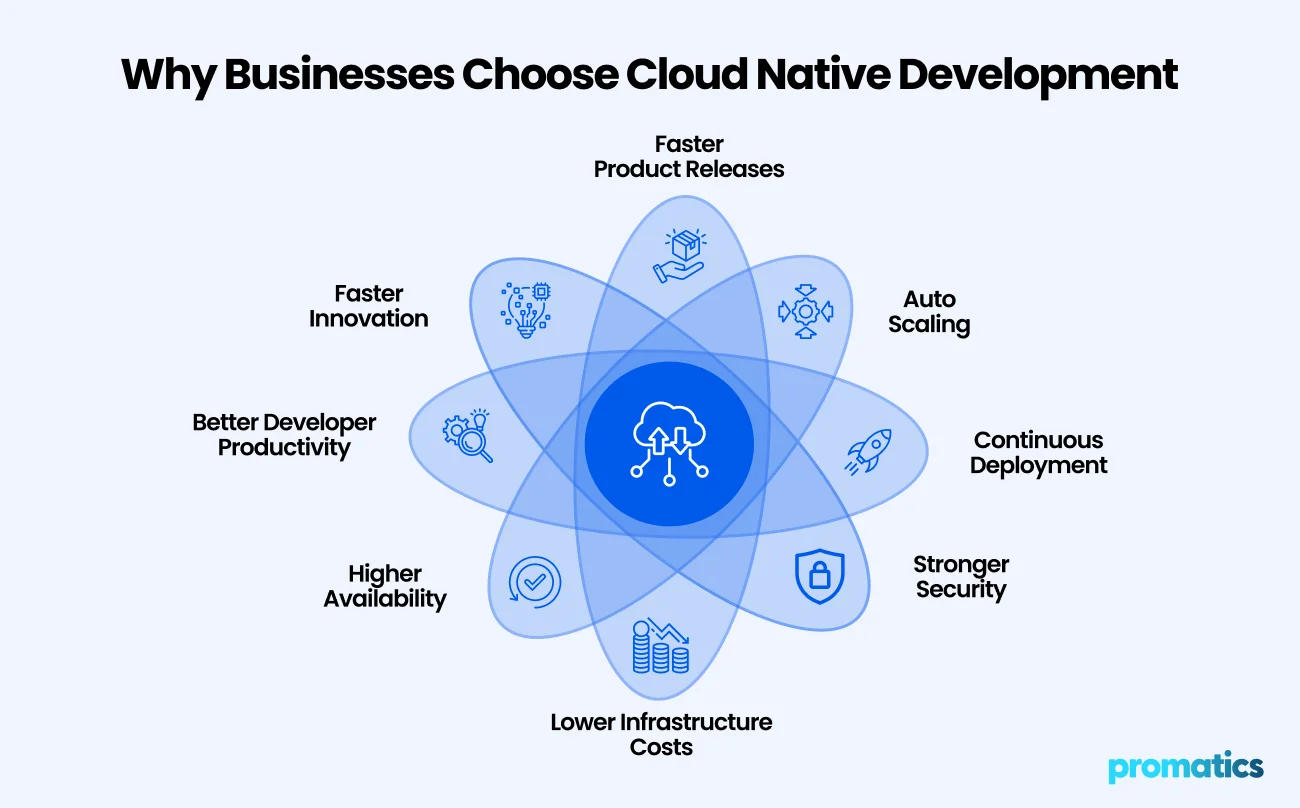
Cloud-native architecture solves these challenges by enabling applications to be modular, scalable, and resilient. Instead of treating software as a single large application, cloud-native development breaks it into smaller, independent services that can be developed, deployed, and scaled individually.
This modern approach helps enterprises:
- Launch new features faster
- Improve application performance
- Scale automatically during traffic spikes
- Reduce infrastructure costs
- Improve system reliability
- Accelerate digital transformation
As a result, organizations across finance, healthcare, retail, manufacturing, logistics, and SaaS are making cloud-native development a core part of their technology strategy.
What Is Cloud-Native Application Development?
Cloud-native application development is the process of designing and building software specifically for cloud environments rather than adapting traditional applications to run in the cloud.
Instead of relying on a single application that performs every function, cloud-native systems consist of multiple independent services working together. Each service performs a specific task and communicates through APIs.
For example, an eCommerce platform may separate:
- User authentication
- Product catalog
- Shopping cart
- Payments
- Inventory management
- Order tracking
Each component can be updated or scaled independently without affecting the rest of the application.
This modular approach makes enterprise applications more flexible, reliable, and easier to maintain.
Core Technologies Behind Cloud-Native Applications
Modern cloud-native applications typically use several technologies that work together to improve performance and scalability.
Microservices
Microservices divide large applications into smaller services that operate independently. Development teams can build, deploy, and update individual services without impacting the entire application.
Benefits include:
- Faster development cycles
- Easier maintenance
- Independent scaling
- Better fault isolation
- Improved team collaboration
Containers
Containers package applications along with their dependencies, ensuring they run consistently across development, testing, and production environments.
Popular container platforms include Docker and Podman.
Benefits include:
- Consistent deployments
- Faster startup times
- Improved resource utilization
- Better portability across cloud platforms
Kubernetes
As applications grow, managing hundreds or thousands of containers manually becomes impossible. Kubernetes automates deployment, scaling, networking, and workload management.
With Kubernetes, organizations can:
- Automatically scale applications
- Recover failed containers
- Balance workloads
- Optimize infrastructure usage
- Maintain high availability
This makes Kubernetes one of the most important technologies in cloud-native application development.
DevOps and CI/CD
Cloud-native development depends heavily on DevOps practices and Continuous Integration/Continuous Deployment (CI/CD).
Instead of releasing software every few months, development teams can safely deploy updates multiple times each day.
CI/CD pipelines automate:
- Code testing
- Security scanning
- Application builds
- Deployment
- Rollbacks
This reduces manual work while improving software quality and release speed.
Key Benefits of Cloud-Native Application Development
Organizations adopting enterprise cloud applications gain more than just modern infrastructure. They unlock faster innovation, better resilience, and long-term operational efficiency.
1. Faster Time-to-Market
Cloud-native development enables development teams to release new features independently instead of waiting for large software updates.
This allows businesses to respond quickly to customer feedback and market changes.
2. Built-In Scalability
One of the biggest advantages of cloud-native architecture is automatic scaling.
Instead of upgrading an entire application, businesses can scale only the services experiencing increased demand.
For example, during a holiday sale, an online retailer can scale payment and checkout services without allocating additional resources to inventory or customer support systems.
3. Improved Reliability
Because services operate independently, failures are isolated.
If one microservice experiences an issue, the rest of the application continues running, minimizing downtime and improving customer experience.
4. Cost Optimization
Cloud-native applications help enterprises reduce infrastructure costs by using cloud resources more efficiently. Instead of provisioning servers for peak demand, organizations can automatically scale resources up or down based on real-time usage.
Businesses can optimize costs through:
- Auto scaling
- Pay-as-you-go cloud services
- Container orchestration
- Resource monitoring
- Serverless computing where appropriate
This ensures organizations only pay for the computing resources they actually use.
5. Better Security and Compliance
Security is built into modern cloud-native architectures rather than being added later.
Enterprises can strengthen application security by implementing:
- Zero Trust security models
- Identity and access management (IAM)
- Data encryption
- Continuous vulnerability scanning
- Automated compliance monitoring
Leading cloud providers also offer built-in security services that simplify compliance with standards such as ISO 27001, HIPAA, PCI DSS, and GDPR.
Traditional vs Cloud-Native Applications
| Traditional Applications | Cloud-Native Applications |
| Monolithic Architecture | Microservices Architecture |
| Manual Scaling | Auto Scaling |
| Infrequent Releases | Continuous Deployment |
| Fixed Infrastructure | Cloud Infrastructure |
| Longer Recovery Times | Self-Healing Systems |
| High Maintenance Costs | Automated Operations |
| Limited Flexibility | High Agility |
| Slower Innovation | Faster Innovation |
Cloud Infrastructure Best Practices for Enterprise Applications
Building successful enterprise cloud applications requires more than migrating workloads to the cloud. Organizations need a well-planned architecture that supports scalability, resilience, and security.
Here are some cloud infrastructure best practices every enterprise should follow.
Design for Scalability
Applications should automatically scale based on user demand instead of relying on fixed infrastructure.
Adopt Infrastructure as Code (IaC)
Tools like Terraform and AWS CloudFormation allow infrastructure to be managed using code, improving consistency and reducing deployment errors.
Implement Continuous Monitoring
Track application performance, infrastructure health, and security events using monitoring platforms such as Prometheus, Grafana, and cloud-native observability tools.
Automate CI/CD Pipelines
Automated testing and deployment reduce manual effort while improving software quality and release frequency.
Secure Every Layer
Apply security across applications, APIs, containers, Kubernetes clusters, and cloud infrastructure instead of relying solely on network-level protection.
Industries Benefiting from Cloud-Native Application Development
Cloud-native architecture is helping organizations across industries build faster, more resilient digital platforms.
Financial Services
Banks and fintech companies use cloud-native applications to support digital banking, payment platforms, fraud detection, and real-time transaction processing.
Healthcare
Healthcare providers modernize electronic health records, telemedicine platforms, patient portals, and healthcare analytics while maintaining regulatory compliance.
Retail & E-commerce
Retailers use cloud-native applications to improve inventory management, personalize customer experiences, and handle seasonal traffic spikes.
Manufacturing
Manufacturers leverage cloud-native platforms to manage connected factories, IoT devices, predictive maintenance, and supply chain visibility.
SaaS Companies
Software companies build cloud-native products to deliver continuous feature updates, improve uptime, and support growing customer bases without service interruptions.
Traditional Applications vs Cloud-Native Applications
| Feature | Traditional Applications | Cloud-Native Applications |
| Architecture | Monolithic | Microservices |
| Deployment | Manual | Automated CI/CD |
| Scalability | Vertical Scaling | Horizontal Auto Scaling |
| Infrastructure | On-Premises | Cloud-Based |
| Updates | Large Releases | Continuous Deployment |
| Availability | Limited Redundancy | High Availability |
| Maintenance | Complex | Simplified |
| Innovation Speed | Slower | Faster |
For enterprises focused on long-term growth, cloud-native development provides the flexibility needed to respond quickly to changing business requirements while maintaining operational efficiency.
Enterprise Cloud Migration Checklist
Migrating to a cloud-native architecture requires careful planning. Before starting your modernization journey, ensure your organization has addressed the following:
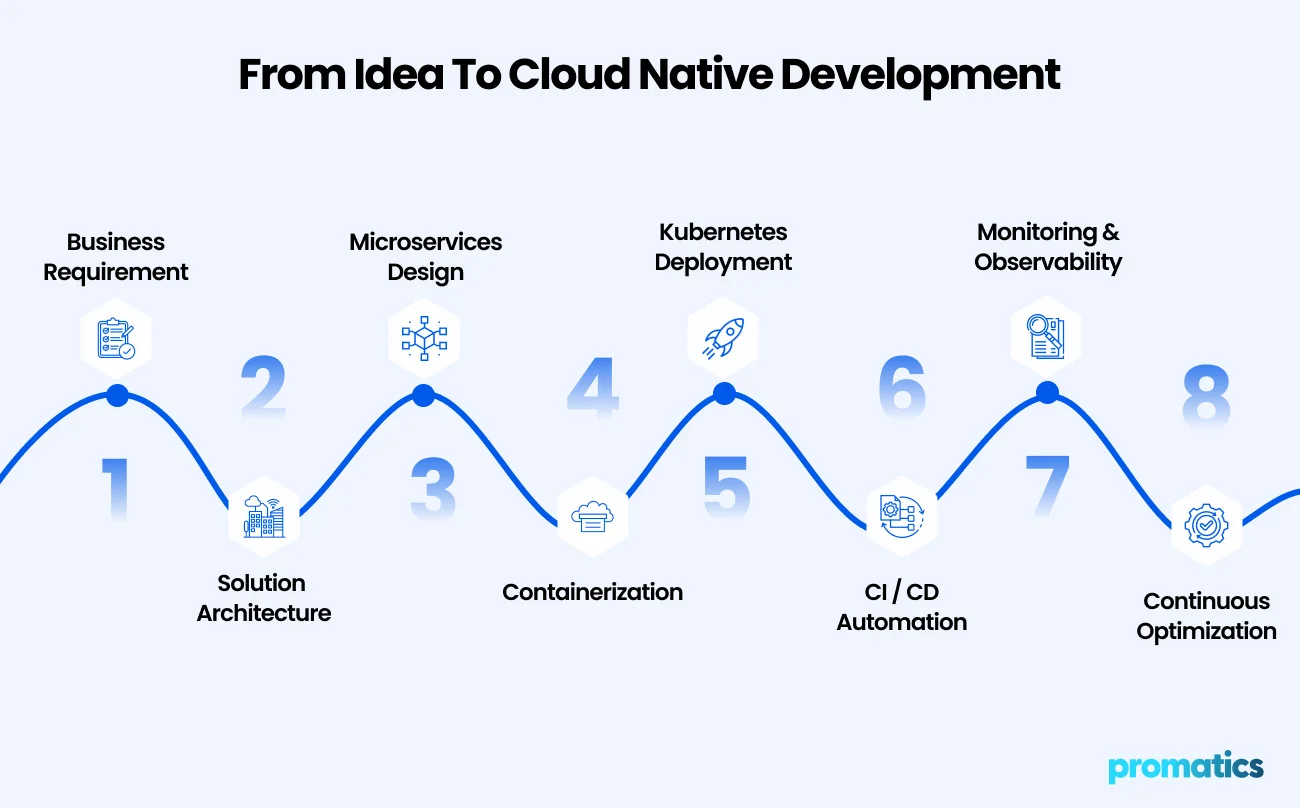
- Assess existing applications and infrastructure
- Define business objectives
- Select the right cloud platform
- Break monolithic applications into microservices
- Containerize workloads
- Deploy Kubernetes for orchestration
- Implement CI/CD pipelines
- Strengthen security and compliance
- Enable monitoring and observability
- Optimize performance after deployment
Why Choose Promatics Technologies?
At Promatics Technologies, we help businesses modernize legacy systems and build secure, scalable, and high-performing cloud-native applications that accelerate digital transformation.
Our cloud-native development services include:
- Cloud-native application development
- Enterprise application modernization
- Microservices architecture
- Kubernetes consulting and deployment
- DevOps and CI/CD implementation
- Cloud migration services
- API development and integration
- Performance optimization
- Cloud infrastructure consulting
- Ongoing maintenance and support
Why Businesses Choose Promatics
- 18+ years of software development expertise
- 700+ successful digital products delivered
- Experience across 20+ industries
- ISO 27001-certified development practices
- Agile development methodology
- Dedicated cloud engineering teams
- End-to-end modernization services
Whether you’re launching a new SaaS platform or modernizing enterprise software, our team builds cloud-native solutions designed for scalability, resilience, and long-term growth.
Final Thoughts
Cloud-native application development has become the foundation of modern enterprise software. By combining microservices, containers, Kubernetes, and DevOps, businesses can build applications that are scalable, resilient, and ready for continuous innovation. Beyond improving operational efficiency, cloud-native architecture enables organizations to respond faster to changing customer needs, reduce infrastructure costs, and accelerate digital transformation.
As enterprises continue to modernize their technology stacks, investing in cloud-native application development is no longer just an IT initiative, it’s a strategic business decision. Partnering with an experienced development team ensures your cloud applications are secure, future-ready, and built to support long-term growth.
Ready to modernize your enterprise applications? Partner with Promatics Technologies to build secure, scalable, and cloud-native solutions that drive innovation and business success.
