Enterprise AI Development: A Complete Guide to Building Scalable AI Solutions in 2026

Artificial Intelligence is no longer a future concept. It has become a core part of how modern businesses operate. From automating routine tasks and improving customer experiences to helping leaders make faster, data-driven decisions, Enterprise AI is transforming every aspect of business.
The numbers reflect this shift. Around 78% of organizations now use AI in at least one business function, and adoption continues to grow as businesses move from experimentation to enterprise-wide implementation. Companies that successfully integrate AI into their operations are improving productivity, accelerating innovation, and increasing operational efficiency.
However, implementing Enterprise AI involves much more than deploying a chatbot or integrating a Large Language Model (LLM). To deliver measurable business value, AI must work seamlessly with enterprise data, business applications, and existing workflows while meeting strict security, governance, and compliance requirements.
This is where Enterprise AI Development becomes essential.
It provides the strategy, architecture, and technology required to build intelligent, scalable, and secure AI solutions that solve real business challenges and support long-term business growth.
Whether you’re a CTO planning an AI strategy, a business leader exploring automation opportunities, or a product manager building AI-powered applications, understanding Enterprise AI is the first step toward making informed decisions.
In this guide, you’ll learn what Enterprise AI Development is, why organizations are investing in it, the technologies behind modern AI solutions, real-world industry use cases, the development process, implementation costs, best practices, and the future trends shaping enterprise innovation.
By the end of this guide, you’ll have a clear understanding of how to plan, build, and scale Enterprise AI solutions that deliver measurable business value. Let’s begin by exploring what Enterprise AI Development really means and why it has become a strategic priority for businesses worldwide.
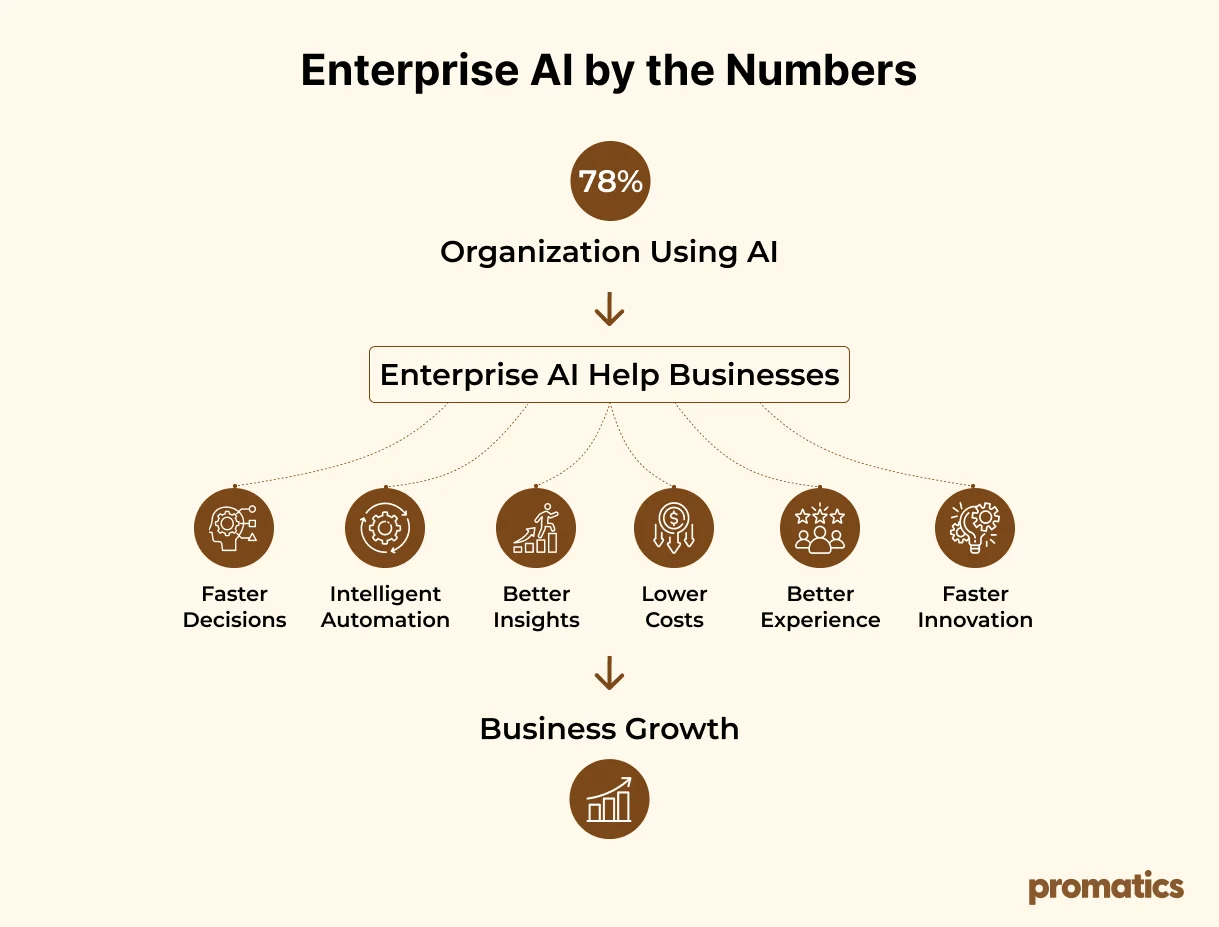
Why Enterprise AI Has Become a Business Imperative
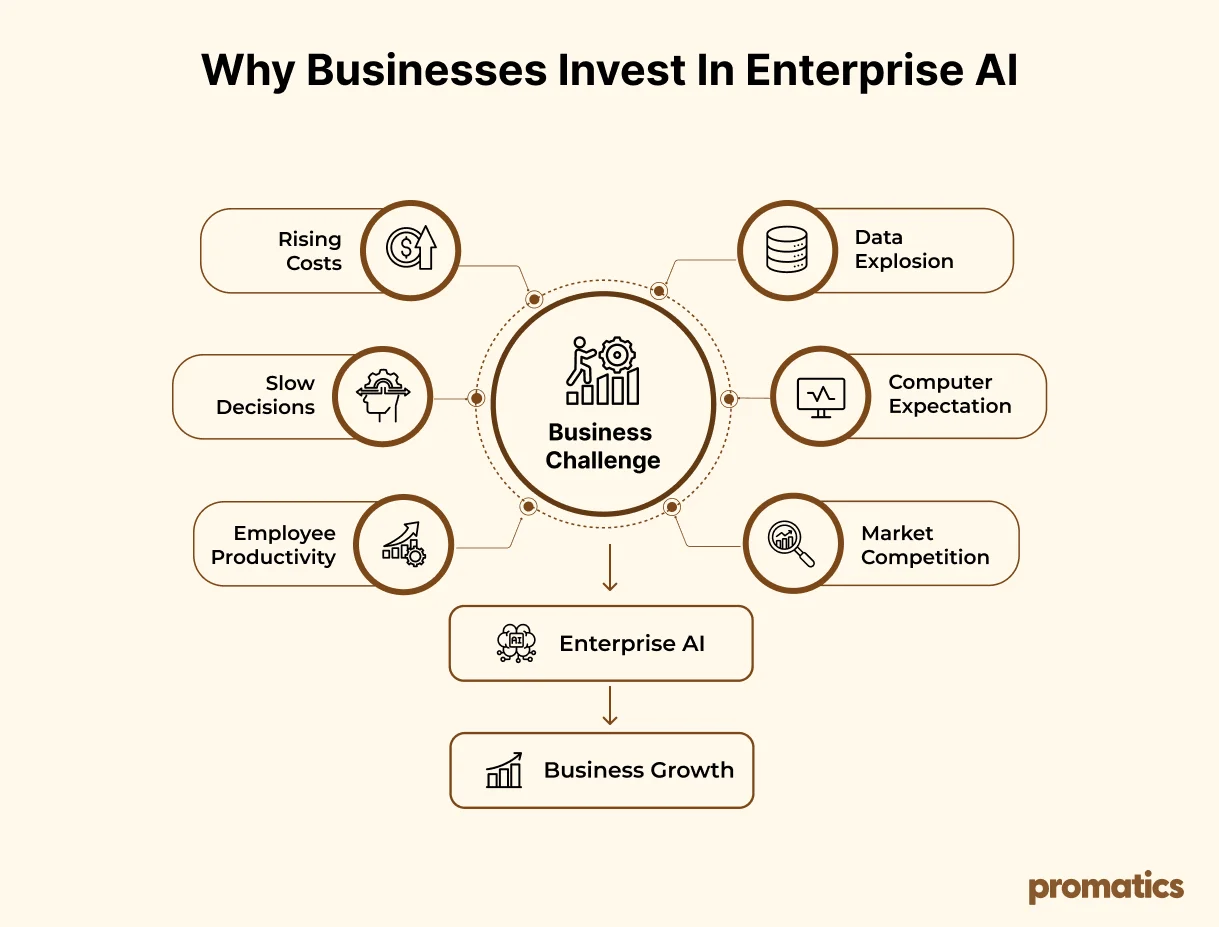
The business environment has changed dramatically over the past few years. Organizations face growing pressure to improve productivity while controlling operational costs. Customers expect faster and more personalized experiences. Employees require intelligent tools that eliminate repetitive work. Meanwhile, businesses continue generating unprecedented volumes of structured and unstructured data that traditional software can no longer analyze efficiently.
Enterprise AI addresses these challenges by enabling organizations to:
- Automate repetitive and time-consuming business processes.
- Improve decision-making through real-time insights and predictive analytics.
- Deliver personalized customer experiences across multiple channels.
- Accelerate software development and innovation.
- Strengthen operational efficiency while reducing costs.
- Enhance collaboration between teams through intelligent assistants.
- Unlock business value hidden within enterprise data.
Unlike traditional automation, which follows predefined rules, Enterprise AI introduces systems capable of learning, adapting, and making context-aware decisions. This allows organizations to automate not only routine tasks but also complex workflows that previously depended on human expertise.
For example, instead of manually processing customer support requests, an Enterprise AI platform can understand customer intent, retrieve relevant information from internal knowledge bases, generate personalized responses, update CRM records, assign support tickets, and notify the appropriate teams—all within seconds.
The result is not simply faster execution but fundamentally smarter business operations.
Enterprise AI Is More Than Technology
One of the most common misconceptions is that Enterprise AI is simply about deploying advanced machine learning models or adopting the latest Large Language Model.
In reality, successful Enterprise AI initiatives require organizations to combine technology, data, governance, security, business strategy, and organizational change into a unified implementation framework.
An effective Enterprise AI solution typically includes:
- High-quality enterprise data
- AI models tailored to business requirements
- Secure cloud infrastructure
- Enterprise system integrations
- Workflow automation
- AI governance and compliance
- Continuous monitoring and optimization
These components work together to create intelligent systems capable of supporting real-world business operations at scale.
This holistic approach distinguishes Enterprise AI from consumer AI tools and isolated AI experiments.
What Is Enterprise AI Development?
Artificial Intelligence has become one of the most transformative technologies in modern business, but not all AI is designed for enterprise use. While millions of people interact with AI through chatbots, virtual assistants, and content generation tools, organizations require something much more sophisticated. They need AI solutions that can securely integrate with existing business systems, process enterprise data, automate complex workflows, and deliver measurable business outcomes at scale.
This is where Enterprise AI Development comes in.
Enterprise AI Development is the process of designing, developing, deploying, and continuously optimizing AI-powered solutions that solve complex business challenges across an organization. Rather than functioning as standalone applications, these solutions become an integral part of the enterprise technology ecosystem, helping businesses automate operations, improve decision-making, increase productivity, and accelerate digital transformation.
Unlike traditional software, which follows predefined rules, Enterprise AI systems can analyze information, understand context, learn from historical data, generate insights, and support intelligent decision-making. They don’t simply execute instructions—they help organizations work smarter by transforming enterprise data into actionable business intelligence.
As AI technologies continue to evolve, Enterprise AI has become the foundation for building intelligent organizations capable of adapting quickly to changing customer expectations, market conditions, and business priorities.
By connecting with these systems, Enterprise AI can analyze enterprise data, retrieve organizational knowledge, automate repetitive tasks, and help employees make faster, more informed decisions.
Enterprise AI vs. Consumer AI
The growing popularity of AI tools like ChatGPT, AI image generators, and coding assistants has made Artificial Intelligence accessible to everyone. While these tools improve individual productivity, they are fundamentally different from Enterprise AI.
Consumer AI is designed to help users complete everyday tasks such as writing content, summarizing documents, or generating ideas. Enterprise AI, on the other hand, is built to solve organization-wide challenges by integrating with business systems, enterprise data, and operational workflows.
| Consumer AI | Enterprise AI |
| Designed for individuals | Designed for organizations |
| Uses mostly public information | Uses proprietary enterprise data |
| Performs general-purpose tasks | Solves business-specific challenges |
| Limited system integration | Deep integration with enterprise applications |
| Standard security | Enterprise-grade security and governance |
| Focuses on personal productivity | Focuses on business transformation |
| Standalone applications | Connected enterprise ecosystems |
For example, a consumer AI assistant can help write an email or summarize a document. An Enterprise AI solution can retrieve customer data from a CRM, analyze previous interactions, generate a personalized response, update business systems, and trigger follow-up workflows automatically.
In short, consumer AI assists individuals, while Enterprise AI transforms end-to-end business operations through intelligent automation, enterprise integration, and secure governance.
Enterprise AI vs. Traditional Machine Learning
Many organizations initially associate Enterprise AI with Machine Learning (ML). Although Machine Learning remains an important component of modern AI systems, Enterprise AI extends far beyond predictive models.
Traditional Machine Learning focuses on recognizing patterns within historical data to generate predictions.
Common examples include:
- Fraud detection
- Demand forecasting
- Product recommendations
- Customer churn prediction
- Predictive maintenance
These models are highly effective for specific analytical tasks but typically require human intervention to interpret predictions and execute business actions.
Enterprise AI expands this capability by combining multiple AI technologies into a unified ecosystem.
Instead of simply predicting outcomes, Enterprise AI can:
- Understand natural language
- Retrieve enterprise knowledge
- Generate business content
- Automate workflows
- Interact with business applications
- Execute multi-step processes
- Continuously improve through feedback
Consider invoice processing as an example.
A Machine Learning model might identify duplicate invoices or classify expense categories.
An Enterprise AI solution can receive invoices, extract information, validate purchase orders, identify discrepancies, route approvals, update ERP systems, notify finance teams, and generate audit reports automatically.
Rather than producing isolated predictions, Enterprise AI transforms complete business processes.
Core Characteristics of Enterprise AI
Enterprise AI solutions share several defining characteristics that distinguish them from conventional AI applications.
Business-Centric Design
Enterprise AI begins with business objectives rather than technology. Successful implementations focus on measurable outcomes such as reducing operational costs, improving customer satisfaction, increasing productivity, or accelerating decision-making.
Technology serves the business—not the other way around.
Deep Enterprise Integration
Enterprise AI connects with existing business systems instead of replacing them.
Integration enables AI to retrieve information, automate workflows, and provide contextual recommendations using real-time enterprise data.
Scalability
Enterprise AI must support thousands of users, millions of transactions, and multiple departments simultaneously.
As organizations grow, AI platforms should scale without compromising performance or security.
Intelligent Automation
Unlike traditional automation, Enterprise AI combines reasoning, contextual understanding, and workflow execution.
Modern AI systems can automate complex business processes that previously required significant human involvement.
Security and Governance
Enterprise AI often processes confidential business information.
Organizations therefore implement:
- Identity management
- Role-based access controls
- Encryption
- Audit logging
- Compliance monitoring
- Responsible AI policies
These controls ensure AI remains secure, transparent, and compliant with industry regulations.
Continuous Learning
Enterprise AI continuously evolves as new data becomes available.
Organizations monitor model performance, update knowledge bases, retrain models, and refine workflows to ensure AI remains aligned with changing business requirements.
What Technologies Power Enterprise AI?
Enterprise AI combines multiple technologies that work together to deliver intelligent automation and decision-making. Key technologies include:
- Generative AI for creating content, reports, and business communications.
- Large Language Models (LLMs) for understanding and generating natural language.
- Machine Learning (ML) for predictive analytics and pattern recognition.
- Retrieval-Augmented Generation (RAG) for accessing enterprise knowledge.
- Natural Language Processing (NLP) for analyzing documents and conversations.
- Computer Vision for interpreting images and videos.
- AI Agents for executing multi-step business workflows.
- Workflow Automation for integrating AI with enterprise systems.
Together, these technologies form an intelligent ecosystem that powers enterprise-wide automation and decision-making. We’ll explore each in detail later in this guide.
Why Enterprise AI Is Different from Traditional Software
Traditional enterprise software relies on predefined business rules. For example, an invoice above a certain amount is automatically routed for manager approval.
Enterprise AI goes beyond static rules by analyzing historical data, detecting anomalies, evaluating supplier performance, recommending actions, and generating supporting documentation. This enables businesses to move from rule-based automation to intelligent, data-driven decision-making.
The Enterprise AI Ecosystem
Enterprise AI is not a single application, it is an interconnected ecosystem where multiple technologies work together.
Business Applications
↓
AI Assistants & AI Agents
↓
Large Language Models (LLMs)
↓
Retrieval-Augmented Generation (RAG)
↓
Enterprise Knowledge Base
↓
Business Data (ERP • CRM • HRMS • Cloud)
↓
Security • Governance • MLOps
Each layer plays a critical role in delivering secure, scalable, and intelligent AI capabilities across the organization.
Key Takeaways
Enterprise AI is more than chatbots or predictive analytics. It combines AI models, enterprise data, automation, applications, and governance into a unified ecosystem that improves efficiency, automates complex workflows, and supports better business decisions.
Unlike consumer AI, which enhances individual productivity, Enterprise AI is designed to solve organization-wide challenges and scale with business growth.
As adoption accelerates, the next question becomes: Why are organizations investing billions in Enterprise AI, and what measurable business value are they gaining?
Why Enterprises Are Investing in AI: Key Benefits, Business Value, and ROI
Artificial Intelligence has evolved from a competitive advantage to a business necessity. Just a few years ago, most organizations viewed AI as an emerging technology suitable for experimentation and innovation labs. Today, it has become a strategic priority for enterprise leaders seeking to improve operational efficiency, reduce costs, enhance customer experiences, and drive long-term business growth.
The conversation around AI has fundamentally changed. Organizations are no longer asking, “Should we invest in AI?” Instead, they are asking, “Where can AI create the greatest business value, and how can we scale it across the enterprise?”
This shift is driven by a combination of factors. Businesses are generating more data than ever before, customer expectations continue to rise, global competition is intensifying, and employees are expected to accomplish more with fewer resources. Traditional software and manual processes can no longer keep pace with these demands.
Enterprise AI addresses these challenges by transforming data into actionable insights, automating repetitive workflows, and enabling employees to focus on higher-value work. Rather than replacing people, AI augments human capabilities by helping teams make faster, smarter, and more informed decisions.
Understanding why organizations are investing heavily in Enterprise AI provides valuable insight into how businesses are preparing for the next phase of digital transformation.
The Business Drivers Behind Enterprise AI Adoption
Every successful AI initiative begins with a business objective rather than a technology trend. Organizations invest in Enterprise AI because it solves real operational challenges and delivers measurable business outcomes.
Some of the most common drivers include:
- Rising operational costs
- Increasing customer expectations
- Rapid growth of enterprise data
- Demand for faster decision-making
- Workforce productivity challenges
- Competitive pressure
- Digital transformation initiatives
- The emergence of Generative AI and AI Agents
Rather than solving a single problem, Enterprise AI enables organizations to improve multiple aspects of their business simultaneously.
1. Improving Operational Efficiency
One of the biggest reasons organizations invest in Enterprise AI is to streamline operations.
Across every department, employees spend a significant amount of time performing repetitive tasks such as processing documents, updating records, searching for information, generating reports, responding to routine inquiries, and coordinating approvals.
While these activities are necessary, they often consume valuable time that could be spent on higher-value strategic work.
Enterprise AI automates these repetitive processes while maintaining consistency and accuracy.
For example, instead of manually reviewing hundreds of invoices, an AI-powered finance platform can extract invoice data, validate purchase orders, identify discrepancies, route approvals, update ERP systems, and generate reports automatically.
Similarly, HR teams can automate employee onboarding, IT departments can streamline help desk requests, and procurement teams can simplify supplier management using AI-powered workflows.
By reducing manual effort, organizations improve operational efficiency while allowing employees to focus on innovation, collaboration, and strategic decision-making.
2. Enhancing Customer Experience
Customer expectations have changed dramatically over the past decade.
Today’s customers expect:
- Instant responses
- Personalized interactions
- Consistent service across channels
- Accurate recommendations
- Faster issue resolution
Meeting these expectations using traditional customer support models is becoming increasingly difficult.
Enterprise AI enables organizations to deliver personalized experiences at scale.
For example, an AI-powered customer support platform can:
- Understand customer intent
- Retrieve account information
- Access internal knowledge bases
- Recommend solutions
- Generate personalized responses
- Escalate complex cases
- Schedule follow-ups
Instead of forcing customers to repeat information across multiple channels, AI creates a connected experience by integrating data from CRM systems, support platforms, and knowledge repositories.
The result is faster service, higher customer satisfaction, and stronger customer loyalty.
3. Turning Enterprise Data into Business Intelligence
Modern enterprises generate enormous volumes of structured and unstructured data every day.
This information comes from:
- Customer interactions
- Sales activities
- ERP systems
- Financial applications
- IoT devices
- Supply chain operations
- Marketing platforms
- Internal documents
- Emails
- Collaboration tools
While this data contains valuable business insights, much of it remains underutilized because traditional analytics tools struggle to process information at scale.
Enterprise AI changes this by transforming raw data into actionable intelligence.
Rather than simply displaying dashboards, AI identifies patterns, predicts future trends, summarizes complex reports, detects anomalies, and recommends business actions.
Executives gain faster access to insights that support strategic planning, while operational teams receive real-time recommendations that improve everyday decision-making.
Organizations that effectively leverage enterprise data often gain a significant competitive advantage over businesses relying solely on historical reporting.
4. Increasing Employee Productivity
Enterprise AI is not designed to replace employees—it is designed to help them work more effectively.
Knowledge workers spend a considerable amount of time searching for information, preparing reports, documenting meetings, responding to emails, and performing repetitive administrative work.
AI reduces this burden by acting as an intelligent workplace assistant.
Employees can use AI to:
- Retrieve company knowledge
- Summarize lengthy documents
- Draft reports
- Generate presentations
- Analyze spreadsheets
- Prepare meeting notes
- Write software code
- Translate documents
- Automate routine workflows
For example, a project manager can ask an AI assistant to summarize project updates from multiple teams, highlight potential risks, and prepare an executive report in minutes instead of hours.
This allows employees to spend less time on repetitive work and more time solving business problems that require creativity, expertise, and collaboration.
5. Supporting Better and Faster Decision-Making
Business leaders make hundreds of decisions every day. Many of these decisions depend on analyzing large volumes of data spread across multiple systems.
Enterprise AI simplifies this process by providing decision-makers with real-time insights instead of static reports.
AI can:
- Analyze historical trends
- Identify anomalies
- Forecast future outcomes
- Recommend actions
- Explain business performance
- Compare multiple scenarios
Imagine a retail executive preparing for the holiday shopping season.
Instead of manually reviewing spreadsheets from finance, inventory, sales, and marketing teams, an Enterprise AI platform can combine information from multiple systems, forecast product demand, identify inventory shortages, recommend pricing adjustments, and generate executive summaries all through a simple natural language query.
This significantly improves both the speed and quality of business decision-making.
6. Reducing Operational Costs
Cost optimization remains one of the strongest business cases for Enterprise AI. Organizations reduce costs through:
- Workflow automation
- Lower administrative effort
- Improved forecasting
- Fewer manual errors
- Optimized inventory
- Reduced downtime
- Better resource utilization
- Faster customer support
- Improved compliance
For example, predictive maintenance helps manufacturers identify equipment failures before production disruptions occur, reducing repair costs and minimizing downtime.
Similarly, AI-powered fraud detection helps financial institutions prevent fraudulent transactions before financial losses occur.
Rather than cutting costs through workforce reductions alone, Enterprise AI improves efficiency by eliminating unnecessary manual work and optimizing resource allocation.
7. Accelerating Innovation
Innovation is no longer limited to product development teams. Enterprise AI enables organizations to innovate across every business function. Marketing teams can launch personalized campaigns faster. Developers can build software more efficiently. Product managers can analyze customer feedback in real time. Legal teams can review contracts more quickly. Executives can evaluate new business opportunities using predictive insights.
By reducing routine work and improving access to knowledge, AI creates more time for strategic thinking and experimentation.
Organizations that successfully integrate AI into daily operations often bring new products and services to market faster while responding more effectively to changing customer needs.
8. Strengthening Competitive Advantage
Markets are becoming increasingly competitive, and businesses that fail to adopt AI risk falling behind organizations that operate faster, make smarter decisions, and deliver better customer experiences.
Enterprise AI creates competitive advantages by helping organizations:
- Respond to customers more quickly
- Improve operational efficiency
- Launch products faster
- Optimize pricing strategies
- Personalize services
- Reduce operational costs
- Improve business agility
Rather than viewing AI as an isolated technology initiative, leading organizations treat it as a strategic capability that supports long-term growth.
Businesses that invest today are better positioned to adapt to future market changes while continuously improving performance.
Measuring the ROI of Enterprise AI
Like any strategic investment, Enterprise AI should be evaluated based on measurable business outcomes.
While technical metrics such as model accuracy and response time are important, executives are primarily interested in the business impact AI delivers.
Common Enterprise AI KPIs include:
| Business Objective | Example KPI |
| Improve Productivity | Hours saved per employee |
| Reduce Costs | Lower operational expenses |
| Improve Customer Experience | Higher CSAT and NPS scores |
| Increase Revenue | Higher conversion rates |
| Improve Operations | Faster workflow completion |
| Reduce Risk | Fewer compliance violations |
| Strengthen Decision-Making | Faster reporting and forecasting |
Organizations should establish baseline metrics before implementation and monitor improvements continuously after deployment.
This ensures AI investments remain aligned with business objectives and deliver measurable return on investment.
Enterprise AI Is a Long-Term Strategic Investment
The organizations achieving the greatest success with AI share one common characteristic.
They do not view AI as a standalone software project.
Instead, they treat AI as a long-term business capability that evolves alongside the organization.
Rather than implementing isolated AI tools, they build connected ecosystems where enterprise data, intelligent automation, AI Agents, predictive analytics, and Generative AI work together to improve every aspect of business operations.
This strategic approach enables organizations to scale AI gradually while maximizing long-term business value.
Key Takeaways
Enterprise AI adoption is accelerating because it delivers measurable business outcomes rather than simply introducing new technology. Organizations invest in AI to improve efficiency, reduce operational costs, enhance customer experiences, increase employee productivity, strengthen decision-making, and accelerate innovation.
The most successful AI initiatives begin with clearly defined business objectives and measurable KPIs. Rather than replacing employees, Enterprise AI empowers teams with intelligent tools that automate repetitive work, unlock insights from enterprise data, and support faster, more informed decisions.
However, achieving these outcomes requires more than selecting the right AI platform. Organizations also need a scalable technical foundation capable of integrating data, AI models, enterprise applications, and governance into a unified ecosystem.
Enterprise AI Architecture and Core Technologies
Enterprise AI is much more than a chatbot connected to a Large Language Model (LLM). Behind every intelligent assistant, predictive dashboard, or automated business workflow is a sophisticated architecture that brings together data, AI models, enterprise applications, cloud infrastructure, and governance.
Think of Enterprise AI as the nervous system of an organization. Just as the human brain receives information, processes it, makes decisions, and coordinates actions throughout the body, an Enterprise AI platform continuously collects business data, analyzes it, generates insights, and executes actions across multiple enterprise systems.
This interconnected ecosystem enables organizations to move beyond isolated AI experiments and build intelligent solutions that support real-world business operations.
Before investing in Enterprise AI Development, it’s important to understand how these technologies work together to create secure, scalable, and enterprise-ready AI solutions.
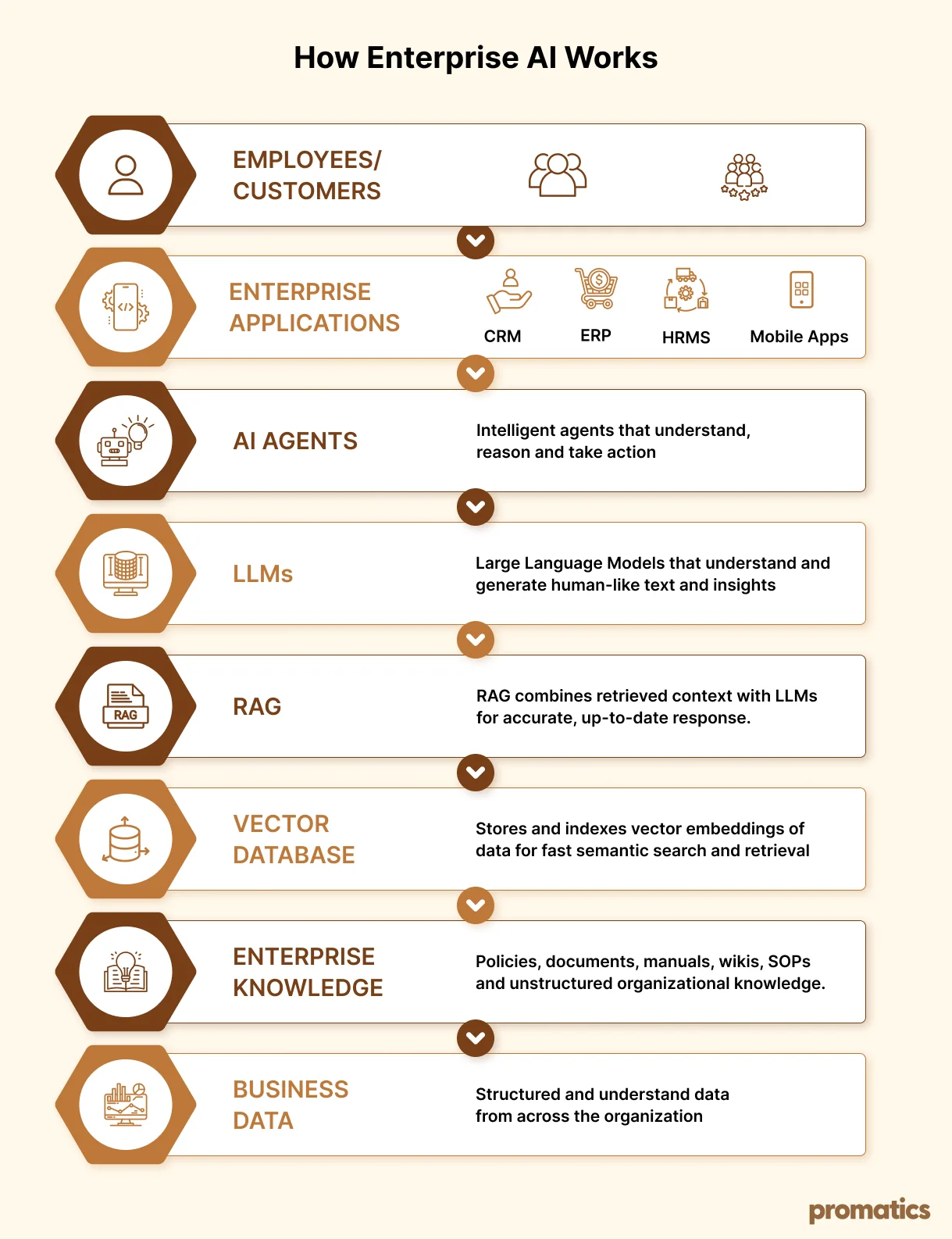
Understanding the Enterprise AI Architecture
A modern Enterprise AI platform consists of several interconnected layers. Each layer performs a specific function, but together they create an intelligent ecosystem capable of understanding enterprise data, reasoning over business knowledge, automating workflows, and continuously improving performance.
Instead of thinking about AI as a single application, it’s more accurate to think of it as a connected architecture where every component contributes to delivering business value.
Enterprise AI Architecture
Users (Employees • Customers • Partners)
│
▼
Enterprise Applications
(CRM • ERP • HRMS • Mobile Apps • Portals)
│
▼
AI Agents & Intelligent Workflows
│
▼
Large Language Models (LLMs)
│
▼
Retrieval-Augmented Generation (RAG)
│
▼
Vector Database + Enterprise Knowledge Base
│
▼
Enterprise Data Sources
(CRM • ERP • Cloud Storage • Documents • APIs)
│
▼
Cloud Infrastructure • Security • Governance • MLOps
Each layer plays an important role in ensuring AI delivers accurate, secure, and context-aware responses.
Let’s explore each component in more detail.
1. Enterprise Data: The Foundation of AI
Every AI system is only as good as the data it can access.
Unlike consumer AI tools that primarily rely on publicly available information, Enterprise AI works with an organization’s proprietary data. This includes customer records, financial information, operational reports, contracts, support tickets, product documentation, HR policies, and countless other business assets.
Common enterprise data sources include:
- ERP systems
- CRM platforms
- HR software
- Financial applications
- Cloud databases
- Customer support platforms
- Business intelligence tools
- Internal documents
- Emails
- APIs
- IoT devices
However, enterprise data is often fragmented across departments and stored in different formats. A key responsibility of Enterprise AI is to connect these disconnected data sources and transform them into a unified knowledge ecosystem.
When AI has access to clean, organized, and governed data, it can deliver far more accurate recommendations and business insights.
2. Large Language Models (LLMs): The Intelligence Engine
Large Language Models are the reasoning engine behind modern Enterprise AI.
They enable AI systems to understand natural language, summarize documents, answer questions, generate content, explain complex information, and interact conversationally with employees and customers.
For example, instead of searching through multiple dashboards, a sales manager can simply ask:
“Which customers are most likely to churn this quarter, and why?”
The LLM interprets the request, identifies the information needed, retrieves enterprise data, and generates an easy-to-understand response.
In enterprise environments, LLMs are commonly used for:
- Enterprise search
- Customer support
- Knowledge management
- Report generation
- Software development
- Contract analysis
- Business intelligence
- Executive decision support
Rather than replacing existing software, LLMs provide a natural language interface that makes complex enterprise systems easier to use.
3. Retrieval-Augmented Generation (RAG): Connecting AI to Business Knowledge
One of the biggest limitations of a standard Large Language Model is that it only knows what it learned during training.
Businesses, however, generate new information every day. Product documentation changes, company policies evolve, customer records are updated, and new regulations are introduced.
Retraining an AI model every time information changes is neither practical nor cost-effective.
This is where Retrieval-Augmented Generation (RAG) becomes essential.
Instead of relying solely on its training data, RAG allows AI to retrieve relevant information from enterprise knowledge bases before generating a response.
For example, if an employee asks about the latest travel reimbursement policy, the AI doesn’t rely on outdated training data. Instead, it searches the organization’s knowledge base, retrieves the latest policy document, and uses that information to generate an accurate response.
This approach offers several advantages:
- More accurate answers
- Access to real-time business information
- Reduced AI hallucinations
- Easier knowledge updates
- Better compliance
- Higher employee trust
Today, RAG has become one of the most important architectural patterns in Enterprise AI because it allows organizations to use their own knowledge without constantly retraining models.
4. Vector Databases: Finding Information by Meaning
Traditional databases retrieve information by matching exact keywords.
Vector databases work differently.
They store information based on semantic meaning, allowing AI to retrieve documents even when the wording differs.
For example, an employee searching for:
“How do I request parental leave?”
should receive the same result as someone searching for:
“What’s the maternity leave process?”
Although the wording is different, both queries express the same intent.
Vector databases enable this type of intelligent retrieval, making enterprise search significantly more accurate and user-friendly.
Together, RAG and vector databases create a powerful foundation for enterprise knowledge management.
5. AI Agents: From Answers to Actions
Traditional AI systems respond to questions.
AI Agents go a step further and they take action.
Instead of simply recommending the next step, AI Agents can interact with enterprise systems, complete tasks, and automate entire workflows.
Imagine a procurement manager asking:
“Order 50 laptops for the new engineering team.”
An AI Agent could:
- Check approved suppliers.
- Compare pricing.
- Verify available budgets.
- Create the purchase order.
- Route it for approval.
- Notify procurement.
- Update the ERP system.
- Track delivery status.
What previously required several employees and multiple software applications can now be coordinated through a single AI-powered workflow.
This shift from AI assistants to AI Agents represents one of the biggest developments in Enterprise AI.
6. Workflow Orchestration: Connecting Everything Together
Enterprise AI rarely operates in isolation.
Instead, it works alongside dozens of enterprise applications.
Workflow orchestration coordinates communication between these systems.
For example, when a customer submits a support request, the orchestration layer may:
- Retrieve customer information from the CRM.
- Search the knowledge base.
- Generate a response using an LLM.
- Create a support ticket.
- Update the ERP system.
- Notify the support team.
- Schedule follow-up communications.
The employee or customer sees a simple interaction, while numerous AI services collaborate behind the scenes.
Workflow orchestration transforms isolated AI capabilities into intelligent business processes.
7. Cloud Infrastructure and MLOps
Enterprise AI requires powerful infrastructure to process large volumes of data and support thousands of users simultaneously.
Most organizations deploy AI using cloud-native infrastructure because it provides:
- Elastic scalability
- High availability
- GPU acceleration
- Secure storage
- API management
- Disaster recovery
- Multi-region deployment
Alongside cloud infrastructure, organizations also implement Machine Learning Operations (MLOps) to manage the AI lifecycle.
MLOps includes:
- Model deployment
- Version control
- Continuous monitoring
- Performance evaluation
- Automated retraining
- Drift detection
- Rollback management
Together, cloud infrastructure and MLOps ensure Enterprise AI remains reliable, scalable, and continuously improves over time.
8. Security and Governance
Enterprise AI often has access to an organization’s most valuable information, including customer data, financial records, legal documents, intellectual property, and confidential business processes.
Without proper governance, AI can introduce security, compliance, and operational risks.
Enterprise AI platforms therefore incorporate:
- Role-based access control (RBAC)
- Identity and access management
- Data encryption
- Audit logging
- Secure APIs
- Compliance monitoring
- Responsible AI policies
- Human oversight for critical decisions
Strong governance not only protects sensitive information but also builds trust among employees, customers, and regulators.
How Everything Works Together
To understand how these technologies interact, consider a simple example.
A customer submits a support request asking for a refund.
Within seconds, the Enterprise AI platform:
- Retrieves customer information from the CRM.
- Searches internal refund policies using RAG.
- Uses a vector database to identify the most relevant documentation.
- Processes the request using an LLM.
- Checks eligibility through the ERP system.
- Routes the request to an AI Agent.
- Updates customer records.
- Send a personalized confirmation email.
- Creates a support ticket if human intervention is required.
To the customer, the experience feels seamless.
Behind the scenes, multiple AI technologies collaborate to complete a complex business process in seconds.
Key Takeaways
Enterprise AI is not powered by a single technology but by an integrated ecosystem of enterprise data, Large Language Models, Retrieval-Augmented Generation (RAG), vector databases, AI Agents, workflow orchestration, cloud infrastructure, and governance frameworks.
Each component plays a distinct role, but together they create intelligent systems capable of understanding business context, automating workflows, and supporting enterprise-wide decision-making. This architecture enables organizations to move beyond isolated AI tools and build scalable, secure, and future-ready AI platforms that deliver measurable business value.
Types of Enterprise AI Solutions
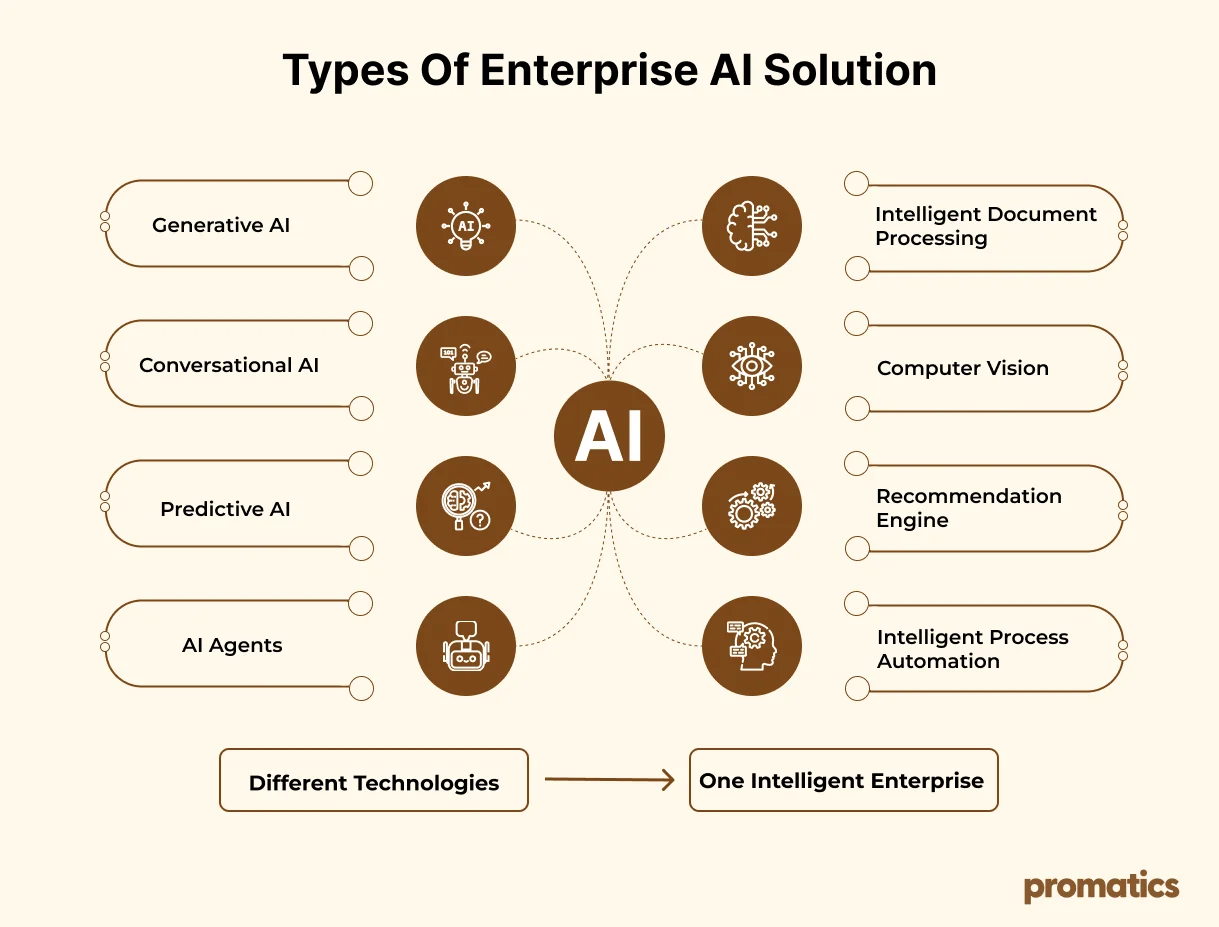
Enterprise AI is not a single technology but a collection of AI capabilities designed to solve different business challenges. While one organization may use AI to automate customer support, another may leverage it for predictive maintenance, document processing, software development, or personalized customer experiences.
The true power of Enterprise AI lies in combining multiple technologies into a unified ecosystem. A single application can use Generative AI to create content, NLP to understand user intent, RAG to retrieve enterprise knowledge, Predictive AI to forecast outcomes, and AI Agents to automate workflows. Together, these capabilities help organizations improve efficiency, enhance decision-making, and drive innovation.
In this chapter, we’ll explore the most common types of Enterprise AI solutions, how they work, and the business value they deliver.
1. Generative AI Solutions
Generative AI creates new content such as reports, emails, product descriptions, software code, technical documentation, meeting summaries, and customer responses. Unlike traditional AI that focuses on analysis or prediction, it helps employees produce high-quality content faster.
Enterprise Use Cases
- Creating marketing campaigns and sales proposals
- Generating software code and technical documentation
- Summarizing meetings and business reports
- Drafting customer support responses
- Producing financial and operational reports
Business Benefits
- Increases employee productivity
- Reduces manual content creation
- Speeds up documentation and reporting
- Improves communication across teams
2. Conversational AI
Conversational AI enables employees and customers to interact with enterprise systems using natural language. Modern AI assistants understand context, retrieve enterprise knowledge, and provide personalized responses instead of relying on predefined scripts.
Enterprise Use Cases
- Customer support chatbots
- Employee and HR self-service assistants
- IT help desk automation
- Internal knowledge assistants
- Voice-enabled enterprise applications
Business Benefits
- Faster customer support
- Lower service costs
- 24/7 assistance
- Improved employee productivity
- Better access to organizational knowledge
3. Predictive AI Solutions
Predictive AI analyzes historical and real-time data to forecast future outcomes. Using machine learning, it helps organizations anticipate risks, optimize operations, and make proactive business decisions.
Enterprise Use Cases
- Sales and demand forecasting
- Customer churn prediction
- Fraud detection
- Inventory optimization
- Predictive maintenance
- Financial risk assessment
Business Benefits
- More accurate forecasting
- Reduced operational risks
- Better resource planning
- Lower maintenance costs
- Higher customer retention
4. AI Agents
AI Agents go beyond answering questions by executing tasks and managing multi-step business workflows with minimal human intervention. They can access enterprise applications, retrieve data, make decisions, and automate complex processes.
Enterprise Use Cases
- Employee onboarding
- IT service management
- Procurement and approval workflows
- Customer service automation
- Project coordination
Business Benefits
- Automates complex business processes
- Reduces manual effort
- Improves operational efficiency
- Accelerates workflow execution
- Scales business operations
5. Intelligent Document Processing (IDP)
Intelligent Document Processing combines OCR, NLP, and Machine Learning to extract, classify, validate, and process information from business documents. It eliminates repetitive manual work while improving speed and accuracy.
Enterprise Use Cases
- Invoice and purchase order processing
- Contract analysis
- Insurance claims
- Loan applications
- Compliance reporting
- Medical records management
Business Benefits
- Faster document processing
- Fewer manual errors
- Improved compliance
- Lower operational costs
- Higher processing accuracy
6. Computer Vision Solutions
Computer Vision enables AI systems to interpret images and videos, allowing organizations to automate visual inspections and monitor physical environments with greater accuracy.
Enterprise Use Cases
- Manufacturing quality inspection
- Medical imaging
- Security surveillance
- Warehouse automation
- Retail shelf monitoring
- Identity verification
Business Benefits
- Improved quality control
- Reduced inspection costs
- Enhanced workplace safety
- Increased operational efficiency
- More accurate visual analysis
7. Recommendation & Personalization Engines
Recommendation engines analyze customer behavior, preferences, and historical interactions to deliver personalized experiences. They are widely used across eCommerce, media, finance, and enterprise applications.
Enterprise Use Cases
- Product recommendations
- Personalized marketing campaigns
- Content recommendations
- Employee learning paths
- Dynamic pricing strategies
Business Benefits
- Higher conversions
- Improved customer engagement
- Better user experiences
- Increased customer loyalty
- Higher revenue opportunities
8. Intelligent Process Automation (IPA)
Intelligent Process Automation combines AI with workflow automation to streamline complex business processes. Unlike traditional automation, IPA can interpret documents, make contextual decisions, and adapt to changing business conditions.
Enterprise Use Cases
- Invoice approvals
- Customer onboarding
- Insurance claims processing
- Procurement workflows
- Compliance monitoring
- Financial reconciliation
Business Benefits
- Faster workflows
- Reduced manual effort
- Improved process consistency
- Lower operational costs
- Greater business agility
Bringing Enterprise AI Solutions Together
Each Enterprise AI solution addresses a different business challenge, but the greatest value comes from combining them into a connected AI ecosystem. For example, a customer support platform can use Conversational AI to interact with users, Generative AI to draft responses, Predictive AI to identify customers at risk of churn, AI Agents to automate ticket resolution, and Intelligent Process Automation to manage follow-up tasks.
By integrating these technologies, organizations can streamline operations, improve decision-making, enhance customer experiences, and unlock new opportunities for innovation. As Enterprise AI continues to evolve, businesses that adopt the right mix of AI solutions will be better positioned to improve efficiency, reduce costs, and gain a lasting competitive advantage.
Choosing the Right Enterprise AI Solution
Not every business needs every type of AI solution. The right choice depends on the organization’s goals, operational challenges, and digital maturity.
The table below provides a simple overview.
| Business Objective | Recommended AI Solution |
| Create business content | Generative AI |
| Improve customer support | Conversational AI |
| Predict future outcomes | Predictive AI |
| Automate complex workflows | AI Agents |
| Process documents | Intelligent Document Processing |
| Analyze images and videos | Computer Vision |
| Personalize customer experiences | Recommendation Engines |
| Automate business processes | Intelligent Process Automation |
Many organizations begin with one high-impact use case—such as customer support automation or document processing—and gradually expand AI capabilities across other departments as they gain experience and confidence.
Key Takeaways
Enterprise AI encompasses a wide range of intelligent solutions, each designed to solve different business challenges. While Generative AI accelerates knowledge work, Predictive AI helps organizations anticipate future outcomes, Conversational AI improves interactions, AI Agents automate complex workflows, and Computer Vision enables machines to understand visual information. Complementary solutions such as Intelligent Document Processing, Recommendation Engines, and Intelligent Process Automation further extend AI’s impact across the enterprise.
The greatest business value is achieved when these capabilities work together rather than in isolation. By integrating multiple AI technologies into a unified ecosystem, organizations can streamline operations, improve customer experiences, enhance employee productivity, and make more informed business decisions.
Types of Enterprise AI Solutions
Enterprise AI is not a one-size-fits-all technology. Organizations use different AI solutions depending on their business goals, operational challenges, and industry requirements. While one company may implement AI to automate customer support, another may focus on predictive maintenance, intelligent document processing, or AI-powered software development.
What makes Enterprise AI so powerful is its ability to combine multiple AI technologies into a unified ecosystem. A single enterprise application might use Generative AI to create responses, Natural Language Processing (NLP) to understand user intent, Retrieval-Augmented Generation (RAG) to access company knowledge, Predictive AI to identify potential risks, and AI Agents to execute business workflows.
Rather than viewing these technologies as competing solutions, organizations should think of them as complementary capabilities that work together to solve different business problems.
1. Generative AI Solutions
Generative AI has become one of the fastest-growing areas of Enterprise AI. Unlike traditional AI systems that analyze data or make predictions, Generative AI creates new content based on user prompts and enterprise knowledge.
It can generate:
- Business reports
- Emails
- Product descriptions
- Marketing content
- Software code
- Technical documentation
- Meeting summaries
- Knowledge articles
- Customer responses
- Financial summaries
For enterprises, Generative AI acts as a productivity accelerator by reducing the time employees spend on repetitive knowledge-based tasks.
Enterprise Use Cases
Organizations use Generative AI to:
- Draft marketing campaigns
- Generate personalized sales proposals
- Summarize meetings
- Create internal documentation
- Assist software developers with code generation
- Produce customer support responses
- Generate financial reports
- Automate technical documentation
For example, instead of spending hours preparing a quarterly business report, finance teams can use Generative AI to summarize financial data, highlight key trends, and generate executive-ready insights in minutes.
Business Benefits
Generative AI helps organizations:
- Improve employee productivity
- Reduce manual content creation
- Accelerate documentation
- Enhance customer communication
- Improve knowledge sharing
- Speed up decision-making
2. Conversational AI
Conversational AI enables employees and customers to interact with enterprise systems using natural language.
Unlike traditional chatbots that rely on predefined scripts, modern conversational AI understands context, retrieves enterprise knowledge, and provides intelligent, personalized responses.
It is commonly deployed through:
- Customer support chatbots
- Employee virtual assistants
- IT help desks
- HR self-service portals
- Voice assistants
- Internal knowledge assistants
Enterprise Use Cases
Imagine an employee asking:
How many vacation days do I have left? Instead of searching through HR portals or contacting the HR department, a conversational AI assistant can securely retrieve the employee’s records, provide the answer instantly, and even guide them through submitting a leave request.
Similarly, customer support assistants can verify customer identities, retrieve purchase history, recommend solutions, process refunds, and escalate complex issues when needed.
Business Benefits
Organizations implementing Conversational AI often experience:
- Faster customer response times
- Reduced support costs
- Improved employee productivity
- 24/7 customer assistance
- Consistent customer experiences
- Better knowledge accessibility
3. Predictive AI Solutions
While Generative AI focuses on creating new content, Predictive AI helps organizations anticipate future events and make proactive decisions.
Using Machine Learning and historical business data, Predictive AI identifies patterns and forecasts outcomes before they occur.
Common applications include:
- Sales forecasting
- Demand prediction
- Customer churn analysis
- Fraud detection
- Inventory planning
- Equipment maintenance
- Financial forecasting
- Risk assessment
Enterprise Use Cases
A retail company can analyze historical sales, seasonal trends, and customer behavior to predict inventory demand for the upcoming holiday season.
Similarly, manufacturers use Predictive AI to monitor machinery and identify signs of equipment failure before production is disrupted.
Business Benefits
Predictive AI enables organizations to:
- Improve forecasting accuracy
- Reduce operational risks
- Optimize inventory
- Lower maintenance costs
- Improve resource planning
- Increase customer retention
Instead of reacting to problems after they occur, organizations can prevent them before they impact the business.
4. AI Agents
AI Agents represent the next evolution of Enterprise AI. Unlike conversational assistants that primarily answer questions, AI Agents are designed to complete tasks and execute business processes with minimal human intervention.
They can:
- Understand business objectives
- Break down complex tasks
- Access enterprise applications
- Retrieve business data
- Execute workflows
- Collaborate with other AI systems
- Monitor progress
- Recommend improvements
Enterprise Use Cases
Consider the employee onboarding process.
Instead of manually coordinating multiple departments, an AI Agent can:
- Create employee accounts
- Provision software access
- Schedule orientation sessions
- Assign mandatory training
- Notify IT and HR teams
- Generate onboarding documentation
- Monitor completion status
The employee experiences a seamless onboarding process, while HR teams save hours of administrative work.
Business Benefits
AI Agents help organizations:
- Automate complex workflows
- Improve operational efficiency
- Reduce manual effort
- Accelerate approvals
- Increase productivity
- Improve process consistency
- Scale business operations
As Enterprise AI continues to evolve, AI Agents are expected to become digital coworkers capable of supporting employees across every department.
5. Intelligent Document Processing (IDP)
Every enterprise manages thousands of documents, including invoices, contracts, purchase orders, forms, insurance claims, compliance reports, and customer applications.
Processing these documents manually is time-consuming and prone to errors.
Intelligent Document Processing (IDP) combines Optical Character Recognition (OCR), Natural Language Processing (NLP), and Machine Learning to automatically extract, classify, validate, and process information from structured and unstructured documents.
Enterprise Use Cases
Organizations use IDP for:
- Invoice processing
- Contract analysis
- Claims processing
- Employee onboarding documents
- Purchase orders
- Compliance reporting
- Loan applications
- Medical records
For example, instead of manually reviewing hundreds of invoices each day, an AI-powered system can extract supplier details, validate purchase orders, detect duplicate invoices, and route documents for approval automatically.
Business Benefits
Intelligent Document Processing helps businesses:
- Reduce processing time
- Minimize manual errors
- Improve compliance
- Accelerate approvals
- Lower operational costs
- Increase document accuracy
6. Computer Vision Solutions
Computer Vision enables AI systems to analyze and understand images and videos. Using deep learning models, organizations can automate visual inspection tasks that previously required human expertise.
Enterprise Use Cases
Computer Vision is widely used for:
- Manufacturing quality inspection
- Medical imaging
- Security surveillance
- Retail shelf monitoring
- Warehouse automation
- Identity verification
- Infrastructure inspection
- Autonomous vehicles
For example, a manufacturing company can install AI-powered cameras on production lines to detect product defects in real time, helping reduce waste and improve product quality.
Business Benefits
Organizations use Computer Vision to:
- Improve quality control
- Reduce inspection costs
- Increase operational efficiency
- Enhance workplace safety
- Improve diagnostic accuracy
- Automate visual inspections
7. Recommendation and Personalization Engines
Modern customers expect personalized experiences. Recommendation engines analyze customer behavior, purchase history, preferences, and interactions to provide relevant recommendations in real time.
Enterprise Use Cases
Businesses use recommendation engines to:
- Suggest products
- Personalize marketing campaigns
- Recommend training content
- Improve search results
- Deliver personalized customer experiences
- Optimize pricing strategies
Streaming platforms recommend movies, e-commerce platforms suggest products, and enterprise learning platforms personalize employee training—all powered by AI-driven recommendation systems.
Business Benefits
Recommendation engines help organizations:
- Increase conversions
- Improve customer engagement
- Enhance user experiences
- Increase average order value
- Strengthen customer loyalty
8. Intelligent Process Automation (IPA)
Traditional automation follows predefined rules. Intelligent Process Automation (IPA) combines AI with workflow automation to manage dynamic, data-driven business processes.
Unlike conventional robotic process automation (RPA), IPA can understand documents, make contextual decisions, and adapt to changing business conditions.
Enterprise Use Cases
Organizations automate processes such as:
- Invoice approvals
- Procurement workflows
- Insurance claims
- Customer onboarding
- Employee onboarding
- Compliance monitoring
- Financial reconciliation
- Service request management
Business Benefits
Intelligent Process Automation enables businesses to:
- Reduce manual effort
- Accelerate workflows
- Improve consistency
- Lower operational costs
- Enhance process visibility
- Increase business agility
Choosing the Right Enterprise AI Solution
Not every business needs every type of AI solution. The right choice depends on the organization’s goals, operational challenges, and digital maturity.
The table below provides a simple overview.
| Business Objective | Recommended AI Solution |
| Create business content | Generative AI |
| Improve customer support | Conversational AI |
| Predict future outcomes | Predictive AI |
| Automate complex workflows | AI Agents |
| Process documents | Intelligent Document Processing |
| Analyze images and videos | Computer Vision |
| Personalize customer experiences | Recommendation Engines |
| Automate business processes | Intelligent Process Automation |
Many organizations begin with one high-impact use case—such as customer support automation or document processing—and gradually expand AI capabilities across other departments as they gain experience and confidence.
Key Takeaways
Enterprise AI encompasses a wide range of intelligent solutions, each designed to solve different business challenges. While Generative AI accelerates knowledge work, Predictive AI helps organizations anticipate future outcomes, Conversational AI improves interactions, AI Agents automate complex workflows, and Computer Vision enables machines to understand visual information. Complementary solutions such as Intelligent Document Processing, Recommendation Engines, and Intelligent Process Automation further extend AI’s impact across the enterprise.
The greatest business value is achieved when these capabilities work together rather than in isolation. By integrating multiple AI technologies into a unified ecosystem, organizations can streamline operations, improve customer experiences, enhance employee productivity, and make more informed business decisions.
Enterprise AI Use Cases Across Industries
Enterprise AI is no longer confined to innovation labs or pilot projects. It has become a practical business capability that organizations across industries are using to solve operational challenges, improve customer experiences, and make faster, data-driven decisions.
While the underlying technologies such as Generative AI, Large Language Models (LLMs), Predictive Analytics, AI Agents, Computer Vision, and Natural Language Processing (NLP) remain the same, the way they are applied varies from one industry to another. A healthcare provider uses AI to support patient care, whereas a manufacturer relies on it to improve production efficiency. Financial institutions focus on fraud prevention and risk management, while retailers leverage AI to personalize customer experiences and optimize inventory.
Despite these differences, the objective is consistent: use AI to automate repetitive work, uncover insights from enterprise data, and create measurable business value.
Let’s explore how Enterprise AI is transforming different industries and why organizations are making AI a core part of their digital transformation strategies.
1. Healthcare: Improving Patient Care and Operational Efficiency
Healthcare organizations generate enormous amounts of clinical and administrative data every day. From patient records and diagnostic reports to medical imaging and insurance claims, managing this information manually is both time-consuming and error-prone.
Enterprise AI helps healthcare providers improve patient outcomes while reducing administrative burden.
Common Use Cases
- AI-assisted diagnostics
- Medical image analysis
- Clinical documentation
- Virtual health assistants
- Patient triage
- Predictive patient monitoring
- Appointment scheduling
- Insurance claims automation
- Hospital resource planning
- Drug discovery support
For example, doctors often spend significant time documenting patient visits. An AI-powered clinical assistant can automatically summarize consultations, update Electronic Health Records (EHRs), recommend follow-up actions, and generate discharge summaries, allowing healthcare professionals to focus more on patient care.
Business Benefits
Healthcare organizations use Enterprise AI to:
- Improve diagnostic accuracy
- Reduce administrative workloads
- Shorten patient wait times
- Optimize hospital resources
- Enhance patient experiences
- Improve clinical decision-making
- Reduce operational costs
2. Banking and Financial Services: Smarter Risk Management
Financial institutions process millions of transactions daily while managing strict regulatory requirements and increasing cybersecurity threats.
Enterprise AI enables banks and financial organizations to improve operational efficiency while strengthening security and compliance.
Common Use Cases
- Fraud detection
- Credit risk assessment
- Loan underwriting
- Regulatory compliance
- Customer service automation
- Financial forecasting
- Investment recommendations
- Anti-money laundering (AML)
- Identity verification
- Personalized banking experiences
For example, AI continuously monitors transaction patterns to identify suspicious activities in real time. Instead of detecting fraud after financial losses occur, banks can prevent fraudulent transactions before they are completed.
Business Benefits
Financial institutions benefit from:
- Faster loan approvals
- Improved fraud prevention
- Better compliance
- Reduced operational costs
- More accurate financial forecasting
- Personalized customer services
- Stronger cybersecurity
3. Retail and E-commerce: Delivering Personalized Shopping Experiences
Today’s customers expect fast, personalized, and seamless shopping experiences across every channel. Enterprise AI helps retailers meet these expectations by analyzing customer behavior, predicting demand, and automating operations throughout the customer journey.
Common Use Cases
- Personalized product recommendations
- Inventory optimization
- Demand forecasting
- Dynamic pricing
- Customer service automation
- Marketing personalization
- Visual product search
- Supply chain optimization
- Customer sentiment analysis
- Shopping assistants
Imagine an online shopper browsing a fashion website. AI analyzes browsing history, purchase behavior, and preferences to recommend products, predict the likelihood of purchase, personalize promotional offers, and even optimize delivery options.
Business Benefits
Retailers use Enterprise AI to:
- Increase conversion rates
- Improve customer loyalty
- Reduce inventory shortages
- Optimize pricing
- Increase average order value
- Improve marketing performance
- Enhance customer experiences
4. Manufacturing: Building Smarter Factories
Manufacturing companies are using Enterprise AI to improve production efficiency, reduce equipment downtime, and maintain consistent product quality.
Instead of relying solely on scheduled maintenance or manual inspections, manufacturers now use AI to monitor production lines and predict potential issues before they occur.
Common Use Cases
- Predictive maintenance
- Computer Vision quality inspection
- Production scheduling
- Inventory optimization
- Supply chain planning
- Energy optimization
- Equipment monitoring
- Robotics coordination
- Worker safety monitoring
- Demand forecasting
For example, AI-powered cameras installed along production lines can identify defects in real time, reducing waste and ensuring products meet quality standards before leaving the factory.
Business Benefits
Manufacturers achieve:
- Reduced downtime
- Higher production efficiency
- Better quality control
- Lower maintenance costs
- Improved inventory planning
- Enhanced worker safety
- Greater operational visibility
5. Logistics and Supply Chain: Optimizing Global Operations
Modern supply chains involve thousands of moving parts, from suppliers and warehouses to transportation networks and customer deliveries.
Enterprise AI enables organizations to improve visibility, optimize logistics, and respond quickly to unexpected disruptions.
Common Use Cases
- Route optimization
- Warehouse automation
- Fleet management
- Inventory forecasting
- Delivery prediction
- Supplier performance analysis
- Procurement optimization
- Shipment tracking
- Demand planning
- Risk assessment
For example, AI can evaluate traffic conditions, weather forecasts, warehouse inventory, and customer demand simultaneously to recommend the most efficient delivery routes.
Business Benefits
Organizations benefit from:
- Faster deliveries
- Lower transportation costs
- Better inventory utilization
- Improved warehouse efficiency
- Stronger supplier relationships
- Increased supply chain resilience
- Higher customer satisfaction
6. Human Resources: Enhancing the Employee Experience
Human Resources teams manage recruitment, onboarding, employee support, payroll, compliance, and workforce planning.
Enterprise AI simplifies these activities by automating repetitive administrative work and providing employees with instant access to information.
Common Use Cases
- Resume screening
- Employee onboarding
- HR virtual assistants
- Workforce planning
- Employee sentiment analysis
- Learning recommendations
- Policy search
- Payroll support
- Performance insights
- Internal knowledge management
For example, instead of emailing HR about leave policies or benefits, employees can ask an AI assistant and receive accurate, personalized answers instantly.
Business Benefits
Organizations use Enterprise AI to:
- Reduce recruitment time
- Improve candidate matching
- Enhance employee engagement
- Accelerate onboarding
- Improve workforce planning
- Reduce HR administrative workloads
7. Software Development and IT Operations: Accelerating Innovation
Artificial Intelligence is changing how software is designed, developed, tested, and maintained. Rather than replacing developers, Enterprise AI acts as an intelligent development assistant that improves productivity throughout the software development lifecycle.
Common Use Cases
- AI-assisted coding
- Code review
- Bug detection
- Test automation
- Documentation generation
- DevOps automation
- Infrastructure monitoring
- Incident management
- Knowledge search
- IT help desk automation
For example, developers can use AI to generate boilerplate code, explain legacy applications, identify security vulnerabilities, and create technical documentation, reducing development time while improving code quality.
Business Benefits
Software organizations benefit from:
- Faster software delivery
- Improved developer productivity
- Better code quality
- Reduced technical debt
- Faster issue resolution
- Improved system reliability
8. Legal and Compliance: Managing Documents at Scale
Legal departments handle contracts, regulations, compliance reports, and corporate policies that require extensive review and analysis.
Enterprise AI automates many of these document-intensive tasks while improving accuracy and reducing review times.
Common Use Cases
- Contract analysis
- Clause extraction
- Legal research
- Document summarization
- Regulatory compliance
- Due diligence
- Policy management
- Risk identification
- Litigation support
- Document comparison
For example, AI can review thousands of contracts, identify renewal clauses, highlight potential risks, compare document versions, and generate executive summaries in a fraction of the time required for manual review.
Business Benefits
Legal teams use Enterprise AI to:
- Accelerate contract reviews
- Improve compliance
- Reduce legal risks
- Lower operational costs
- Improve document accuracy
- Increase productivity
Enterprise AI Use Cases Across Business Functions
Although AI applications vary by industry, many organizations implement similar solutions across different departments.
| Business Function | Enterprise AI Applications |
| Customer Support | AI chatbots, virtual assistants, ticket automation |
| Sales | Lead scoring, proposal generation, sales forecasting |
| Marketing | Content generation, campaign optimization, personalization |
| Finance | Fraud detection, invoice automation, forecasting |
| Human Resources | Recruitment, onboarding, employee support |
| Operations | Workflow automation, predictive analytics |
| IT | AI coding assistants, infrastructure monitoring |
| Executive Leadership | Business intelligence, forecasting, decision support |
This demonstrates that Enterprise AI is no longer limited to a single department—it has become an organization-wide capability that supports nearly every business function.
What Makes Enterprise AI Successful?
Implementing AI is not simply about adopting new technology. The organizations achieving the greatest success focus on solving specific business challenges rather than deploying AI for its own sake.
Successful Enterprise AI initiatives typically share several characteristics:
- Clear business objectives aligned with organizational goals.
- High-quality and well-governed enterprise data.
- Seamless integration with existing business systems.
- Strong security, privacy, and compliance controls.
- Continuous monitoring and optimization after deployment.
- Employee training and effective change management.
By combining these elements with the right AI technologies, organizations can build scalable solutions that continue delivering value as business needs evolve.
Key Takeaways
Enterprise AI is creating measurable impact across virtually every industry. From improving patient care in healthcare and preventing fraud in banking to personalizing retail experiences, optimizing manufacturing operations, streamlining logistics, supporting HR teams, accelerating software development, and simplifying legal workflows, AI has become a versatile business capability that extends far beyond automation.
The common thread across all successful implementations is a focus on solving real business problems. Organizations that align AI initiatives with operational goals, integrate AI into existing workflows, and continuously measure outcomes are far more likely to achieve long-term success.
As these use cases demonstrate, Enterprise AI is not just about adopting advanced technologies it is about transforming how businesses operate.
Enterprise AI Development Cost: Factors, Pricing, and ROI
One of the first questions business leaders ask before starting an AI initiative is:
“How much does Enterprise AI Development cost?”
Unlike purchasing off-the-shelf software, Enterprise AI is not a fixed-cost investment. Every implementation is different because organizations have unique business objectives, infrastructure, security requirements, data environments, and integration needs.
A simple AI-powered knowledge assistant for employees will require a very different level of investment than an enterprise-wide AI platform that automates customer support, financial operations, and supply chain management.
For this reason, Enterprise AI should not be viewed as a one-time technology purchase. Instead, it is a long-term strategic investment that delivers value through improved productivity, operational efficiency, better decision-making, and enhanced customer experiences.
Understanding what influences Enterprise AI development costs helps organizations plan budgets more effectively, prioritize high-impact initiatives, and maximize return on investment (ROI).
What Determines the Cost of Enterprise AI Development?
There is no universal price for Enterprise AI because every project differs in scope and complexity. Several technical and business factors influence the total investment.
The most significant cost drivers include:
- Project scope and business complexity
- Type of AI solution
- Data readiness and quality
- Enterprise system integrations
- Infrastructure requirements
- Security and compliance
- Development team expertise
- Ongoing maintenance and optimization
Let’s look at each of these factors in more detail.
1. Project Scope and Complexity
The scope of an AI project has the greatest impact on development costs.
A small internal AI assistant designed to help employees search company documents is much easier to develop than an enterprise-wide platform capable of automating workflows across multiple departments.
Generally, Enterprise AI projects fall into three categories.
Small-Scale AI Projects
Examples include:
- Internal knowledge assistants
- Document summarization
- FAQ chatbots
- Meeting assistants
- Basic workflow automation
These projects usually involve fewer integrations, smaller datasets, and shorter implementation timelines.
Mid-Sized Enterprise AI Projects
Examples include:
- Customer support automation
- Sales intelligence
- HR automation
- Predictive analytics
- Financial reporting assistants
These solutions require deeper enterprise integrations, stronger security, and support for larger user groups.
Enterprise-Wide AI Platforms
Examples include:
- AI Agents
- Enterprise search platforms
- Intelligent workflow automation
- Multi-department AI ecosystems
- Industry-specific AI solutions
These projects involve multiple AI technologies, enterprise-wide integrations, governance frameworks, and continuous optimization, making them the most complex and resource-intensive.
2. Type of AI Solution
Not all AI applications require the same level of development effort.
For example, deploying a conversational AI assistant is generally less complex than building an autonomous AI Agent capable of executing business workflows.
The table below provides a general comparison.
| AI Solution | Relative Complexity |
| AI Knowledge Assistant | Low |
| Conversational AI | Low to Medium |
| Generative AI Applications | Medium |
| Predictive Analytics | Medium |
| Recommendation Engines | Medium |
| Computer Vision Solutions | Medium to High |
| AI Agents | High |
| Enterprise Workflow Automation | High |
| Autonomous Decision Systems | Very High |
The more advanced the AI capabilities, the greater the development effort, testing requirements, and long-term maintenance.
3. Enterprise Data Readiness
AI is only as effective as the data it uses.
Unfortunately, many organizations discover that their enterprise data is fragmented across different departments, stored in incompatible formats, or contains duplicate and outdated information.
Before AI can generate reliable results, organizations often need to invest in:
- Data cleaning
- Data labeling
- Data standardization
- Metadata management
- Knowledge base creation
- Data governance
- Security classification
Although this preparation requires time and resources, it significantly improves model accuracy and reduces future maintenance costs.
Organizations with mature data governance practices generally experience faster and more cost-effective AI implementations.
4. Enterprise System Integration
Enterprise AI delivers the greatest value when it works seamlessly with existing business systems.
Typical integrations include:
- ERP platforms
- CRM systems
- HRMS applications
- Business Intelligence tools
- Customer support software
- Cloud storage
- Knowledge management systems
- Third-party APIs
The number and complexity of these integrations directly influence implementation effort.
Businesses with modern API-driven architectures often experience lower integration costs than organizations relying on legacy systems.
5. Infrastructure Requirements
AI applications require reliable infrastructure to process data, run models, and support enterprise users.
Infrastructure costs depend on several factors, including:
- Number of users
- AI workload
- Model size
- Data storage
- Geographic deployment
- Availability requirements
- Security standards
Organizations typically choose one of the following deployment models.
- Cloud Deployment
Cloud infrastructure offers:
- Faster deployment
- Elastic scalability
- Lower upfront investment
- Simplified infrastructure management
It is an excellent choice for organizations looking to scale AI quickly without investing heavily in on-premises hardware.
- On-Premises Deployment
Organizations handling highly sensitive information often prefer on-premises infrastructure because it offers:
- Greater control over data
- Enhanced security
- Better compliance with regulatory requirements
- Full ownership of infrastructure
This approach is common in industries such as healthcare, banking, defense, and government.
- Hybrid Deployment
Many enterprises adopt a hybrid model that combines cloud flexibility with on-premises security.
For example, confidential customer data may remain on private infrastructure, while AI processing and analytics run in the cloud.
This approach balances scalability, performance, and compliance.
6. Security and Compliance
Enterprise AI frequently processes sensitive business information, making security a critical part of the implementation budget.
Organizations typically invest in:
- Identity and access management
- Data encryption
- Secure APIs
- Audit logging
- Compliance reporting
- Threat monitoring
- Responsible AI governance
Businesses operating in regulated industries may also need to comply with standards such as GDPR, HIPAA, ISO 27001, SOC 2, or industry-specific regulations.
While these measures increase implementation costs, they help reduce legal, operational, and cybersecurity risks.
7. Development Team and Expertise
Enterprise AI projects require expertise across multiple disciplines.
A typical implementation team may include:
- AI Architects
- Machine Learning Engineers
- Data Scientists
- Software Developers
- Data Engineers
- Cloud Architects
- MLOps Engineers
- Security Specialists
- QA Engineers
- Business Analysts
- Project Managers
Organizations can either build internal AI teams or partner with an experienced Enterprise AI development company to accelerate implementation and reduce hiring challenges.
The right development partner can also help avoid costly mistakes during architecture design, integration, and deployment.
Build vs. Buy vs. Customize
One of the biggest decisions organizations face is whether to build a custom AI solution, purchase an existing platform, or customize a foundation model.
Each approach has its advantages.
| Approach | Best For | Advantages | Considerations |
| Build | Highly specialized enterprise solutions | Full customization, complete ownership | Higher cost and longer development time |
| Buy | Standard business applications | Faster deployment, vendor support | Limited flexibility and ongoing licensing fees |
| Customize | Most enterprise use cases | Balance of speed, flexibility, and cost | Requires AI expertise for integration and optimization |
For many organizations, customizing an existing enterprise-grade AI platform offers the best balance between implementation speed, scalability, and long-term value.
Hidden Costs to Consider
Many organizations focus primarily on development costs while overlooking the ongoing expenses associated with Enterprise AI.
Some commonly overlooked costs include:
- Employee training
- Change management
- Knowledge base updates
- Model retraining
- API usage fees
- Infrastructure scaling
- Security audits
- Compliance monitoring
- Performance optimization
- Technical support
Planning for these expenses early helps organizations avoid unexpected costs after deployment.
Measuring the Return on Investment (ROI)
While development cost is important, it should always be evaluated alongside the business value AI delivers.
Organizations that successfully implement Enterprise AI typically measure ROI using metrics such as:
- Reduction in operational costs
- Time saved through automation
- Employee productivity improvements
- Faster decision-making
- Increased customer satisfaction
- Higher sales conversions
- Reduced process errors
- Improved compliance
- Better resource utilization
- Revenue growth
For example, if an AI-powered customer support platform reduces average response time by 60% while enabling support agents to handle significantly more inquiries, the resulting productivity gains and customer satisfaction improvements often outweigh the initial implementation cost.
Rather than viewing AI as an expense, organizations should evaluate it as a long-term investment in operational efficiency and business growth.
Budgeting for Long-Term Success
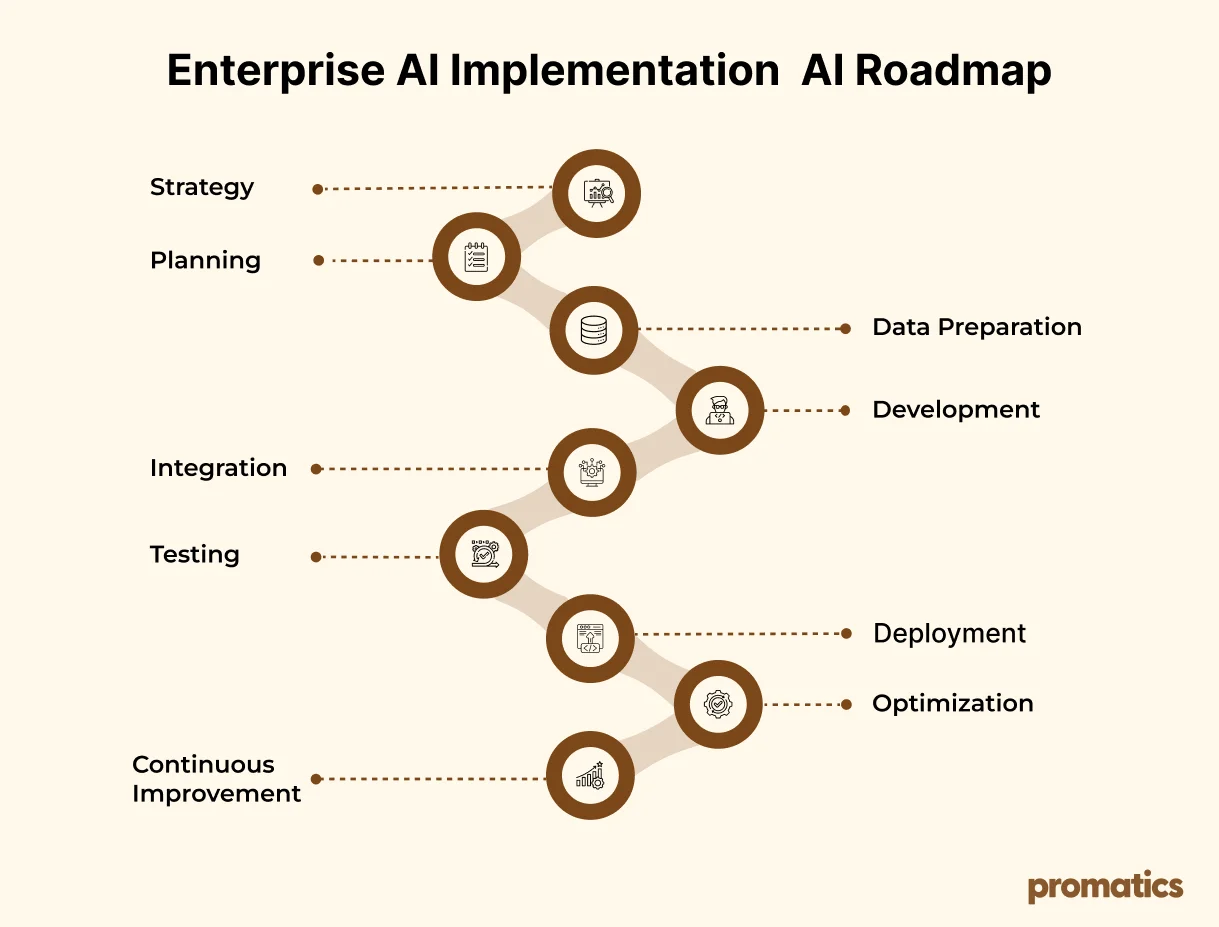
Enterprise AI should not be treated as a one-time implementation project.
Instead, organizations should plan their investment across multiple phases.
Phase 1: Strategy and Planning
- Business assessment
- AI roadmap
- Technology evaluation
- Architecture planning
Phase 2: Development and Integration
- Data preparation
- Model development
- Enterprise integrations
- Workflow automation
- Security implementation
Phase 3: Deployment
- Infrastructure setup
- User onboarding
- Production rollout
- Governance implementation
Phase 4: Continuous Optimization
- Performance monitoring
- Model improvements
- Knowledge base updates
- New feature development
- AI governance and compliance
This phased approach allows organizations to spread investment over time while continuously improving their AI capabilities.
Key Takeaways
Enterprise AI Development costs vary depending on project scope, technology choices, enterprise integrations, infrastructure, security requirements, and long-term maintenance. Rather than focusing solely on the initial investment, organizations should evaluate AI based on the measurable business value it creates through improved productivity, operational efficiency, customer satisfaction, and revenue growth.
The most successful organizations approach AI as a strategic capability rather than a standalone technology purchase. By planning budgets carefully, selecting the right implementation approach, and investing in continuous optimization, businesses can maximize the long-term return on their AI initiatives.
However, even well-funded AI projects can face implementation challenges. Data quality issues, integration complexity, employee adoption, governance, and security all play a significant role in determining project success.
Enterprise AI Challenges, Best Practices, and Future Trends
Implementing Enterprise AI is not simply about deploying advanced algorithms or integrating a Large Language Model (LLM) into existing software. It requires organizations to rethink how they manage data, redesign business processes, prepare employees, and establish governance frameworks that ensure AI is secure, ethical, and scalable.
While Enterprise AI has the potential to transform every aspect of an organization, success depends on much more than technology. Many businesses invest in AI expecting immediate results, only to discover that challenges such as poor data quality, legacy systems, employee resistance, or regulatory requirements can slow adoption and reduce business value.
The organizations achieving the greatest success are those that approach AI as a long-term business capability rather than a one-time implementation project. They combine the right technology with strong leadership, clear governance, continuous optimization, and a culture of innovation.
This chapter explores the most common Enterprise AI challenges, practical best practices to overcome them, and the future trends shaping the next generation of intelligent enterprises.
Common Challenges in Enterprise AI Development
Although Enterprise AI offers significant business opportunities, implementing it successfully requires organizations to overcome several technical and organizational challenges.
Understanding these challenges before starting an AI initiative helps reduce implementation risks and improve long-term success.
1. Poor Data Quality
Artificial Intelligence relies on data to learn, analyze, and generate accurate results. If enterprise data is incomplete, inconsistent, duplicated, or outdated, AI systems will inevitably produce unreliable outputs.
Many organizations store information across multiple departments using different formats, making it difficult to create a unified view of enterprise knowledge.
Best Practices
Organizations should:
- Establish enterprise-wide data governance.
- Standardize data collection methods.
- Clean and validate data regularly.
- Remove duplicate or outdated records.
- Build centralized knowledge repositories.
Investing in data quality before AI implementation significantly improves accuracy and user trust.
2. Integrating AI with Existing Systems
Enterprise AI rarely operates independently. It must interact with ERP platforms, CRM systems, HRMS applications, cloud services, customer support tools, and other business software.
Legacy applications often present integration challenges because they were not originally designed to support AI-driven workflows.
Best Practices
To simplify integration:
- Use API-first architectures whenever possible.
- Modernize legacy systems gradually instead of replacing them entirely.
- Adopt middleware for connecting older applications.
- Design modular AI architectures that support future expansion.
A well-integrated AI ecosystem allows organizations to maximize the value of their existing technology investments.
3. Security and Data Privacy
Enterprise AI often processes highly sensitive information, including financial records, customer data, legal documents, healthcare records, and proprietary business knowledge.
Without appropriate safeguards, organizations risk data breaches, unauthorized access, and compliance violations.
Best Practices
Organizations should implement:
- Role-based access control (RBAC)
- Identity and access management
- Data encryption
- Secure API communication
- Continuous security monitoring
- Audit logging
- Zero-trust security principles
Security should be incorporated into every stage of AI development rather than added after deployment.
4. Regulatory Compliance and AI Governance
As AI adoption grows, governments and regulatory bodies are introducing new requirements governing transparency, accountability, privacy, and responsible AI use.
Organizations operating in industries such as healthcare, finance, insurance, and government must ensure AI complies with applicable regulations.
Best Practices
Successful organizations:
- Include compliance teams early in AI projects.
- Document model decisions and data sources.
- Conduct regular AI audits.
- Monitor evolving regulations.
- Maintain explainable AI processes.
Strong governance reduces legal risks while increasing trust among employees, customers, and stakeholders.
5. Employee Adoption and Change Management
Technology alone does not guarantee successful AI adoption.
Employees may hesitate to use AI because they fear job displacement, lack confidence in AI-generated recommendations, or simply prefer familiar ways of working.
Without proper change management, even technically successful AI projects may struggle to deliver business value.
Best Practices
Organizations should:
- Clearly communicate AI objectives.
- Position AI as a tool that augments human work rather than replacing employees.
- Provide practical training and workshops.
- Encourage employee feedback.
- Introduce AI gradually through pilot projects.
Organizations that invest in employee education consistently achieve higher adoption rates and stronger long-term outcomes.
6. Measuring Return on Investment
Many businesses struggle to determine whether their AI initiatives are delivering meaningful value.
Focusing solely on technical metrics such as model accuracy or response time does not provide a complete picture of business impact.
Best Practices
Measure AI success using business-focused KPIs such as:
- Productivity improvements
- Time savings
- Operational cost reduction
- Customer satisfaction
- Revenue growth
- Workflow efficiency
- Error reduction
- Employee engagement
Regularly reviewing these metrics helps organizations prioritize future AI investments and optimize existing solutions.
Best Practices for Successful Enterprise AI Implementation
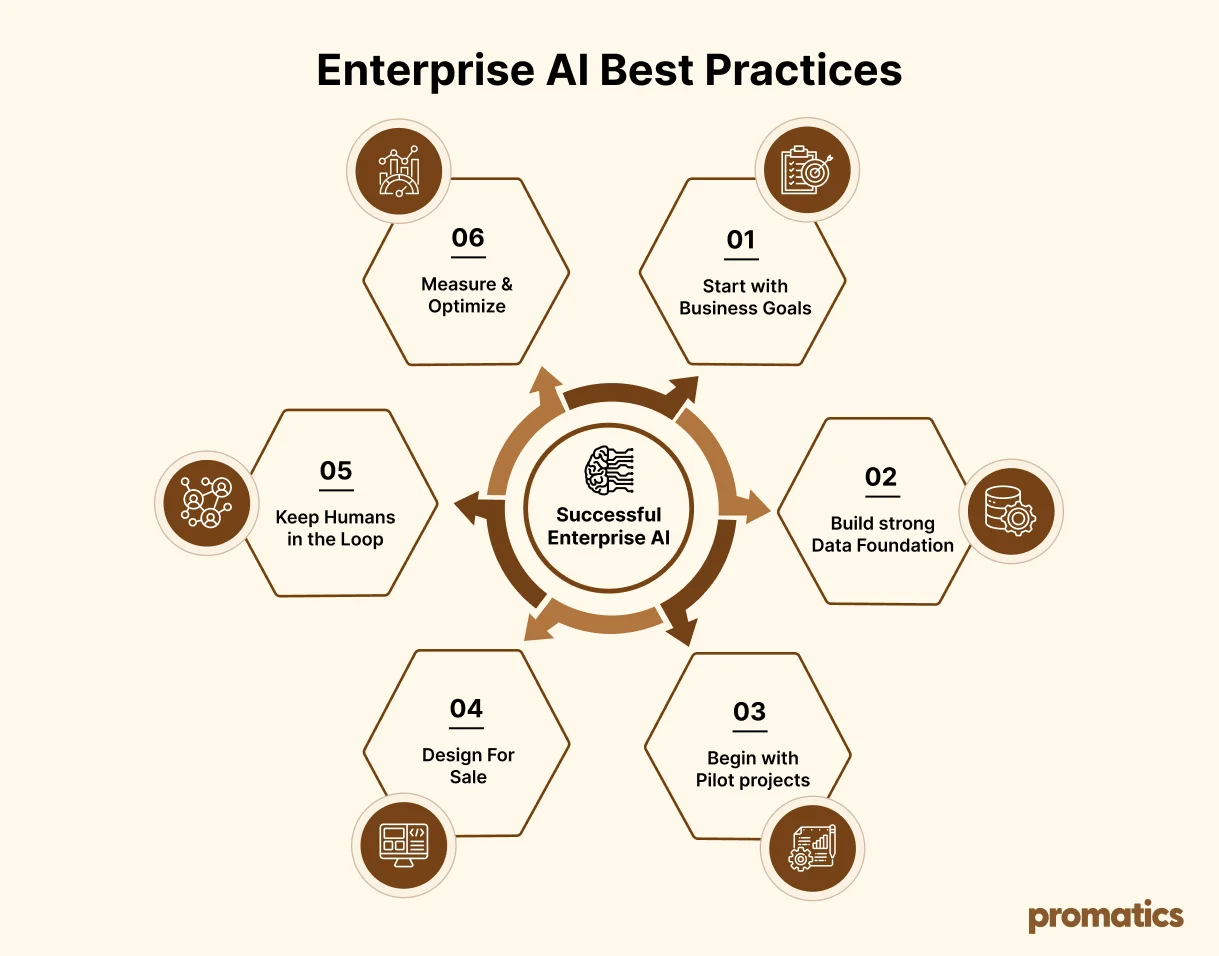
While every organization has unique business requirements, the most successful Enterprise AI implementations share several common characteristics.
Following these best practices helps organizations maximize value while minimizing implementation risks.
- Start with Business Problems, Not Technology
Avoid implementing AI simply because it is a popular technology.
Instead, identify high-impact business challenges where AI can create measurable value, such as reducing manual effort, improving customer support, or optimizing operations.
When AI initiatives are aligned with business goals, they are more likely to gain executive support and deliver long-term results.
- Build a Strong Data Foundation
High-quality AI begins with high-quality data.
Organizations should invest in:
- Data governance
- Data quality improvement
- Knowledge management
- Secure data access
- Consistent data standards
Reliable enterprise data enables AI to generate accurate, trustworthy, and actionable insights.
- Begin with High-Impact Pilot Projects
Rather than attempting an enterprise-wide rollout immediately, start with a focused use case.
Examples include:
- Internal knowledge assistants
- Customer support automation
- Invoice processing
- HR self-service
- AI-powered reporting
Successful pilot projects build organizational confidence and create momentum for larger AI initiatives.
- Design for Scalability
Enterprise AI should be built with future growth in mind.
Organizations should adopt architectures that allow new AI capabilities to be added without redesigning existing systems.
A scalable foundation reduces future implementation costs and supports long-term digital transformation.
- Keep Humans in the Loop
AI performs best when combined with human expertise.
For high-impact decisions involving finance, healthcare, legal services, or compliance, organizations should maintain appropriate human oversight.
This approach improves trust, reduces risks, and ensures accountability.
- Continuously Monitor and Improve
Enterprise AI is never truly “finished.”
Organizations should regularly:
- Update knowledge bases
- Monitor model performance
- Refine prompts
- Improve workflows
- Retrain models where necessary
- Gather employee feedback
Continuous optimization ensures AI evolves alongside changing business requirements.
Future Trends Shaping Enterprise AI
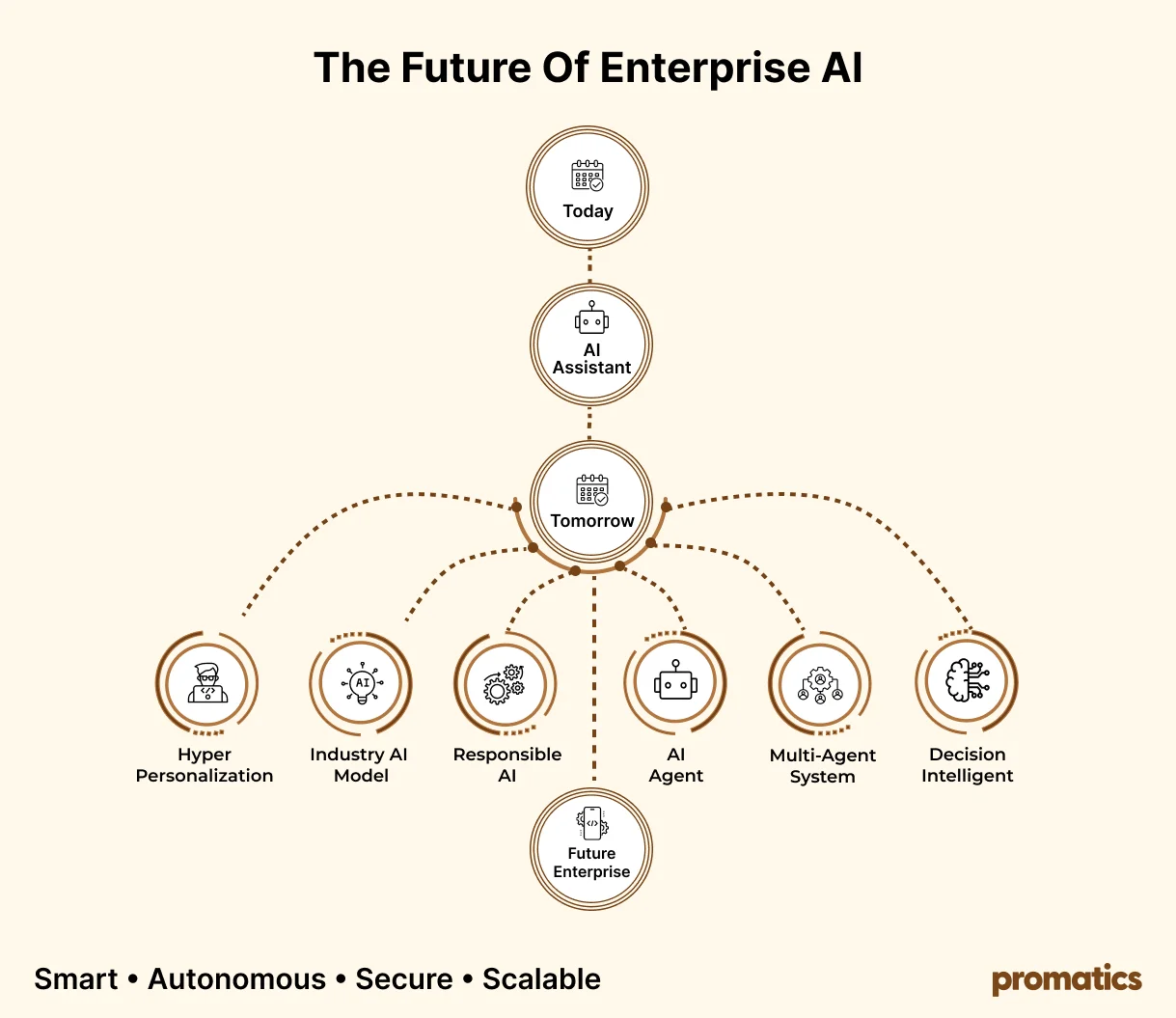
Artificial Intelligence continues to evolve rapidly, and the next generation of Enterprise AI will be more autonomous, collaborative, and deeply integrated into everyday business operations.
Here are some of the key trends organizations should prepare for.
- AI Agents Will Become Digital Coworkers
Today’s AI assistants primarily answer questions and generate content.
Tomorrow’s AI Agents will independently manage workflows, collaborate with employees, coordinate tasks across enterprise systems, and proactively recommend actions.
Instead of simply assisting employees, they will become trusted digital coworkers capable of handling increasingly complex responsibilities.
- Multi-Agent AI Systems
Rather than relying on a single AI model, organizations will deploy multiple specialized AI Agents that collaborate to solve business problems.
For example:
- One AI Agent analyzes customer requests.
- Another retrieves enterprise knowledge.
- A third manages approvals.
- A fourth updates business systems.
Together, these agents create highly efficient and intelligent workflows.
- Hyper-Personalized Enterprise Experiences
Enterprise software will become increasingly personalized.
AI will adapt dashboards, recommendations, workflows, and learning resources based on each employee’s role, responsibilities, preferences, and working style.
Similarly, customers will receive more personalized products, services, and support experiences.
- Decision Intelligence
Business Intelligence dashboards are evolving beyond historical reporting.
Future Enterprise AI platforms will combine predictive analytics, real-time monitoring, and Generative AI to recommend actions—not just present data.
Executives will spend less time analyzing reports and more time acting on AI-driven recommendations.
- Industry-Specific AI Models
Organizations are increasingly adopting AI models tailored to specific industries.
Healthcare providers require models trained on clinical terminology.
Financial institutions require AI optimized for compliance and risk analysis.
Manufacturers benefit from AI models specialized in quality inspection and predictive maintenance.
Industry-specific AI delivers greater accuracy while reducing implementation effort.
- Responsible AI Will Become a Business Requirement
Responsible AI is becoming a competitive advantage rather than simply a compliance obligation.
Customers, employees, and regulators increasingly expect organizations to develop AI systems that are:
- Transparent
- Fair
- Secure
- Explainable
- Privacy-focused
- Accountable
Businesses that invest in responsible AI practices today will be better positioned to build trust and scale AI responsibly in the future.
- Preparing for an AI-First Future
Enterprise AI is moving beyond isolated applications to become a core component of business operations.
In the coming years, organizations will increasingly use AI to automate workflows, support employees, improve customer experiences, and enhance decision-making across every department.
The businesses that succeed will not necessarily be those with the largest AI budgets. Instead, they will be the organizations that build strong data foundations, adopt scalable architectures, invest in employee readiness, and continuously improve their AI capabilities over time.
Rather than replacing human expertise, Enterprise AI will enable employees to focus on strategic thinking, creativity, innovation, and relationship-building while AI manages repetitive, data-intensive work.
Key Takeaways
Enterprise AI implementation involves more than deploying advanced technology. Success depends on overcoming challenges related to data quality, system integration, security, governance, compliance, and organizational adoption. Businesses that address these challenges proactively are far more likely to achieve sustainable, long-term value from their AI investments.
At the same time, emerging technologies such as AI Agents, multi-agent systems, decision intelligence, and industry-specific AI models are reshaping how enterprises operate. Organizations that prepare for these trends today will be better positioned to compete, innovate, and adapt in an increasingly AI-driven economy.
With a clear understanding of the opportunities, challenges, and future direction of Enterprise AI, the final step is bringing everything together.
Why Choose Promatics Technologies for Enterprise AI Development?
Implementing Enterprise AI successfully requires more than technical expertise. It demands a strategic partner who understands business challenges, enterprise architecture, modern AI technologies, and scalable software development.
At Promatics Technologies, we help organizations design, develop, and deploy enterprise-grade AI solutions tailored to their unique business needs. Whether you’re looking to build an AI-powered enterprise application, automate business workflows, implement Generative AI, develop AI Agents, or integrate intelligent capabilities into existing software, our team combines deep technical expertise with a business-first approach.
Our Enterprise AI services include:
- Custom Enterprise AI Development
- Generative AI Solutions
- AI Agent Development
- Enterprise Workflow Automation
- AI-Powered Software Development
- Intelligent Document Processing
- Predictive Analytics Solutions
- AI Integration with ERP, CRM, and Enterprise Platforms
- AI Consulting and Strategy
- MLOps, Security, and AI Governance
From strategy and architecture to deployment and ongoing optimization, we work closely with organizations to build secure, scalable, and future-ready AI solutions that deliver measurable business outcomes.
Final Thoughts
Enterprise AI is redefining how organizations operate in an increasingly digital and data-driven world. It goes beyond traditional automation by enabling intelligent systems that understand context, analyze complex information, generate actionable insights, and support faster, more informed decision-making.
The most successful organizations understand that Enterprise AI is not a standalone product but a long-term strategic capability. They invest in high-quality data, scalable architectures, secure integrations, responsible AI governance, and continuous optimization to maximize business value over time.
As technologies like Generative AI, AI Agents, Retrieval-Augmented Generation (RAG), and predictive analytics continue to evolve, Enterprise AI will become deeply embedded across every business function from customer experience and operations to finance, HR, and software development. Organizations that begin building their AI capabilities today will be better equipped to improve productivity, accelerate innovation, adapt to changing market demands, and gain a lasting competitive advantage.
The future belongs to businesses that combine human expertise with intelligent automation and Enterprise AI provides the foundation for that transformation.
Ready to Build an Enterprise AI Strategy?
Whether you’re exploring your first AI initiative or looking to scale enterprise-wide adoption, success starts with the right strategy, technology, and implementation partner. By identifying high-impact use cases, building a secure AI foundation, and integrating AI into core business processes, organizations can unlock measurable value and long-term growth.
Ready to accelerate your AI transformation? Connect with our Enterprise AI experts to discover how custom AI solutions can streamline operations, automate complex workflows, and create a smarter, more competitive business for the future.
