AI/ML Development Services Businesses Need to Stay Competitive in 2026

TL;DR
- Machine learning helps businesses automate processes, improve decision-making, and increase operational efficiency.
- Common machine learning use cases include predictive analytics, fraud detection, customer personalization, forecasting, and intelligent automation.
- Successful machine learning adoption requires clear business goals, quality data, workflow integration, and continuous monitoring.
- Businesses should start with one high-impact machine learning use case, measure ROI, and scale gradually.
- Companies using machine learning strategically are improving customer experiences, reducing costs, and creating long-term competitive advantages.
Machine learning is no longer a futuristic technology reserved for large tech companies. It has become one of the biggest drivers of business growth. In 2026, businesses are using machine learning to predict customer behavior, optimize operations, personalize experiences, reduce risks, and unlock new revenue opportunities.
Adoption is accelerating rapidly. Around 65% of organizations now use generative AI in at least one business function, nearly doubling adoption levels seen just months earlier. At the same time, AI investments continue to grow as the market moves toward hundreds of billions of dollars in value, shifting from experimentation to large-scale implementation.
From startups building lean teams to enterprises transforming decision-making with predictive intelligence, machine learning is becoming a business necessity. Companies adopting AI are not just improving efficiency. Nearly two thirds already report measurable productivity gains while building smarter, faster, and more adaptive business models.In this blog, we’ll explore the importance of machine learning in businesses, the real-world applications driving growth, and why data-driven intelligence is shaping the future of business.
What is Machine Learning?
Machine learning is a branch of artificial intelligence that allows computers to learn from data and improve over time without being programmed for every specific task. Instead of relying only on fixed instructions, machine learning systems analyze information, identify patterns, and use those patterns to make predictions or decisions.
Simply put, machine learning teaches computers to learn from experience, similar to how humans recognize patterns and improve through observation.
Data is at the center of machine learning. Businesses feed large amounts of historical and real-time data into models that identify trends, correlations, and insights that may be difficult for humans to detect.
For example, an e-commerce platform can analyze browsing behavior and purchase history to recommend products customers are likely to buy. Similarly, financial institutions use machine learning to detect unusual transactions and identify fraud faster.
Once trained, machine learning models apply what they learn to new data, helping businesses automate processes, improve decision-making, increase efficiency, and generate more accurate predictions.
Today, machine learning powers recommendation systems, fraud detection, personalized marketing, predictive analytics, voice assistants, and intelligent automation. Because it can process massive amounts of data at scale, machine learning has become a key driver of business growth, innovation, and digital transformation.
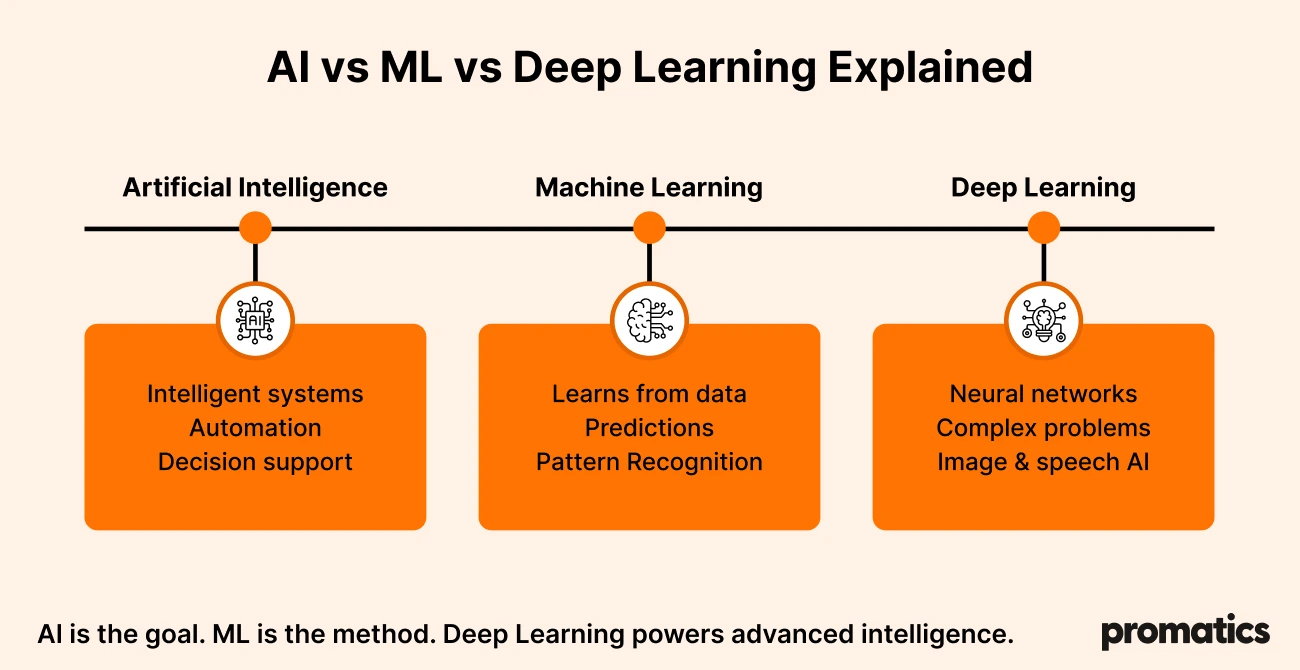
Machine Learning Vs Ai Vs Deep Learning
| Technology | Definition | Primary Purpose | Common Business Use Cases |
| Artificial Intelligence (AI) | Broad concept of machines performing intelligent tasks | Simulate human intelligence | Automation, decision support, virtual assistants |
| Machine Learning (ML) | Subset of AI that learns from data | Identify patterns and make predictions | Forecasting, fraud detection, recommendations |
| Deep Learning | Advanced ML using neural networks | Solve complex data problems | Image recognition, chatbots, voice assistants |
Understanding the Relationship Between AI, ML, and Deep Learning
The easiest way to understand these technologies is to think of them as layers:
Artificial Intelligence is the broader goal of building intelligent systems.
Machine Learning is one of the primary approaches used to achieve AI by enabling machines to learn from data.
Deep Learning is a specialized form of machine learning designed to solve more advanced and data-intensive problems using neural networks.
In simple terms:
- AI is the destination.
- Machine Learning is the method.
Deep Learning is the advanced engine powering more complex intelligence.
Together, these technologies are transforming industries by enabling smarter automation, improving customer experiences, reducing operational costs, and creating entirely new business opportunities.
Growing Demand for AI/ML Development for Businesses
Modern businesses generate enormous volumes of data every second. Every website click, customer interaction, financial transaction, support ticket, sensor reading, and operational process creates valuable information. The challenge today is no longer collecting data, it is transforming that data into faster, smarter, and more profitable business decisions.
Traditional reporting tools can explain what happened in the past, but they often struggle to identify hidden opportunities, predict future outcomes, or detect risks before they become costly problems. However, machine learning development services change this approach by enabling businesses to move beyond reactive decision-making and adopt predictive, data-driven strategies.
The importance of machine learning is becoming increasingly clear as enterprise adoption accelerates globally. In 2026, nearly 78% of companies worldwide are actively using AI in at least one business function, while more than 90% exploring AI technologies, showing how quickly intelligent systems are becoming part of core business operations. Meanwhile, worker access to AI tools increased significantly during 2025 as organizations shifted from experimentation toward large-scale deployment.
Machine learning matters because it enables organizations to process and analyze massive datasets far beyond human capabilities. Instead of relying only on predefined rules, machine learning systems continuously learn from historical and real-time data, identify patterns, generate predictions, and improve performance over time.
The market growth surrounding machine learning further highlights its importance. Industry forecasts suggest that the global machine learning market could grow from approximately $65 billion in 2026 to hundreds of billions of dollars within the next decade, driven by increasing demand for automation, predictive analytics, personalization, and intelligent decision-making systems.
The strongest business impact of machine learning typically comes from five key capabilities:
- Process Massive Volumes of Data Efficiently
Modern organizations produce more information than human teams can realistically analyze. Machine learning systems can process millions of records, transactions, and interactions simultaneously, helping businesses extract valuable insights faster and more accurately.
- Discover Hidden Patterns and Relationships
Many business opportunities and risks remain invisible when organizations rely only on traditional analytics. Machine learning algorithms identify complex patterns, anomalies, and correlations that manual analysis may overlook, allowing companies to make more informed decisions.
- Predict Outcomes Before They Happen
One of machine learning’s most valuable capabilities is prediction. Businesses use machine learning to forecast customer behavior, estimate demand fluctuations, predict equipment failures, identify fraud risks, and anticipate market changes before they become serious problems.
- Automate Repetitive Processes and Decisions
Machine learning allows organizations to automate repetitive workflows while maintaining human oversight where necessary. From recommendation engines and supply chain optimization to fraud detection and customer support systems, automation increases efficiency while reducing operational costs.
- Continuously Improve Through Learning
Unlike traditional systems that remain static after deployment, machine learning models continuously improve as they receive new and relevant data. This enables businesses to adapt faster to changing customer preferences, market conditions, and operational challenges.
Perhaps the greatest advantage machine learning provides is speed. Once properly trained, machine learning models can analyze enormous datasets, identify opportunities, and generate predictions within seconds of tasks that could take human teams days or even weeks to complete manually.
This capability fundamentally changes how businesses allocate resources, optimize operations, improve customer experiences, and create competitive advantages. As data volumes continue growing and AI adoption accelerates, machine learning is rapidly evolving from an emerging technology into a fundamental driver of business growth and long-term competitiveness. Recent enterprise deployments further show this transition, with organizations increasingly moving AI from isolated experiments into large-scale operational workflows.
Top Machine Learning Benefits for Businesses
| Business Benefit | What It Does | Example Use Cases |
| Better Forecasting | Predict future outcomes | Demand planning, revenue forecasting |
| Automation | Reduces manual work | Ticket routing, fraud detection |
| Personalization | Creates relevant experiences | Recommendations, segmentation |
| Cost Reduction | Improves efficiency | Inventory optimization, maintenance |
| Scalability | Handles growth efficiently | Large transaction processing |
| Risk Detection | Identifies anomalies faster | Fraud prevention, compliance |
| Data Utilization | Extracts insights from data | Customer analysis, logs |
Where Businesses Usually See Machine Learning Value First
Not every business process is an ideal starting point for machine learning implementation. The strongest use cases typically share several characteristics:
- The process occurs frequently
- Sufficient historical data exists
- Outcomes have measurable business impact
- Existing decisions can be improved
- Results can be measured clearly
Because of this, organizations often achieve their earliest wins in forecasting, personalization, fraud detection, customer retention, and operational optimization.
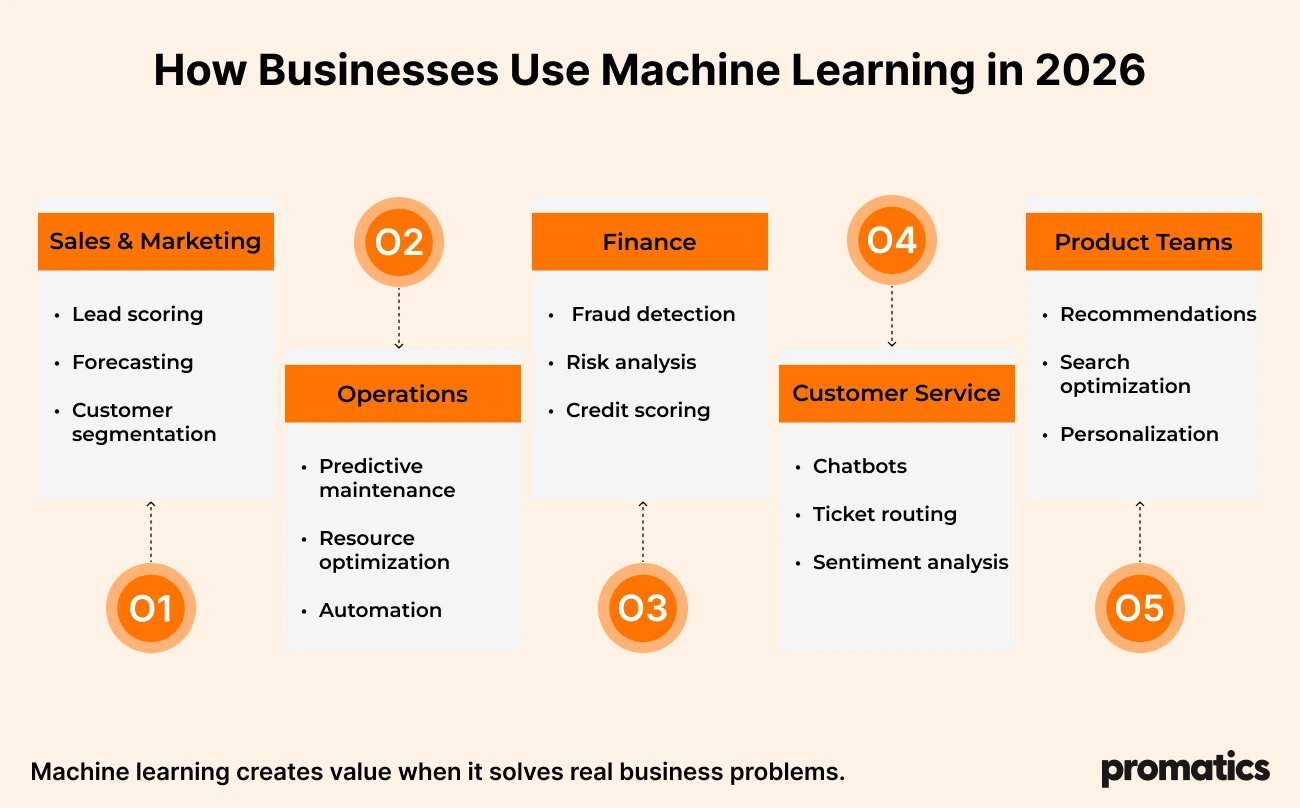
Common Business Applications by Function
- Sales and Marketing
• Lead scoring and qualification
• Demand forecasting
• Campaign optimization
• Customer segmentation
• Churn prediction
- Operations
• Capacity planning
• Predictive maintenance
• Queue prioritization
• Document automation
• Resource optimization
- Finance
• Fraud detection
• Credit scoring
• Risk assessment
• Collections prioritization
• Anomaly detection
- Customer Service
• Ticket routing
• Intent detection
• Chatbots and self-service support
• Sentiment analysis
• Customer escalation management
- Product and Digital Channels
• Recommendation engines
• Search optimization
• Personalization systems
• Usage prediction
• Feature adoption analysis
Machine learning creates the most value when businesses focus less on the technology itself and more on solving measurable operational problems. Organizations that identify high-impact use cases early often see faster adoption, stronger ROI, and more sustainable growth.
What Companies Need Before Adopting Machine Learning
Machine learning adoption is not only a technology challenge. Successful adoption depends on data, business strategy, processes, and people working together. Without the right foundation, many projects never move beyond experimentation.
- Clear Business Objectives
Many machine learning projects fail because companies focus on technology before business problems. Successful initiatives start with clear goals such as:
• Reducing customer churn
• Improving forecasting accuracy
• Detecting fraud faster
• Lowering operational costs
• Increasing customer retention and conversions
The first question should not be “What model should we build?” but rather “What problem are we solving?’’
- High-Quality Data
Machine learning is only as effective as the data behind it. Large volumes of poor-quality data rarely produce good results.
Organizations need data that is:
• Accurate and reliable
• Consistently formatted
• Updated regularly
• Relevant to business goals
• Easily accessible
Strong data quality often matters more than complex algorithms.
- Workflow Integration
Building models is only half the process. Machine learning creates value when predictions influence real business decisions.
Companies should define:
• Who uses model outputs
• How predictions affect decisions
• When human oversight is required
• How teams act on recommendations
Predictions only create value when they lead to action.
- Continuous Monitoring
Machine learning models are not set-and-forget systems. Customer behavior, markets, and business processes constantly change.
Organizations should continuously:
• Monitor model performance
• Detect prediction drift
• Retrain models regularly
• Maintain data quality
• Reduce unexpected outcomes
Continuous optimization keeps models accurate over time.
- Governance and Infrastructure
As machine learning becomes part of core operations, governance becomes essential. Businesses need clear ownership, security controls, compliance processes, and reliable infrastructure.
Organizations should consider:
• Where data is stored
• How teams access information
• Whether systems support retraining
• How models will scale and be monitored
- Success Starts With Foundations
Many companies believe machine learning success depends on algorithms. In reality, strong data, workflow integration, governance, and operational readiness matter far more.
Businesses that build strong foundations first are far more likely to move beyond experiments and create measurable business value at scale.
Challenges That Can Change the Business Case for Machine Learning
Machine learning can create significant business value, but successful adoption requires understanding its limitations as clearly as its benefits. Many organizations focus heavily on potential gains while underestimating the operational, technical, and organizational challenges involved.
Machine learning projects rarely fail because algorithms are weak. They often fail because businesses underestimate complexity. Understanding these challenges early helps organizations build more realistic expectations, allocate resources effectively, and create stronger implementation strategies.
- Data Quality Can Limit Performance
Machine learning systems are only as good as the data used to train them.
Because models learn patterns from historical information, poor-quality data directly affects prediction accuracy and business outcomes. If datasets contain missing values, inconsistent records, outdated information, or biased inputs, machine learning systems will often replicate and amplify those problems.
Common data challenges include:
• Incomplete or missing records
• Outdated information and stale datasets
• Inconsistent formatting across systems
• Duplicate or conflicting data sources
• Bias within historical business processes
A common misconception is that better algorithms automatically solve poor data quality problems. In reality, stronger algorithms applied to weak data often produce unreliable results faster, not better results.
For many organizations, improving data quality creates more value than adopting more advanced models.
- Explainability Is Often a Business Requirement
In many industries, generating accurate predictions is not enough. Organizations also need to understand why a model produced a particular recommendation or decision.
This becomes particularly important in industries such as:
• Financial services and lending
• Healthcare and medical systems
• Insurance and claims processing
• Compliance and regulatory environments
• Human resource decision-making
If teams cannot explain how predictions are generated, trust decreases and adoption slows.
For example, a machine learning system that rejects a loan application or flags suspicious activity without clear reasoning may create operational risks, regulatory challenges, or customer trust issues.
As machine learning adoption grows, explainability is increasingly becoming a business requirement rather than a technical preference.
AI Integration , Governance, and ROI Challenges in Machine Learning
- Integration Is Often Harder Than Building Models
Many machine learning projects work well during testing but fail to create business value after deployment. The reason is simple: models only create value when predictions become part of real workflows.
Organizations often face integration challenges with:
• Legacy systems and databases
• Existing workflows and approval processes
• CRM and ERP platforms
• Reporting systems and dashboards
• Operational processes and monitoring
This is why deployment, automation, monitoring, and production management have become just as important as building the model itself.
- Human Oversight Still Matters
Machine learning reduces manual work, but it does not remove the need for human expertise.
Organizations still need teams that understand:
• Data quality and model performance
• Risk management and governance
• Business context and operational constraints
• Model limitations and failure scenarios
One common mistake is assuming machine learning predictions are always correct. In reality, models can drift, produce inaccurate outputs, or perform poorly when conditions change. Human oversight remains essential.
- Measuring ROI Is More Difficult Than Expected
Many organizations struggle to prove machine learning ROI because they deploy solutions without defining success metrics first.
Businesses should clearly define:
• Success metrics and KPIs
• Financial impact targets
• Expected operational improvements
• Baseline performance measurements
• Long-term monitoring processes
High prediction accuracy alone does not guarantee business success. What matters is measurable impact such as higher revenue, lower costs, improved efficiency, or better customer outcomes.
- Successful Adoption Requires More Than Technology
Machine learning success rarely depends on technology alone. Organizations that succeed usually combine:
Strong data + clear objectives + operational readiness + human oversight + continuous improvement
Companies that recognize these challenges early are more likely to move beyond experimentation and build machine learning systems that create long-term business value.
Machine Learning in Customer and Language Workflows
One of the most practical applications of machine learning is improving customer interactions and language-driven workflows. Businesses generate massive volumes of emails, support tickets, chats, calls, and documents every day. Managing this information manually is slow, expensive, and difficult to scale.
Machine learning helps businesses process language data faster, automate repetitive tasks, and improve customer experiences.
- Understanding Customer Intent
Machine learning can analyze customer messages, emails, and chats to understand intent automatically. This helps businesses identify:
• What customers need
• Which team should respond
• Request urgency levels
• Whether inquiries are technical, operational, or sales-related
Automated intent detection reduces manual effort and speeds up responses.
- Smarter Routing and Faster Support
Support delays often happen because requests reach the wrong teams. Machine learning improves routing by analyzing:
• Customer history
• Topic classification
• Urgency levels
• Product categories
• Language preferences
This reduces unnecessary handoffs and improves customer satisfaction.
- Detecting Dissatisfaction and Escalation Risks
Machine learning can identify hidden signals within conversations to detect:
• Customer frustration or dissatisfaction
• Potential churn risks
• Escalation requirements
• High-priority service requests
This allows businesses to act proactively before problems become larger.
- Automating Summaries and Reducing Workload
Support teams often spend valuable time reviewing conversations and creating documentation. Machine learning can:
• Generate conversation summaries
• Extract actions and next steps
• Highlight customer concerns
• Reduce manual documentation work
This improves productivity and allows teams to focus more on customers.
- Finding Patterns Across Customer Data
Machine learning transforms customer conversations into business insights by identifying:
• Frequently reported issues
• Recurring complaints
• Service bottlenecks
• Product defects
• Emerging operational problems
These insights help businesses improve products, services, and operations.
- Supporting Multilingual Operations
As businesses expand globally, language complexity increases. Machine learning helps organizations:
• Translate conversations automatically
• Support multilingual customer service
• Improve localization efforts
• Scale operations without proportional hiring increases
The goal of machine learning is not simply to automate conversations. It is to improve customer experiences, reduce operational friction, and create faster, smarter service workflows.
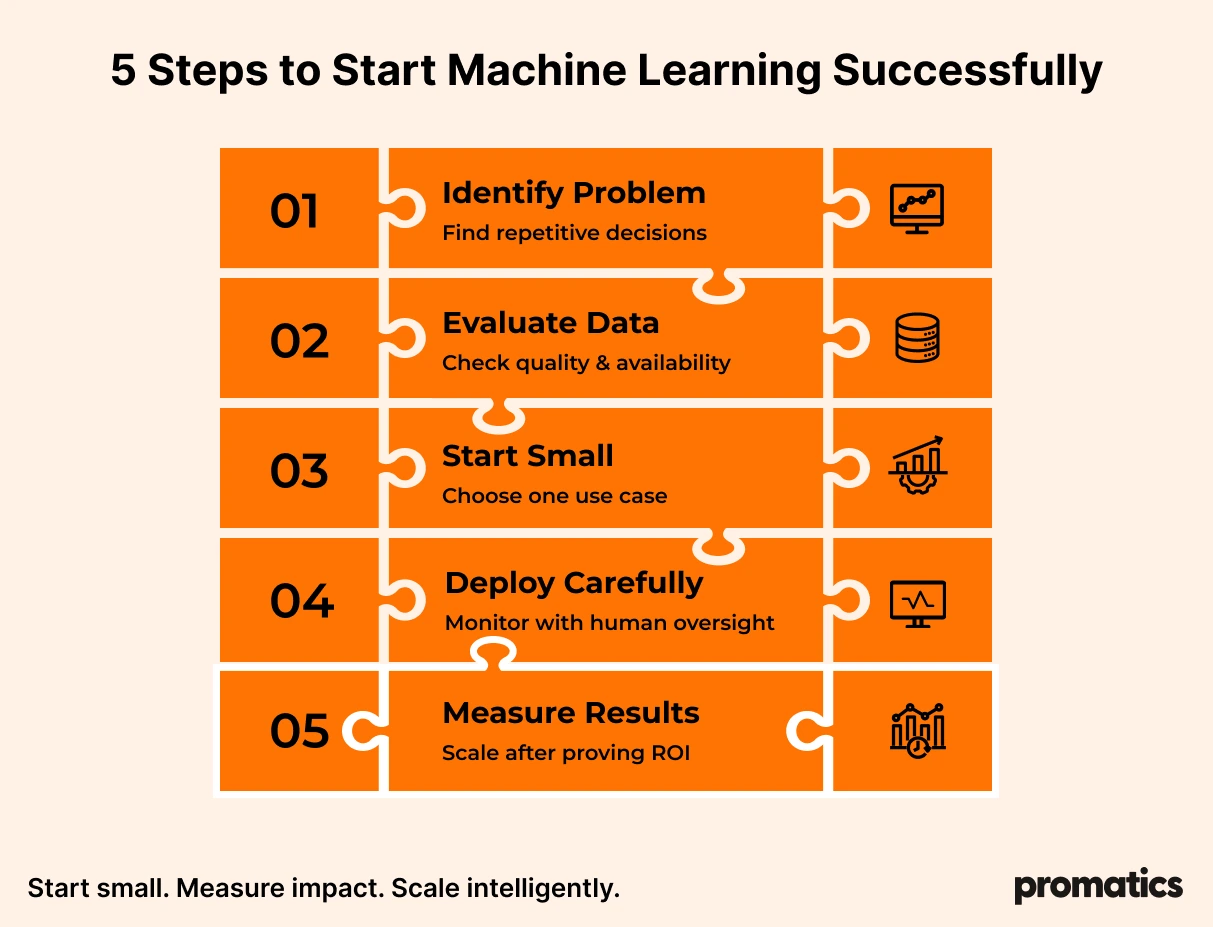
How to Choose the Right Machine Learning Use Case for Your Business
Many organizations fail because they try to launch multiple machine learning initiatives at once. Successful adoption usually starts with solving one clear business problem first.
1. Identify High-Volume Decisions
Start with repetitive decisions that happen frequently within existing workflows. Examples include:
• Customer ticket routing
• Fraud detection
• Inventory forecasting
• Customer retention decisions
• Support prioritization
The more frequently a decision occurs, the greater the opportunity for measurable impact.
2. Evaluate Business Value and Data Availability
Not every problem is suitable for machine learning. Focus on opportunities with:
• High business impact
• Available historical data
• Clear operational pain points
• Easy-to-measure outcomes
• Reasonable implementation complexity
High-value problems with strong data availability usually deliver faster results.
3. Choose One Use Case With Clear Ownership
Many projects fail because no team owns the outcome. Successful initiatives require:
• Defined stakeholders
• Clear success metrics
• Operational accountability
• Measurable business outcomes
Clear ownership improves accountability and speeds adoption.
4. Deploy Into Real Workflows
Models create value only when people actually use them. Early deployments should focus on:
• Human oversight
• Workflow integration
• Feedback collection
• Performance monitoring
This reduces risk while building trust across teams.
5. Measure Results Before Scaling
Before expanding, measure whether the solution creates real value using metrics such as:
• Cost reduction
• Faster response times
• Higher accuracy
• Revenue growth
• Lower operational risk
• Better customer satisfactionStarting with one high-impact use case is often far more effective than launching large machine learning programs without clear goals.
Building Long-Term Value With Machine Learning
Machine learning creates the most value when it becomes part of everyday business operations rather than remaining isolated experiments. Long-term success depends less on constantly replacing models and more on improving the systems around them.
Organizations typically create sustainable value through:
• Better workflow integration
• Continuous monitoring and retraining
• Strong governance practices
• Reliable operational processes
• High-quality data management
This is why governance should be part of machine learning planning from the beginning, not after deployment.
Businesses increasingly need:
• Clear ownership and accountability
• Testing and validation processes
• Traceability and auditability
• Performance monitoring
• Defined limits for automation
Ultimately, machine learning success is not only about building accurate models. It is about creating systems that businesses can trust, manage, scale, and continuously improve over time.
Top 5 Tips for Choosing the Right AI Development Partner in 2026
As AI adoption accelerates, choosing the right AI development partner has become just as important as choosing the technology itself. The right partner can help businesses move faster, reduce implementation risks, and create solutions that deliver measurable business value.
Here are five factors businesses should evaluate before selecting an AI development company:
1. Look Beyond Technical Skills
Strong AI development is not only about building models. Your partner should understand business workflows, operational challenges, scalability requirements, and long-term implementation strategies.
Ask questions such as:
• Do they understand your industry?
• Can they connect AI solutions to business outcomes?
• Do they focus on measurable ROI?
2. Evaluate Real Experience
Many companies talk about AI capabilities, but proven execution matters more.
Look for partners with experience in:
• Machine learning development
• Predictive analytics solutions
• AI workflow automation
• Enterprise AI integrations
• Industry-specific implementations
Real-world experience often reduces deployment risks and accelerates implementation.
3. Prioritize Scalability and Integration
Building AI models is only part of the process. Successful AI projects require integration with existing systems, workflows, databases, and business processes.
A strong AI partner should help answer:
• How will AI fit existing workflows?
• Can solutions scale as business needs grow?
• How will models be monitored and maintained?
4. Focus on Transparency, Governance, and Support
AI systems require continuous monitoring, retraining, and optimization. Businesses should work with partners that provide transparency around development processes, security, governance, and long-term support.
Look for:
• Clear communication and ownership
• Security and compliance processes
• Monitoring and maintenance strategies
• Defined success metrics
5. Choose a Partner That Thinks Long Term
AI adoption is rarely a one-time project. The strongest partnerships focus on long-term business value rather than short-term deployments.
Companies such as Promatics Technologies focus on building scalable AI solutions that align with business objectives rather than simply delivering standalone models.
Ultimately, the right AI development partner should help businesses reduce complexity, accelerate adoption, and create measurable outcomes rather than simply deliver technology.
Conclusion
Machine learning is no longer an emerging technology. It is becoming a core business capability that helps organizations make smarter decisions, improve efficiency, and scale faster.
Its value extends beyond automation. Businesses are using machine learning to improve forecasting, reduce costs, personalize customer experiences, detect risks earlier, optimize workflows, and uncover insights hidden within large volumes of data.
But successful adoption is not about implementing AI for the sake of innovation. The biggest impact comes when machine learning aligns with clear business goals and real operational challenges.
The question businesses should ask is not whether machine learning works, but where it can create the greatest impact.
Organizations that identify high-value use cases early are gaining competitive advantages through faster decisions, better customer experiences, and more efficient operations.
If your business is exploring machine learning to improve performance, automate workflows, or build intelligent products, implementation strategy matters as much as the technology itself.
At Promatics Technologies, we help businesses turn machine learning concepts into scalable solutions, from predictive analytics and intelligent automation to enterprise AI systems.
Ready to unlock measurable business value with machine learning? Connect with our team and discover how tailored AI solutions can accelerate growth, improve efficiency, and future-proof your business.
