Enterprise SaaS Transformation: Modern SaaS Architecture for Growing Businesses

TL;DR
- Enterprise SaaS transformation helps businesses modernize legacy applications for better scalability, performance, and customer experience.
- Modern SaaS architecture combines cloud-native infrastructure, multi-tenant architecture, APIs, microservices, and automation to support long-term growth.
- Businesses adopting modern SaaS platforms can accelerate releases, improve system reliability, reduce operational costs, and simplify integrations.
- A successful SaaS transformation requires the right architecture, migration strategy, security, and development expertise.
- Partnering with an experienced SaaS development company helps organizations modernize faster while minimizing business disruption.
Software has become the backbone of modern businesses, but the way enterprises build and deliver software is changing rapidly. Customers expect seamless digital experiences, faster feature releases, stronger security, and always-on availability. Legacy applications built on monolithic architectures often struggle to meet these expectations, making it difficult for businesses to innovate and scale.
This shift is driving the demand for enterprise SaaS transformation. Instead of simply moving applications to the cloud, organizations are redesigning their platforms with modern SaaS architecture that supports scalability, resilience, automation, and continuous innovation.
According to Gartner, worldwide public cloud end-user spending continues to grow as enterprises prioritize cloud-first strategies for business agility and digital transformation. At the same time, organizations are investing in application modernization to reduce technical debt, improve operational efficiency, and accelerate product delivery.
Growing businesses, in particular, need software that can evolve alongside customer demands. Whether it’s supporting thousands of concurrent users, integrating with third-party platforms, or introducing AI-powered capabilities, modern SaaS architecture provides the flexibility required for long-term success.
In this blog, we’ll explore what enterprise SaaS transformation means, why businesses are modernizing their software, and the architectural principles that enable scalable, future-ready SaaS platforms.
What Is Enterprise SaaS Transformation?
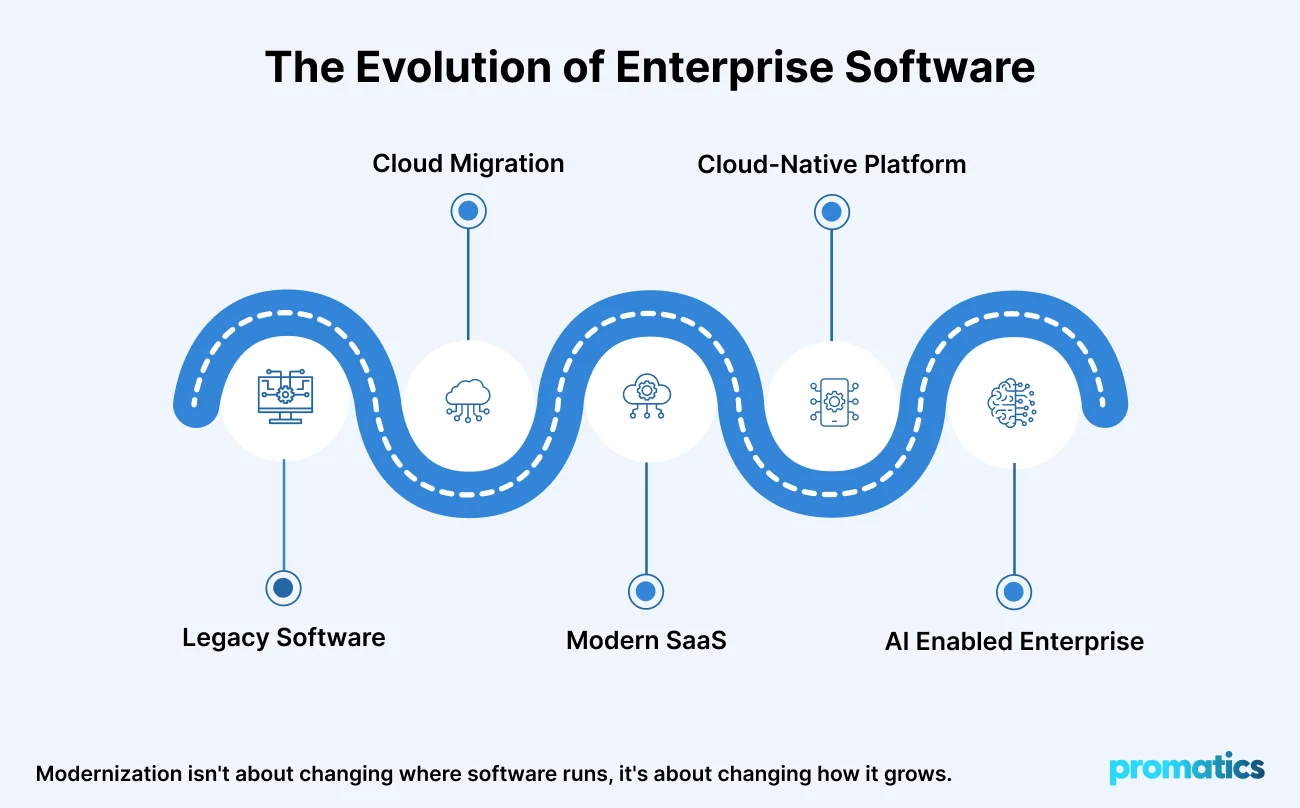
Enterprise SaaS transformation is the process of modernizing software applications, infrastructure, and business processes to deliver scalable, cloud-based Software-as-a-Service solutions.
Unlike a simple cloud migration, SaaS transformation involves redesigning applications to improve performance, flexibility, security, and maintainability. It enables businesses to transition from rigid legacy systems to platforms that can continuously evolve with changing market needs.
A successful transformation often includes:
- Modern SaaS architecture
- Cloud deployment
- Multi-tenant architecture
- API-first integration
- Microservices adoption
- DevOps and CI/CD automation
- Enterprise-grade security
- Performance monitoring
The goal isn’t just to move software to the cloud—it’s to create an application that can support business growth for years to come.
Why Growing Businesses Need Modern SaaS Architecture
Many organizations launch successful products using traditional application architectures. However, as customer adoption grows, these systems often become difficult to maintain, expensive to scale, and slow to evolve.
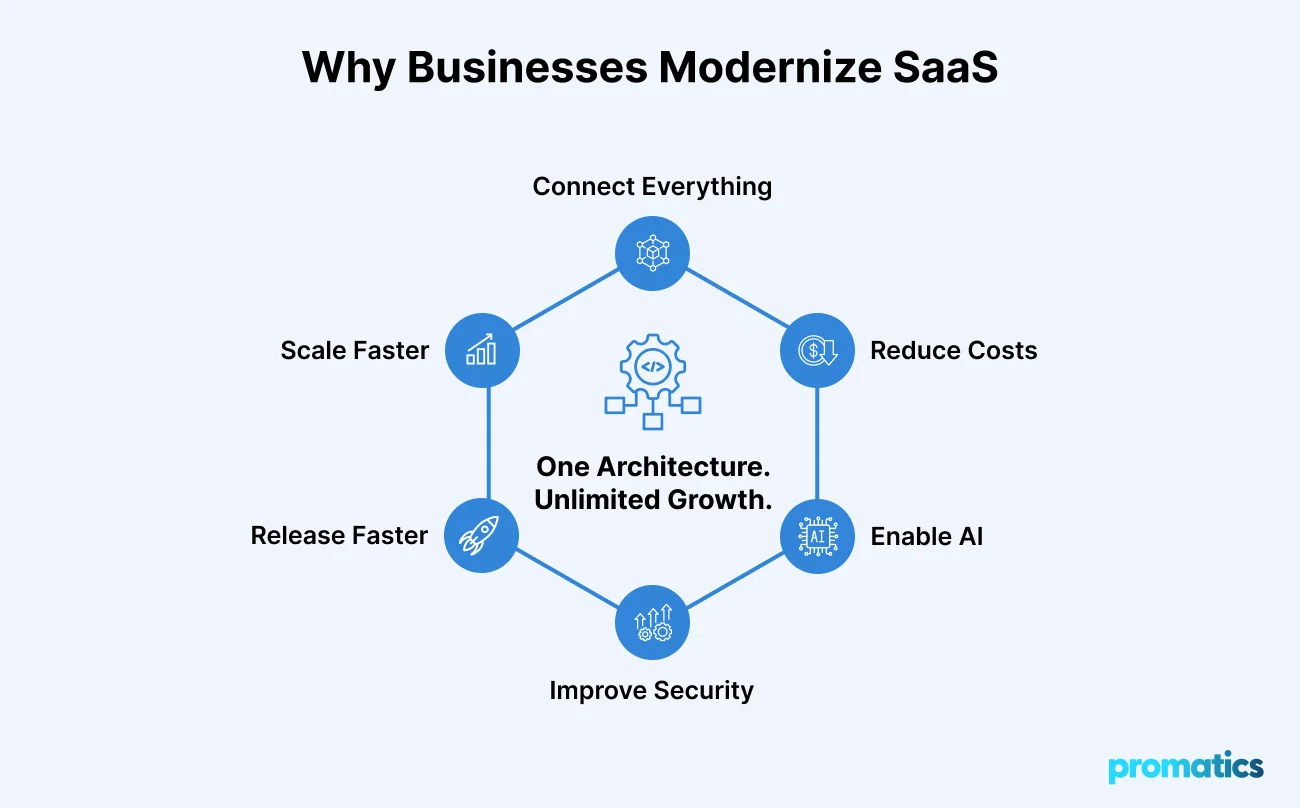
Modern SaaS architecture addresses these challenges by enabling businesses to build applications that are flexible, resilient, and ready for continuous innovation.
1. Scalability Without Performance Bottlenecks
Business growth brings more users, transactions, and data. Applications designed for small workloads often struggle to maintain performance as demand increases.
Modern SaaS scalability allows organizations to:
- Handle traffic spikes automatically
- Scale services independently
- Improve application responsiveness
- Reduce infrastructure waste
- Maintain high availability
Instead of upgrading an entire application, businesses can scale only the components experiencing increased demand.
2. Faster Product Innovation
Customer expectations evolve quickly. Businesses that release new features faster gain a competitive advantage.
Modern SaaS architecture enables development teams to:
- Deploy updates continuously
- Release features independently
- Reduce deployment risks
- Shorten development cycles
- Respond quickly to market feedback
This agility allows organizations to innovate without disrupting existing users.
3. Better Integration Across Business Systems
Today’s enterprises rely on dozens of applications, including CRM platforms, ERP systems, payment gateways, analytics tools, and AI services.
An API-first architecture makes it easier to connect these systems, enabling smooth data exchange and automated workflows across the organization.
Instead of isolated software, businesses create connected digital ecosystems that improve efficiency and decision-making.
4. Lower Long-Term Operating Costs
Modernization isn’t only about adding new technology it’s also about reducing operational complexity.
Cloud-native SaaS platforms help businesses optimize costs by:
- Scaling infrastructure on demand
- Automating deployments
- Reducing maintenance effort
- Minimizing downtime
- Improving resource utilization
Over time, these efficiencies contribute to a lower total cost of ownership.
5. Enhanced Security and Compliance
Security has become a critical business requirement, particularly for industries such as healthcare, finance, and enterprise software.
Modern SaaS platforms incorporate security throughout the development lifecycle, including:
- Identity and access management
- Data encryption
- Role-based permissions
- Continuous monitoring
- Compliance-ready architectures
Building security into the platform from the beginning reduces risks while simplifying regulatory compliance.
Pillars of Modern SaaS Architecture
Successful enterprise SaaS transformation is built on architectural decisions that support long-term scalability rather than short-term fixes. The following principles form the foundation of modern SaaS platforms.
Cloud-Native Infrastructure
Cloud-native applications are designed specifically for cloud environments rather than being adapted from on-premise systems.
They provide:
- Elastic scaling
- High availability
- Automated recovery
- Faster deployments
- Better resilience
This approach enables businesses to respond quickly to changing workloads while improving operational efficiency.
Multi-Tenant Architecture
A multi-tenant architecture allows multiple customers to share the same application while keeping their data securely isolated.
Benefits include:
- Lower infrastructure costs
- Simplified maintenance
- Centralized updates
- Easier scaling
- Consistent user experience
For growing SaaS businesses, multi-tenancy offers a balance between operational efficiency and customer flexibility.
API-First Development
APIs have become the foundation of modern SaaS platforms.
An API-first approach enables applications to integrate seamlessly with:
- CRM systems
- ERP platforms
- Payment gateways
- AI services
- Third-party applications
- Mobile apps
This flexibility allows businesses to expand their digital ecosystems without rebuilding core systems.
Microservices Architecture
Instead of building one large application, microservices divide software into smaller, independent services.
Each service can be developed, deployed, and scaled separately.
Advantages include:
- Faster releases
- Independent scaling
- Easier maintenance
- Better fault isolation
- Improved developer productivity
Although not every SaaS product requires microservices initially, they become increasingly valuable as applications grow in complexity.
Containerization and Orchestration
Containers package applications with all required dependencies, ensuring consistent performance across different environments.
Combined with orchestration platforms like Kubernetes, containers enable:
- Automated deployments
- High availability
- Efficient resource utilization
- Simplified scaling
- Faster disaster recovery
DevOps and Continuous Delivery
Modern SaaS relies on continuous improvement rather than occasional software releases.
DevOps practices automate testing, deployment, and monitoring, allowing teams to deliver updates more frequently while maintaining software quality.
Benefits include:
- Faster deployment cycles
- Reduced human error
- Higher release confidence
- Improved collaboration
- Continuous optimization
Observability and Monitoring
Building scalable software isn’t enough businesses also need visibility into system performance.
Modern observability includes:
- Application monitoring
- Performance metrics
- Error tracking
- Infrastructure health
- User experience analytics
Real-time insights help teams identify issues before they affect customers.
Security by Design
Security should be integrated into every layer of the architecture rather than added after development.
Key practices include:
- Zero-trust principles
- Encryption at rest and in transit
- Secure APIs
- Identity management
- Compliance monitoring
- Continuous vulnerability assessments
A proactive security strategy helps businesses protect customer data while maintaining trust.
Enterprise SaaS Modernization Roadmap
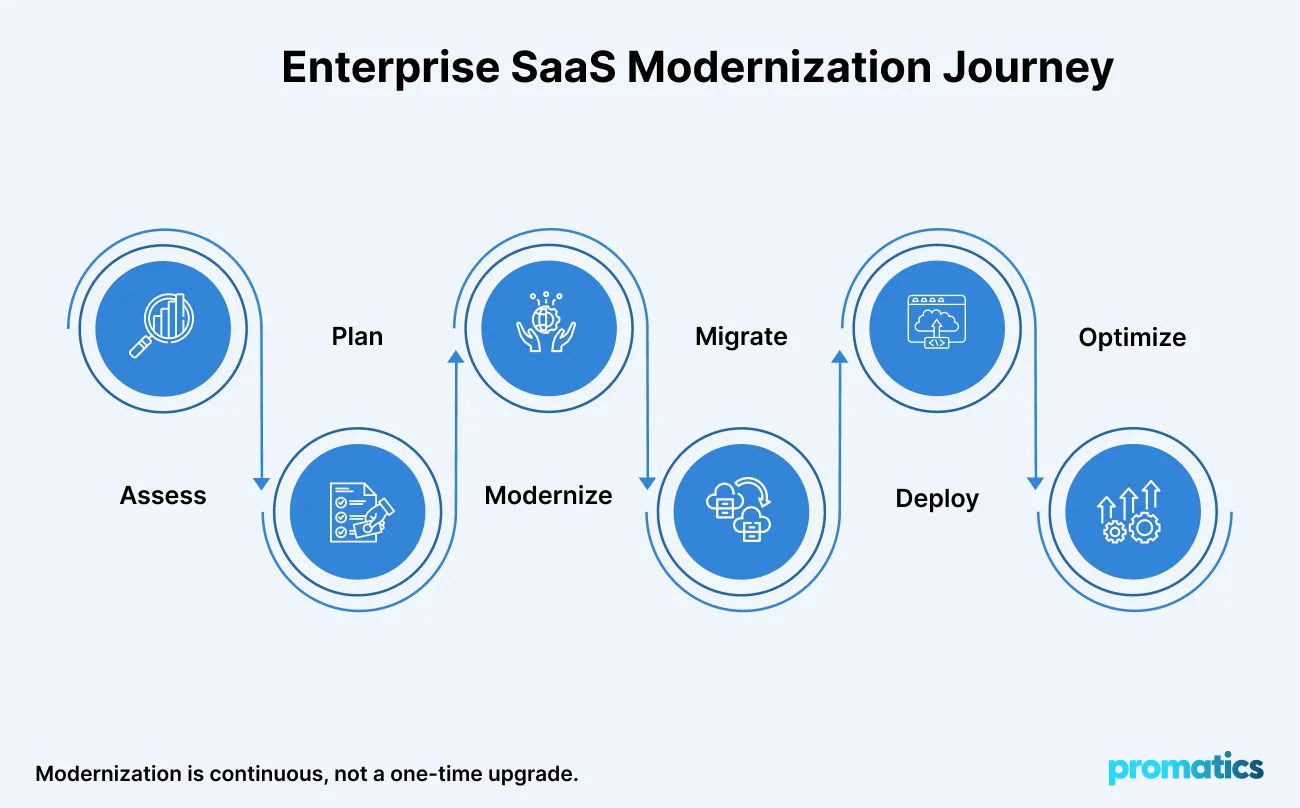
A successful enterprise SaaS transformation is more than migrating applications to the cloud. It requires a structured approach that minimizes disruption while improving scalability, security, and performance.
Step 1: Assess Your Existing Platform
Start by evaluating your current architecture, infrastructure, and business goals.
Key questions include:
- Is the application scalable?
- Which components create performance bottlenecks?
- What technical debt exists?
- Which integrations are business-critical?
- What are your long-term growth objectives?
A detailed assessment helps prioritize modernization efforts while reducing implementation risks.
Step 2: Redesign the Architecture
Rather than rebuilding everything from scratch, identify which components should be modernized.
Common improvements include:
- Moving to multi-tenant architecture
- Adopting microservices
- Implementing API-first design
- Migrating to cloud-native infrastructure
- Strengthening security and compliance
The goal is to create an architecture that supports continuous growth without frequent redesigns.
Step 3: Plan Data Migration
Data is one of the most valuable business assets. During modernization, organizations should ensure data integrity, security, and minimal downtime.
A migration strategy should include:
- Data validation
- Backup and recovery plans
- Incremental migration
- Security checks
- Performance testing
Careful planning reduces business disruption while protecting critical information.
Step 4: Test Before Deployment
Comprehensive testing helps identify issues before they affect users.
Testing should cover:
- Performance
- Scalability
- Security
- API compatibility
- User acceptance
- Load testing
This ensures the platform is production-ready.
Step 5: Monitor and Optimize
Modern SaaS platforms continue evolving after deployment.
Continuous monitoring enables teams to:
- Improve application performance
- Detect issues early
- Optimize infrastructure costs
- Enhance user experience
- Release updates more efficiently
Modernization is an ongoing process rather than a one-time project.
Cloud Deployment Models for Enterprise SaaS
Choosing the right cloud deployment strategy is just as important as selecting the right architecture.
Public Cloud
Ideal for businesses seeking rapid scalability, faster deployments, and lower infrastructure management.
Best for
- SaaS startups
- Growing businesses
- Global applications
Private Cloud
Offers greater control, security, and compliance for organizations handling sensitive data.
Best for
- Healthcare
- Banking
- Government
- Regulated industries
Hybrid Cloud
Combines public and private environments, allowing businesses to balance scalability with compliance.
Many enterprises are adopting hybrid strategies to modernize gradually while protecting mission-critical workloads. According to Broadcom’s 2025 Private Cloud Outlook, organizations are increasingly balancing public and private cloud deployments based on workload, security, and cost requirements.
Common Challenges in Enterprise SaaS Transformation
Modernization projects often fail because businesses underestimate architectural complexity.
- Legacy Systems
Older applications frequently rely on tightly coupled architectures that are difficult to modernize.
- Integration Complexity
Connecting ERP, CRM, payment systems, and third-party APIs requires careful planning.
- Technical Debt
Years of incremental development often create dependencies that slow innovation.
- Security & Compliance
As systems become more connected, protecting sensitive business data becomes increasingly important.
- Downtime Risks
Poor migration planning can interrupt business operations and impact customer experience.
Best Practice
Modernize incrementally instead of replacing the entire application at once.
What Influences SaaS Transformation Costs?
The cost of enterprise SaaS transformation depends on multiple factors rather than a fixed price.
Common cost drivers include:
- Existing application complexity
- Architecture redesign
- Cloud migration
- Third-party integrations
- Data migration
- Security implementation
- Testing and QA
- Ongoing maintenance
Although modernization requires investment, businesses often achieve long-term savings through improved scalability, automation, and reduced maintenance.
Future Trends in Enterprise SaaS
Enterprise SaaS continues to evolve as organizations embrace cloud-native technologies and AI.
- AI-Native SaaS
AI-powered copilots, automation, and intelligent workflows are becoming standard features across enterprise software.
- Vertical SaaS
Industry-specific SaaS platforms are replacing generic software by offering specialized functionality.
- Composable Architecture
Businesses increasingly combine modular services instead of relying on large, monolithic platforms.
- Agentic AI
AI agents capable of completing multi-step business workflows are reshaping enterprise productivity.
- Edge Computing
Processing data closer to users improves application responsiveness and reduces latency.
Organizations investing in flexible architectures today will be better positioned to adopt these innovations tomorrow.
Why Businesses Choose Promatics
Modernizing enterprise software requires more than technical expertise—it demands a partner who understands business goals, scalability, and long-term growth.
At Promatics Technologies, we help organizations transform legacy applications into secure, scalable, and cloud-native SaaS platforms.
Our expertise includes:
- Custom SaaS Development
- Enterprise SaaS Transformation
- SaaS Modernization Services
- Cloud Application Development
- Multi-tenant Architecture
- API Development & Integration
- AI-Powered SaaS Solutions
- DevOps & CI/CD
- Enterprise Software Development
From architecture consulting and cloud migration to platform modernization and ongoing optimization, our team delivers SaaS solutions designed for performance, resilience, and future growth.
Whether you’re launching a new SaaS product or modernizing an existing platform, we help you reduce technical debt, improve scalability, and accelerate innovation.
Conclusion
Enterprise SaaS transformation is no longer just a technology initiative—it’s a business strategy for long-term growth. Modern SaaS architecture enables organizations to scale efficiently, deliver better customer experiences, and adapt quickly to changing market demands.
By embracing cloud-native infrastructure, multi-tenant architecture, API-first development, and modern deployment practices, businesses can build resilient SaaS platforms that support continuous innovation.
If you’re planning to modernize your SaaS application or build a scalable cloud platform from the ground up, partnering with an experienced SaaS development company can significantly reduce risk while accelerating time-to-market.
Ready to modernize your SaaS platform? Connect with Promatics to build secure, scalable, and future-ready enterprise SaaS solutions tailored to your business goals.
