Google Maps API Pricing Explained: Cost Guide for Mobile App Development
Think about the last time you tracked a delivery in real time, booked a ride instantly, or searched for nearby services. Behind those seamless experiences lies one powerful force: location intelligence.
Today, location data is not just an added feature. It drives entire business models. Logistics platforms rely on accurate routing to cut costs. Ride-sharing apps depend on real-time tracking to build trust. Real estate marketplaces and SaaS platforms use mapping to power discovery, monitoring, and analytics. Mapping infrastructure is no longer supporting the product. It is shaping the business itself.
Google Maps remains the preferred platform for companies investing in mobile app development, web applications, and enterprise software. Its global coverage, real-time traffic insights, and data accuracy make it highly reliable. However, while API integration may seem straightforward, understanding the actual Google Maps API cost requires strategic planning.
Google Maps API pricing is usage-based and scales with user activity, feature complexity, and business growth. The $200 monthly free credit may support early experimentation, but as applications scale, pricing can quickly become a significant infrastructure expense.
This guide breaks down Google Maps API cost from an enterprise perspective, exploring pricing structures, scalability considerations, and strategies to optimize costs while building for long-term growth.
The Strategic Role of Google Maps in Enterprise Application Development
In today’s digital ecosystem, maps are not decorative elements. They are operational infrastructure.
Consider how deeply Google Maps integrates into various industries:
In logistics app development, route optimization reduces fuel costs and delivery time.
In ride-sharing app development, real-time tracking builds customer trust.
In retail, store locator tools drive offline foot traffic.
In real estate platforms, property discovery depends on geolocation filtering.
In SaaS application development, location intelligence powers analytics dashboards and asset monitoring systems.
For enterprises, mapping is not just a UI component. It is part of the operational engine.
That is why understanding Google Maps integration cost must be treated as infrastructure planning rather than a minor feature expense.
How Google Maps API Pricing Works at a Structural Level
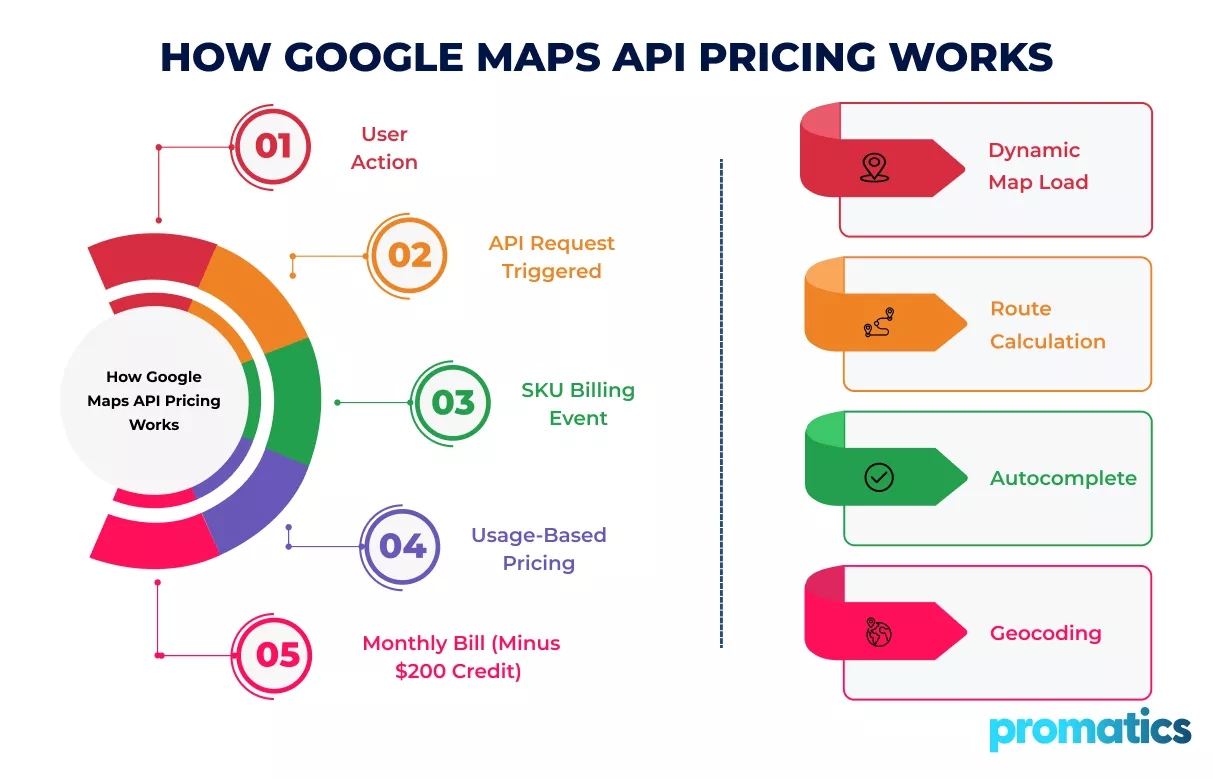
Google Maps Platform operates on a pay-as-you-go billing structure. This means you are charged based on usage volume rather than flat subscriptions.
Each API action generates a billable event under Google Cloud. These actions are categorized by SKUs, which represent individual pricing units.
For example:
- Loading an interactive dynamic map
- Rendering a static map image
- Performing geocoding
- Fetching place autocomplete
- Calculating driving directions
- Updating route matrices
- Displaying Street View
Each event has a defined price tier based on volume.
This pricing model offers flexibility but introduces unpredictability at scale.
For enterprises building high-traffic applications, this variability requires forecasting, modeling, and continuous monitoring.
Google Maps API Pricing Breakdown (Approximate Cost per 1,000 Requests)
To better understand real-world Google Maps API cost, here is a simplified comparison of commonly used APIs. Pricing may vary based on usage volume and Google updates, but this provides a general benchmark for planning.
| API / Service | Approximate Cost (Per 1,000 Requests) | Common Use Case | Cost Impact Level |
| Static Maps API | ~$2 | Basic map display, store locator | Low |
| Dynamic Maps (JavaScript API) | ~$7 | Interactive web applications | Medium |
| Static Street View API | ~$7 | Location previews | Medium |
| Dynamic Street View API | ~$14 | Interactive 360° experiences | Medium-High |
| Directions API | Higher tier pricing | Route calculations in delivery apps | High |
| Distance Matrix API | Higher tier pricing | Multi-location route optimization | High |
| Places API (Autocomplete) | Usage-based pricing | Address search in mobile apps | Medium-High |
| Geocoding API | Usage-based pricing | Convert address to coordinates | Medium |
The $200 Free Credit: Startup-Friendly but Not Enterprise-Ready
Google provides a $200 monthly free credit per billing account. For MVPs and small websites, this credit can cover moderate usage.
However, for enterprise platforms serving thousands or millions of users, the free credit becomes negligible.
At enterprise scale, the focus shifts from free usage to cost optimization and architectural efficiency.
The free credit should be seen as an onboarding benefit, not a long-term cost strategy.
Understanding the Four Core Pricing Categories
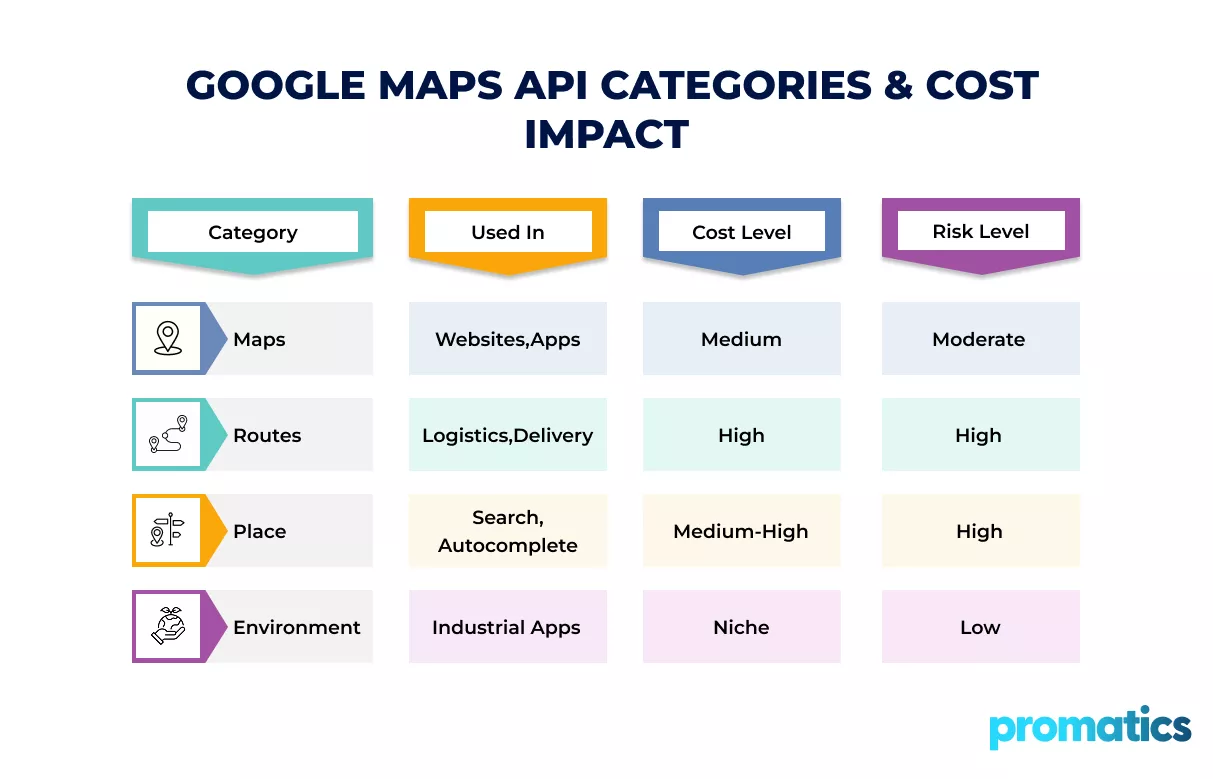
Google Maps Platform groups its APIs into four main categories: Maps, Routes, Places, and Environment. Each category impacts overall Google Maps API cost differently depending on how your application uses them.
The Maps category includes Dynamic and Static Maps. Dynamic maps are interactive and generally more expensive than static images.
The Routes category covers APIs like Directions and Distance Matrix. Because these involve complex route calculations, they often generate higher costs, especially in logistics and ride-sharing apps.
The Places category includes Geocoding and Autocomplete. These features can drive significant request volume in mobile applications if not optimized properly.
The Environment category includes specialized location-based data APIs, typically used in niche or industrial solutions.
Enterprise applications often use multiple categories together, increasing total cost exposure and making usage optimization essential.
Google Maps API Cost in Mobile App Development
In enterprise mobile app development, mapping infrastructure often operates continuously in the background.
A single user session in a delivery application may include:
Map rendering, route calculation, live driver tracking, ETA recalculation, reverse geocoding, and autocomplete input validation.
Multiply that by tens of thousands of users per day, and API calls scale exponentially.
This is why Google Maps API cost by Mobile app development company in India must be forecasted alongside user acquisition projections.
High-growth platforms frequently underestimate how mapping costs scale with active usage.
Enterprise-Level Cost Drivers
At enterprise scale, Google Maps API cost is influenced by:
- Daily Active Users
- Average API Calls Per Session
- Real-Time Update Frequency
- International Market Expansion
- Multi-Tenant SaaS Architecture
- API Redundancy Due to Poor Caching
- Inefficient Autocomplete Implementation
In global logistics platforms, route recalculations triggered by traffic updates can generate thousands of API calls per hour.
In ride-sharing systems, live tracking refresh intervals significantly impact monthly cost.
In SaaS fleet management software, monitoring multiple vehicles multiplies request volume across clients.
Without architectural optimization, costs increase proportionally with growth.
Architectural Planning for Cost Efficiency
Enterprise-level location-based app development requires careful infrastructure planning.
Strategies include:
Implementing intelligent caching layers to reduce redundant API calls.
Using static maps for preview experiences before loading dynamic maps.
Reducing real-time refresh intervals when precision is not critical.
Implementing request throttling mechanisms.
Designing microservices architecture to centralize mapping logic.
Monitoring request volume through cloud analytics dashboards.
Architectural efficiency can reduce mapping infrastructure costs by a significant margin.
Mapping optimization is as important as UI optimization.
Forecasting Google Maps API Cost Before Launch
Enterprises should build cost models before product launch.
Forecasting requires:
- Estimating expected daily active users.
- Calculating average API calls per session.
- Modeling traffic growth scenarios.
- Projecting international expansion.
- Identifying peak usage patterns.
This forecasting should be integrated into financial planning. For example, a SaaS platform serving 50 enterprise clients with live asset tracking may generate exponentially higher API calls than a consumer-facing static location website.
Cost planning must align with revenue models.
When Google Maps API Becomes a Major Infrastructure Expense
For consumer applications with millions of users, mapping costs can become one of the top infrastructure line items.
This is particularly true in:
- Ride-sharing platforms
- Food delivery apps
- On-demand service marketplaces
- Transportation SaaS platforms
- Logistics optimization systems
At this stage, enterprises must evaluate:
- Whether Google Maps remains cost-effective
- Whether hybrid mapping solutions make sense
- Whether certain features can be offloaded to alternative providers
However, switching providers involves trade-offs in data accuracy, developer ecosystem maturity, and reliability.
Google Maps often remains preferred due to global reliability and performance consistency.
The Role of Promatics Technologies in Location-Based Digital Transformation
For businesses planning large-scale web and mobile app development projects, managing Google Maps API pricing is not just about understanding rate tables. It requires strategic architecture, cost forecasting, performance optimization, and long-term scalability planning.
Promatics Technologies has extensive experience in building enterprise-grade digital platforms that rely on advanced location intelligence. The company specializes in mobile app development, SaaS application development, logistics app development, and custom web solutions where mapping infrastructure plays a central operational role.
What differentiates Promatics Technologies in location-based application development is its architectural approach. Instead of treating mapping as a simple integration, Promatics designs scalable systems that balance performance, user experience, and infrastructure cost efficiency.
This includes:
- Designing optimized API usage strategies
- Implementing intelligent caching frameworks
- Reducing redundant API calls
- Structuring microservices for mapping logic
- Forecasting infrastructure cost before deployment
- Ensuring secure API key management
- Monitoring real-time billing analytics
By aligning mapping architecture with business growth models, Promatics Technologies helps enterprises avoid unexpected Google Maps API cost escalation while maintaining high performance and user satisfaction.
For organizations building logistics platforms, ride-sharing applications, fleet management SaaS solutions, or any location-driven digital ecosystem, having a strategic development partner is critical.
Promatics Technologies positions mapping infrastructure as a growth enabler rather than an uncontrolled expense.
Long-Term Cost Optimization Strategy for Enterprises
Managing Google Maps API cost is not a one-time task. It requires continuous evaluation.
Enterprises should:
- Review usage analytics monthly.
- Audit redundant API calls quarterly.
- Optimize high-cost endpoints.
- Reassess refresh intervals as user behavior evolves.
- Align mapping infrastructure with revenue metrics.
Location intelligence should scale alongside revenue, not outpace it. Mapping costs must be proportionate to value generation.
Final Thoughts
Google Maps is one of the most powerful and reliable mapping platforms available today. However, at enterprise scale, Google Maps API pricing becomes a critical infrastructure decision rather than a minor development detail. As usage grows, costs increase based on API calls, real-time updates, routing complexity, and overall user activity.
While startups can benefit from the $200 monthly free credit, scaling SaaS platforms and mobile app development projects must carefully forecast Google Maps API cost, optimize architecture, and monitor usage proactively. Planning early helps prevent unexpected expenses, performance bottlenecks, and long-term scalability challenges.If you are building a location-driven web or mobile application and need a scalable, cost-efficient Google Maps integration, Promatics Technologies can help. Our team designs optimized mapping architectures that balance performance, security, and cost control. Connect with Promatics Technologies to ensure your Google Maps API implementation is built for sustainable growth and enterprise-level scalability.
Frequently Asked Questions
1. Is Google Maps API free to use?
Google Maps API is not completely free. Google provides a $200 monthly free credit per billing account, which covers moderate usage. Once your usage exceeds that credit, you are charged based on the pay-as-you-go pricing model.
2. How much does Google Maps API cost per 1,000 requests?
Google Maps API pricing varies depending on the specific API used. Static Maps are generally cheaper, while Dynamic Maps, Routes, and Places APIs cost more. The final Google Maps API cost depends on request volume and feature usage.
3. What is the $200 free monthly credit in Google Maps Platform?
The $200 free monthly credit is automatically applied to your Google Maps API usage each month. It resets monthly and helps startups and small businesses reduce initial costs. Unused credit does not roll over to the next month.
4. Why does Google Maps API cost increase as my app grows?
Google Maps API cost increases because pricing is based on usage. As your web or mobile app gains more users, API requests such as map loads, route calculations, and geocoding calls increase proportionally.
5. How can I reduce Google Maps API cost?
You can reduce Google Maps API cost by:
- Using static maps instead of dynamic maps when possible
- Implementing caching for geocoding results
- Debouncing autocomplete requests
- Loading maps only when necessary
- Setting billing alerts in Google Cloud
Proper architecture in mobile app development significantly lowers costs.
