Headless eCommerce Explained: How It Works and Why It Matters

TL;DR
- Headless eCommerce separates frontend and backend via APIs
- Enables flexibility, customization, and faster development
- Supports omnichannel experiences across web, mobile, and devices
- Improves performance, scalability, and integrations 5.Ideal for modern, scalable, and future-ready eCommerce
The way people shop online has evolved significantly. Today’s customers no longer rely solely on websites; they shop through mobile apps, social media platforms, smart devices, and even voice assistants. They expect fast, personalized, and seamless experiences across every touchpoint. However, traditional eCommerce platforms often struggle to meet these growing expectations.
This is where Headless eCommerce comes into play.
Headless eCommerce is a modern architecture that separates the frontend what customers see, from the backend, where the business logic and operations run. This separation gives businesses greater flexibility to create fast, scalable, and highly customized shopping experiences without the limitations of traditional eCommerce platforms.
Whether you’re launching a mobile app, building an omnichannel strategy, or enhancing website performance, headless architecture makes it easier to innovate, adapt, and scale.
In this guide, we’ll explore what Headless eCommerce is, how it works, and why it’s gaining momentum among modern businesses. We’ll also cover its key benefits, potential challenges, and when companies should consider adopting this approach. If you’re looking to build faster, smarter, and future-ready digital commerce experiences, Headless eCommerce could be the solution you’ve been searching for.
What is Headless eCommerce?
Headless eCommerce is a modern architecture that separates the frontend presentation layer (the “head”) from the backend eCommerce functionality. In traditional eCommerce platforms, the frontend and backend are tightly connected, meaning any changes to the user interface often require modifications to the underlying system, making development slower and less flexible.
In a headless commerce setup, the frontend and backend operate independently but communicate through APIs (Application Programming Interfaces). This approach gives businesses greater flexibility and agility to deliver seamless shopping experiences across multiple digital touchpoints, including websites, mobile apps, IoT devices, voice assistants, and more.
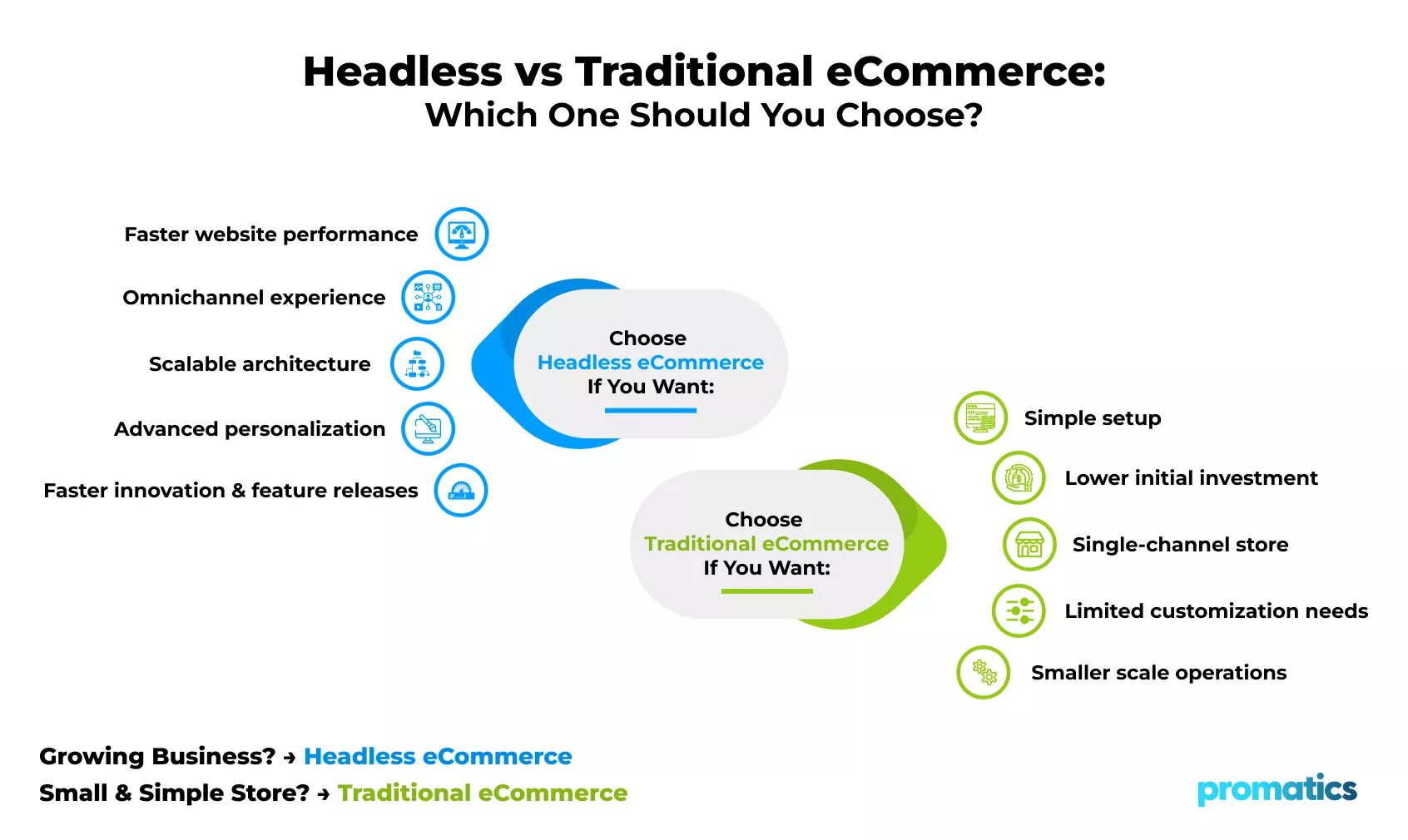
While the choice between headless and traditional commerce ultimately depends on specific business goals and requirements, many organizations are increasingly adopting headless commerce for its scalability, flexibility, and ability to support modern digital experiences.
Why Headless eCommerce is Growing in 2026?
Headless commerce adoption is rapidly accelerating as businesses look for more flexible, scalable, and future-ready digital commerce solutions. With evolving customer expectations and increasing competition in the eCommerce space, organizations are moving away from traditional monolithic platforms toward more agile and customizable architectures.
According to recent industry reports, the demand for headless commerce continues to grow at a significant pace:
- 60% of retailers plan to adopt headless architecture within the next two years
- Businesses adopting headless commerce report up to 50% faster website performance, while companies implementing headless architecture often experience 20–30% higher conversion rates, driven by improved speed, personalization, and seamless user experiences across multiple digital touchpoints.
- The global headless commerce market is expected to grow 3,811.3 Million by 2030.
This growth is driven by the need to deliver faster, more personalized, and seamless shopping experiences across multiple digital channels. Modern consumers expect consistent interactions whether they are shopping on websites, mobile apps, social media platforms, or emerging technologies like voice assistants and smart devices.
Headless commerce empowers businesses to meet these expectations by enabling greater flexibility, faster innovation, and improved performance. As a result, it is quickly becoming the preferred architecture for organizations looking to enhance customer experiences, improve operational efficiency, and stay competitive in the evolving digital commerce landscape.
Challenges of headless ecommerce architecture
While headless eCommerce offers flexibility, scalability, and improved performance, it also comes with certain challenges that businesses should carefully consider before adopting this architecture. Transitioning to a headless model requires thoughtful planning, technical expertise, and the right infrastructure to ensure successful implementation. Understanding these potential challenges can help organizations make informed decisions and prepare for a smoother transition.
Complexity
One of the primary challenges of headless commerce is its implementation complexity. Unlike traditional eCommerce platforms that provide a unified frontend and backend, headless architecture separates these components. This means businesses must develop, manage, and maintain two independent systems: the frontend and the backend.
This separation requires experienced development teams, additional planning, and strong technical expertise. Businesses may also need to select appropriate frontend frameworks, APIs, and backend services, which can increase development time and complexity, especially for organizations without prior experience in headless architecture.
Cost
Implementing headless commerce can involve higher upfront costs compared to traditional eCommerce solutions. Since businesses must build and manage separate frontend and backend systems, development costs, infrastructure expenses, and maintenance requirements may increase.
Additionally, organizations may need to invest in multiple tools and technologies, such as content management systems (CMS), APIs, cloud hosting, and third-party integrations. While headless commerce can deliver long-term benefits and scalability, businesses should carefully evaluate their budget and resources before making the transition.
Integration
Integration is another key challenge in headless commerce architecture. Since the frontend and backend operate independently, businesses must ensure seamless communication between multiple systems using APIs. This includes integrating payment gateways, inventory management systems, customer data platforms, content management systems, and third-party services.
Managing these integrations can be complex and may require ongoing monitoring and maintenance. Without proper planning and execution, integration issues can affect performance, user experience, and operational efficiency.
Despite these challenges, many businesses find that the long-term benefits of headless commerce such as flexibility, scalability, and improved customer experiences outweigh the initial complexities and investment.
Difference Between Headless Commerce vs. Traditional Commerce
As eCommerce continues to evolve, businesses are rethinking the technology behind their digital storefronts. Traditional commerce platforms have long been the foundation of online stores, offering an all-in-one solution where the frontend and backend are tightly connected. While this approach simplifies initial setup, it often limits flexibility, slows innovation, and makes it harder to adapt to changing customer expectations.
Headless commerce, on the other hand, takes a modern approach by separating the frontend from the backend. This decoupled architecture allows businesses to build customized user experiences, launch new features faster, and deliver seamless interactions across multiple digital channels. As customer expectations continue to rise, many organizations are moving toward headless commerce to stay competitive and future-ready.
Below is a simplified comparison between Headless Commerce and Traditional Commerce:
| Feature | Headless Commerce | Traditional Commerce |
| Architecture | Frontend and backend are separated, allowing independent development and flexibility | Frontend and backend are tightly connected in a single system |
| Flexibility & Customization | Highly customizable user experiences across multiple platforms | Limited customization due to rigid architecture |
| Time to Market | Faster updates and quicker feature releases | Slower updates and longer development cycles |
| Omnichannel Experience | Seamless integration across websites, apps, and digital channels | Challenging to deliver consistent omnichannel experiences |
| Scalability & Performance | Easily scalable with improved performance | Scaling can be complex and may affect performance |
Real-World Use Cases of Headless Commerce
Headless commerce is being adopted across various industries as businesses seek greater flexibility, improved performance, and seamless omnichannel experiences. By separating the frontend from the backend, organizations can deliver tailored customer experiences across multiple platforms while maintaining operational efficiency. Below are some of the most common real-world use cases where headless commerce is making a significant impact.
Retail & Fashion
Retail and fashion brands are among the biggest adopters of headless commerce. These businesses often need to deliver highly personalized shopping experiences across websites, mobile apps, and social media platforms. With headless architecture, brands can quickly update product displays, launch seasonal campaigns, and customize user experiences without affecting backend operations.
For example, fashion brands can create dynamic product pages, personalized recommendations, and interactive shopping experiences. They can also ensure consistent branding and customer journeys across multiple digital touchpoints, helping improve engagement, conversions, and customer loyalty.
B2B Commerce
Headless commerce is also gaining popularity in the B2B sector, where businesses require more complex functionality and customization. B2B companies often need features such as custom pricing, bulk ordering, personalized catalogs, and account-based experiences. Traditional platforms may struggle to support these requirements efficiently.
With headless commerce, businesses can create customized portals for different clients, offer personalized pricing, and streamline purchasing workflows. This flexibility improves operational efficiency and enhances the overall buying experience for business customers.
Multi-Brand Businesses
Organizations that manage multiple brands or storefronts benefit significantly from headless commerce architecture. Instead of maintaining separate backend systems for each brand, businesses can operate multiple storefronts using a single backend.
This approach simplifies management, reduces operational costs, and ensures consistency across all brands. At the same time, each brand can maintain its unique design, content, and customer experience, making it easier to scale and manage multiple business units.
Global Commerce
Businesses operating in international markets often face challenges such as localization, regional preferences, language variations, and currency differences. Headless commerce makes it easier to create region-specific experiences while maintaining centralized backend management.
Companies can deliver localized content, region-specific pricing, and tailored promotions based on geographic markets. This flexibility helps organizations expand globally while providing seamless and personalized shopping experiences for customers across different regions.
These real-world use cases demonstrate how headless commerce empowers businesses to innovate faster, scale efficiently, and deliver modern digital experiences tailored to evolving customer expectations.
Understanding the Architecture of Headless Commerce
To fully understand the value of headless commerce, it’s important to explore the architecture behind it. Headless commerce is built on a flexible, modular structure that separates different components of an eCommerce platform, allowing businesses to scale, innovate, and deliver seamless customer experiences across multiple digital channels.
This architecture is typically built around several key concepts, including frontend and backend decoupling, API-first development, microservices, and headless CMS integration. Together, these components create a modern, scalable, and future-ready commerce ecosystem.
Frontend and Backend Decoupling
At the core of headless commerce is the separation of the frontend and backend. The frontend represents the user interface that customers see and interact with while the backend handles business logic, data processing, and core eCommerce functionality.
By decoupling these components, businesses gain greater flexibility and scalability. Frontend developers can focus on creating engaging user experiences, while backend teams manage data, security, and performance independently. This separation also allows teams to work in parallel, accelerating development and reducing time to market.
Another advantage of this approach is the ability to use different technologies for each layer. Businesses can choose modern frontend frameworks while maintaining a stable backend system, as long as both communicate through APIs.
API-First Approach
An API-first approach is a fundamental principle of headless commerce architecture. In this model, APIs serve as the communication layer between different components of the system, enabling seamless interaction between frontend applications and backend services.
Designing APIs before development ensures they are well-structured, scalable, and easy to integrate. This approach allows businesses to connect various services such as payment gateways, content management systems, and third-party tools without disrupting the core platform.
The API-first model also makes it easier to deliver consistent experiences across multiple channels, including websites, mobile apps, smart devices, and emerging digital platforms.
Role of Microservices
Microservices architecture is another essential component of headless commerce. Instead of building a single monolithic system, microservices divide the platform into smaller, independent services. Each service handles a specific function such as product catalog management, order processing, payments, or user authentication.
This modular structure improves flexibility, scalability, and fault isolation. Businesses can update or scale individual services without affecting the entire system. It also enables faster innovation and easier maintenance, making microservices ideal for growing and complex eCommerce environments.
Additionally, microservices allow development teams to use different technologies for different services, improving efficiency and optimizing performance.
Headless CMS and Its Importance
A headless CMS (Content Management System) plays a crucial role in headless commerce architecture. Unlike traditional CMS platforms, which tightly connect content management with presentation, a headless CMS focuses solely on content creation, storage, and management.
Content is delivered through APIs, allowing businesses to display it across multiple platforms such as websites, mobile apps, and other digital touchpoints. This flexibility enables organizations to maintain consistent content while customizing experiences for different channels.
A headless CMS also empowers marketing teams to update content quickly without relying heavily on developers. This improves agility, enhances collaboration, and ensures faster content delivery.
Overall, the headless commerce architecture enables businesses to build scalable, flexible, and future-ready digital commerce platforms. By combining decoupled systems, API-first development, microservices, and headless CMS, organizations can deliver seamless, personalized, and high-performing customer experiences across all digital channels.
Critical Components Of Headless Commerce Architecture
Headless eCommerce Platforms
Headless ecommerce platforms serve as the backbone of a headless commerce architecture. These platforms provide the core functionalities needed to run an online store, such as product catalog management, pricing, customer management, and shopping carts. The essential characteristics of a headless ecommerce platform is its API-centric approach, which allows frontend applications to interact with the platform through APIs, enabling the decoupling of frontend and backend systems.
Headless Payment Systems
A headless payment system handles the processing of payments in a headless commerce environment. It integrates with the headless ecommerce platform through APIs to facilitate secure and seamless payment transactions.
Headless payment systems enable merchants to connect with various payment gateways, processors, and alternative payment methods, providing customers with multiple payment options. This flexibility is essential to accommodate the diverse preferences of customers across different regions and ensure a smooth checkout experience.
Product Inventory Management
Product inventory management (PIM) systems are responsible for monitoring and controlling the stock levels of products in an online store. These systems keep track of available quantities, handle backorders, and provide real-time inventory updates.
A headless approach to PIM allows efficient integration with the ecommerce platform and other systems. It ensures the product availability information is accurate and consistent across all sales, preventing overselling and stockouts.
Order Management
Order management systems manage, process, and track customer orders from placement to fulfilment. These systems ensure efficient order processing, shipping, and customer communication.
In a headless architecture, the order management system operates independently. Yet, it can seamlessly communicate with the ecommerce platform, inventory management, and shipping providers through APIs. This decoupled setup allows for greater agility, scalability, and customizability in handling complex order workflows.
Implementing Headless Commerce
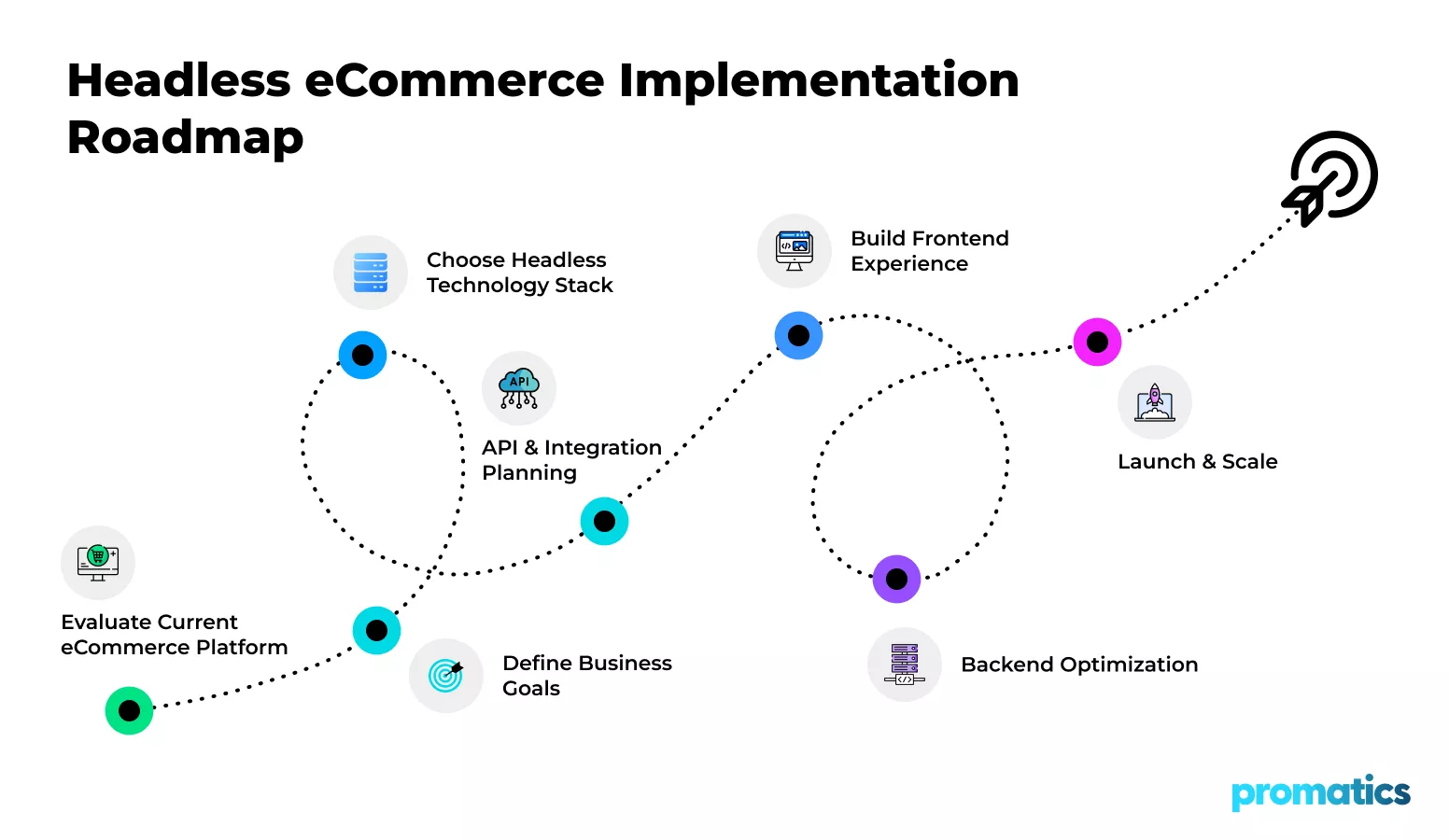
Transitioning a headless commerce model represents a significant shift towards a more agile and personalized ecommerce experience. However, this requires meticulous planning and in-depth understanding of the business’s needs and the technological landscape. Businesses must evaluate their current technology stack, understand their objectives for moving to headless commerce, and assess their team’s readiness in terms of skills and resources.
Promatics Technologies partners like commercetools, commerce layer, SAP commerce cloud and big commerce (to name only a handful) have the professional expertise to guide you on this journey. Please browse through our partner directory as a first port of call.
Conclusion
Headless eCommerce is transforming how businesses build and deliver modern digital shopping experiences. By separating the frontend from the backend, organizations gain the flexibility to innovate faster, scale efficiently, and deliver seamless omnichannel experiences across multiple platforms.
As customer expectations continue to evolve, traditional eCommerce platforms often struggle to keep up with demands for speed, personalization, and performance. Headless commerce addresses these challenges by offering a flexible, future-ready architecture that helps businesses adapt quickly and stay competitive.
Whether you’re expanding into new channels, improving performance, or planning long-term growth, headless eCommerce provides the agility needed to succeed in today’s fast-changing digital landscape. At Promatics Technologies, we help businesses design and build scalable headless eCommerce solutions tailored to their needs. Connect with our experts to start building a faster, more flexible, and future-ready commerce experience.
