Build Secure Blockchain Solutions with a Trusted Hyperledger Development Company

TL;DR
- Hyperledger is an open-source framework for enterprise blockchain solutions
- Uses permissioned networks for secure, private transactions
- Supports smart contracts to automate business processes
- Offers scalable, modular architecture for enterprise use cases
- Ideal for industries like finance, supply chain, and healthcare
Blockchain technology is rapidly transforming the global economy, redefining how businesses manage data, transactions, and trust. The growing demand for secure and transparent digital systems is accelerating enterprise adoption, with the global blockchain market projected to reach over $145 billion by 2030, driven by industries seeking scalable and secure infrastructure. Among the leading innovations driving this shift is Hyperledger blockchain development, particularly in enterprise environments that require high security, scalability, and operational flexibility.
Launched in 2015 by the Linux Foundation, Hyperledger is an open-source initiative designed to support enterprise-grade blockchain development. At the core of this ecosystem is Hyperledger Fabric, a powerful permissioned blockchain platform that enables organizations to build secure, high-performance, and customizable blockchain networks tailored to their business needs.
In this blog, we’ll explore the fundamentals of Hyperledger development, including its architecture, smart contracts (chaincode), key frameworks, and real-world use cases. We’ll also examine the role of a Hyperledger development company in building scalable, secure blockchain solutions for modern enterprises.
Understanding the Basics of Hyperledger Blockchain
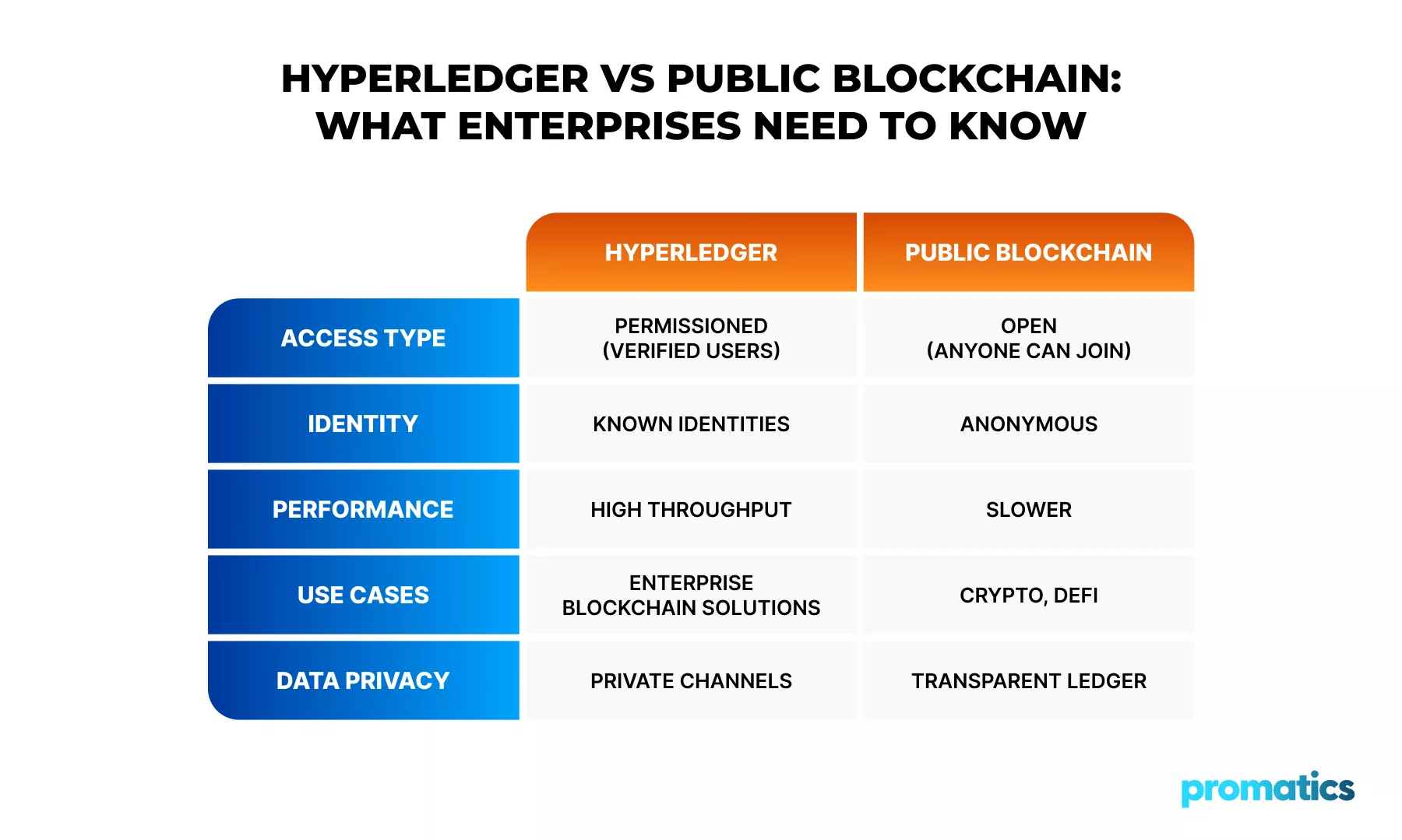
Hyperledger is specifically designed for enterprise use cases. Unlike public blockchains such as Bitcoin or Ethereum, where anyone can join and participate anonymously, Hyperledger operates on private, permissioned networks. Every participant has a verified identity and clearly defined roles.
This structured approach makes Hyperledger ideal for businesses that require data privacy, regulatory compliance, and strong governance mechanisms. According to industry reports, over 60% of enterprise blockchain implementations now use permissioned blockchain frameworks, highlighting the growing preference for platforms like Hyperledger in enterprise environments.
How Hyperledger Differs from Public Blockchains
Hyperledger stands out from public blockchain networks in several key ways:
Permissioned Access
Only verified and authorized participants can join a Hyperledger network. This ensures greater control and security compared to public blockchains, where participation is open and often anonymous.
Privacy Through Channels
Hyperledger allows organizations to create private channels within a network. These channels ensure that only selected participants can access specific transactions, thereby protecting sensitive business data.
Modular Architecture
Unlike public blockchains that follow a rigid structure, Hyperledger offers a modular design. Businesses can customize components such as consensus mechanisms, identity management systems, and data storage formats according to their needs.
Core Components of Hyperledger Fabric
Hyperledger Fabric is the most mature and widely adopted framework within the Hyperledger ecosystem. Originally contributed by IBM and Digital Asset, it has evolved into a robust platform powering enterprise-grade deployments worldwide. Many Fortune 500 companies are already using Hyperledger Fabric to support supply chain, finance, and identity management solutions, reinforcing its position as a leading enterprise blockchain platform.
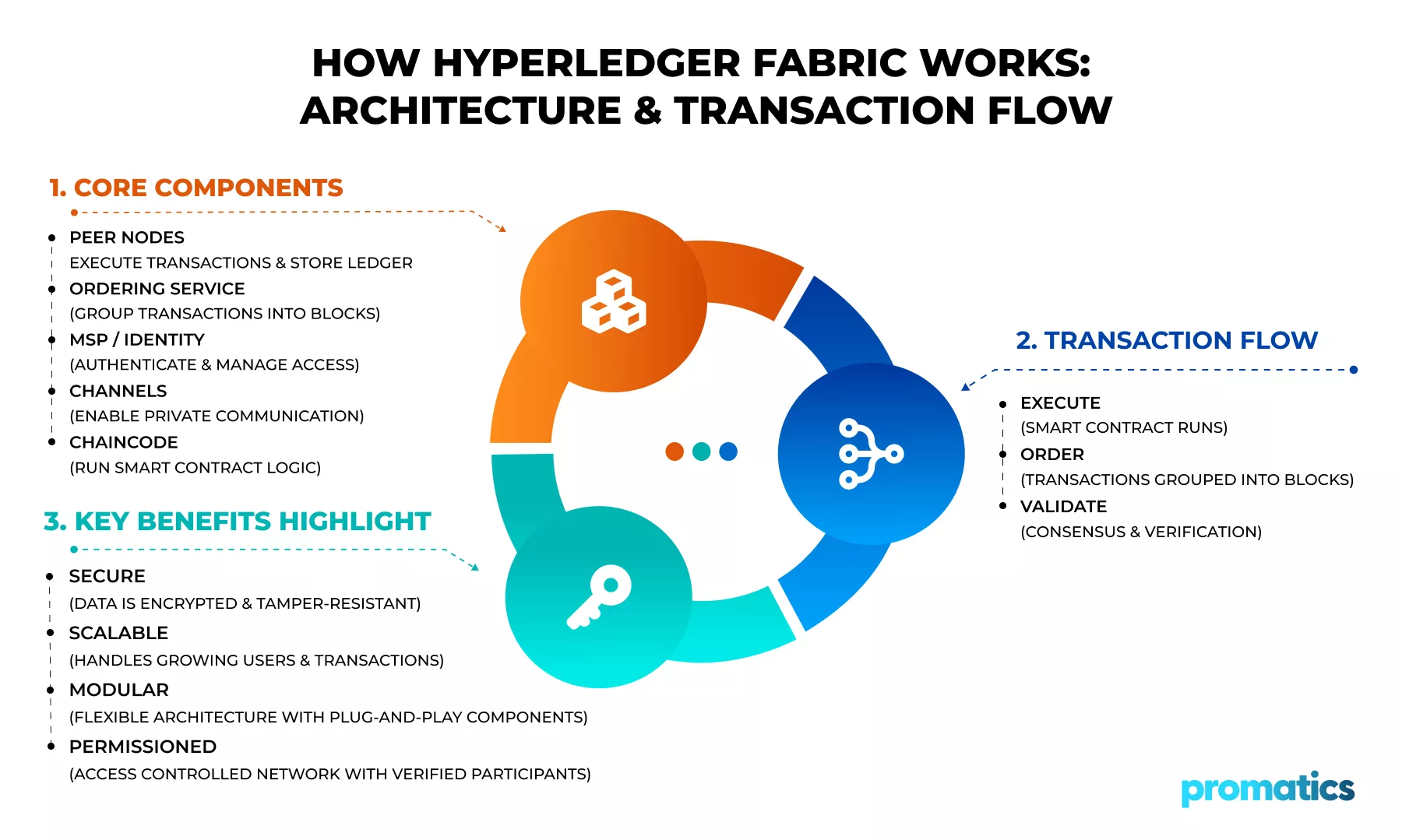
- Peer Nodes: Maintain the ledger and execute smart contracts (chaincode)
- Ordering Service: Collects transactions, packages them into blocks, and determines their order
- Membership Service Provider (MSP): Manages identities and access control across the network
- Channels: Enable private and secure communication between specific participants
- Chaincode: Represents business logic and automates workflows through smart contracts
The Role of Consensus in Hyperledger
Hyperledger employs a unique consensus mechanism that differs significantly from public blockchain models. Instead of relying on energy-intensive approaches like proof-of-work, Hyperledger uses pluggable consensus mechanisms tailored to different enterprise requirements.
The ordering service plays a central role by collecting, ordering, and distributing transactions across the network. Common consensus mechanisms supported by Hyperledger include:
- Solo
- Kafka
- Raft
Hyperledger Fabric follows an execute–order–validate transaction model, which separates execution, ordering, and validation into distinct phases. This architecture significantly enhances performance, scalability, and security compared to traditional order-execute models.
The Top 5 Hyperledger Solutions Explained
Hyperledger offers multiple frameworks to support diverse Hyperledger development services:
1. Hyperledger Fabric: The Enterprise Workhorse
Hyperledger Fabric is the most mature and widely adopted framework within the Hyperledger ecosystem. Originally contributed by IBM and Digital Asset, it has evolved into a robust platform powering thousands of enterprise-grade deployments worldwide.
One of Fabric’s defining features is its modular architecture, which allows organizations to customize network components based on their requirements. Whether it’s selecting a consensus mechanism or configuring a database for state storage, Fabric provides unmatched flexibility for building custom Hyperledger solutions.
Fabric also introduces channels, enabling private communication between specific participants. For example, in a supply chain network, two companies can securely share sensitive data without exposing it to other participants.
Smart contracts in Fabric, referred to as chaincode, can be written in widely used programming languages such as Go, JavaScript, and Java. This simplifies Hyperledger application development and allows organizations to leverage existing development expertise.
Many Fortune 500 companies have adopted Hyperledger Fabric due to its ability to combine enterprise-grade reliability with the benefits of decentralized systems.
2. Hyperledger Sawtooth: Flexibility for IoT and Scalable Systems
Hyperledger Sawtooth, contributed by Intel, is designed with flexibility and scalability in mind. It supports multiple consensus algorithms, allowing organizations to choose the model that best fits their operational and trust requirements.
A standout feature of Sawtooth is Proof of Elapsed Time (PoET), a consensus mechanism developed by Intel. It leverages trusted execution environments to achieve consensus efficiently with minimal energy consumption, making it an environmentally friendly option for enterprise blockchain solutions.
Sawtooth also supports parallel transaction execution, significantly improving performance in scenarios where transactions do not conflict. This is particularly valuable in IoT and supply chain environments that rely on real-time distributed ledger development.
Additionally, Sawtooth offers compatibility with Ethereum smart contracts, enabling organizations to migrate existing applications into a permissioned blockchain environment without complete redevelopment.
3. Hyperledger Iroha: Simplicity for Mobile and Lightweight Applications
Hyperledger Iroha is designed for simplicity and ease of use, making it an excellent choice for mobile and web-based Hyperledger application development.
Developed by Soramitsu, Iroha provides a clean and intuitive API that reduces development complexity and accelerates deployment timelines. It is particularly effective for digital asset management and identity tracking.
For example, a financial institution building a peer-to-peer payment app can use Iroha as the backend ledger without dealing with the complexities of more advanced frameworks.
Iroha uses a consensus algorithm called Yet Another Consensus (YAC), which provides crash fault tolerance while maintaining simplicity ideal for permissioned blockchain solutions with trusted participants.
4. Hyperledger Indy: Decentralized Identity Infrastructure
Hyperledger Indy is purpose-built for decentralized identity management, one of the most promising applications of blockchain technology.
Traditional identity systems rely on centralized databases, which are vulnerable to breaches and misuse. Indy introduces self-sovereign identity, allowing individuals to control their personal data and selectively share it, an essential capability within modern enterprise DLT solutions.
5. Hyperledger Burrow: Bridging Ethereum and Enterprise
Hyperledger Burrow is designed for organizations that want to leverage Ethereum capabilities within a permissioned environment.
It includes a fully functional Ethereum Virtual Machine (EVM), allowing Solidity-based smart contracts to run without modification. This makes it an ideal solution for companies transitioning to private blockchain development environments.
Burrow also adds enterprise-grade features such as permissioned access control, governance mechanisms, and simplified contract management.
Comparing the Five Hyperledger Frameworks
| Framework | Best For | Smart Contract Language | Consensus Options | Complexity |
| Fabric | Enterprise networks | Go, JavaScript, Java | Raft, Kafka | High |
| Sawtooth | IoT & supply chain | Multiple | PoET, PBFT, Raft | Medium |
| Iroha | Mobile & simple apps | Built-in | YAC | Low |
| Indy | Identity solutions | N/A | RBFT | Medium |
| Burrow | Ethereum migration | Solidity | Tendermint | Medium |
The Hyperledger Technology Stack: Understanding the Layers
Every Hyperledger solution operates across multiple interconnected layers:
Application Layer
This layer includes user interfaces, APIs, and integrations that connect business processes with blockchain infrastructure.
Smart Contract Layer
Contains self-executing programs that automate workflows and enforce business rules.
Consensus Layer
Ensures agreement across distributed nodes using appropriate algorithms.
Networking Layer
Handles secure communication, peer discovery, and data propagation across the network.
Data Layer
Manages ledger storage, state databases, and data retrieval systems.
Real-World Applications of Hyperledger
Supply Chain Transparency
Hyperledger enables end-to-end product tracking, improving traceability and reducing fraud.
Healthcare Data Management
Facilitates secure sharing of patient data with full auditability.
Financial Services
Enables faster, more cost-effective cross-border transactions.
Government & Public Sector
Supports use cases such as land registries and digital voting systems.
The Hyperledger Implementation Lifecycle
A structured approach ensures successful blockchain deployment:
- Discovery & assessment
- Framework selection
- Proof of concept (PoC)
- Network architecture design
- Development & testing
- Deployment & ongoing operations
Common Challenges and How to Address Them
- Legacy integration: Use APIs and middleware for seamless connectivity
- Governance issues: Define roles and policies early
- Scalability concerns: Design systems with future growth in mind
- Talent gap: Partner with experienced blockchain developers
- Regulatory changes: Build adaptable and compliant solutions
The Future of Hyperledger and Enterprise Blockchain
Enterprise blockchain adoption is expected to accelerate as organizations focus on transparency, security, and automation. The blockchain market is projected to grow at a CAGR of over 47% through 2030, driven by enterprise demand for scalable blockchain infrastructure.
- Increased interoperability between blockchain networks
- Growth of privacy-enhancing technologies like zero-knowledge proofs
- Expansion of cloud-based blockchain services
- Continued focus on energy-efficient consensus mechanisms
Why Choose Promatics Technologies as Your Hyperledger Development Company
Successful blockchain implementation requires strong technical expertise and real-world experience. Choosing the right Hyperledger development partner is essential.
Promatics Technologies is a trusted Hyperledger development company delivering end-to-end, enterprise-grade blockchain solutions. From consulting and development to deployment and support, Promatics ensures seamless execution aligned with business goals.
With expertise in frameworks like Hyperledger Fabric, Sawtooth, and Indy, the team builds secure, scalable, and customizable blockchain systems. They also ensure smooth integration with existing platforms such as ERP and CRM.
Security, compliance, and performance are at the core of every solution, supported by best practices in smart contract development and network design.
By partnering with Promatics, businesses gain:
- End-to-end blockchain expertise
- Scalable and customized solutions
- Seamless integration
- Ongoing support and optimization
Promatics enables organizations to leverage Hyperledger for secure and future-ready digital transformation.
Getting Started with Hyperledger
Organizations should begin by identifying relevant use cases and building small pilot projects. Partnering with an experienced Hyperledger development company ensures faster implementation, reduced risks, and long-term success.
