JAMstack vs Traditional Web Development: What’s Better in 2026?
TL;DR
- Compares JAMstack and traditional web architectures for modern apps
- JAMstack offers faster performance and better security for static sites
- Traditional development suits complex, dynamic, and scalable applications
- Choice depends on project needs, scalability, and functionality
- Hybrid approaches combine speed, flexibility, and long-term growth
Web development has evolved far beyond creating static websites. Today businesses rely on digital platforms that can scale seamlessly, support real-time interactions, integrate with multiple systems and deliver consistent performance across devices. As a result, choosing the right web development company has become a key business decision.
In recent years, JAMstack has gained attention for its promise of faster load times, improved security, and simplified deployments. At the same time, traditional web development continues to power complex enterprise platforms, SaaS products, eCommerce ecosystems, and data-driven web applications worldwide.
As businesses plan for 2026, a critical question emerges: should organizations adopt JAMstack or rely on traditional web development? At Promatics Technologies, where we design and build scalable digital solutions for global clients, the answer depends on application complexity, scalability requirements, and long-term growth goals.
This blog explores both options and explains why partnering with an experienced web development company remains the smarter choice for most real-world business applications.
Understanding JAMstack Architecture
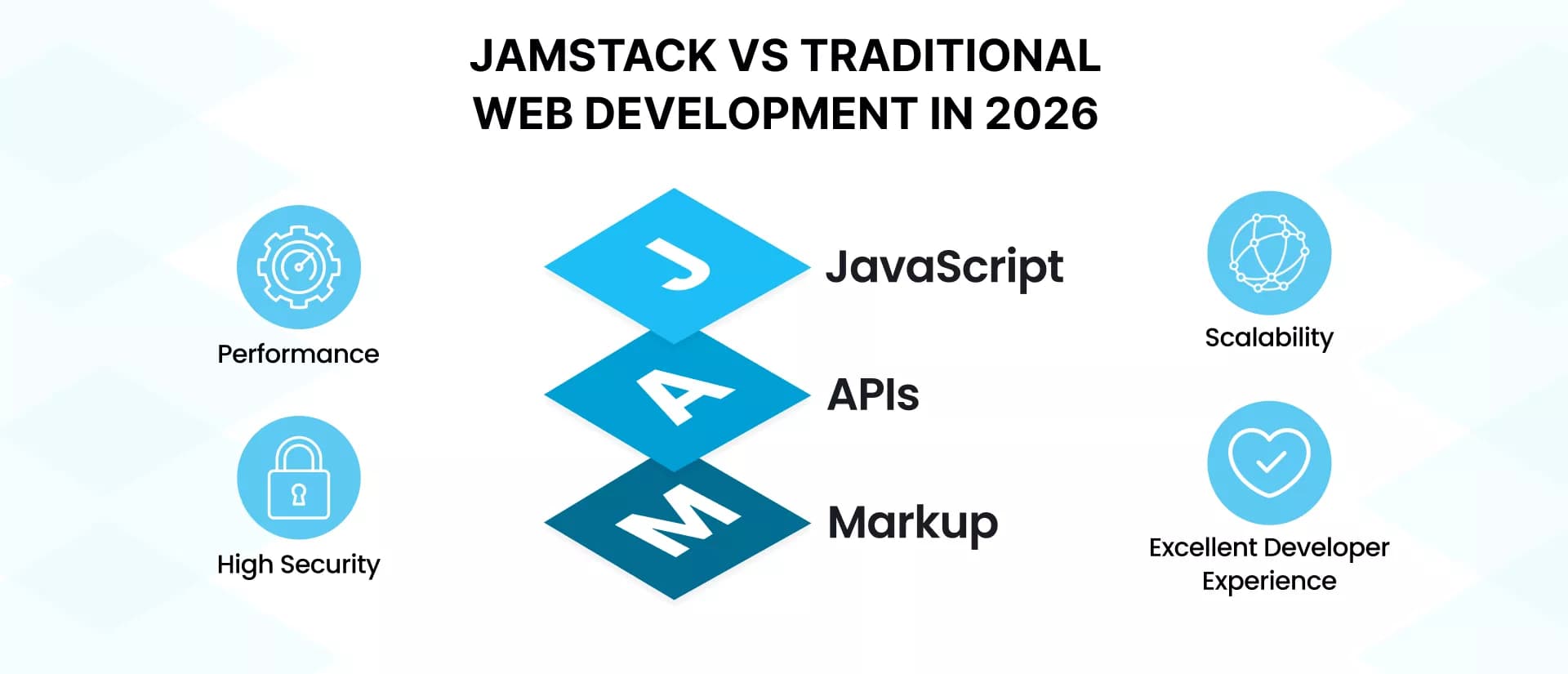
JAMstack stands for JavaScript, APIs, Markup. Its main core principle is to decouple the frontend from the backend and deliver pre-built static assets through Content Delivery Networks (CDNS).
Instead of rendering pages dynamically for every user request, JAMstack websites are pre-rendered during the build process. Interactive features such as forms, authentication, and data fetching are handled via APIs or serverless functions. This reduces server dependency and improves delivery speed.
Core Characteristics of JAMstack
- Pre-rendered statics HTML, CSS, and JavaScript files
- Frontend frameworks such as React, Vue, and Svelte
- APIs and serverless functions for dynamic functionality
- Minimal direct server interaction at runtime
This architecture significantly reduces server load and improves performance, mal and content speed is greatly enhanced by this architecture, thereby making JAMstack a strong option for content-driven and marketing-focused websites.
What Is Traditional Web Development?
Traditional web development relies on server-side logic to generate content dynamically in real-time. Each user request is processed by a backend that interacts with databases, authentication services, and business logic before delivering a response.
Over time, this model has evolved to incorporate modern technologies such as cloud hosting, microservices, containerization, and edge rendering. These advancements allow traditional architecture to scale efficiently while supporting complex business requirements.
Key Components of Traditional Web Development
- Backbone frameworks, such as Node.js, Laravel, Django and .Net
- Dynamic rendering and real time data processing
- Tight integration with databases and third-party systems
- Full power over the logic and flow of application
Traditional web development remains the foundation for enterprise portals, Saas platforms, CRMs, ERPs, eCommerce systems, and other data-intensive web applications.
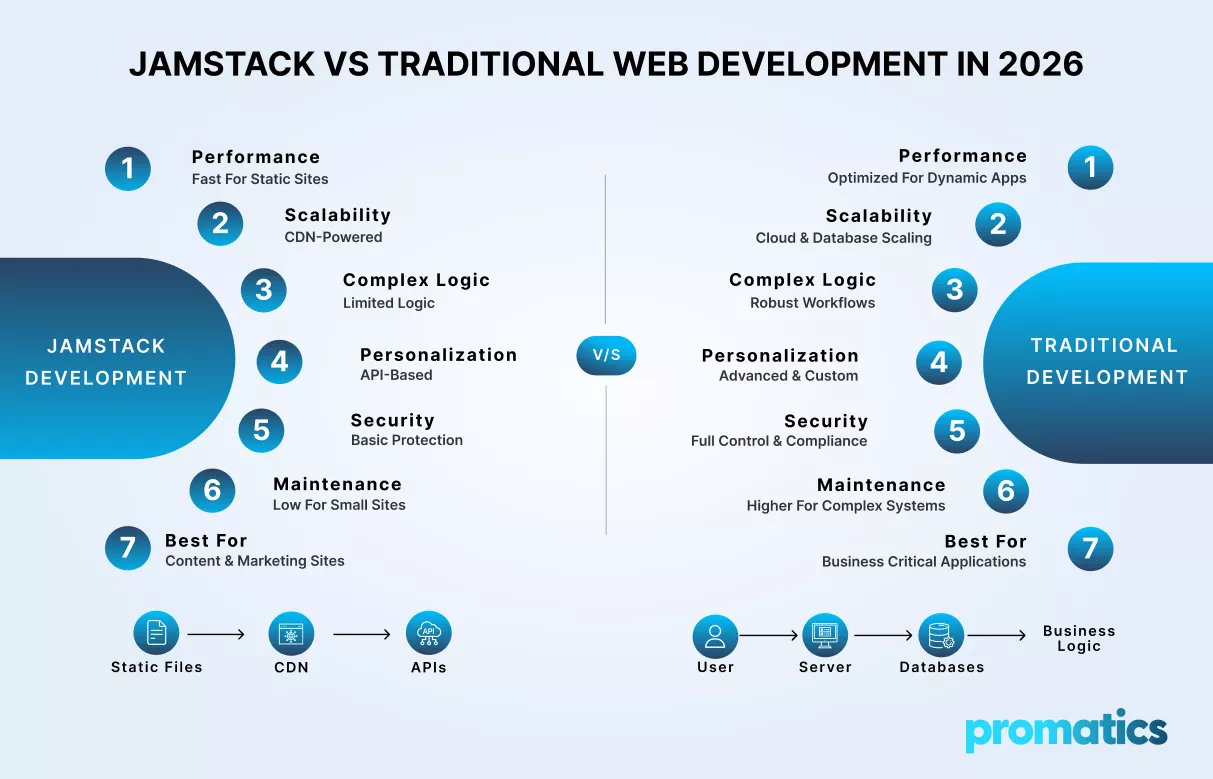
JAMstack vs Traditional Web Development Insights
Performance in 2026: Beyond Static Speed
JAMstack gained popularity largely due to its performance benefits. Serving static files via CDN results in fast load times and strong Core Web Vitals, especially for simple websites.
However, modern traditional web development has significantly narrowed this gap by adopting advanced performance techniques such as:
- Server-side rendering (SSR)
- Edge computing
- Intelligent caching strategies
- Hybrid static and dynamic rendering
For web applications that require real-time updates, dashboards, authentication, transactions, or personalization, traditional architectures deliver more consistent and predictable performance.
In 2026, performance is no longer just about speed, it is about functional performance at scale.
Scalability & Business Growth
JAMstack scales exceptionally well for read-heavy, static content. However, as applications grow more complex with added users, roles, workflows, integrations, and permissions the architecture becomes increasingly dependent on multiple APIs.
This often leads to:
- Higher network overhead
- More points of failure
- Increased debugging and monitoring complexity
Traditional web development enables:
- Centralized business logic
- Scalable backend services
- Database-level optimization
- Cloud-native scaling strategies
For startups planning growth and enterprises managing large-scale platforms, traditional development offers greater long-term and architecture clarity.
While JAMstack may appear cost-effective initially, traditional architecture often delivers better long-term ROI by minimizing rework as systems evolve.
Flexibility & Feature Development
This is where traditional web development clearly leads in 2026.
JAMstack Limitations
- Complex workflows require chaining multiple APIs
- Real-time personalization becomes harder to manage
- Debugging across distributed services can be challenging
Traditional Web Development Advantages
- Advanced role-based systems
- Secure authentication and authorization
- Complex data relationships
- Custom business workflows
As a custom web development company, Promatics Technologies frequently works on projects that require deep backend logic integrations, and continuous enhancements- making traditional web development the more practical and scalable choice.
Security Considerations
JAMstack reduces certain attack vectors by limiting direct server exposure. However, most modern applications still require:
- Secure authentication mechanisms
- Data validation and sanitization
- Role-based access control
- Compliance with industry regulations
Traditional web development provides greater visibility and control over security architecture, making it a preferred choice for regulated industries such as finance, healthcare and enterprise SaaS.
When JAMstack Makes Sense
Despite its limitations, JAMstack remains a strong option for specific use cases, Including:
- Marketing websites
- Blogs and documentation portals
- Static landing pages
- Brand showcase sites
These projects benefit from simplicity, speed, and lower maintenance overhead.
Why Traditional Web Development Is Better in 2026
For businesses focused on growth, functionality, and user experience, regular web development actually has its own advantages.
1. Enhanced Support for Complicated Applications
Enterprise platform, SaaS products, CRMS, and eCommerce systems rely heavily on backed-driven logic and integrations.
2. Long-Term Scalability
Traditional architectures adapt more effectively as product growth and business requirements evolve.
3. Advanced Personalization & SEO
Dynamic personalized content improves engagement, retention, and conversion rates.
4. Mature Ecosystem & Tooling
Decades of frameworks, security standards, and performance optimizations ensures long-term reliability.
The Hybrid Reality of Modern Web Development
In practice, the most effective solutions in 2026 combine traditional web development enhanced with modern practices, such as:
- Static generation where appropriate
- CDN-based delivery
- API-driven integrations
- Modular backend architectures
This hybrid approach delivers performance and flexibility, without the architectural constraints of JAMstack alone.
How Promatics Technologies Constructs Future-Ready Web Solutions
At Promatics Technologies, we provide web application development services tailored to performance, scalability, and business growth. As a web application development company, our approach combines:
- Robust backend development
- Modern frontend frameworks
- Secure, scalable architectures
- Performance-optimized delivery
As a trusted web design and development partner, we don’t chase trends, we build solutions that deliver real business value.
Conclusion
Modern web platforms are expected to support dynamic content, real-time data processing, third-party integrations, personalization, and long-term scalability. These requirements demand greater backend control, architectural flexibility, and reliability areas where traditional web development continues to outperform.
With advancements such as server-side rendering, intelligent caching, and cloud-native architectures, traditional web development delivers both performance and scalability, without limiting future growth. For businesses building SaaS platforms, enterprise portals, or custom digital solutions, it remains the most future-ready foundation.
At Promatics Technologies, we help businesses build secure, scalable, and high-performing web platforms tailored to their unique goals. Whether you’re planning a new product, modernizing an existing system, or looking for a reliable web development company, our team is here to help.Ready to build a scalable web application that grows with your business? Connect with Promatics Technologies today to explore our custom web development and web application development services.
