Vertical AI Companies: Why Industry-Specific AI Solutions Are Dominating in 2026

TL;DR
- Vertical AI companies are redefining enterprise AI with industry-specific solutions built for real business outcomes.
- Healthcare, finance, manufacturing, and logistics are leading the next wave of Vertical AI adoption.
- AI agents are accelerating automation by executing complex workflows with greater precision.
- The most successful AI initiatives prioritize ROI, compliance, and seamless integration.
- Businesses that invest in specialized intelligence today will gain a stronger competitive advantage tomorrow.
- Partnering with the right AI development company can help turn AI opportunities into measurable business value.
AI promised to transform every industry. But in 2026, businesses have realized that success doesn’t come from using the most powerful AI. It comes from using the right AI. A hospital doesn’t need an AI that writes marketing copy. It needs one that understands clinical workflows and medical terminology. Banks require systems capable of detecting fraud and navigating complex compliance frameworks.
Manufacturers need predictive intelligence that prevents costly downtime. Industry by industry, organizations are moving away from one-size-fits-all tools and embracing AI built specifically for their unique challenges.
This shift is fueling the rise of Vertical AI.
Unlike general-purpose AI models that require extensive customization, Vertical AI solutions combine domain expertise, industry data, and specialized workflows to deliver faster deployment, higher accuracy, and measurable business value. As businesses increasingly look for tailored AI implementations, partnering with an experienced AI development company can accelerate the journey from experimentation to enterprise adoption.
The market growth reflects this momentum. According to Market.us, the global Vertical AI market is projected to grow from USD 12.9 billion in 2024 to USD 115.4 billion by 2034, expanding at a remarkable 24.5% CAGR. Businesses are no longer experimenting with AI simply to stay ahead of trends. They’re investing in solutions that solve real problems and generate real ROI.
The question is no longer, Should we adopt AI? Should we choose a generalist, or an AI built specifically for our industry?
Increasingly, enterprises are choosing the latter.
In this article, we’ll explore why Vertical AI companies are dominating in 2026, what’s driving their rapid growth, and how industry-specific AI solutions are reshaping the future of business.
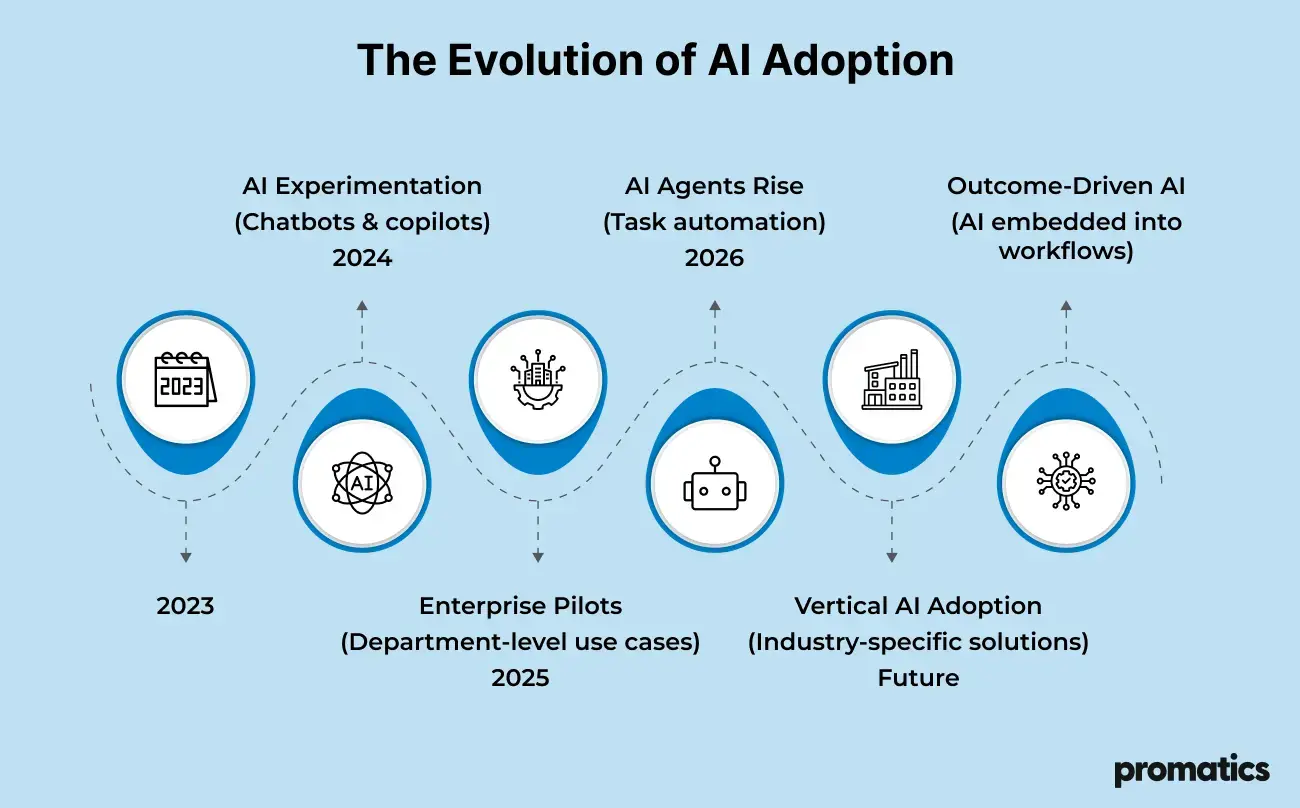
What Are Vertical AI Companies?
Vertical AI companies build artificial intelligence solutions designed for the unique needs of specific industries rather than broad, one-size-fits-all applications. Unlike horizontal AI platforms that serve multiple sectors, these companies develop solutions trained on industry-specific data, workflows, regulations, and terminology to address specialized challenges with greater precision.
Their objective isn’t to do everything. It’s to solve the problems that matter most within a particular domain and deliver measurable business outcomes. As a result, organizations increasingly partner with providers offering custom AI development services to create solutions that align with their operational processes, compliance requirements, and long-term business goals.
For example:
- Healthcare AI assists with clinical documentation and patient management.
- Financial AI detects fraud and automates compliance checks.
- Manufacturing AI predicts equipment failures and optimizes operations.
- Legal AI streamlines contract analysis and legal research.
The key differentiator is specialization.
By combining domain expertise with advanced AI capabilities, Vertical AI companies deliver:
- Higher accuracy
- Faster deployment
- Improved user adoption
- Better compliance
- Stronger business outcomes
As enterprises move from experimentation to implementation, Vertical AI is emerging as the preferred path to scalable, ROI-driven innovation.
Horizontal AI vs Vertical AI Explained
To understand Vertical AI’s rapid growth, it’s important to understand what sets it apart from Horizontal AI.
Horizontal AI refers to general-purpose solutions designed to support a wide variety of tasks across industries. Examples include chatbots, writing assistants, coding copilots, and productivity tools.
Vertical AI focuses on solving challenges within a specific domain.
Think of it this way: Horizontal AI is a general practitioner. Vertical AI is a specialist.
A general doctor can address a range of concerns. But if you’re dealing with a heart condition, you’d rather consult a cardiologist.
Businesses are making the same choice with AI.
| Feature | Horizontal AI | Vertical AI |
| Purpose | Broad applications | Industry-specific solutions |
| Training Data | General datasets | Domain-specific datasets |
| Customization | Extensive tuning required | Built around industry workflows |
| Time to Value | Longer implementation | Faster deployment |
| Accuracy | Broad capabilities | Higher precision |
| Examples | Chatbots, copilots | Healthcare AI, FinTech AI, Legal AI |
While Horizontal AI remains valuable, organizations seeking measurable outcomes increasingly prefer specialized solutions designed for their industries.
Why Enterprises Choose Vertical AI
| Vertical AI Delivers | Business Impact |
| Faster deployment | Reduced implementation time |
| Domain expertise | Higher accuracy |
| Built-in compliance | Lower risk |
| Workflow alignment | Faster adoption |
| Specialized outcomes | Better ROI |
Why Businesses Prefer Industry-Specific AI
Businesses don’t adopt AI simply to keep up with technological trends. They adopt it to improve efficiency, reduce costs, and generate results. Generic AI tools often struggle with industry nuances. They may not understand regulatory requirements, technical terminology, or complex operational processes.
Industry-specific AI changes that. Because these systems are trained using domain expertise and tailored datasets, they provide relevant outputs from day one.
Key benefits include:
- Greater accuracy and contextual understanding
- Faster implementation timelines
- Stronger regulatory compliance
- Higher employee trust and adoption
- Improved decision-making
- Better ROI
The conversation around AI is shifting from capability to impact. Organizations no longer want AI that can do a little bit of everything. They want AI that solves the problems that matter most.
Top Industries Adopting Vertical AI
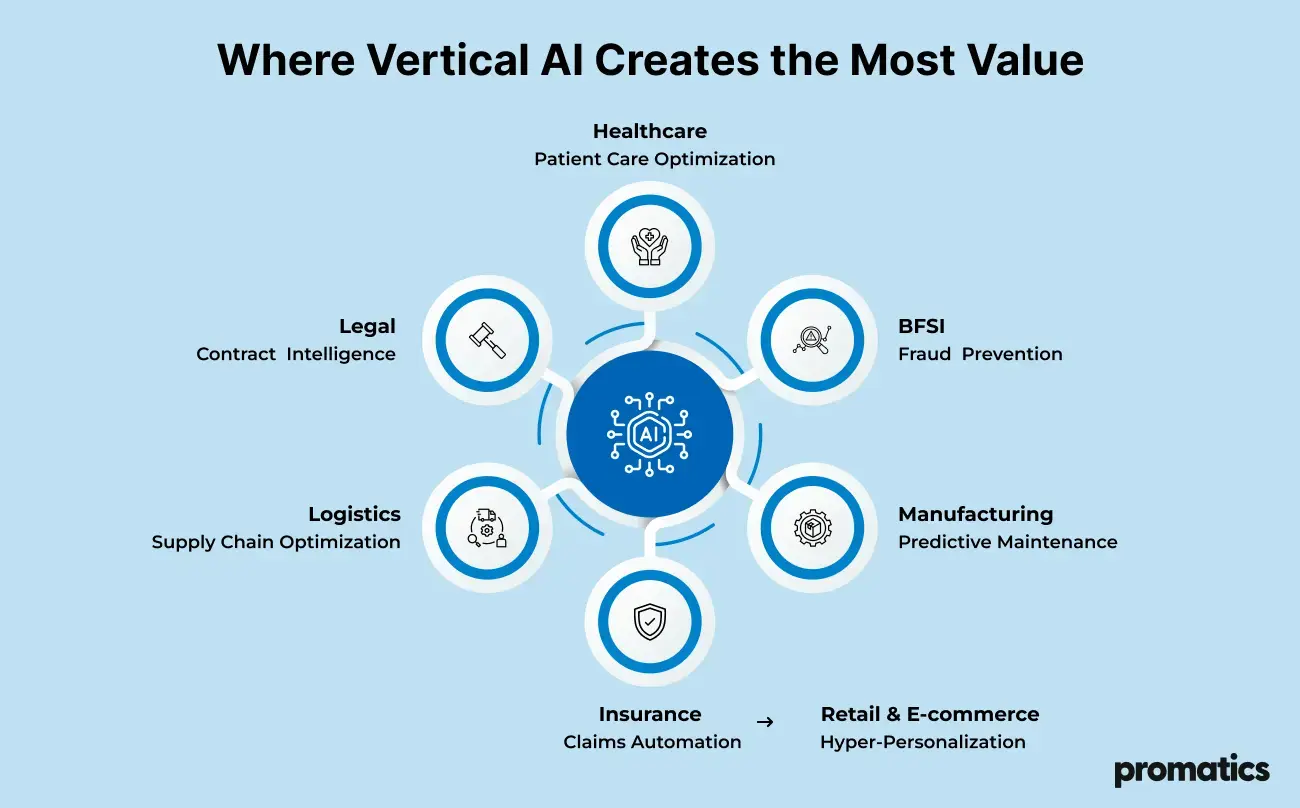
Vertical AI is no longer a niche trend embraced only by early adopters. It has become a strategic priority across industries looking to improve efficiency, reduce costs, and gain a competitive edge.
As enterprises move beyond AI experimentation, several sectors are emerging as leaders in vertical AI adoption.
1. Healthcare
Healthcare has become one of the largest adopters of Vertical AI. Hospitals and healthcare providers use AI to automate clinical documentation, assist in diagnostics, streamline administrative workflows, and improve patient outcomes.
By understanding medical terminology and clinical processes, these solutions reduce physician burnout and allow healthcare professionals to focus more on patient care.
2. Banking and Financial Services (BFSI)
Financial institutions operate in highly regulated environments where accuracy and compliance are critical. Vertical AI helps banks detect fraud, automate KYC and AML checks, assess credit risks, and personalize customer experiences.
The result is faster decision-making with reduced operational risk.
3. Manufacturing
Manufacturers leverage Vertical AI to optimize production lines, forecast demand, monitor equipment health, and enable predictive maintenance.
Rather than reacting to machine failures, businesses can anticipate problems before they occur, minimizing downtime and increasing productivity.
4. Retail and E-commerce
Retailers are using industry-specific AI to personalize recommendations, optimize inventory levels, forecast buying patterns, and improve customer engagement.
In an increasingly competitive market, these insights help businesses deliver seamless experiences while maximizing profitability.
5. Legal Services
Law firms and legal departments use Vertical AI to conduct legal research, review contracts, identify risks, and analyze large volumes of documentation.
By automating repetitive tasks, legal professionals can devote more time to strategic decision-making and client advisory work.
6. Insurance
Insurance providers are adopting AI to streamline underwriting, automate claims processing, detect fraud, and improve risk assessment.
These capabilities not only enhance efficiency but also improve customer satisfaction through faster service delivery.
7. Logistics and Supply Chain
Supply chain disruptions have highlighted the need for intelligent decision-making. Vertical AI helps logistics companies optimize routes, forecast demand, automate warehouses, and track shipments in real time.
As supply chains become increasingly complex, specialized intelligence is becoming essential.
The industries embracing Vertical AI today are not merely adopting new technology. They’re redefining how work gets done.
Examples of Vertical AI Applications
The true value of Vertical AI lies in its ability to solve real-world business challenges.
Unlike general-purpose tools that offer broad capabilities, Vertical AI applications are embedded directly into industry workflows to automate tasks, enhance decision-making, and improve operational efficiency.
Businesses exploring these use cases increasingly invest in AI-powered application development to bring intelligent workflows and automation into their existing digital ecosystems.
Here are some of the most impactful applications transforming businesses today:
- AI-Powered Clinical Documentation
Healthcare providers use AI to generate medical notes, summarize patient histories, and support diagnostics.
Administrative workloads decrease, allowing clinicians to focus on delivering better care.
- Fraud Detection and Compliance Monitoring
Banks employ Vertical AI to identify suspicious transactions, automate compliance checks, and detect emerging fraud patterns before they escalate.
These systems continuously analyze financial data at a scale humans simply cannot match.
- Predictive Maintenance
Manufacturers monitor machinery through AI systems that identify warning signs of equipment failure.
This predictive approach minimizes disruptions, reduces maintenance costs, and increases productivity.
- Contract Review and Legal Research
Legal teams use AI to extract clauses, identify risks, and accelerate document reviews.
What once took hours can now be completed in minutes without sacrificing accuracy.
- Intelligent Customer Support
AI agents are transforming customer service by resolving inquiries, tracking requests, and delivering personalized responses.
Unlike generic chatbots, these systems understand the products, policies, and workflows unique to a business.
- Insurance Claims Processing
Specialized AI solutions verify documents, assess claims, detect fraud, and streamline underwriting processes.
Claims move faster, and decision quality improves.
- Supply Chain Optimization
From route planning to inventory forecasting, Vertical AI enables logistics providers to make smarter decisions based on real-time operational insights.
These applications demonstrate a growing reality:
Businesses aren’t adopting AI simply to automate tasks.
They’re deploying specialized intelligence designed to solve their industry’s most pressing challenges.
How AI Agents Power Vertical AI Platforms
Behind every successful Vertical AI platform is an increasingly powerful technology layer: AI agents. Traditional AI models generate outputs based on prompts.
AI agents go a step further. They can reason, make decisions, interact with systems, and execute tasks autonomously.
Think of AI models as the brains. AI agents are the employees that put that intelligence into action.
For example:
- A healthcare AI agent can review patient records, generate clinical summaries, schedule follow-ups, and flag potential risks.
- A banking AI agent can monitor transactions, identify suspicious activities, conduct compliance checks, and escalate high-risk cases.
- A customer support agent can retrieve information, resolve requests, and update backend systems without human intervention.
What makes these agents particularly effective is their specialization.
Rather than operating with broad knowledge alone, Vertical AI agents understand industry terminology, workflows, regulations, and decision-making frameworks.
Key capabilities include:
- Understanding domain-specific language and context
- Executing multi-step workflows autonomously
- Integrating with enterprise applications
- Delivering real-time recommendations
- Learning from interactions over time
- Escalating complex cases when human expertise is required
As enterprises embrace agentic AI, Vertical AI platforms are evolving from passive software tools into active participants in business operations.
The future of enterprise AI isn’t just about generating answers.
It’s about delivering outcomes.As businesses adopt agentic AI, demand for AI agent development services and intelligent workflow automation continues to grow across industries.
Real-World Examples of Vertical AI Companies
The rise of Vertical AI isn’t theoretical. It’s already reshaping industries through companies that have chosen specialization over scale.
In healthcare, Abridge helps physicians automate clinical documentation, reducing administrative burdens and enabling more meaningful patient interactions.
In legal services, Harvey assists professionals with legal research, contract analysis, and drafting complex documents.
Financial teams increasingly rely on Hebbia to extract insights from vast datasets and accelerate high-stakes decision-making.
Meanwhile, companies like Hippocratic AI are building healthcare-focused conversational agents designed specifically for patient engagement and support.
These organizations share a common philosophy:
They aren’t trying to build AI for everyone.
They’re building AI that solves specific problems exceptionally well.
The same philosophy extends to enterprise technology partners helping organizations unlock AI’s potential.
At Promatics Technologies, businesses collaborate with experts to identify high-value AI opportunities and develop custom solutions aligned with their workflows, compliance requirements, and strategic goals.
From intelligent automation and AI-powered applications to domain-specific AI agents, the focus remains on one objective: transforming AI investments into measurable business outcomes. The message from the market is becoming impossible to ignore.
The next generation of category-defining AI companies won’t succeed by doing everything. They’ll succeed by becoming indispensable within the industries they serve.
Challenges in Building Vertical AI Products
The opportunity surrounding Vertical AI is enormous. But building industry-specific AI products is far more complex than launching a general-purpose application.
Unlike consumer-facing AI tools, Vertical AI solutions operate in environments where accuracy, trust, and compliance are non-negotiable. A single mistake in healthcare, finance, or legal services can lead to financial losses, regulatory penalties, or reputational damage.
To deliver meaningful outcomes, organizations must overcome several critical challenges.
1. Access to High-Quality Domain Data
Vertical AI is only as effective as the data it learns from. However, obtaining industry-specific datasets isn’t easy.
Healthcare records are protected by privacy regulations. Financial institutions manage highly sensitive customer information. Legal documents often remain confidential.
Without access to clean, high-quality, domain-specific data, even the most advanced models struggle to deliver reliable results.
2. Integrating with Legacy Systems
Most enterprises still operate on decades-old infrastructure, including ERPs, CRMs, and proprietary databases.
Integrating AI into these environments without disrupting existing operations remains one of the biggest implementation hurdles. The true challenge isn’t building the AI itself. It’s embedding it into the systems businesses already depend on.
3. Ensuring Accuracy and Reliability
In Vertical AI, mistakes carry consequences.
An inaccurate medical recommendation, a missed fraud alert, or an incorrect legal interpretation can erode trust instantly.
Organizations must continuously test, validate, and monitor AI systems to ensure consistency and reliability.
4. Navigating Compliance Requirements
Industries such as healthcare, banking, and insurance operate under strict regulatory frameworks.
Vertical AI solutions must support:
- Data privacy and protection
- Explainability and transparency
- Audit trails
- Governance controls
- Accountability mechanisms
Compliance can no longer be treated as an afterthought. It must be built into the product from day one.
5. Scaling Across Organizations
An AI solution that works perfectly in one organization may struggle in another.
Different workflows, approval structures, technology stacks, and operational practices often require extensive adaptation.
Scaling Vertical AI while maintaining performance and security is one of the industry’s biggest challenges.
6. Driving User Adoption
Even the most sophisticated AI solution will fail if employees don’t trust it.
Organizations must invest in training, change management, and transparency to help teams understand how AI supports their work rather than replaces it.
7. Balancing Automation with Human Expertise
The goal of Vertical AI isn’t to eliminate human judgment.
It’s to augment it.
Businesses must carefully determine which decisions can be automated and where human oversight remains essential, especially in high-risk scenarios.
Building successful Vertical AI products requires more than powerful algorithms. It demands domain expertise, robust governance, seamless integration, and a relentless focus on trust.
The journey may be complex, but the rewards make it worthwhile.
Future of Vertical AI Startups in 2026
If the last few years were about discovering what AI could do, 2026 is becoming the year businesses decide what AI should do and increasingly, the answer is clear: solve real industry problems.
Vertical AI startups are gaining momentum by building specialized solutions for industries like healthcare, finance, legal services, insurance, manufacturing, and logistics. Their focus on solving domain-specific challenges is attracting both enterprises and investors. According to Brainpool, vertical AI investment reached USD 3.5 billion in 2025, nearly tripling year over year, reflecting growing confidence in industry-focused solutions.
Several factors are driving this shift, including the demand for measurable ROI, increased emphasis on compliance, the rise of AI agents, and the need for faster business impact. In fact, while 88% of organizations use AI in at least one business function, only 6% generate significant financial returns from it, highlighting the opportunity for Vertical AI startups that can bridge the gap between experimentation and execution.
Looking ahead, AI agents will become digital teammates, Vertical AI platforms will integrate more deeply into enterprise systems, and trust, transparency, and measurable outcomes will emerge as key differentiators. The future won’t belong to companies building the biggest AI models. It will belong to those that understand industry problems deeply enough to solve them better than anyone else.
Looking ahead, several trends are likely to define the future of Vertical AI:
AI Agents Become Digital Teammates
Specialized agents capable of executing end-to-end workflows will become integral members of enterprise teams.
- Deeper Industry Integration
Vertical AI solutions will increasingly integrate with CRMs, ERPs, and operational systems, becoming embedded into everyday workflows.
- Outcome-Based Pricing Models
Businesses will shift from paying for software access to paying for measurable outcomes and performance improvements.
- Trust Becomes a Competitive Advantage
Companies prioritizing transparency, security, and governance will stand out in crowded markets.
- Expansion into Untapped Industries
Construction, agriculture, education, energy, and real estate are expected to become the next frontier of Vertical AI innovation.
The future won’t belong to companies building the largest models.
It will belong to those that understand their customers’ problems deeply enough to solve them better than anyone else.
How to Choose the Right Vertical AI Solution for Your Business
The real challenge isn’t deciding whether to adopt AI. It’s choosing the right AI.
With countless vendors promising transformation, businesses must look beyond impressive demos and focus on practical value.
The best Vertical AI solution isn’t necessarily the one with the most features. Evaluating a vendor’s technical expertise, domain knowledge, and implementation experience is equally important when selecting an AI partner.
It’s the one that understands your business.
Before making an investment, ask these questions:
- Does the solution understand our industry?
Look for vendors with proven expertise in your sector’s terminology, regulations, and workflows.
- Can it integrate with our existing systems?
The solution should connect seamlessly with your current infrastructure, including CRMs, ERPs, and internal databases.
- How does it address security and compliance?
Data privacy, governance, and explainability should be core priorities rather than afterthoughts.
- Can it scale with our growth?
Your AI investment should evolve alongside your organization.
- Is there evidence of measurable ROI?
Case studies, success stories, and performance metrics provide confidence that the solution delivers real value.
- Does it support human oversight?
The most effective AI solutions empower employees rather than remove them from the process entirely.
At Promatics Technologies, we help organizations navigate this journey by identifying high-impact opportunities, developing tailored AI solutions, and ensuring that every implementation aligns with long-term business objectives.
Because successful AI adoption isn’t about implementing the newest technology.
It’s about implementing the right technology.
Final Thoughts
Vertical AI is no longer an emerging trend. It’s becoming the foundation of how businesses innovate, compete, and grow. The organizations that succeed won’t necessarily be those with access to the biggest models but those that know how to apply AI where it creates the greatest impact.
At Promatics Technologies, we help businesses identify high-value AI opportunities, build intelligent applications, and implement industry-specific solutions that deliver measurable results. Whether you’re exploring AI for the first time or scaling enterprise-wide initiatives, our team can help you move from strategy to execution with confidence.
Ready to build AI solutions tailored to your business? Explore our AI development services or connect with our experts to discover how specialized intelligence can become your next competitive advantage.
