From Automation to Intelligence: How AI Development Companies Are Evolving
TL;DR
- AI is evolving from rule-based automation to intelligent, self-learning systems
- Enables smarter decisions, predictive insights, and real-time actions
- AI companies now offer end-to-end, scalable, and integrated solutions
- Improves efficiency, personalization, and business performance
- Future focuses on autonomous systems, generative AI, and adaptive intelligence
Artificial intelligence, commonly known as AI, is not just a distant concept confined to research labs or speculative technology. As of 2025, AI is deeply embedded in multiple industries, and artificial intelligence companies serve as key architects of this integration. They are innovators, problem-solvers, and visionaries shaping the AI ecosystem’s rapid evolution.
These companies not only research and develop the next generation of AI algorithms but also drive vast commercialization and ethical deployment of AI solutions. Understanding how artificial intelligence development companies function and influence the AI landscape is essential to grasping the border trends in technology and business today.
These businesses not only research and develop the next generation of AI algorithms but also drive the vast commercialization and ethical deployment of AI solutions. Understanding how these companies function and influence the AI landscape is important to grasping the broader trends in technology and business today.
In this blog, we explore how AI development companies are evolving, what this transition means for businesses, and how the right AI development services can enable intelligent, future-ready digital transformation.
Understanding Ai And It’s The Dynamic Character
The phrase “AI’’ captures more than just a definition; it reflects the dynamic qualities and evolving essence of artificial intelligence.
- AI is adaptive: Modern AI systems learn in real time, tailoring outputs to user behaviors, environmental changes, and new data sources.
- AI is collaborative : Today’s AI platforms integrate seamlessly with human workflows, augmenting decision-making rather than replacing it.
- AI is pervasive – From healthcare diagnostic and autonomous vehicles to finance and creative arts, AI’s reach touches every sector.
Artificial intelligence companies focus on these facets, pushing boundaries through innovations in machine learning, natural language processing, computer vision, and beyond.
The Evolution of AI: From Automation to Intelligence
The Early Stage: Rule-Based Automation
In its initial adoption phase, AI was largely synonymous with automation. Businesses used technology to reduce manual effort by automating repetitive, rule-based tasks. These systems were effective in improving productivity but had clear limitations.
Traditional automation systems:
- Operated on fixed rules
- Required constant manual updates
- Could not learn from outcomes
- Struggled in dynamic environments
While automation improved efficiency, it lacked adaptability and intelligence.
The Shift to Intelligent Automation
As data volumes increased and computing capabilities improved, automation began to evolve. Machine learning introduced the ability to analyze historical data, identify patterns, and make predictions.
This phase often referred to as intelligent automation enabled:
- Predictive analytics
- Context-aware workflows
- Natural language processing
- Intelligent document handling
Businesses could now anticipate outcomes instead of reacting to them. This marked a turning point in how AI development services were perceived—from operational tools to strategic enablers.
The Present: Cognitive and Adaptive Intelligence
Today, leading artificial intelligence development companies are building systems that continuously learn and adapt. These intelligent solutions can process structured and unstructured data, improve accuracy over time, and operate autonomously within complex environments.
Modern AI systems are defined by:
- Self-learning algorithms
- Real-time decision-making
- Enterprise-wide integration
- Scalable, cloud-native architectures
This evolution has transformed the role of AI development companies into long-term technology partners rather than short-term solution providers.
What Defines a Modern AI Development Company?
A modern AI development company focuses on embedding intelligence into business operations, not just deploying isolated models.
- Business-Aligned AI Strategy
Successful AI initiatives begin with a clear understanding of business goals. Modern AI companies prioritize outcomes such as revenue growth, cost optimization, risk reduction, and customer experience improvement.
- End-to-End Artificial Intelligence Development Services
From strategy and data engineering to deployment and optimization, AI development services now cover the full lifecycle, ensuring scalability, reliability, and measurable impact.
- Industry and Domain Expertise
Effective AI solutions require context. AI development companies bring experience across industries such as healthcare, finance, retail, manufacturing, logistics, and enterprise software.
- Scalable and Integrated Solutions
AI must work seamlessly with existing systems such as CRMs, ERPs, analytics platforms, and cloud infrastructure. Scalability and interoperability are critical for long-term success.
Core Artificial Intelligence Development Services Offered Today
- AI Consulting and Strategy
Helps organizations identify high-impact use cases, assess data readiness, and define an AI roadmap aligned with business priorities.
Custom AI Solution Development
Tailored AI systems built to solve specific challenges, such as:
- Predictive analytics
- Recommendation engines
- Fraud detection
- Demand forecasting
- Intelligent virtual assistants
Custom development ensures relevance, accuracy, and higher ROI.
- Machine Learning Model Development
This includes data preparation, feature engineering, model training, validation, and continuous improvement—forming the foundation of intelligent systems.
- Natural Language Processing (NLP)
NLP enables systems to understand and generate human language. Common applications include customer support automation, sentiment analysis, intelligent search, and document processing.
- Computer Vision Solutions
Computer vision allows machines to interpret images and video for use cases such as quality inspection, medical imaging, surveillance analytics, and visual recognition.
- AI Integration and Deployment
AI solutions are deployed across cloud, edge, or hybrid environments and integrated with existing business systems to ensure real-world usability.
- Monitoring, Optimization, and Support
AI systems require continuous monitoring to maintain accuracy, address bias, and adapt to changing data patterns, ensuring long-term value.
How AI Development Companies Are Transforming Business Operations
- Smarter Decision-Making
AI-powered insights enable organizations to make faster, data-driven decisions using predictive and prescriptive intelligence rather than static reports.
- Personalized Customer Experiences
From personalized recommendations to intelligent chat interfaces, AI enables tailored experiences at scale, driving engagement and retention.
- Operational Efficiency
Intelligent automation reduces errors, accelerates workflows, and optimizes resource utilization, leading to measurable cost savings.
- Improved Risk and Compliance Management
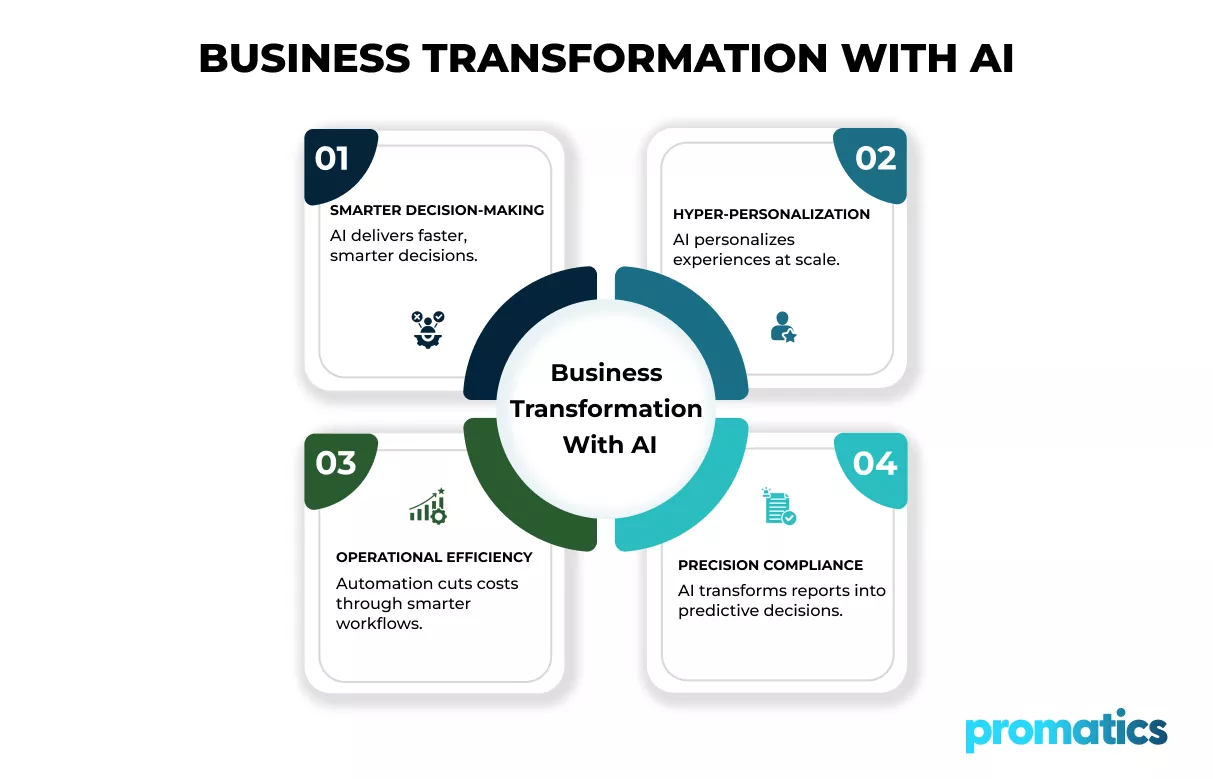
AI helps detect anomalies, monitor compliance, and manage risks in highly regulated environments.
The Importance of Data in Intelligent AI Systems
AI intelligence depends entirely on data quality. Leading AI development companies emphasize:
- Strong data governance
- Scalable data pipelines
- Secure storage and access
- Real-time data processing
Without a solid data foundation, even advanced AI models fail to deliver consistent outcomes.
Responsible and Secure AI Development
As AI adoption increases, ethical and secure implementation is essential. Modern AI development services prioritize:
- Data privacy and security
- Bias detection and mitigation
- Explainable and transparent models
- Regulatory compliance
Responsible AI builds trust and supports sustainable, long-term adoption evolving landscape.
The Future of AI Development Companies
Looking ahead, AI development companies will increasingly focus on:
- Autonomous and adaptive systems
- Generative AI applications
- Multi-modal intelligence
- AI-first enterprise platforms
- Stronger governance and explainability
AI is evolving from a support tool into a core business capability.
Industry-Wide Impact of AI Development Services
- Healthcare: diagnostics, patient analytics, operational efficiency
- Finance: fraud detection, credit assessment, risk modeling
- Retail & eCommerce: personalization, inventory optimization, pricing intelligence
- Manufacturing: predictive maintenance, quality control, supply chain optimization
- Enterprise & SaaS: customer intelligence, process automation, product analytics
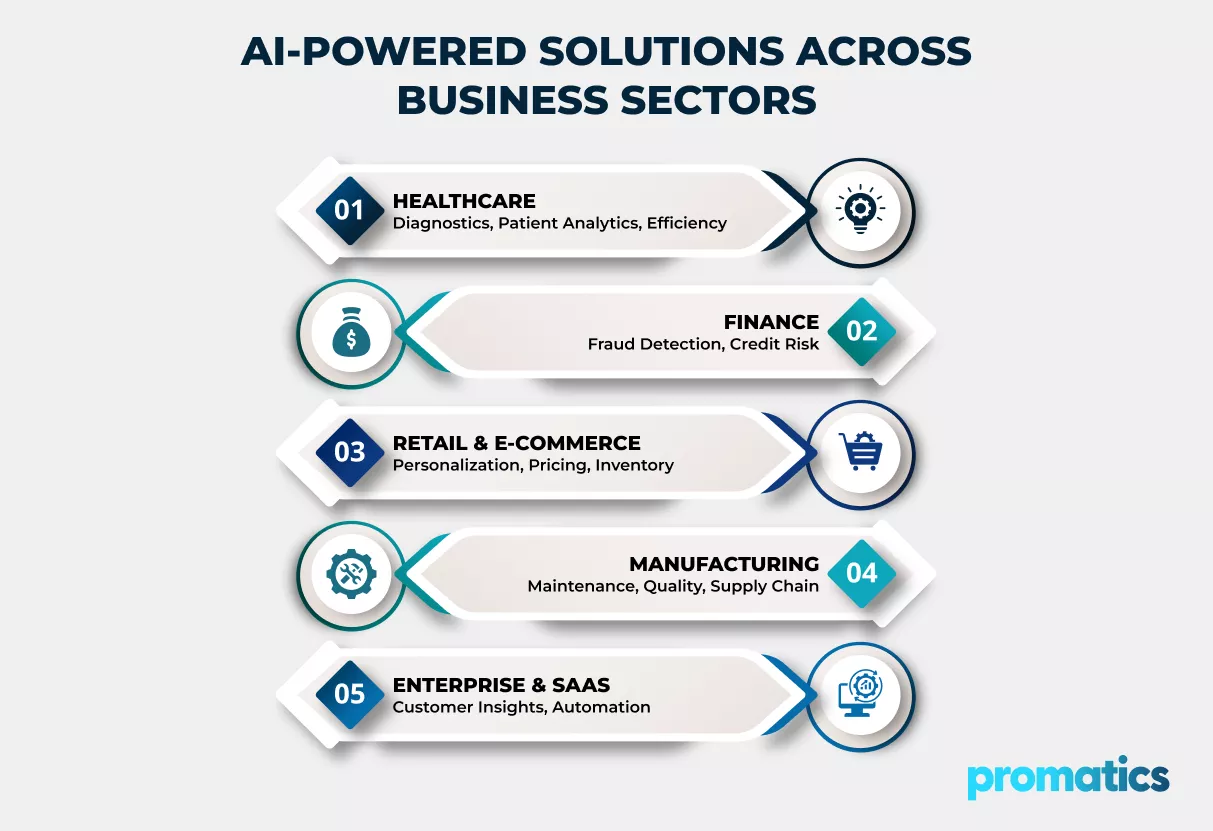
AI is no longer industry-specific; it is becoming foundational across sectors.
Why Choose Promatics Technologies for AI Development?
As a trusted Promatics Technologies, Promatics Technologies delivers end-to-end artificial intelligence development services designed for modern, data-driven businesses.
Promatics helps organizations:
- Identify high-value AI use cases
- Build custom, scalable AI solutions
- Integrate AI with existing systems
- Optimize and scale AI initiatives over time
With a strong focus on business outcomes, security, and scalability, Promatics supports enterprises at every stage of their AI journey, from automation to true intelligence.
Conclusion
The transition from automation to intelligence marks a defining shift in digital transformation. AI development companies are no longer just implementing tools; they are enabling intelligent ecosystems that learn, adapt, and evolve with the business.
With the right AI development services and an experienced partner like Promatics Technologies, organizations can unlock smarter decision-making, operational efficiency, and long-term competitive advantage.
Artificial intelligence is no longer the future; it is the foundation of intelligent enterprises today.
