AI/ML Development Solutions: How Enterprises Are Building Smarter Applications

TL;DR
- AI/ML development solutions enable businesses to automate workflows, improve decision-making, and deliver personalized customer experiences.
- Modern enterprise AI combines machine learning, Generative AI, AI agents, LLMs, RAG, and MLOps into scalable, production-ready solutions.
- AI adoption is growing rapidly, but successful implementation requires quality data, governance, cloud infrastructure, and expert development.
- Custom AI solutions provide greater flexibility, security, and scalability than off-the-shelf AI tools.
- Partnering with an experienced machine learning development company helps organizations accelerate AI adoption while maximizing long-term ROI.
Artificial Intelligence (AI) is no longer a futuristic concept; it’s a business growth driver. According to McKinsey, 92% of organizations plan to increase their AI investments over the next three years, while IBM reports that 61% of CEOs are already adopting AI agents or preparing to scale them across their organizations.
Across healthcare, finance, retail, manufacturing, logistics, and other industries, enterprises are using AI to automate operations, enhance customer experiences, and make faster, data-driven decisions. However, building enterprise AI applications requires much more than integrating an AI model or chatbot.
Organizations need scalable architectures, high-quality data, secure infrastructure, and continuous optimization to unlock long-term business value.
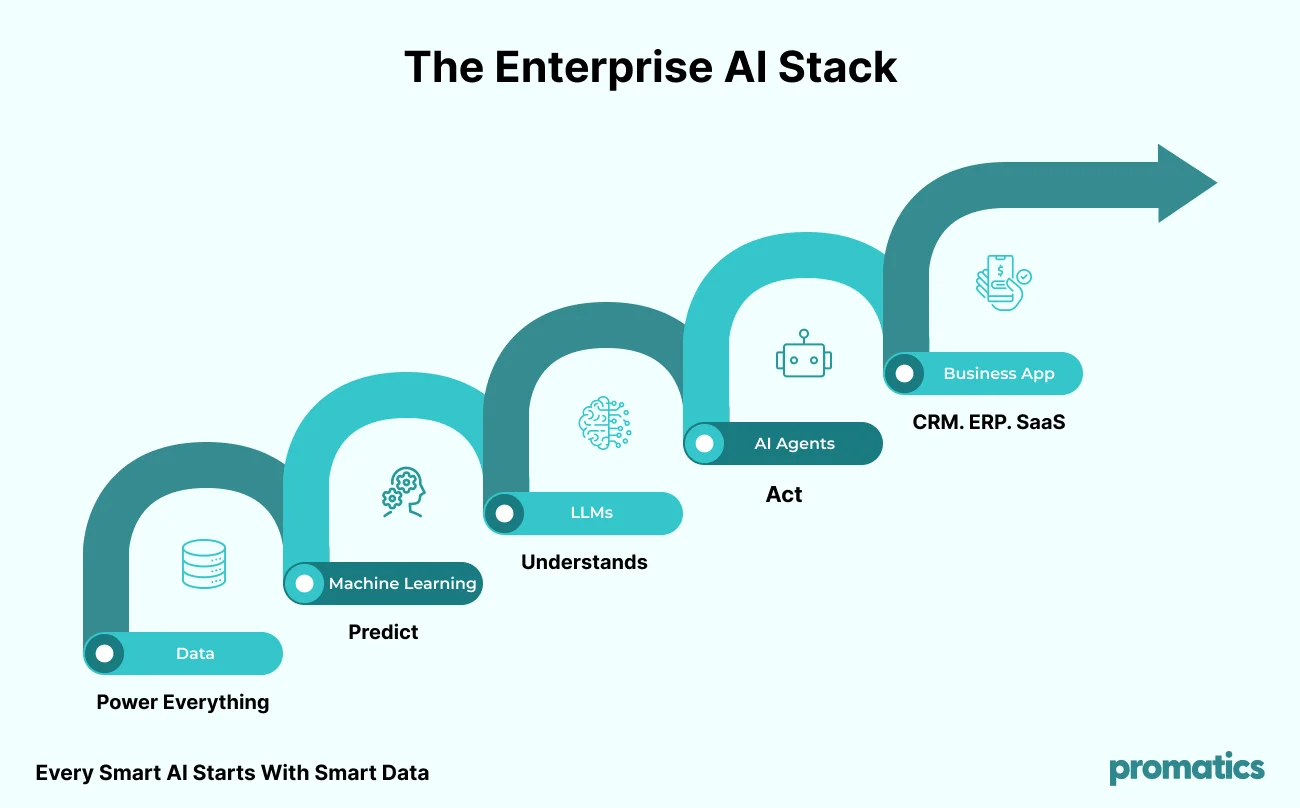
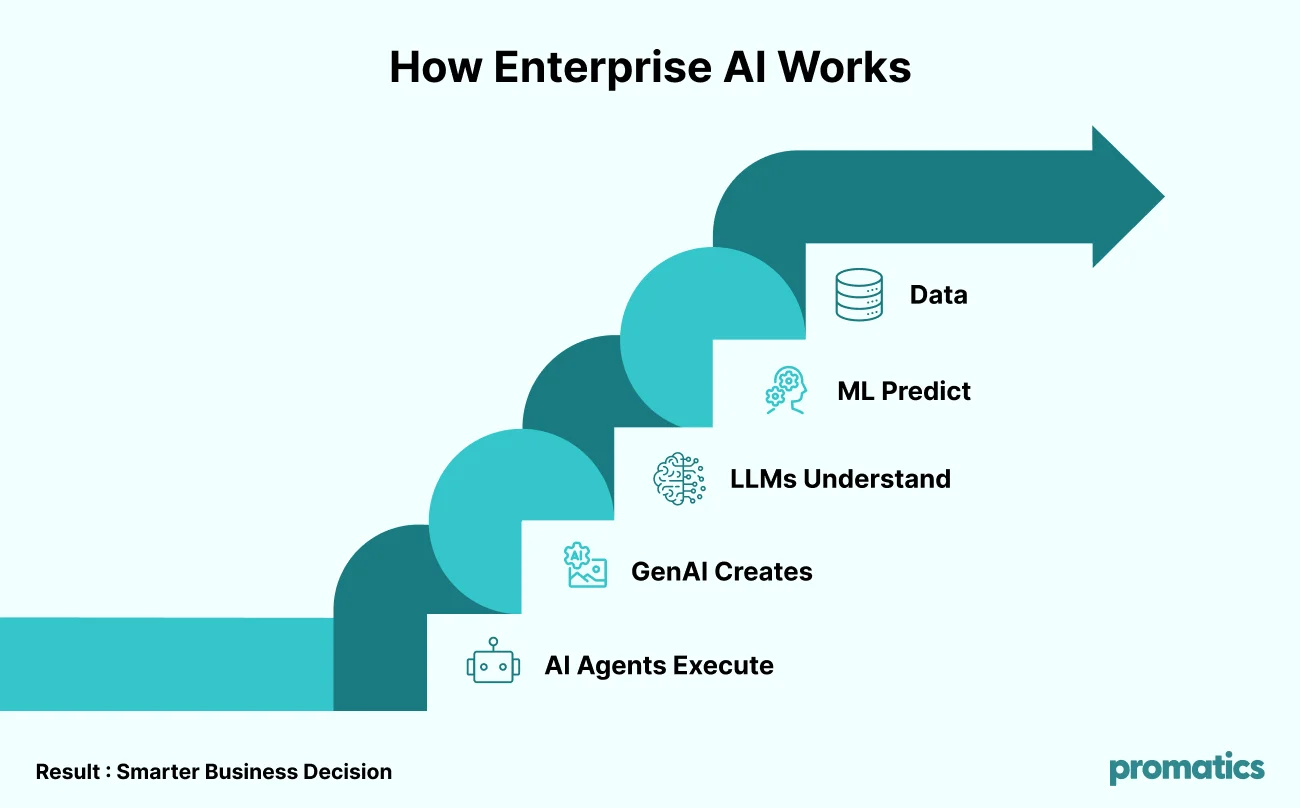
Modern AI/ML development solutions combine machine learning, generative AI, large language models (LLMs), AI agents, retrieval-augmented generation (RAG), and MLOps to build intelligent applications that solve real-world business challenges.
In this blog, we’ll explore how enterprises are adopting AI, the technologies behind successful AI applications, implementation best practices, and why investing in AI/ML development services has become a strategic priority for businesses worldwide.
What Are AI/ML Development Solutions?
AI/ML development solutions involve designing, building, deploying, and optimizing intelligent applications that use artificial intelligence (AI) and machine learning (ML) to automate processes, analyze data, predict outcomes, and improve business efficiency.
Unlike traditional software that follows fixed rules, AI-powered applications learn from data and user interactions, enabling them to adapt, improve, and make smarter decisions over time.
A typical AI/ML development solution includes:
- AI strategy and consulting
- Data engineering
- Machine learning model development
- Deep learning
- Natural Language Processing (NLP)
- Computer Vision
- Predictive analytics
Rather than replacing existing systems, AI enhances platforms like CRM, ERP, HRMS, eCommerce applications, and customer portals, helping businesses build smarter workflows and deliver better customer experiences.
For example:
- eCommerce: Recommend products based on customer behavior to increase conversions and average order value.
- Healthcare: Use AI-powered diagnostics to identify patterns in medical images.
- Finance: Detect fraudulent transactions in real time with machine learning.
- Manufacturing: Predict equipment failures to reduce downtime.
- Logistics: Optimize delivery routes to lower costs and improve efficiency.
While off-the-shelf AI tools handle general tasks, they often lack the flexibility for industry-specific workflows, enterprise integrations, and compliance requirements.
Custom AI development delivers greater value by building solutions tailored to your business processes, technology stack, and growth goals, ensuring seamless integration, stronger security, and better scalability.
Why Businesses Choose Custom AI Development
As AI adoption grows, businesses are shifting from generic tools to tailored solutions. AI software development services help organizations:
- Build AI around unique business workflows
- Integrate with CRM, ERP, HRMS, and legacy systems
- Ensure enterprise-grade security and compliance
- Scale as business needs evolve
- Retain ownership of AI models and data
- Maximize long-term ROI
Promatics Insight
As AI evolves, businesses need to understand which technology best fits their goals. Every business has unique operational challenges, data environments, and customer expectations. At Promatics, we help organizations move beyond generic AI tools by developing secure, scalable, and business-specific AI solutions.
From AI consulting services and machine learning development to Generative AI, AI agent development, and enterprise AI integration, our team builds intelligent applications designed to deliver measurable business outcomes.
Build AI That Fits
| Generic AI | Custom AI |
| One-size | Tailored |
| Limited | Flexible |
| Shared | Private |
| Basic | Enterprise |
| Short-term | Scalable |
Custom AI grows with your business
AI vs Machine Learning vs Generative AI vs AI Agents
As AI evolves, businesses need to understand which technology best fits their goals.
| Technology | Purpose | Common Use Cases |
| Artificial Intelligence (AI) | Simulates human intelligence | Automation, decision support, business intelligence |
| Machine Learning (ML) | Learns from data to make predictions | Fraud detection, forecasting, predictive maintenance |
| Generative AI | Creates text, code, images, and more | Content creation, summarization, coding |
| Large Language Models (LLMs) | Understand and generate language | Chatbots, enterprise search, knowledge management |
| AI Agents | Execute multi-step tasks autonomously | Customer support, workflow automation, IT operations |
These technologies work best together. For example, an AI support platform can combine LLMs for conversations, ML for intent prediction, and AI agents to automate customer requests.
How Promatics Delivers Enterprise AI Solutions
At Promatics, we build custom AI solutions by combining machine learning, generative AI, AI agents, and cloud-native technologies. From strategy and integration to deployment and optimization, we help businesses develop scalable AI applications that deliver measurable results.
Why Enterprises Are Investing in AI/ML Development Solutions
AI is no longer limited to automation; it’s driving digital transformation, improving decision-making, and creating new business opportunities. However, businesses need custom AI development services that align with their goals, integrate with existing systems, and scale securely.
According to the Kyndryl AI Readiness Report 2025, many organizations still struggle to operationalize AI due to fragmented data, legacy infrastructure, governance challenges, and limited AI expertise. Businesses with strong AI readiness are far more likely to achieve measurable results.
Partnering with an experienced AI/ML development company helps reduce implementation risks and accelerate time-to-market.
1. Smarter Business Decisions with Predictive Analytics
Machine learning transforms enterprise data into actionable insights by identifying patterns and predicting future outcomes.
Common use cases:
- Demand forecasting
- Inventory optimization
- Customer churn prediction
- Fraud detection
- Financial forecasting
- Risk management
2. Intelligent Process Automation
Unlike traditional automation, AI understands context, processes documents, and executes complex workflows.
Common use cases:
- Invoice and claims processing
- Contract analysis
- Resume screening
- Customer onboarding
- Compliance workflows
Modern AI agents can plan, reason, access enterprise data, and automate multi-step business processes.
3. Hyper-Personalized Customer Experiences
AI analyzes customer behavior to deliver personalized experiences across every touchpoint.
Use cases include:
- Product recommendations
- AI chatbots
- Intelligent search
- Customer segmentation
- Dynamic pricing
- Personalized marketing
Businesses investing in AI application development improve engagement, retention, and customer lifetime value.
4. Cost Optimization and Operational Efficiency
AI improves efficiency by reducing manual work and optimizing business operations.
Common applications:
- Predictive maintenance
- Supply chain optimization
- Route planning
- Workforce scheduling
- Energy forecasting
- Automated quality inspection
5. Accelerating Innovation and Competitive Advantage
AI enables businesses to launch smarter products and create new revenue opportunities.
Organizations use AI to:
- Build AI-powered SaaS platforms
- Develop industry-specific AI copilots
- Improve software development
- Support employee decision-making
- Create new AI-driven services
Why Do Businesses Choose Promatics?
As a trusted AI development company, Promatics combines AI consulting, machine learning, generative AI, cloud engineering, and enterprise software development to build secure, scalable AI solutions that deliver real business outcomes.
Enterprise AI Development Lifecycle
Successful AI implementation isn’t just about building a model, it’s about creating an end-to-end ecosystem that continuously delivers business value.
At Promatics, our AI/ML development services follow a structured development framework that minimizes risk while accelerating deployment.
Step 1: AI Discovery & Business Consulting
Every successful AI project begins with understanding the business problem rather than selecting a technology.
During this phase, we:
- Identify AI opportunities
- Define business objectives
- Prioritize use cases
- Assess ROI potential
- Create an implementation roadmap
Deliverables
- AI strategy
- Technical roadmap
- Success metrics
Step 2: Data Engineering & Preparation
AI models are only as good as the data they’re trained on.
This stage includes:
- Data collection
- Cleaning
- Annotation
- Transformation
- Feature engineering
- Data governance
High-quality data significantly improves model accuracy and reliability.
Step 3: Model Development
Our AI engineers build models tailored to each business problem.
Technologies include:
- Machine Learning
- Deep Learning
- NLP
- Computer Vision
- Generative AI
- LLMs
Rather than selecting the most complex model, we focus on choosing the approach that delivers the highest business value.
Step 4: Enterprise Integration
This is where many AI projects fail.
AI should work seamlessly with:
- CRM
- ERP
- HRMS
- Mobile apps
- Web applications
- APIs
- Legacy systems
Promatics Advantage
We specialize in integrating AI into existing enterprise ecosystems without disrupting ongoing business operations.
Step 5: Testing & Validation
Before deployment, AI models undergo rigorous testing.
Key evaluation metrics include:
- Accuracy
- Precision
- Recall
- F1 Score
- Response latency
- Business KPIs
Testing ensures the solution performs reliably under real-world conditions.
Step 6: Production Deployment
Deployment involves much more than launching a model.
Our deployment process includes:
- Cloud infrastructure
- API deployment
- Security implementation
- CI/CD pipelines
- MLOps
- Performance monitoring
Step 7: Continuous Monitoring & Optimization
AI models evolve as business data changes.
Our MLOps services continuously monitor:
- Model drift
- Prediction accuracy
- Infrastructure health
- User feedback
- Business performance
Continuous optimization ensures long-term AI success.
Technologies Powering Modern AI/ML Development Solutions
Enterprise AI combines multiple technologies that work together to build intelligent applications.
Instead of relying on a single AI model, modern AI ecosystems integrate specialized technologies for prediction, automation, content generation, and decision-making.
Core technologies include:
- Artificial Intelligence
- Machine Learning
- Deep Learning
- Natural Language Processing (NLP)
- Computer Vision
- Predictive Analytics
- Generative AI
- Large Language Models (LLMs)
- AI Agents
- Retrieval-Augmented Generation (RAG)
- Vector Databases
- MLOps
- Cloud Computing
Promatics Technology Stack
We build enterprise-grade AI solutions using industry-leading frameworks and cloud platforms, enabling businesses to develop scalable, secure, and future-ready applications.
Whether you need Generative AI development, AI agent development, machine learning development, or custom AI software development, our team selects the right technologies based on your business objectives rather than adopting a one-size-fits-all approach.
Common Challenges in Enterprise AI Implementation (And How to Overcome Them)
Artificial intelligence has the potential to transform business operations, but implementing enterprise AI successfully isn’t without challenges. While AI technologies have become more accessible, many organizations still struggle to move beyond pilot projects due to technical, organizational, and operational roadblocks.
Understanding these challenges early and partnering with an experienced AI development company can significantly improve implementation success and maximize long-term ROI.
1. Poor Data Quality and Data Silos
AI models are only as good as the data they’re trained on.
Many organizations store business data across disconnected systems, spreadsheets, legacy applications, and cloud platforms. Inconsistent, incomplete, or duplicate data can significantly reduce model accuracy and limit AI performance.
Common data challenges include:
- Duplicate records
- Missing information
- Inconsistent formatting
- Departmental data silos
- Outdated datasets
- Limited real-time data access
Without reliable data, even the most advanced machine learning model will struggle to produce meaningful business insights.
Best Practice
Before investing in AI, organizations should establish a strong data foundation by implementing data governance, cleaning historical datasets, and creating centralized data pipelines.
2. Integrating AI with Existing Enterprise Systems
One of the biggest misconceptions about AI is that businesses need to replace their existing software.
In reality, enterprise AI delivers the greatest value when it integrates seamlessly with existing platforms such as the following:
- CRM
- ERP
- HRMS
- Accounting software
- Supply chain systems
- Customer portals
- Mobile applications
- Legacy enterprise software
However, integrating AI with multiple business applications often involves complex APIs, inconsistent data structures, and security considerations.
Best Practice
Choose custom AI development services that prioritize interoperability, API-first architecture, and scalable system integration rather than standalone AI tools.
3. Security, Privacy, and Regulatory Compliance
As organizations increasingly use AI to process sensitive business and customer information, security and compliance have become top priorities.
Industries such as healthcare, finance, insurance, and legal services must comply with strict regulations regarding data storage, access control, and privacy.
Common concerns include:
- Unauthorized data access
- AI-generated data leakage
- Regulatory compliance
- Model transparency
- Data residency
- User authentication
Ignoring governance can expose businesses to significant operational and reputational risks.
Best Practice
Security should be built into every stage of the AI development lifecycle rather than treated as an afterthought.
How Promatics Helps
Our AI software development services incorporate enterprise-grade security practices, secure API integrations, access controls, encryption, audit logging, and governance frameworks that help organizations meet industry-specific compliance requirements while protecting sensitive business information.
4. Selecting the Right AI Technology
With hundreds of AI tools available today, many organizations struggle to decide whether they need the following:
- Machine Learning
- Generative AI
- AI Agents
- Computer Vision
- NLP
- Predictive Analytics
- Large Language Models
- Fine-tuned Models
- Retrieval-Augmented Generation (RAG)
Choosing technology based solely on industry trends often leads to unnecessary complexity and increased costs.
Best Practice
Instead of starting with technology, start with the business problem. Select AI capabilities that directly support measurable business objectives.
How Promatics Helps
As an experienced AI consulting company, Promatics evaluates your business goals before recommending the right AI architecture. Whether your project requires predictive analytics, Generative AI, AI agents, or an end-to-end enterprise AI platform, we design solutions around business outcomes, not technology hype.
5. AI Talent and Skill Gaps
Building enterprise-grade AI applications requires expertise across multiple disciplines, including:
- Data engineering
- Machine learning
- Cloud architecture
- DevOps
- MLOps
- Prompt engineering
- LLM orchestration
- UX design
- Enterprise software integration
Hiring and retaining specialists across all these areas can be expensive and time-consuming.
Best Practice
Many organizations accelerate AI adoption by partnering with an experienced machine learning development company that provides multidisciplinary expertise under one roof.
6. Model Drift and Long-Term Performance
AI implementation doesn’t end after deployment. As customer behavior, business processes, and market conditions evolve, machine learning models gradually lose accuracy, a phenomenon known as model drift.
Without continuous monitoring, AI systems may produce unreliable predictions or outdated recommendations.
Best Practice
Implement MLOps practices that continuously monitor model performance, retrain models using new datasets, and automate deployments.
Enterprise AI Maturity Framework
Many organizations view AI implementation as a one-time project.
In reality, enterprise AI is an ongoing transformation that evolves as business needs, data, and technology mature.
At Promatics, we help businesses progress through every stage of their AI journey using a structured implementation framework.
| AI Maturity Stage | Business Focus | How Promatics Helps |
| Discover | Identify AI opportunities and prioritize use cases | AI consulting, workshops, business case development |
| Prepare | Organize data, modernize infrastructure, establish governance | Data engineering, cloud migration, security planning |
| Build | Develop AI models and intelligent applications | Machine learning development, Generative AI, AI agents |
| Deploy | Integrate AI into enterprise systems | ERP, CRM, HRMS integration, APIs, cloud deployment |
| Optimize | Monitor performance and continuously improve models | MLOps, model retraining, analytics, long-term support |
This framework enables organizations to adopt AI strategically rather than treating it as a standalone technology initiative.
How to Measure the ROI of AI/ML Development Solutions
One of the most common questions business leaders ask before investing in AI is:
How do we measure whether our AI investment is actually delivering value?
Unlike traditional software projects, AI success should be evaluated using a combination of technical performance and business impact.
Instead of focusing solely on model accuracy, organizations should define measurable KPIs before development begins.
Business KPIs
Track how AI contributes to organizational performance through metrics such as:
- Operational cost reduction
- Revenue growth
- Customer acquisition
- Customer retention
- Average response time
- Employee productivity
- Process automation rate
AI Performance KPIs
Monitor the health and effectiveness of AI models using:
- Prediction accuracy
- Precision and recall
- F1 score
- Response latency
- Model drift
- Data quality
How Promatics Maximizes ROI
Every AI initiative begins with clearly defined business objectives and success metrics. Our team works with stakeholders to establish baseline KPIs, prioritize high-impact use cases, and continuously optimize AI models after deployment. This outcome-driven approach helps organizations achieve measurable value rather than simply deploying AI for the sake of innovation.
Why Custom AI Development Outperforms Off-the-Shelf AI Solutions
Pre-built AI platforms can be useful for general productivity tasks, but they often lack the flexibility, scalability, and integrations required for enterprise environments.
Organizations looking to automate complex workflows or build AI-powered products typically benefit more from custom AI development services.
| Off-the-Shelf AI Tools | Custom AI Development |
| Generic functionality | Tailored to your business workflows |
| Limited customization | Fully customized features and models |
| Basic integrations | Seamless ERP, CRM, HRMS, and API integrations |
| Shared AI capabilities | Business-specific intelligence and workflows |
| Vendor limitations | Full ownership of your solution and data |
| Difficult to scale for unique needs | Built to scale as your business grows |
Custom AI solutions also provide stronger governance, better performance optimization, and the flexibility to incorporate emerging technologies such as AI agents, multimodal AI, and industry-specific copilots.
Why Businesses Partner with Promatics
Whether you’re building an AI-powered SaaS platform, modernizing enterprise software, or integrating intelligent automation into existing applications, Promatics delivers end-to-end AI development services tailored to your business goals.
From AI strategy and consulting to machine learning development, Generative AI, AI agent implementation, and MLOps, we help organizations build secure, scalable, and future-ready AI solutions that generate measurable business impact.
Future Trends Shaping Enterprise AI
Enterprise AI continues to evolve rapidly, creating new opportunities for organizations to innovate and improve operational efficiency.
Businesses investing in AI today should prepare for the following trends.
AI Agents Will Become Digital Employees
AI agents are moving beyond customer support to autonomously execute business processes across HR, finance, IT operations, procurement, and customer service.
Future enterprise software will increasingly rely on AI agents capable of planning, reasoning, and collaborating across multiple systems.
Industry-Specific AI Models
Instead of relying solely on general-purpose models, organizations are developing specialized AI models trained on industry-specific data.
These models provide greater accuracy, stronger compliance, and improved business relevance.
Multimodal AI
Future AI systems will process multiple data types simultaneously, including:
- Text
- Images
- Audio
- Video
- Documents
- Structured business data
This will enable richer enterprise applications across healthcare, manufacturing, retail, and logistics.
Responsible AI and Governance
As AI adoption grows, organizations will place greater emphasis on:
- Explainable AI
- Ethical AI
- Bias monitoring
- Data privacy
- AI governance
- Regulatory compliance
Responsible AI practices will become a competitive differentiator for enterprise organizations.
Smaller, More Efficient AI Models
Many businesses are adopting smaller language models (SLMs) for internal applications where speed, lower infrastructure costs, and data privacy are more important than using extremely large foundation models.
SLMs can deliver strong performance for domain-specific tasks while reducing operational costs.
AI + Human Collaboration
Rather than replacing employees, AI will increasingly function as a productivity partner.
From software development and customer support to finance and operations, AI copilots will help employees complete work faster while enabling better decision-making.
Organizations that combine human expertise with AI-driven automation are likely to achieve the greatest long-term value.
Conclusion
AI is transforming how businesses operate, automate processes, and deliver better customer experiences. But achieving real results requires more than adopting the latest AI technology; it takes the right strategy, quality data, and expert implementation.
At Promatics, we help businesses design, develop, and deploy secure, scalable AI solutions tailored to their goals. Whether you’re starting your AI journey or expanding existing capabilities, our team is here to help.
Ready to turn AI into a competitive advantage? Contact Promatics today to build AI solutions that deliver measurable business impact.
