Which Language is Best for Mobile App Development?
TL;DR
- Comparison of Swift, Kotlin, Java, Dart, JavaScript, and Python.
- Best programming languages for Android, iOS, and hybrid apps.
- Performance, scalability, and development speed considerations.
- Language selection based on project type and business goals.
- Emerging trends shaping mobile app programming technologies.
Mobile apps are now a part of our daily lives. From shopping and payments to learning and healthcare, everything is just a tap away. With so many new apps coming up, businesses need the right language to build fast, secure, and reliable solutions.
In India, where 750+ million smartphone users are driving the digital economy, this choice becomes even more critical. Whether you’re a startup, SME, or enterprise, this guide will walk you through the best languages for mobile app development in 2025 and help you pick the one that fits your needs.
Why Choosing the Right Programming Language Matters
The language behind your mobile app does more than just define how it’s coded; it shapes the user experience, long-term stability, and cost efficiency of your project.
- Performance & Speed: Indian users expect apps that load instantly, even on budget smartphones or slower networks. Languages like Swift and Kotlin enable high responsiveness, while cross-platform options like Flutter or React Native balance speed with flexibility.
- Cost Efficiency: Startups often operate on tight budgets. Using cross-platform languages such as JavaScript or Dart lets developers maintain a single codebase for both iOS and Android, significantly cutting development time and costs.
- Scalability & Maintenance: A language supported by an active community ensures frequent updates, easier bug fixes, and long-term app viability. Kotlin and TypeScript, for example, are growing quickly and offer strong community support.
- Security: With India tightening data protection laws, choosing a language with robust security frameworks is critical. Native options like Swift and Java offer built-in support for encryption and secure coding practices.
- Developer Availability: India’s vast developer pool favors widely used languages like Java, JavaScript, and Kotlin. Easy access to skilled talent reduces project delays and ensures smoother scaling as your app grows.
In short, selecting the right language is not just a technical choice; it’s a strategic decision that can determine your app’s success in India’s competitive digital ecosystem.
Types of Languages for Mobile App Development
1. Swift
Swift is Apple’s official programming language for iOS, macOS, watchOS, and tvOS. Swift has current syntax and built-in safety measures that make it much less likely to fail while running and make frequent programming mistakes.
Its speed and memory management make it one of the most efficient languages for mobile app development. With Apple’s backing, Swift is regularly updated to support new iOS features, ensuring apps remain compatible with the latest devices.
Pros:
- Optimized for Apple hardware and software.
- Easy-to-read syntax that reduces development time.
- ABI stability ensures forward compatibility with future iOS updates.
Cons:
- Exclusively tied to Apple’s ecosystem, making it unsuitable for Android apps.
- Smaller developer base in India compared to Java or JavaScript, raising hiring challenges.
Best For: Businesses targeting premium iOS users in India’s fintech, healthcare, or lifestyle sectors, where seamless integration with features like Apple Pay or Face ID is vital.
2. Java
Java has been the foundation of Android development for over a decade and remains one of the most trusted languages globally. Its object-oriented design and JVM (Java Virtual Machine) allow for reliable, secure, and portable applications. With extensive libraries and frameworks, Java supports everything from enterprise-scale Android apps to e-commerce platforms.
Pros:
- Mature ecosystem with thousands of libraries and frameworks.
- Backward compatibility ensures older Android versions remain supported.
- A large pool of experienced developers in India reduces hiring challenges.
Cons:
- Verbose syntax leads to longer code and slower development.
- Lacks some of the modern conveniences offered by Kotlin.
Best For: Enterprise applications, government projects, and large-scale Android apps in India, where stability and backward compatibility are essential.
3. Kotlin
Google has said that Kotlin is the best language for Android, and it has fast become more popular than Java for new applications. With concise syntax and full interoperability with Java, Kotlin makes it easier to write clean, maintainable code.
Features like coroutines support asynchronous programming, improving app responsiveness, a critical factor in India’s budget smartphone-driven market.
Pros:
- Concise and expressive, reducing boilerplate code.
- Null safety prevents many common crashes.
- Seamlessly interoperates with Java, making migration easier.
Cons:
- Still growing in ecosystem maturity compared to Java.
- Some developers transitioning from Java face a learning curve.
Best For: Startups and enterprises creating modern Android apps that need to scale quickly and deliver fast, crash-free experiences.
4. JavaScript
JavaScript powers web and mobile applications alike. With frameworks like React Nativeand Ionic, developers can build cross-platform apps using a single codebase. For Indian startups looking to launch quickly with limited budgets, JavaScript provides flexibility and faster time-to-market.
Pros:
- Huge global community and readily available Indian developers.
- Cross-platform frameworks save time and cost.
- Ideal for teams with a web development background.
Cons:
- Performance can lag behind native apps, especially in graphics-heavy projects.
- Device-specific features often require third-party plugins, which may be unreliable.
Best For: SMEs and startups in India building budget-friendly apps or MVPs for e-commerce, edtech, or social networking.
5. Objective-C
Objective-C was Apple’s primary programming language before Swift’s introduction. While its popularity has declined, many legacy iOS applications are still maintained using Objective-C. Businesses with long-standing iOS apps often rely on Objective-C for updates or adding new features.
Pros:
- Mature ecosystem with a wide library base.
- Dynamic runtime offers flexibility.
- Crucial for maintaining older iOS projects.
Cons:
- Outdated syntax compared to Swift.
- A shrinking community makes hiring Objective-C developers difficult.
Best For: Businesses with legacy iOS applications that require ongoing support without a complete rewrite.
6. Dart (Flutter)
Dart, combined with Flutter, has surged in popularity as a cross-platform solution. Flutter compiles into native ARM code, ensuring high performance across both iOS and Android. Its widget-based approach makes creating attractive UIs easier, which is particularly useful in India’s competitive consumer app market, where user experience is a key differentiator.
Pros:
- Single codebase for iOS and Android.
- Hot reload speeds up development and iteration.
- Strong support from Google and rapid community growth.
Cons:
- Smaller ecosystem compared to JavaScript.
- Some platform-specific features require extra custom coding.
Best For: Startups and SMEs needing visually rich cross-platform apps such as edtech, delivery, and on-demand services.
7. Python
Python is a very flexible programming language that is used a lot for AI, machine learning, and backend services. While it’s not a first choice for native mobile development, Python plays a vital role in data-driven mobile apps by powering APIs and backend systems.
Pros:
- Easy-to-learn syntax, ideal for rapid prototyping.
- Excellent for integrating AI/ML features through frameworks like TensorFlow.
- India has a lot of talented people who can work on backend and AI projects.
Cons:
- Mobile UI development frameworks (Kivy, BeeWare) are not as robust.
- Slower performance compared to compiled languages.
Best For: Apps requiring AI-driven recommendations, predictive analytics, or heavy data processing, common in India’s fintech and edtech sectors.
8. C# (.NET MAUI, Unity)
C# is popular in both enterprise app development and the gaming industry. With .NET MAUI, developers can create cross-platform apps, while Unity (powered by C#) dominates global and Indian gaming development.
Pros:
- Strong support for enterprise-grade cross-platform applications.
- Unity engine allows powerful 2D/3D game development.
- Backed by Microsoft’s ecosystem and security standards.
Cons:
- Larger app sizes may deter users on budget devices.
- The development environment is more Windows-focused.
Best For: Mobile games, AR/VR apps, and enterprise apps integrated with Microsoft Azure or Office tools.
9. TypeScript
TypeScript is a superset of JavaScript that offers type safety and additional tools. Increasingly popular in mobile development, it makes apps more reliable and easier to scale. With React Native supporting TypeScript out of the box, many teams are switching for long-term maintainability.
Pros:
- Static typing prevents runtime errors.
- Better tooling and refactoring support.
- Scales well for large codebases.
Cons:
- Requires compilation, adding build steps.
- Not all JavaScript libraries have type definitions.
Best For: Large, complex apps such as financial services, healthcare, or B2B solutions that demand high reliability.
10. C++
C++ is one of the most powerful programming languages because it lets you control memory at a low level and has the best performance. It is commonly used in performance-critical applications, including mobile games and AR/VR tools.
Pros:
- High performance for resource-heavy apps.
- Widely used in game engines like Unreal Engine.
- Enables precise hardware control.
Cons:
- Complex syntax with a steep learning curve.
- Longer development cycles compared to modern languages.
Best For: Gaming apps, AR/VR, and tools requiring maximum speed and performance.
11. HTML, CSS, JavaScript (Hybrid)
Hybrid frameworks like Ionic and Cordova allow developers to use web technologies for mobile apps. This is cost-effective and great for quickly testing ideas, but hybrid apps may not offer the same performance as native solutions.
Pros:
- Reuses web development skills for mobile apps.
- Faster time-to-market with shared codebases.
- Lower development costs.
Cons:
- Limited access to device features.
- Slower performance and less responsive UI.
Best For: MVPs, internal tools, and small-scale apps that don’t require advanced performance.
12. Lua
Lua is a simple programming language that is quite popular for making games. It powers engines like Corona SDK and is known for its speed and efficiency, even on low-end devices, a big plus in India’s diverse smartphone market.
Pros:
- Lightweight and fast execution.
- Easy to embed within applications.
- Great for optimizing apps on budget devices.
Cons:
- Small developer community outside gaming.
- Limited third-party libraries.
Best For: Lightweight games, utilities, and apps targeting lower-end Android devices.
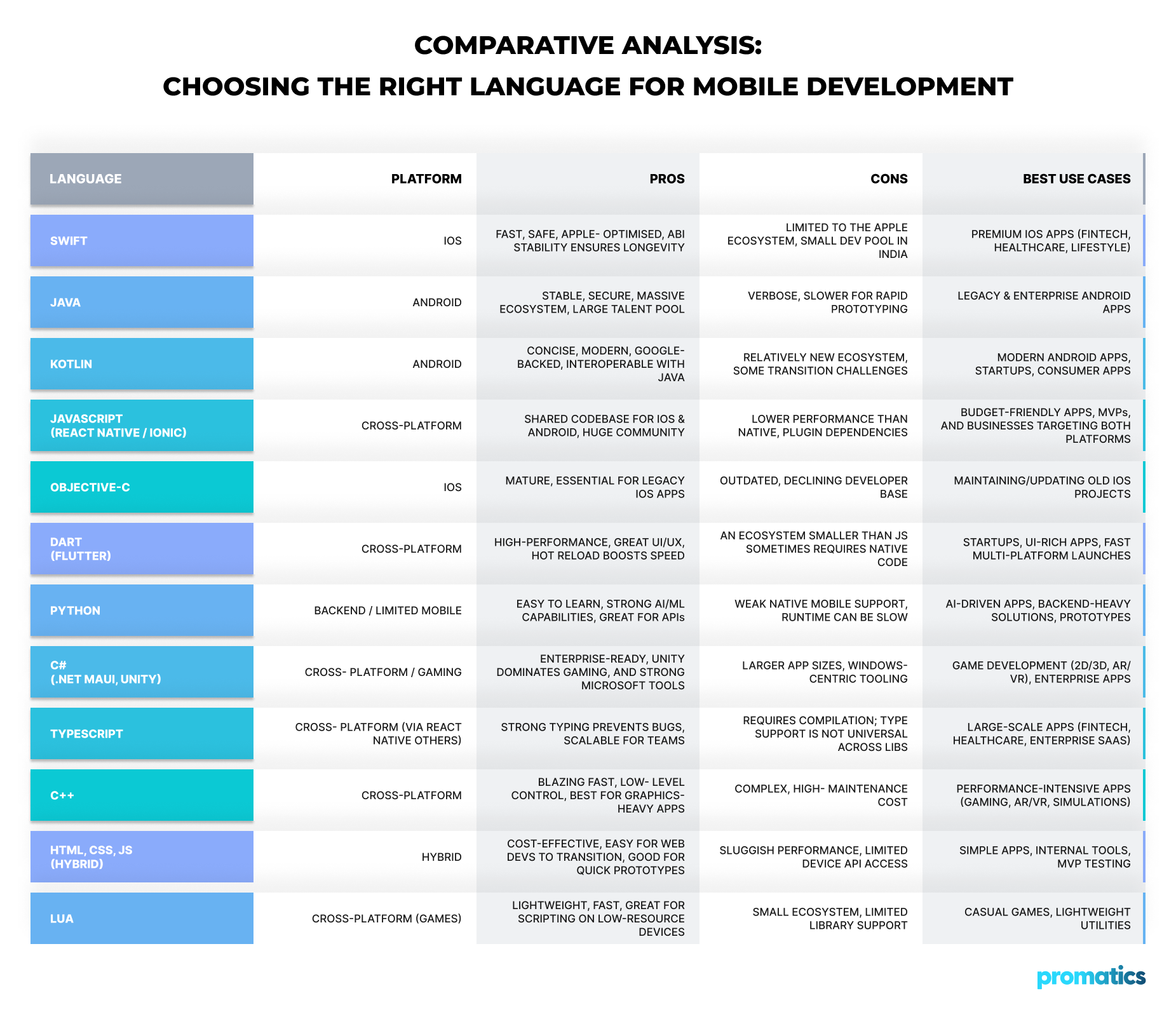
Comparison Table: Which Language Should You Choose?
Here’s a side-by-side comparison of the best languages for mobile app development in 2025, tailored for India’s rapidly growing digital market:
7 Key Factors to Consider Before Choosing a Mobile App Development Language
When deciding on the best language for mobile app development, it’s not just about features; it’s about aligning technology with your business goals, user expectations, and India’s dynamic digital market. Here are the seven key factors you should weigh before finalizing your choice:
1. Target Platform (iOS, Android, or Cross-Platform)
Your target audience determines your platform. If your customers are mostly iPhone users in urban India, Swift is the best bet. For Android, which dominates the Indian market, Kotlin or Java are the natural choices. If you want to reach both platforms quickly, cross-platform solutions like Flutter (Dart) or React Native (JavaScript) are cost-efficient options.
2. App Complexity and Features
The complexity of your app influences the language choice.
- High-performance apps (gaming, fintech) benefit from native languages like Swift, Kotlin, or C++.
- Medium-complexity apps (e-commerce, food delivery) work well with Flutter or React Native.
- Simple apps or MVPs can be built with hybrid technologies(HTML, CSS, JavaScript) for faster launches.
3. Performance Requirements
In India, users expect apps that are lightweight and responsive, even on budget devices. For apps with real-time features, AR/VR, or 3D graphics, native options like C++, C# (Unity), or Swift/Kotlin deliver optimal performance. For standard apps, cross-platform tools balance speed with development efficiency.
4. App Development Time
If speed to market is your priority, choose a language that supports rapid prototyping. Flutter with hot reload and React Native with reusable components allow developers to launch apps quickly. In contrast, languages like Java or C++ may extend timelines but offer long-term stability.
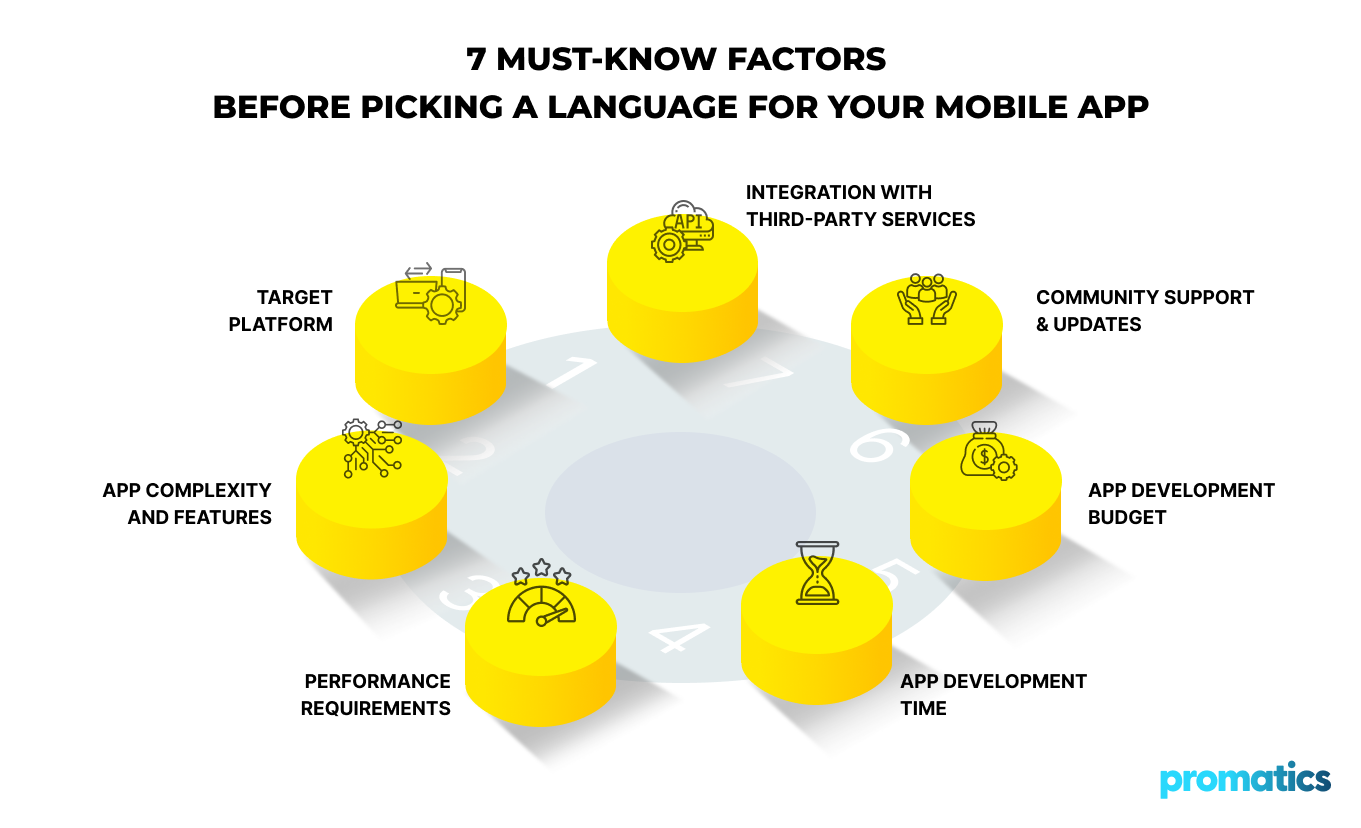
5. App Development Budget
Budget constraints are typical for startups and SMEs in India. Cross-platform frameworks like Flutter and React Native reduce costs by allowing a single codebase for iOS and Android. Native apps (Swift, Kotlin) may be more expensive but deliver better performance for industries like fintech and healthcare, where quality is non-negotiable.
6. Community Support & Updates
An active community ensures continuous learning, troubleshooting, and updates. Popular languages like Java, JavaScript, and Kotlin enjoy robust support, while newer languages like Dart and TypeScript are catching up fast. Choosing a language with frequent updates ensures your app stays compatible with evolving technologies like 5G and AI.
7. Integration with Third-Party Services
Most apps in India, whether in e-commerce, edtech, or healthtech, require integrations with payment gateways, APIs, or cloud services. Languages like Java, Kotlin, and Swift offer strong compatibility with third-party services. Meanwhile, cross-platform frameworks like Flutter and React Native provide plugins but may sometimes need custom coding for complex integrations.
CTA: Need help finalizing your tech stack? Book a free consultation with Promatics and let our experts guide you to the best solution.
3 Common Mistakes to Avoid
Choosing the best language for mobile app development is a strategic decision, but many businesses in India fall into common traps that can derail projects. Here are three mistakes you should avoid:
- Following Trends Blindly
Just because a language or framework is trending doesn’t mean it’s the right fit for your app. For example, Flutter may be popular, but if your target audience is exclusively iOS, Swift will serve you better. Always align language choice with business needs, not hype. - Ignoring Long-Term Scalability
An app’s lifecycle doesn’t end at launch; it grows with your business. Picking a language without considering future scalability can result in costly rewrites. Choosing well-supported languages like Kotlin, Swift, or TypeScript ensures your app evolves smoothly. - Overlooking Developer Availability
India has a vast developer pool, but not all skills are equally available. Choosing a niche language with limited talent can delay hiring and increase costs. Opting for widely adopted languages like Java, JavaScript, or Kotlin reduces this risk.
Avoiding these mistakes will save time, money, and effort, ensuring your app remains competitive in India’s fast-changing digital landscape.
Concluding Words
Now, as we’ve reached the end of this blog so let’s share a quick recap. Choosing the best language for mobile app development is one of the most important decisions businesses in India can make. It influences performance, scalability, user experience, and long-term costs.
With India’s digital economy booming, driven by 5G, AI, and government initiatives, apps must be fast, secure, and future-ready. There’s no single “perfect” language; the right choice depends on your target platform, budget, and business goals.
At Promatics Technologies, we’ve helped startups and enterprises build successful apps across every major programming language. Let’s build yours. Talk to our experts today.