Cross-Platform App Development in 2026: React Native vs Flutter vs MAUI

TL;DR
- Build apps faster across Android, iOS, web & desktop using a single codebase
- Flutter delivers smooth performance and visually rich UI experiences
- React Native speeds up development with the power of JavaScript
- Kotlin Multiplatform combines shared logic with native user experiences
- .NET MAUI is ideal for Microsoft-focused enterprise ecosystems
What makes some mobile apps scale effortlessly while others become difficult and expensive to maintain within just a few years? More often than not, the answer comes down to one critical factor: choosing the right development framework.
In 2026, businesses are under growing pressure to launch applications faster, reduce operational costs, and deliver seamless experiences across Android, iOS, web, and desktop platforms. This shift has transformed cross-platform app development from a budget-friendly alternative into a mainstream strategy for building scalable digital products.
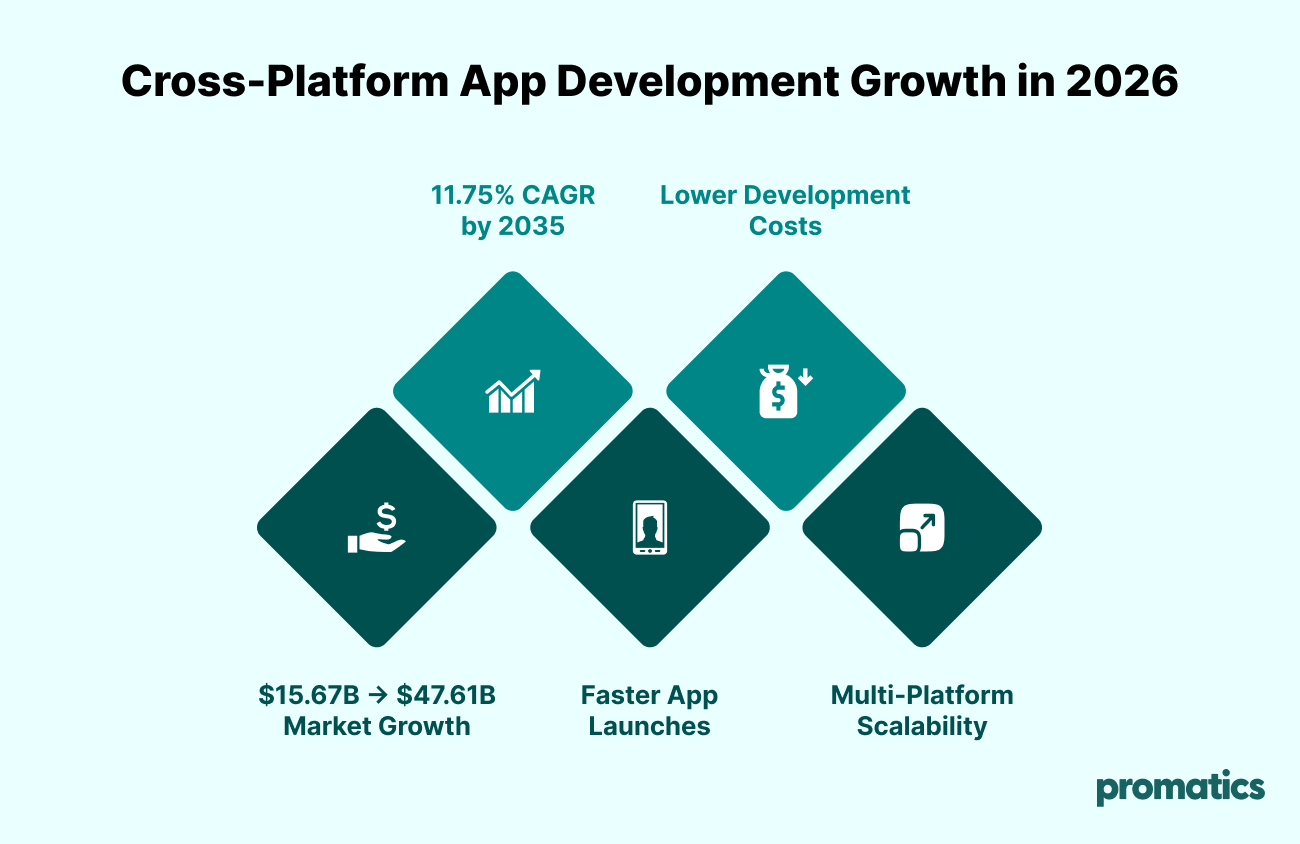
The industry’s rapid expansion reflects this transformation. Recent market reports suggest that the cross-platform app development framework market is projected to grow from $15.67 billion in 2025 to $47.61 billion by 2035, expanding at a CAGR of 11.75% during the forecast period. This surge highlights how businesses are increasingly investing in technologies that accelerate development, simplify maintenance, and support multi-platform scalability.
As demand continues rising, frameworks like Flutter app development, React Native app development, Kotlin Multiplatform, and .NET MAUI development are shaping the future of modern application development. Each framework offers unique strengths in architecture, scalability, code sharing, performance, and developer experience, making framework selection more strategic than ever before.
However, not all frameworks are designed for the same purpose. Some prioritize rendering performance and visually rich user interfaces, while others focus on native user experiences, enterprise integration, or rapid MVP development. A framework suitable for a startup may not always be ideal for enterprise-grade or performance-intensive applications.
In this blog, we compare the leading cross-platform app development frameworks in 2026 based on performance, development speed, scalability, ecosystem maturity, code-sharing efficiency, and real-world use cases. We also explore where native app development still remains the stronger long-term choice for highly specialized applications.
Exploring the Evolution of Flutter and React Native in 2026
Since their launch, Flutter app development and React Native app development have evolved into two of the most influential technologies in the cross-platform ecosystem. Their growing adoption reflects how businesses are increasingly prioritizing faster releases, scalable architectures, and seamless multi-platform experiences. Industry reports suggest that Flutter currently leads with nearly 46% developer adoption, while React Native continues maintaining a strong market presence because of its mature JavaScript ecosystem and rapid development capabilities.
Flutter has gained strong popularity for its optimized rendering engine, which delivers smooth animations, responsive interfaces, and visually consistent user experiences across Android, iOS, web, desktop, and embedded platforms. Its single codebase architecture simplifies maintenance and accelerates development workflows, although Flutter applications are often comparatively larger in size because of bundled rendering resources.
React Native, meanwhile, continues benefiting from its mature ecosystem and massive JavaScript community. Since it relies on native UI components, React Native applications feel more platform-native while still supporting substantial code reuse across platforms. Improvements like the Hermes engine and React Native’s New Architecture have also significantly improved startup speed, memory optimization, and application responsiveness.
The rapid growth of both frameworks also reflects a broader industry shift toward cross-platform mobile app development, where businesses increasingly seek faster time-to-market, lower operational costs, and easier maintenance through shared codebases. Reports suggest that cross-platform approaches can reduce development effort by up to 80% while accelerating delivery timelines by nearly 40% compared to traditional native development methods.
Despite the rise of cross-platform frameworks, native development using Kotlin, Java, or Swift still remains relevant for highly specialized and performance-intensive applications requiring deep hardware integration and platform-level optimization.
Flutter vs React Native: Detailed Comparison in 2026
| Feature | Flutter | React Native |
| Developed By | Meta | |
| Programming Language | Dart | JavaScript |
| UI Rendering | Uses its own rendering engine (Skia/Impeller) | Uses native UI components |
| Performance | Near-native performance with smooth animations | Good native-like performance |
| Code Reusability | 90–95% | 70–80% |
| Development Speed | Fast with Hot Reload | Fast with Fast Refresh |
| UI Consistency | Highly consistent across platforms | Depends on native platform components |
| Ecosystem Size | Rapidly growing | Larger and more mature |
| Learning Curve | Moderate due to Dart | Easier for JavaScript developers |
| App Size | Usually larger | Comparatively smaller |
| Native API Access | Platform channels | Native modules and JSI |
| Best For | UI-heavy and performance-focused apps | MVPs and content-driven apps |
| Web & Desktop Support | Strong | Improving gradually |
| Popular Apps | Google Pay, BMW, Alibaba | Instagram, Shopify, Discord |
Ultimately, the choice between Flutter and React Native depends on project goals, team expertise, scalability requirements, and long-term maintenance strategy. Flutter excels in performance and UI consistency, while React Native offers faster onboarding through the JavaScript ecosystem.
The Battle of Programming Languages: Dart vs JavaScript
The competition between Flutter and React Native also comes down to the programming languages behind them: Dart and JavaScript. Both languages influence app performance, scalability, and development speed in different ways.
Flutter uses Dart, a modern language developed by Google for high-performance applications. With features like static typing and Ahead-of-Time (AOT) compilation, Dart enables Flutter apps to compile directly into native machine code, resulting in smooth animations, faster rendering, and consistent performance. Combined with Flutter’s Hot Reload feature, it also improves development efficiency and UI customization.
React Native, meanwhile, is powered by JavaScript, one of the world’s most widely used programming languages. Its biggest advantage is a massive ecosystem, strong community support, and easier developer availability. Recent improvements like the Hermes engine and React Native’s New Architecture have also enhanced startup speed, memory optimization, and app responsiveness.
While Dart is often preferred for performance-heavy and UI-intensive applications, JavaScript remains ideal for rapid development, faster hiring, and projects already connected to the React ecosystem. The better choice ultimately depends on project goals, team expertise, and scalability requirements.
What Cross-Platform Mobile Development Actually Means
Cross-platform app development is often described as building a single application that works across multiple operating systems like Android and iOS. However, modern cross-platform development is not limited to one universal approach. In reality, it consists of two distinct architectural models, each designed to solve different development challenges.
Shared Rendering Approach
Frameworks like Flutter and React Native follow a shared rendering approach, where much of the application’s interface and business logic is developed from a single codebase.
In Flutter, the framework uses its own rendering engine, such as Skia and Impeller, to draw UI elements directly on the screen. This allows developers to create highly consistent and visually rich interfaces across platforms. React Native, on the other hand, relies on native UI components and a JavaScript bridge to communicate with platform-specific features.
The primary goal of this approach is to increase code sharing while decreasing development time, maintenance effort, and overall project costs. It is especially beneficial for businesses seeking faster releases and consistent cross-platform user experiences.
Shared Business Logic Approach
Frameworks like Kotlin Multiplatform take a different route by focusing mainly on sharing business logic rather than the entire UI layer. In this model, developers still build native interfaces separately for Android and iOS using technologies like SwiftUI and Jetpack Compose, while sharing core functionality such as networking, authentication, data handling, and business rules.
This approach gives businesses the flexibility of maintaining native user experiences while reducing duplicate backend and logic development efforts. It is often preferred for applications that require deeper platform optimization, higher performance consistency, or platform-specific design standards.
Understanding the difference between these approaches is essential because they directly affect code-sharing percentages, performance behavior, testing complexity, scalability, and long-term maintenance requirements.
| Framework | Code Sharing | UI Approach | Native Integration Method |
| Flutter | 90–95% | Uses its own rendering engine (Impeller/Skia) | Platform channels |
| React Native | 70–80% | Uses native UI components | JSI and native modules |
| Kotlin Multiplatform | 60–70% | Native UI for each platform | Kotlin and Swift interoperability |
| .NET MAUI | 80–85% | XAML-based native UI rendering | .NET interoperability layer |
How Flutter and React Native Handle UI and User Experience Differently
User experience plays a major role in the success of modern mobile applications, making UI consistency, responsiveness, and customization critical factors when selecting a cross-platform framework.
Flutter follows a widget-based architecture where every UI element is rendered through its own graphics engine. This enables developers to create highly customizable, visually consistent, and animation-rich interfaces across platforms. Flutter is especially effective for applications requiring pixel-perfect design consistency and advanced UI customization.
React Native, on the other hand, relies on native UI components, allowing applications to feel more platform-specific and natural on Android and iOS devices. This approach helps deliver familiar user experiences while still supporting significant code reuse across platforms.
While Flutter excels in rendering consistency and UI customization, React Native offers stronger native interaction patterns and ecosystem flexibility. The ideal choice ultimately depends on the project’s design priorities and user experience goals.
Flutter: The Performance-First Cross-Platform Choice
Known for its high-performance rendering engine and visually consistent UI, Flutter has established itself as a leading choice for cross-platform app development. Unlike frameworks that rely heavily on native UI components, Flutter uses its own rendering engine to create highly consistent interfaces across the Android, iOS, web, desktop, and embedded platforms.
One of Flutter’s biggest advantages is near-native performance. Since Flutter compiles directly into native ARM code, applications often deliver smoother animations, faster transitions, and more responsive user experiences compared to many hybrid alternatives. This makes Flutter highly suitable for fintech apps, eCommerce platforms, streaming platforms, and animation-heavy applications.
Flutter also improves development speed through features like Hot Reload, allowing developers to instantly preview UI changes without restarting the application. Its widget-based architecture provides extensive customization flexibility, enabling businesses to create visually unique and highly branded user experiences.
Furthermore, Flutter’s expanding ecosystem, strong community support, and long-term Google support ensure that it remains one of the most scalable and future-ready cross-platform frameworks in 2026.

React Native: The JavaScript Ecosystem Advantage
React Native remains one of the most popular cross-platform frameworks due to its flexibility, JavaScript ecosystem, and large developer community. Meta created and maintains React Native, which allows developers to build mobile applications using JavaScript and React, making it easier for web development teams to transition to mobile app development.
One of React Native’s biggest strengths is substantial code reuse while still leveraging native UI components. This enables businesses to maintain platform-native experiences across Android and iOS without creating entirely separate applications.
The framework’s vast ecosystem of third-party libraries, plugins, and open-source tools significantly accelerates development workflows and lowers implementation costs. Recent advancements like the Hermes engine and React Native’s New Architecture have also improved startup speed, memory optimization, and application responsiveness.
React Native works particularly well for startups, marketplace applications, social networking platforms, and content-driven apps where rapid development and scalability are key priorities. However, highly graphics-intensive applications may benefit more from Flutter or fully native development methods.
Kotlin Multiplatform (KMM): Native Experience with Shared Logic
Kotlin Multiplatform takes a different approach to cross-platform development. Instead of sharing the entire application interface, KMM focuses on sharing business logic while preserving fully native UI experiences on both Android and iOS.
Developed by JetBrains, Kotlin Multiplatform enables developers to reuse networking layers, authentication systems, data handling, and business rules while allowing platform-specific UI development using SwiftUI and Jetpack Compose.
This approach is particularly valuable for industries like banking, healthcare, fintech, and enterprise mobility where reliability and platform-specific optimization are critical. Businesses that already maintain native applications also benefit from KMM because they can gradually introduce shared business logic without rebuilding their applications entirely.
Although KMM offers strong native integration and flexibility, it generally requires separate UI development teams for each platform, increasing development complexity compared to Flutter or React Native.
.NET MAUI: Microsoft’s Enterprise-Focused Framework
.NET MAUI is Microsoft’s modern evolution of Xamarin, designed to simplify cross-platform development within the .NET ecosystem. It enables developers to create Android, iOS, Windows, and macOS applications from a single codebase using C# and XAML.
For enterprises already invested in Microsoft technologies, .NET MAUI offers strong compatibility with Azure, Microsoft 365, SQL Server, and enterprise Windows infrastructure. This makes it especially attractive for businesses building enterprise dashboards, logistics systems, productivity applications, and internal management tools.
The framework also benefits from Microsoft’s mature developer tooling, enterprise-grade security standards, and long-term support ecosystem through Visual Studio. However, compared to Flutter and React Native, MAUI’s ecosystem and third-party plugin support are still relatively smaller.
Performance Benchmark Comparison
Choosing the right framework often comes down to balancing performance, scalability, development speed, and platform flexibility.
| Metric | Flutter | React Native | KMM | .NET MAUI |
| Startup Speed | Excellent | Good | Excellent | Good |
| Animation Performance | Excellent | Very Good | Native-Level | Good |
| UI Consistency | Excellent | Platform Dependent | Native UI | Good |
| Code Sharing | 90–95% | 70–80% | 60–70% | 80–85% |
| Native API Access | Strong | Moderate | Excellent | Strong |
| Desktop Support | Strong | Moderate | Limited | Strong |
| Learning Curve | Moderate | Easy | Advanced | Moderate |
Flutter excels in rendering-heavy applications and visually rich interfaces, while React Native offers flexibility and developer accessibility through JavaScript. KMM provides the best native experience but requires more platform-specific development effort. Meanwhile, .NET MAUI performs particularly well in enterprise-centric environments.
Development Cost and Time Comparison
One of the primary reasons businesses choose cross-platform frameworks is cost efficiency. Building separate native applications for Android and iOS often requires multiple development teams, separate maintenance cycles, and higher operational costs. Cross-platform frameworks reduce these expenses by enabling significant code reuse across platforms.
| Framework | Cost Efficiency | Development Speed | Maintenance Effort |
| Flutter | High | Fast | Moderate |
| React Native | High | Very Fast | Moderate |
| KMM | Moderate | Medium | Higher |
| .NET MAUI | Moderate | Medium | Moderate |
Flutter and React Native generally offer the fastest time-to-market, making them ideal for startups and MVP development. KMM may require higher initial investment but provides stronger native optimization. Meanwhile, .NET MAUI works best for enterprises already invested in Microsoft technologies.
Popular Apps Built with Each Framework
The adoption of cross-platform frameworks by major global brands demonstrates their maturity and production readiness.
Flutter Apps
React Native Apps
Kotlin Multiplatform Apps
.NET MAUI and Xamarin Ecosystem Apps
These implementations highlight how different frameworks serve different business priorities, from enterprise-grade reliability to consumer-focused scalability.
Security and Scalability Considerations
Security and scalability have become critical priorities in modern mobile app development, especially as applications increasingly handle sensitive customer data, digital payments, and AI-driven personalization.
Flutter and React Native both support modern security implementations such as encrypted storage, secure API communication, biometric authentication, and OAuth integration. However, third-party plugin quality must be carefully evaluated to avoid vulnerabilities.
KMM offers stronger native security control because it preserves native platform layers, making it particularly suitable for banking and healthcare applications. Meanwhile, .NET MAUI benefits from Microsoft’s enterprise-grade security ecosystem and Azure integration capabilities.
From a scalability perspective, all four frameworks can support large-scale applications when paired with proper backend architecture and cloud infrastructure.
Community Support and Ecosystem Maturity
A framework’s ecosystem significantly impacts development speed, troubleshooting, hiring, and long-term maintainability.
React Native currently benefits from one of the largest cross-platform communities because of JavaScript’s widespread adoption. Flutter’s ecosystem has also grown rapidly and now rivals React Native in many areas through Google’s active investment and community support.
KMM’s ecosystem is smaller but steadily growing among enterprise organizations seeking shared business logic without sacrificing native performance. Meanwhile, .NET MAUI benefits from Microsoft’s enterprise support structure, though its open-source ecosystem remains comparatively smaller.
When Native Development Is Still the Better Choice
Despite advancements in cross-platform technologies, native development remains the preferred option for certain application categories.
Native development is often better suited for:
- High-end mobile gaming
- AR and VR applications
- Advanced camera and image processing
- Deep hardware integrations
- Complex animation-heavy interfaces
- Performance-critical enterprise systems
Although frameworks like Flutter and React Native have significantly narrowed the performance gap, native development still provides the highest level of platform optimization and hardware access.
Future of Cross-Platform Development in 2026 and Beyond
Cross-platform development is entering a new phase driven by AI-assisted development, cloud-native architectures, and increasingly advanced rendering technologies.
AI-powered tools are already helping developers automate testing, improve debugging, accelerate UI generation, and optimize code development workflows. Flutter continues expanding into web, desktop, embedded systems, and automotive interfaces, while React Native continues evolving through Fabric architecture improvements and stronger native interoperability.
Kotlin Multiplatform is expected to gain further enterprise adoption, while .NET MAUI will likely strengthen its role in enterprise and desktop ecosystems.
Which Cross-Platform Framework Should You Choose in 2026?
The best framework depends entirely on business goals, technical requirements, scalability expectations, and development resources.
| Business Requirement | Recommended Framework |
| Startup MVP | Flutter |
| Fast Development | React Native |
| Native User Experience | KMM |
| Enterprise Ecosystem | .NET MAUI |
| High-Performance UI | Flutter |
| JavaScript Development Teams | React Native |
Businesses focused on visually rich applications often prefer Flutter, while companies with existing JavaScript expertise may benefit more from React Native. Enterprises prioritizing native optimization may choose KMM, while Microsoft-centric organizations often find .NET MAUI more aligned with their infrastructure.
Best Use Cases by Framework
| Framework | Best Use Cases |
| Flutter | eCommerce apps, fintech platforms, streaming apps, super apps |
| React Native | Startup MVPs, marketplace apps, social networking platforms |
| Kotlin Multiplatform (KMM) | Banking apps, healthcare platforms, enterprise mobility solutions |
| .NET MAUI | Enterprise software, Microsoft ecosystem applications, internal business tools |
These recommendations can help businesses align framework selection with scalability goals, development resources, and long-term product strategies.
Final Thoughts
Cross-platform app development in 2026 is no longer just about reducing costs or speeding up releases. It has become a strategic approach for building scalable, high-performance, and future-ready digital products. Modern frameworks now offer faster development, near-native performance, and seamless multi-platform experiences, making them a powerful choice for businesses of all sizes.
While Flutter excels in performance and visually rich UI, React Native remains ideal for rapid development and JavaScript-driven ecosystems. Kotlin Multiplatform offers native flexibility with shared business logic, whereas .NET MAUI continues serving enterprise-focused applications effectively.
The right framework ultimately depends on your business goals, scalability requirements, development resources, and long-term product vision. Businesses that make the right technology decisions today are better positioned to build scalable and competitive digital products in the future.
At Promatics Technologies, we help startups and enterprises build scalable, high-performing mobile applications using modern cross-platform technologies like Flutter, React Native, Kotlin Multiplatform, and .NET MAUI. Whether you are launching a new product or modernizing an existing application, our team can help you choose the right framework aligned with your business goals.
