React Native vs Swift: Which Is Better for Enterprise Mobile App Development?

TL;DR
- React Native enables faster, cost-effective cross-platform development with a shared codebase.
- Swift delivers superior native performance, security, and Apple ecosystem integration.
- React Native offers lower long-term ownership costs for multi-platform enterprise apps.
- Scalability depends on architecture, with both frameworks supporting enterprise growth.
- Choose React Native for reach and ROI, Swift for premium iOS experiences.
Choosing between React Native and Swift isn’t just a technical decision. It influences your development costs, time to market, long-term maintenance, scalability, and ultimately, your return on investment. For businesses investing in digital transformation, selecting the right framework can determine how efficiently a mobile application supports future growth.
According to Statista, global mobile app revenue is projected to surpass $613 billion, highlighting the increasing importance of mobile applications as a strategic business investment. However, building a successful enterprise app requires more than innovative features or an intuitive interface. Choosing the right development approach is equally important to ensure your application remains scalable, secure, and cost-effective over the long term.
So, should you choose React Native or Swift?
While both technologies can power high-quality mobile applications, they are designed for different business needs. React Native helps organizations accelerate cross-platform development with a shared codebase, while Swift delivers exceptional native performance and seamless integration with Apple’s ecosystem.
This blog compares React Native and Swift across development speed, performance, scalability, security, and total cost of ownership, helping you choose the right technology and development partner for your business.
React Native vs Swift at a Glance
Before diving deeper, here’s a high-level comparison of both technologies from an enterprise perspective.
| Evaluation Criteria | React Native | Swift |
| Platform Support | Android & iOS | iOS Only |
| Development Approach | Cross-platform | Native |
| Time to Market | ★★★★★ | ★★★☆☆ |
| Development Cost | ★★★★★ | ★★★☆☆ |
| Native Performance | ★★★★☆ | ★★★★★ |
| User Experience | ★★★★☆ | ★★★★★ |
| Maintenance | ★★★★★ | ★★★☆☆ |
| Enterprise Scalability | ★★★★★ | ★★★★★ |
| Security | ★★★★☆ | ★★★★★ |
| Best For | Multi-platform enterprise apps | Premium iOS applications |
Quick Recommendation
| Business Objective | Recommended Technology |
| Launch on Android and iOS simultaneously | React Native |
| Reduce development costs | React Native |
| Build an enterprise SaaS application | React Native |
| Create an iOS-only application | Swift |
| Develop a banking or financial application | Swift |
| Build AR or graphics-intensive apps | Swift |
| Speed up product launch | React Native |
| Simplify long-term maintenance | React Native |
At a glance, React Native offers greater flexibility and cost efficiency for businesses targeting multiple platforms, while Swift excels in delivering premium iOS experiences where performance and native capabilities are top priorities.
However, choosing the right framework isn’t just about comparing features. It’s about understanding how each technology impacts your business over the lifecycle of your application.
React Native vs Swift: Which Framework Delivers Better ROI?
Instead of asking Which framework is better?, a more valuable question is:
Which framework helps my business achieve its goals faster and more efficiently?
Both React Native and Swift are enterprise-ready technologies, but they create value in different ways.
React Native: Optimized for Business Agility
React Native’s maturity is also supported by the strength of its underlying ecosystem. According to the Stack Overflow Developer Survey, JavaScript remained the world’s most widely used programming language, with 62% of developers reporting that they use it professionally.
This widespread adoption gives businesses access to a large global talent pool, a mature open-source ecosystem, and long-term framework support, making React Native a reliable choice for enterprise mobile app development.
For enterprises, this translates into measurable business benefits, including:
- Faster MVP development and validation
- Simultaneous Android and iOS releases
- Lower development and maintenance costs
- Simplified testing and updates
- Better resource utilization across engineering teams
These advantages make React Native an excellent choice for organizations focused on accelerating digital transformation without significantly increasing engineering overhead.
Swift: Built for Premium Native Experiences
Swift is Apple’s native programming language, designed specifically for developing applications across the Apple ecosystem.
Unlike cross-platform frameworks, Swift provides direct access to native APIs, hardware capabilities, and Apple’s latest platform innovations.
Businesses often choose Swift when they require:
- Maximum application performance
- Deep integration with Apple services
- Advanced security features
- High-performance graphics
- Native UI and animations
- Hardware-intensive functionality
For industries such as banking, healthcare, and media, these capabilities can justify the additional investment required for native development.
React Native vs Swift: Development Speed, Performance, Security, and Scalability
Choosing between React Native and Swift isn’t just about selecting a development framework. It’s about evaluating how each technology impacts product delivery, operational efficiency, customer experience, and long-term business growth.
For enterprise organizations, every decision should contribute to measurable business outcomes, whether that’s reducing development costs, accelerating product launches, improving application performance, or simplifying maintenance.
Let’s compare React Native and Swift across the factors that matter most to enterprise decision-makers.
React Native vs Swift: Which Accelerates Time to Market?
For enterprises, launching a product even a few months earlier can create a significant competitive advantage. Faster releases allow businesses to validate ideas sooner, respond to market changes, and generate revenue earlier.
React Native: Accelerating Time to Market
One of React Native’s biggest advantages is its ability to use a single codebase for both Android and iOS applications. Developers can reuse a substantial portion of the application logic, user interface components, and integrations across platforms.
For businesses, this translates into:
- Faster product development
- Simultaneous Android and iOS launches
- Lower engineering effort
- Reduced QA and testing cycles
- Faster feature rollouts
- Lower maintenance overhead
Instead of coordinating separate development teams for Android and iOS, organizations can streamline project execution, making React Native an attractive choice for startups, SaaS companies, retailers, and enterprises pursuing digital transformation.
Swift: Optimized for Native Development
Swift follows a platform-specific development approach. Every feature is built specifically for iOS, giving developers complete control over the application’s behavior and performance.
While Swift requires separate Android development if multi-platform support is needed, businesses benefit from:
- Better platform optimization
- Native user experiences
- Faster adoption of new iOS features
- Greater flexibility for complex functionalities
Swift is often the preferred option for organizations building premium iOS products where performance and user experience outweigh development speed.
Development Speed Comparison
| Business Factor | React Native | Swift |
| Android & iOS Development | ★★★★★ | ★★☆☆☆ |
| MVP Development | ★★★★★ | ★★★☆☆ |
| Feature Releases | ★★★★★ | ★★★☆☆ |
| Engineering Resources | Lower | Higher |
| Development Cost | Lower | Higher |
| Time to Market | Faster | Moderate |
Winner: React Native
For businesses targeting both Android and iOS, React Native offers a clear advantage with faster development, lower engineering costs, and quicker time to market.
Speed also drives business results. According to Deloitte, improving digital experience speed by just 0.1 seconds increased retail conversion rates by 8.4% and travel conversions by 10.1%. While the study measures post-launch performance, it reinforces the value of delivering high-quality digital products faster to improve customer engagement and maximize ROI.
React Native vs Swift Performance Comparison for Enterprise Apps
Performance directly influences customer satisfaction, employee productivity, and application reliability.
However, enterprise performance isn’t just about benchmark scores. It’s about how consistently an application performs under real-world conditions.
Swift: Native Performance Without Compromise
Swift applications communicate directly with Apple’s operating system, eliminating the additional abstraction layers found in cross-platform frameworks.
This allows Swift applications to deliver:
- Faster startup times
- Superior memory management
- Better battery efficiency
- Smooth animations
- Lower latency
- Optimized hardware utilization
Swift performs exceptionally well in applications involving:
- AI processing
- Machine learning
- Video editing
- Financial trading
- Augmented reality
- High-performance enterprise tools
React Native: More Than Fast Enough for Enterprise Apps
Earlier versions of React Native struggled with complex animations and bridge communication. Today, the introduction of Fabric, TurboModules, and the New Architecture has significantly improved runtime performance.
For most enterprise applications including CRM systems, employee portals, eCommerce platforms, healthcare apps, and logistics solutions the performance difference between React Native and Swift is minimal.
Unless your application depends heavily on graphics rendering or hardware-intensive functionality, React Native delivers excellent real-world performance while reducing development effort.
Enterprise Performance Comparison
| Application Type | React Native | Swift |
| CRM Applications | ★★★★★ | ★★★★★ |
| Enterprise SaaS | ★★★★★ | ★★★★★ |
| Healthcare Portals | ★★★★★ | ★★★★★ |
| Banking Dashboards | ★★★★☆ | ★★★★★ |
| Retail & eCommerce | ★★★★★ | ★★★★☆ |
| Logistics Platforms | ★★★★★ | ★★★★☆ |
| AR Applications | ★★★☆☆ | ★★★★★ |
| Graphics-Intensive Apps | ★★★☆☆ | ★★★★★ |
Winner: Depends on Your Use Case
For customer-facing business applications, React Native provides more than enough performance. Swift becomes the better choice when applications demand advanced graphics, complex animations, or deep integration with Apple’s hardware and native frameworks.
Which Framework Scales Better for Enterprise Growth?
Enterprise applications are expected to evolve over several years. As user bases grow and business requirements change, your application should be able to support:
- More users
- New features
- Third-party integrations
- Cloud-native infrastructure
- Global expansion
- Larger development teams
A scalable architecture reduces future redevelopment costs and supports long-term business growth.
React Native: Designed for Enterprise Growth
Modern React Native applications can scale effectively when built with the right architecture.
A skilled React Native app development company will typically implement:
- Microservices architecture
- API-first development
- Cloud-native deployment
- Containerized infrastructure
- CI/CD pipelines
- Automated testing
- Modular application design
These practices make it easier to release updates, onboard new developers, and support growing user bases without disrupting operations.
Swift: Native Scalability for the Apple Ecosystem
Swift also supports enterprise-scale applications, particularly those designed for Apple’s ecosystem.
Organizations benefit from:
- Efficient memory allocation
- Native concurrency
- Optimized background processing
- High-performance networking
- Stable platform updates
If your business primarily serves iPhone and iPad users, Swift provides excellent long-term scalability and platform stability.
Scalability Comparison
| Scalability Factor | React Native | Swift |
| Cross-Platform Growth | ★★★★★ | ★★☆☆☆ |
| Cloud Integration | ★★★★★ | ★★★★★ |
| API Integration | ★★★★★ | ★★★★★ |
| Modular Architecture | ★★★★★ | ★★★★★ |
| Long-Term Maintainability | ★★★★★ | ★★★★☆ |
| Platform Expansion | ★★★★★ | ★★★☆☆ |
Winner: React Native
For businesses planning to expand across multiple platforms and continuously release new features, React Native offers greater flexibility and lower long-term maintenance complexity.
React Native vs Swift: Security & Compliance Comparison
For industries like finance, healthcare, insurance, and government, security isn’t optional, it’s a business requirement.
According to IBM’s Cost of a Data Breach Report 2024, the average global cost of a data breach reached $4.88 million, making secure application development a top priority for enterprise organizations.
Swift: Native Security Advantages
Swift integrates directly with Apple’s security ecosystem, providing access to:
- Face ID
- Touch ID
- Secure Enclave
- Keychain Services
- App Transport Security (ATS)
- Passkeys
- DeviceCheck
These capabilities make Swift a strong choice for applications handling sensitive financial, healthcare, or enterprise data.
React Native: Enterprise-Grade Security
React Native also supports robust security through native integrations and secure development practices.
An experienced React Native app development company can implement:
- End-to-end encryption
- OAuth 2.0 authentication
- JWT-based authorization
- Certificate pinning
- Secure local storage
- Multi-factor authentication
- Biometric authentication
- Secure API communication
Security depends far more on application architecture, coding standards, and infrastructure than on the framework itself.
Compliance Support
Both React Native and Swift can be developed to meet enterprise compliance standards, including:
- GDPR
- HIPAA
- PCI DSS
- ISO 27001
- SOC 2
The key is choosing an enterprise mobile app development company with experience building secure, compliant applications for regulated industries.
Key Takeaway
At this stage, one trend is becoming clear:
- React Native consistently delivers better value for businesses prioritizing speed, cost efficiency, and cross-platform scalability.
- Swift remains the preferred option for organizations building premium iOS applications where native performance, advanced hardware integration, and Apple ecosystem optimization are essential.
React Native vs Swift: Which Offers Better Long-Term ROI?
When comparing React Native and Swift, many businesses focus on initial development costs. However, enterprise applications are long-term investments that require continuous updates, security patches, feature enhancements, infrastructure scaling, and ongoing support.
To make the right decision, businesses should evaluate the Total Cost of Ownership (TCO) rather than just the upfront development expense.
React Native: Lower Long-Term Investment
React Native’s shared codebase significantly reduces ongoing operational costs because development, testing, and maintenance are largely managed from a single project.
Businesses typically benefit from:
- Lower development costs
- Faster feature releases
- Reduced QA efforts
- Smaller development teams
- Easier maintenance
- Simultaneous Android and iOS updates
For enterprises planning continuous product improvements, these efficiencies translate into lower operating costs over the application’s lifecycle.
Best suited for
- Enterprise SaaS
- Retail platforms
- Healthcare portals
- Logistics applications
- Customer-facing mobile apps
- Employee productivity solutions
Swift: Higher Investment, Greater Platform Optimization
Swift generally requires a larger investment because businesses supporting Android must maintain separate development teams and release cycles.
However, that investment is justified when:
- iOS users represent the majority of customers.
- Premium performance directly impacts revenue.
- Hardware integration is essential.
- Native Apple technologies provide a competitive advantage.
For many fintech, healthcare, and media companies, the additional investment results in a better user experience and stronger long-term value.
Cost Comparison
| Cost Factor | React Native | Swift |
| Initial Development Cost | Lower | Higher |
| Team Size | Smaller | Larger |
| Maintenance | Lower | Higher |
| Feature Updates | Faster | Separate for iOS |
| Testing Effort | Lower | Higher |
| Total Cost of Ownership | Lower | Higher |
Business Insight
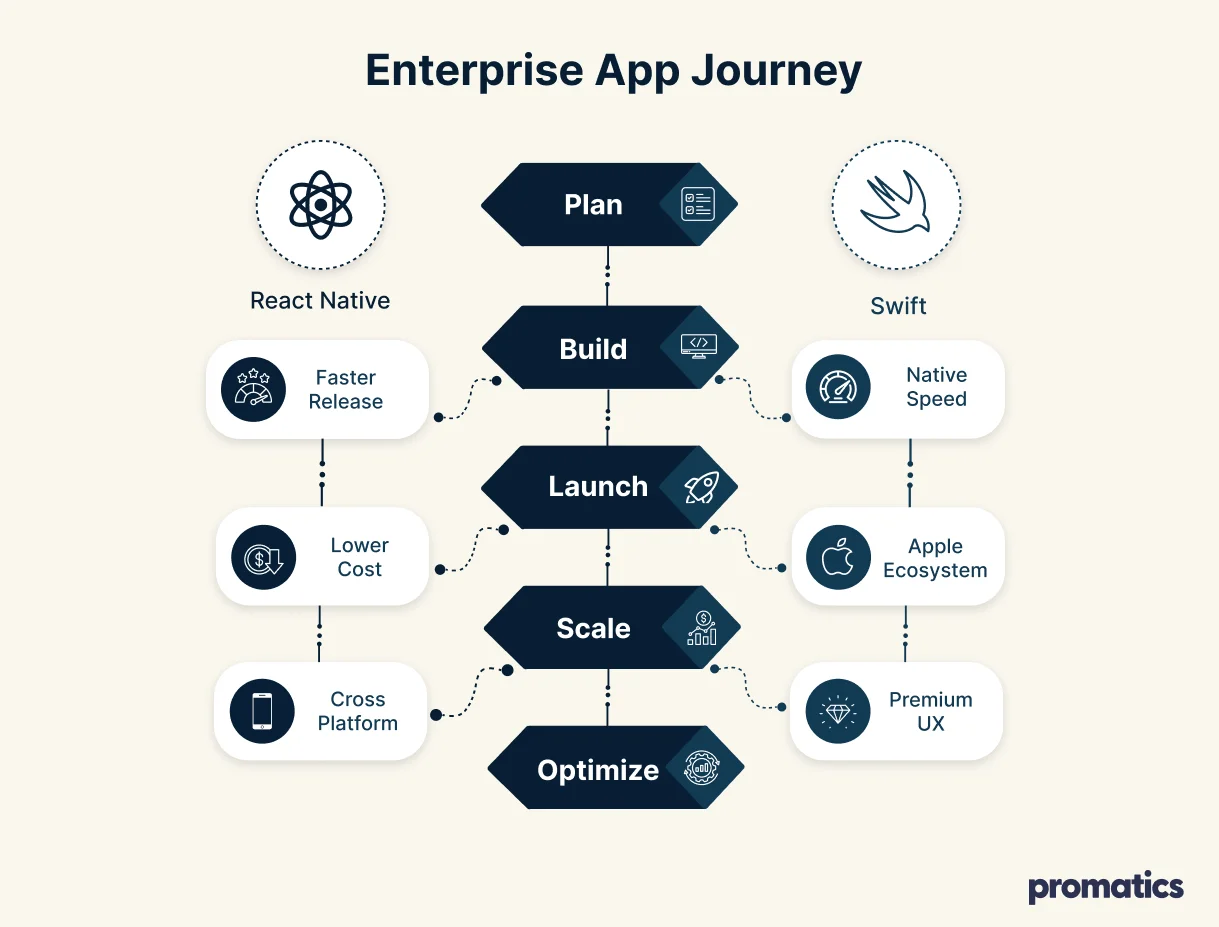
If your organization plans to launch on both Android and iOS, React Native typically provides the strongest return on investment by reducing duplicate development work and simplifying long-term maintenance.
Which Framework Is Right for Your Industry?
Every industry has unique technical requirements, security standards, and customer expectations. Here’s how React Native and Swift compare across common enterprise use cases.
| Industry | Recommended Technology | Why |
| Retail & eCommerce | React Native | Faster multi-platform deployment and lower maintenance costs |
| Healthcare Patient Apps | React Native | Wider device accessibility and faster updates |
| Clinical iPad Applications | Swift | Native performance and deeper Apple hardware integration |
| Banking & Fintech | Swift | Advanced security and native optimization |
| Enterprise SaaS | React Native | Faster feature releases and lower TCO |
| Logistics & Transportation | React Native | Cross-platform workforce mobility |
| Manufacturing | React Native | Internal employee applications across multiple devices |
| Education | React Native | Cost-effective deployment for students and staff |
| Media & Streaming | Swift | Superior graphics rendering and media performance |
| Augmented Reality | Swift | Native access to ARKit and Apple frameworks |
Industry Recommendation
If your business serves users across multiple platforms, React Native provides greater flexibility and faster product delivery. If you’re developing a premium iOS experience where performance is critical, Swift remains the better option.
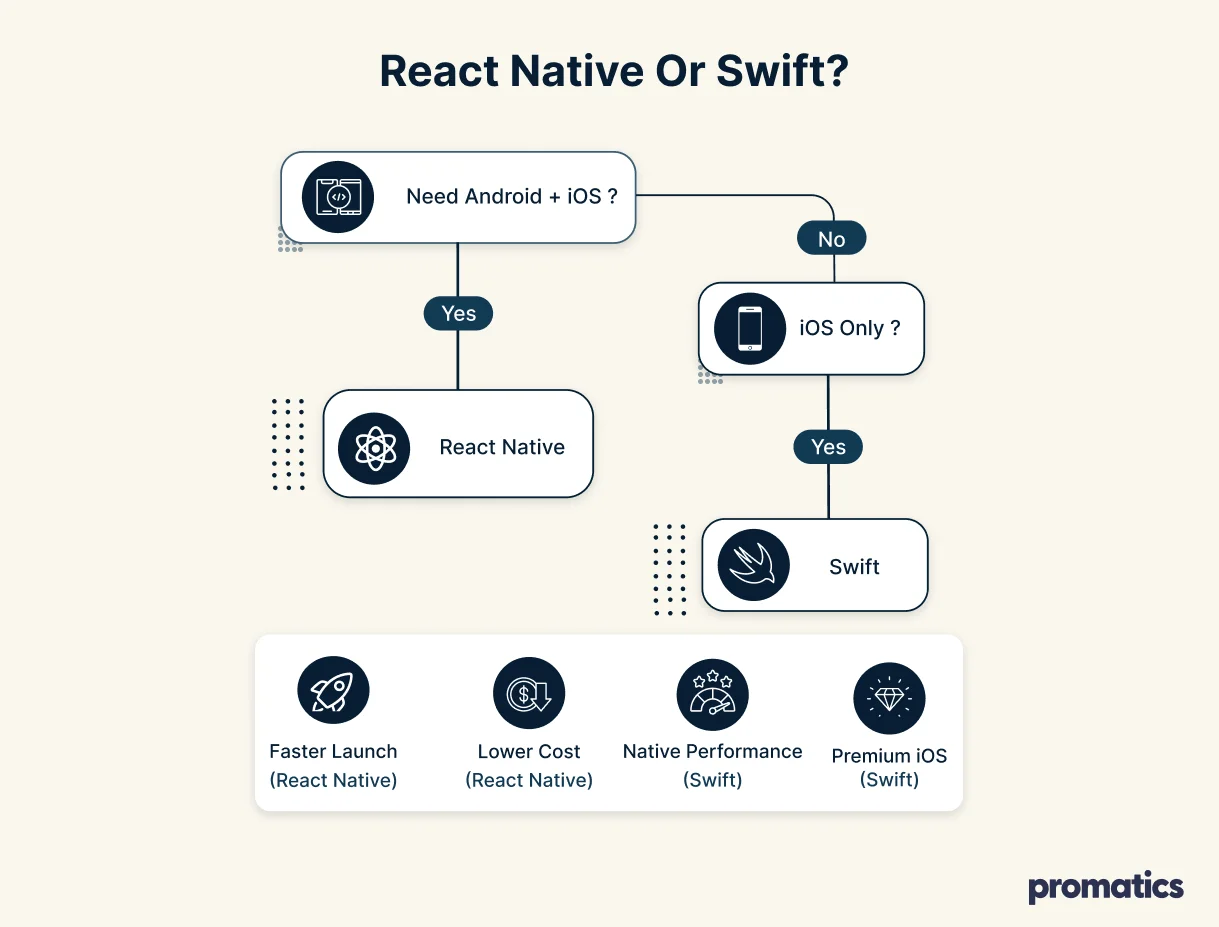
React Native vs Swift: How to Choose the Right Framework
If you’re still deciding, use the following framework to align the technology with your business goals.
Choose React Native if your business wants to:
✔ Launch on Android and iOS simultaneously
✔ Reduce development and maintenance costs
✔ Validate an MVP quickly
✔ Deliver frequent feature updates
✔ Reach a broader audience
✔ Simplify long-term application management
✔ Build enterprise SaaS, retail, logistics, or customer engagement applications
Choose Swift if your business wants to:
✔ Build exclusively for Apple users
✔ Deliver the highest level of native performance
✔ Develop graphics-intensive or AR applications
✔ Integrate deeply with Apple’s ecosystem
✔ Prioritize platform-specific user experiences
✔ Build enterprise applications requiring advanced iOS capabilities
Decision Matrix
| Business Priority | Recommended Choice |
| Faster Product Launch | React Native |
| Lower Total Cost | React Native |
| Multi-Platform Strategy | React Native |
| Premium iOS Experience | Swift |
| Hardware Integration | Swift |
| Long-Term Cross-Platform Growth | React Native |
| Native Graphics Performance | Swift |
| Faster ROI | React Native |
What to Look for in an Enterprise Mobile App Development Company
Selecting the right framework is only part of the decision. The success of your application ultimately depends on the expertise of your development partner.
A reliable enterprise mobile app development company should help you evaluate your business goals before recommending a technology.
Look for a partner that offers:
- Product discovery and consulting
- Technical architecture planning
- UI/UX design
- Cross-platform and native development expertise
- API integration
- Cloud-native deployment
- DevOps and CI/CD implementation
- Security and compliance support
- Quality assurance and testing
- Post-launch maintenance and optimization
Avoid choosing a company based solely on pricing. Instead, prioritize experience in delivering scalable, secure, and high-performing enterprise applications.
Why Choose Promatics for Enterprise Mobile App Development?
Choosing the right technology is important, but choosing the right development partner can have an even greater impact on your project’s success.
At Promatics Technologies, we help startups, SMBs, and enterprises transform ideas into scalable mobile solutions tailored to their business objectives.
Our expertise includes:
- 18+ years of software development experience
- 700+ successful mobile and web applications delivered
- Experience across 20+ industries
- Expertise in React Native, Swift, Flutter, AI, and enterprise technologies
- End-to-end development, from product discovery to post-launch support
- Secure, scalable, and cloud-ready application architecture
Whether you need a cross-platform business application or a high-performance iOS solution, our team helps you choose the right technology based on your goals, users, and long-term growth strategy.
Conclusion
There isn’t a one-size-fits-all answer to the React Native vs Swift debate. The right choice depends on your business goals, target audience, budget, and long-term product strategy.
If your priority is faster cross-platform development, lower maintenance costs, and quicker time to market, React Native is the ideal choice. If you’re building an iOS-exclusive application that demands exceptional performance and deep integration with Apple’s ecosystem, Swift remains the gold standard.
Technology is only part of the equation. Success also depends on choosing the right development partner.
Ready to Build Your Enterprise Mobile App? At Promatics Technologies, we help startups, SMBs, and enterprises choose the right technology and build secure, scalable mobile applications that deliver long-term business value. Whether you’re considering React Native or Swift, our experts can help you turn your vision into a high-performing mobile solution. Let’s discuss your project and find the best technology for your business.
