iPhone App Development Services: Find the Right iOS Development Company

TL;DR
- Explores profitable quick commerce app ideas across multiple industries.
- Covers business models, monetization, and customer demand.
- Highlights essential features for rapid delivery experiences.
- Discusses technology stack and scalability considerations.
- Helps entrepreneurs validate and launch successful Q-commerce apps.
Building an iPhone app is easy. Building one that attracts users, scales with your business, and delivers measurable ROI is far more challenging. Many projects fail because of poor planning, choosing the wrong technology, or partnering with an inexperienced iOS app development company.
As customer expectations continue to evolve, investing in iPhone app development services has become a strategic business decision rather than just a technology initiative. Apple’s ecosystem continues to attract high-value users, making iOS the preferred platform for startups, SMBs, and enterprises building secure, scalable, and premium digital experiences.
From AI-powered applications and enterprise mobility solutions to healthcare, fintech, SaaS, and eCommerce platforms, businesses are leveraging iPhone apps to improve customer experiences, streamline operations, and unlock new revenue opportunities.
Whether you’re evaluating development partners or planning your next mobile product, this guide will help you understand what to look for in professional iPhone app development services, compare development approaches, estimate costs, and choose the right iOS app development company for your business goals.
What Should You Expect from an iPhone App Development Company?
Not every development partner offers the same level of expertise. While some agencies focus only on coding, experienced technology partners support businesses throughout the complete product lifecycle from idea validation to post-launch optimization.
A reliable iPhone app development agency should help you:
- Validate product ideas before development
- Choose the right technology stack
- Design intuitive user experiences
- Develop secure and scalable applications
- Integrate cloud platforms and third-party services
- Ensure App Store compliance
- Provide ongoing maintenance and feature enhancements
Beyond technical expertise, businesses should evaluate industry experience, development methodology, communication processes, security standards, and long-term support capabilities before selecting a partner.
Why It Matters
Choosing the right development partner early can reduce project risks, accelerate time-to-market, and lower long-term development costs.
Who Can Benefit from iPhone App Development Services?
The demand for custom iPhone applications continues to grow across industries, but the development approach varies depending on business objectives.
Professional iPhone app development services are particularly valuable for:
Startups
Validate ideas quickly through MVP development while creating a scalable foundation for future growth.
Small & Mid-Sized Businesses
Improve customer engagement, digitize business processes, and launch mobile products without maintaining an in-house development team.
Enterprises
Modernize legacy systems, improve operational efficiency, enable secure workforce mobility, and integrate enterprise software through custom iOS applications.
SaaS Companies
Deliver native mobile experiences that increase product adoption, customer engagement, and subscription retention.
AI-Driven Businesses
Integrate technologies such as Apple Intelligence, Core ML, predictive analytics, conversational AI, and intelligent automation into mobile applications.
Key Takeaway
Whether the goal is customer acquisition, operational efficiency, or enterprise innovation, the right iPhone application can become a long-term competitive advantage.
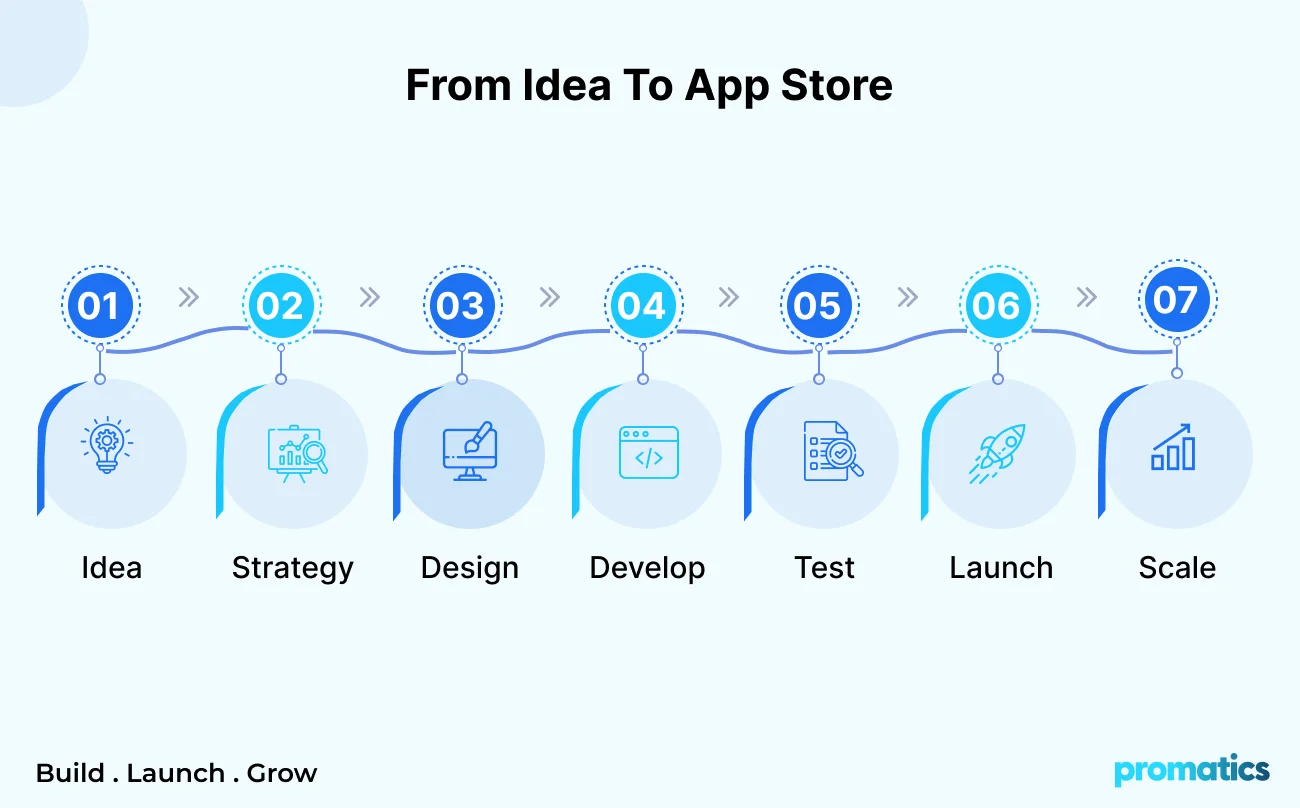
Our iPhone App Development Services
Successful iPhone applications are built through a combination of strategy, design, engineering, security, and continuous improvement.
A full-service iPhone app development company typically supports businesses across every stage of the product lifecycle.
Product Discovery & Technology Consulting
Every successful application starts with understanding business goals before writing code.
The discovery phase helps define user needs, prioritize features, identify technical requirements, and validate ideas before development begins.
Typical activities include:
- Business requirement analysis
- Market research
- Competitor analysis
- User persona development
- MVP planning
- Product roadmap creation
- Technical architecture planning
Why It Matters
A structured discovery process minimizes development risks, prevents unnecessary features, and helps businesses invest in functionality that delivers measurable ROI.
UI/UX Design
User experience has a direct impact on customer engagement, App Store ratings, and retention.
Professional design teams create experiences that are intuitive, accessible, and aligned with Apple’s Human Interface Guidelines.
Key design activities include:
- User research
- Wireframing
- Interactive prototypes
- Design systems
- Accessibility optimization
- User journey mapping
Rather than focusing solely on aesthetics, effective UI/UX design improves usability while supporting business objectives.
Native iPhone App Development
| Native iOS | Cross-Platform |
| Swift | Flutter |
| SwiftUI | React Native |
| High Performance | Shared Code |
| Apple Ecosystem | Faster Launch |
Choose based on your business goals.
Native development remains the preferred choice for organizations that prioritize performance, security, scalability, and access to Apple’s latest technologies.
Modern iPhone applications are commonly developed using:
- Swift
- SwiftUI
- UIKit
- Core ML
- CloudKit
- Xcode
| Business Need | Why Native iOS? |
| High Performance | Faster execution and smoother experiences |
| AI Integration | Direct access to Apple Intelligence & Core ML |
| Enterprise Security | Built-in Apple security framework |
| Long-Term Scalability | Easier maintenance and future expansion |
| Apple Ecosystem | Seamless integration across iPhone, iPad, Apple Watch and Vision Pro |
Why It Matters
Native development enables businesses to deliver premium user experiences while taking advantage of Apple’s latest innovations from day one.
Backend Development & System Integration
Mobile applications increasingly depend on cloud infrastructure, APIs, payment systems, enterprise software, and third-party services.
A scalable backend ensures applications remain reliable as user demand grows.
Typical backend capabilities include:
- REST APIs
- GraphQL
- Authentication
- CRM Integration
- ERP Integration
- Payment Gateway Integration
- Cloud Infrastructure
- Push Notifications
AI-Powered iPhone App Development
Artificial Intelligence is rapidly becoming a core component of modern mobile applications. Businesses are integrating AI to automate workflows, personalize user experiences, improve decision-making, and create intelligent digital products.
Common AI capabilities include:
- AI Chatbots
- Recommendation Engines
- Predictive Analytics
- Computer Vision
- Voice Assistants
- Personalization
- Natural Language Processing
- Workflow Automation
As Apple’s AI ecosystem continues to evolve, businesses investing in AI-ready applications today will be better positioned to deliver next-generation customer experiences.
Why Businesses Continue Investing in iPhone App Development
Choosing iPhone app development services isn’t simply about launching an application, it’s about investing in a platform that supports business growth, customer engagement, and long-term digital innovation.
While Android dominates global smartphone market share, iOS continues to outperform in several business-critical metrics, including customer spending, subscription revenue, user engagement, and enterprise adoption. This is why startups, growing businesses, and global enterprises continue prioritizing iPhone applications, particularly when targeting premium markets.
For organizations planning long-term digital products, iOS offers a combination of security, performance, and user experience that’s difficult to replicate on other platforms.
Access to High-Value Customers
One of the biggest advantages of iPhone app development is the quality of its user base.
Research consistently shows that iOS users are more likely to make in-app purchases, subscribe to premium services, and engage with digital products over a longer period. This makes Apple’s ecosystem especially attractive for businesses focused on customer lifetime value rather than simply acquiring the largest number of users.
Industries that frequently benefit include:
- Healthcare
- FinTech
- SaaS
- Retail & eCommerce
- Travel & Hospitality
- Education
- Professional Services
Rather than competing purely on downloads, businesses can focus on building meaningful customer relationships that generate recurring revenue.
Industry Insight
According to Apple’s 2026 App Store ecosystem report, the App Store facilitated more than $1.4 trillion in developer billings and sales in 2025, with over 90% of those transactions generating no commission for Apple. The platform also serves 850+ million average weekly users across 175 countries and regions, highlighting the enormous commercial opportunity available to iOS app publishers.
Why It Matters
If your business targets premium customers or subscription-based revenue models in markets like the United States, Canada, Australia, the UK, and Western Europe, investing in custom iPhone app development can deliver stronger long-term ROI.
Enterprise Adoption Continues to Grow
Mobile applications are no longer limited to customer-facing experiences.
Organizations across industries increasingly rely on iPhone applications to improve internal operations, enable remote work, automate workflows, and connect employees with enterprise systems.
Common enterprise use cases include:
- Workforce Management
- Sales Enablement
- Inventory Management
- Field Service Applications
- CRM & ERP Access
- Internal Communication
- Business Intelligence Dashboards
Apple’s enterprise ecosystem, combined with robust device management capabilities, has made iOS a preferred platform for many organizations seeking secure and reliable mobility solutions.
As businesses continue investing in digital transformation, enterprise iPhone applications have become valuable tools for improving operational efficiency and supporting distributed teams.
Privacy and Security by Design
Security has become one of the most important considerations when selecting a mobile platform.
Businesses handling financial transactions, healthcare records, customer data, or confidential business information require applications that prioritize privacy from the ground up.
Apple’s ecosystem includes several built-in security features, including:
- Secure Enclave
- Face ID & Touch ID
- End-to-End Encryption
- App Sandboxing
- App Tracking Transparency
- Secure Keychain
- Regular Security Updates
These capabilities help organizations strengthen data protection while supporting compliance with industry regulations such as GDPR, HIPAA, and PCI DSS.
However, platform security alone isn’t enough. Secure application architecture, encrypted APIs, authentication mechanisms, and regular security testing also play an essential role during development. This is one of the reasons businesses often partner with an experienced iOS app development company rather than relying solely on in-house resources.
Key Takeaway
A secure application combines Apple’s platform-level protections with secure coding practices, scalable architecture, and ongoing maintenance.
Consistent Performance Across Devices
Unlike Android, where applications must support thousands of hardware configurations, Apple’s ecosystem consists of a relatively limited number of devices.
This consistency allows developers to optimize applications more effectively for:
- Performance
- Battery Efficiency
- Responsiveness
- Device Compatibility
- Memory Management
- User Experience
For businesses, this often translates into fewer compatibility issues, lower maintenance costs, and a more consistent experience across supported devices.
Whether customers access an application on an iPhone, iPad, or other Apple devices, they can expect the same level of performance and reliability.
Better User Experience Drives Better Business Outcomes
The quality of a mobile application’s user experience directly influences customer satisfaction, retention, and revenue.
Apple’s Human Interface Guidelines encourage applications that are intuitive, accessible, and consistent across the ecosystem.
Businesses that prioritize user experience typically benefit from:
- Higher App Store ratings
- Better customer retention
- Increased user engagement
- Lower abandonment rates
- Stronger brand perception
While features remain important, long-term success often depends on how easily users can complete tasks, discover functionality, and interact with the application.
This is why UI/UX strategy is considered a core part of successful iPhone app development services, rather than an optional design activity.
How Much Do iPhone App Development Services Cost in 2026?
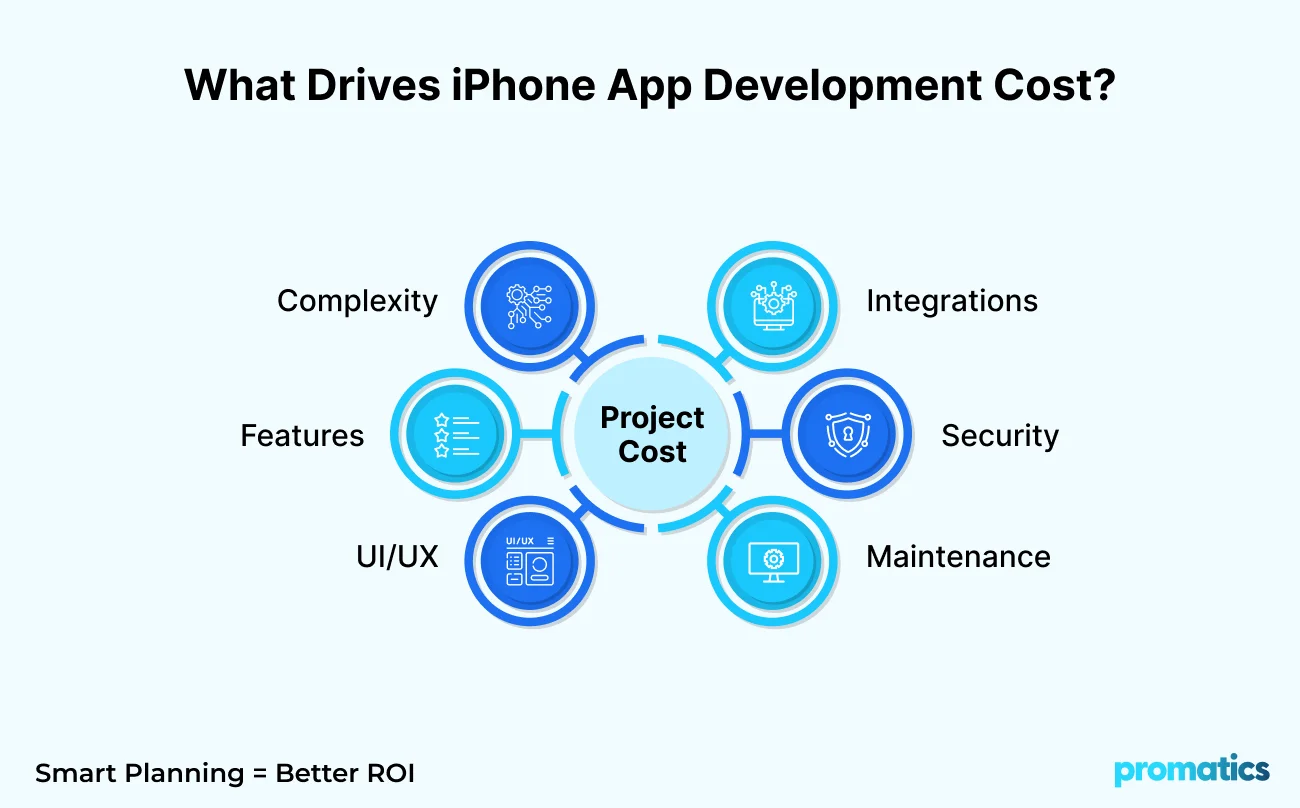
One of the first questions businesses ask before starting an iPhone app project is: How much does iPhone app development cost? The answer depends on several factors, including the application’s complexity, feature set, integrations, design requirements, and development approach.
Rather than focusing on a fixed price, it’s more helpful to understand what influences development costs and how to plan your budget effectively.
Estimated iPhone App Development Costs
| App Type | Estimated Cost* | Timeline |
| MVP / Prototype | $15,000 – $35,000 | 2–4 Months |
| Standard Business App | $35,000 – $80,000 | 4–6 Months |
| Feature-Rich Consumer App | $80,000 – $150,000 | 6–9 Months |
| Enterprise iOS Application | $150,000 – $300,000+ | 9–12+ Months |
Actual costs vary depending on project scope, third-party integrations, compliance requirements, infrastructure, and ongoing maintenance.
Industry Insight
Businesses that invest time in product discovery and feature prioritization often reduce unnecessary development costs and avoid expensive scope changes later in the project.
What Influences iPhone App Development Costs?
Several factors determine the overall investment required for custom iPhone app development.
Application Complexity
A basic booking or eCommerce application requires significantly less effort than a large enterprise platform with AI capabilities, real-time analytics, and multiple user roles.
UI/UX Design
Custom animations, interactive interfaces, accessibility features, and premium user experiences increase both design and development effort but often improve engagement and retention.
Features & Integrations
Development costs increase as additional capabilities are introduced, including:
- AI-powered recommendations
- Payment gateways
- CRM & ERP integrations
- Push notifications
- Chat functionality
- Maps & GPS
- Wearable integration
- Cloud synchronization
Security & Compliance
Industries such as healthcare, finance, and insurance often require additional security measures, encryption, authentication, and regulatory compliance.
Ongoing Maintenance
Launching an application is only the beginning.
Businesses should also budget for:
- Feature enhancements
- Performance optimization
- Security updates
- iOS compatibility updates
- Analytics monitoring
- Infrastructure management
Key Takeaway
A successful iPhone application should be viewed as a long-term digital product rather than a one-time development project.
How to Choose the Right iPhone App Development Company
Selecting a development partner is one of the most important decisions in the success of your mobile application.
While pricing is an important consideration, choosing the lowest-cost provider can often lead to delays, technical debt, poor scalability, and expensive redevelopment.
When evaluating an iOS app development company, consider the following factors.
Industry Experience
Look for companies that have delivered applications across multiple industries and understand different business models, compliance requirements, and user expectations.
A diverse portfolio often reflects stronger technical expertise and problem-solving capabilities.
Technical Expertise
An experienced development partner should have expertise in technologies such as:
Technology decisions made early in the project have a significant impact on long-term scalability.
Development Process
Choose a company that follows a transparent development methodology with regular communication, milestone reviews, sprint planning, and continuous testing.
A structured process helps reduce project risks while keeping stakeholders aligned throughout development.
Security & Compliance
Applications handling sensitive customer information should be built with security from day one.
Ask potential partners about their approach to:
- Authentication
- Data Encryption
- API Security
- Privacy
- Compliance
- Security Testing
Long-Term Support
Technology continues evolving long after launch.
Choose a partner capable of supporting future feature development, platform updates, security improvements, and performance optimization.
Buyer Checklist
Before hiring an iPhone app development company, ask:
- Have they built projects similar to yours?
- Do they provide product consulting?
- Can they scale with your business?
- What technologies do they specialize in?
- Do they offer post-launch support?
- How do they manage security and quality assurance?
Why Businesses Choose Promatics Technologies
After understanding what to look for in a development partner, the next step is evaluating experience, technical capability, and long-term value.
Promatics Technologies has spent more than 18+ years helping startups, growing businesses, and enterprises build secure, scalable, and future-ready mobile applications.
Rather than focusing only on development, projects are approached with a product mindset combining business strategy, user experience, engineering, AI capabilities, and continuous improvement.
What Sets Promatics Apart?
- 18+ Years of Software Development Experience
- 700+ Mobile Applications Delivered
- Experience Across 20+ Industries
- Dedicated Swift & SwiftUI Specialists
- AI-Powered Mobile Development Expertise
- Agile Project Delivery
- Enterprise Security Practices
- End-to-End Product Development
- Long-Term Product Maintenance
Whether you’re building a customer-facing application, enterprise mobility platform, AI-powered solution, or SaaS product, the focus remains on delivering applications that support measurable business outcomes, not simply completing development tasks.
Every successful mobile application starts with a clear strategy. Whether you’re validating a startup idea, expanding an existing digital product, or modernizing enterprise operations, investing in professional iPhone app development services can help reduce development risks while accelerating time-to-market.
If you’re evaluating development partners, begin with a discovery session to define your business goals, prioritize features, and identify the technology approach that best fits your product vision. A well-planned roadmap lays the foundation for a secure, scalable, and successful iPhone application.
Conclusion
The demand for high-quality iPhone applications continues to grow as businesses invest in digital experiences that deliver stronger customer engagement, operational efficiency, and long-term business value.
From startups launching their first MVP to enterprises building AI-powered platforms, choosing the right iPhone app development services involves more than comparing costs. It requires evaluating technical expertise, product strategy, security practices, scalability, and long-term support.
By combining thoughtful planning, the right technology stack, and an experienced development partner, businesses can build secure, future-ready iOS applications that continue delivering value well beyond launch.