Headless Commerce vs Traditional eCommerce: Which is Better for Scaling?

TL;DR
- Traditional eCommerce platforms are easier to launch but can become restrictive as businesses grow.
- Headless commerce separates the frontend and backend, enabling faster, more flexible, and personalized shopping experiences.
- API-first architecture supports seamless integrations with CRMs, payment gateways, mobile apps, and other business tools.
- Headless commerce improves scalability, website performance, and omnichannel customer experiences.
- For fast-growing brands focused on innovation and long-term growth, headless commerce offers a more future-ready solution.
Your eCommerce business is growing fast. More traffic. More orders. More customers. On the surface, everything looks like success. But behind the scenes, the cracks start to appear.
Your website slows down during high traffic sales. Launching a new feature takes weeks, not days. Updating the storefront becomes frustratingly complex. Expanding to mobile apps, marketplaces, or multiple digital channels suddenly feels expensive and difficult. What once worked perfectly for your business now struggles to keep up with its growth.
This is the reality many fast-growing brands face today. The challenge is no longer attracting customers. The real challenge is building an eCommerce infrastructure that can scale without limiting innovation, performance, or customer experience.
At the same time, customer expectations are evolving faster than ever. According to industry reports, the global headless commerce market is projected to witness substantial growth through 2030 as businesses increasingly invest in scalable, API-first commerce architectures to support omnichannel customer experiences and digital transformation initiatives.
Shoppers now expect lightning-fast websites, personalized experiences, seamless omnichannel journeys, and consistent interactions across every device and platform. Traditional eCommerce systems, built around tightly connected architectures, often struggle to deliver this level of flexibility at scale.
That’s why businesses are increasingly turning toward headless commerce, a modern architecture powering scalable, flexible, and omnichannel digital experiences for modern eCommerce brands. This architecture gives brands greater flexibility, faster development capabilities, improved scalability, and the freedom to create highly customized digital experiences.
But does headless commerce truly provide a better foundation for scaling, or is traditional eCommerce still the smarter and more practical option for many businesses?
In this blog, we’ll break down the differences between headless commerce and traditional eCommerce, compare their scalability advantages, and help you determine which solution aligns best with your long-term growth strategy.
What is Headless eCommerce?
Headless commerce is a modern eCommerce architecture that allows businesses to separate the customer-facing experience from the backend commerce system. Modern headless commerce platforms allow businesses to separate customer experiences from backend operations while supporting faster innovation and omnichannel scalability. Instead of relying on a tightly connected setup, both layers work independently, giving brands more flexibility to scale and innovate faster.
The frontend is responsible for everything customers interact with, including website design, product pages, mobile experiences, and digital storefronts. The backend handles essential business functions such as inventory, payments, order management, customer data, and fulfillment processes.
Because these systems are decoupled, businesses can improve or modify one side without disrupting the other. This makes it easier to create faster digital experiences, launch updates quickly, and adapt to changing customer expectations. This growing demand for speed and flexibility is one of the key reasons why enterprises are rapidly investing in headless commerce platforms and modern API-driven commerce ecosystems.
For example:
- Frontend
Brands can design highly customized and engaging shopping experiences tailored for websites, mobile apps, smart devices, kiosks, or other digital platforms.
- Backend
The backend infrastructure focuses on managing operational processes efficiently, including product information, transactions, logistics, and system integrations.
Another major advantage of headless commerce is omnichannel flexibility. Businesses can deliver consistent customer experiences across multiple channels without rebuilding the entire platform for every new device or touchpoint.
In simple terms, headless commerce gives businesses the freedom to innovate on the frontend while maintaining a strong and scalable backend foundation. This balance helps brands improve performance, increase agility, and support long-term growth more effectively.
How Does Headless Commerce Work?
Headless commerce works by connecting the frontend experience with backend systems through APIs, also known as Application Programming Interfaces. These APIs act as bridges that allow different systems to communicate and exchange data in real time.
In a traditional eCommerce setup, the frontend and backend are tightly connected. In headless commerce, they operate independently while still staying synchronized through API Development Services. This gives businesses the flexibility to update customer experiences without affecting backend operations.
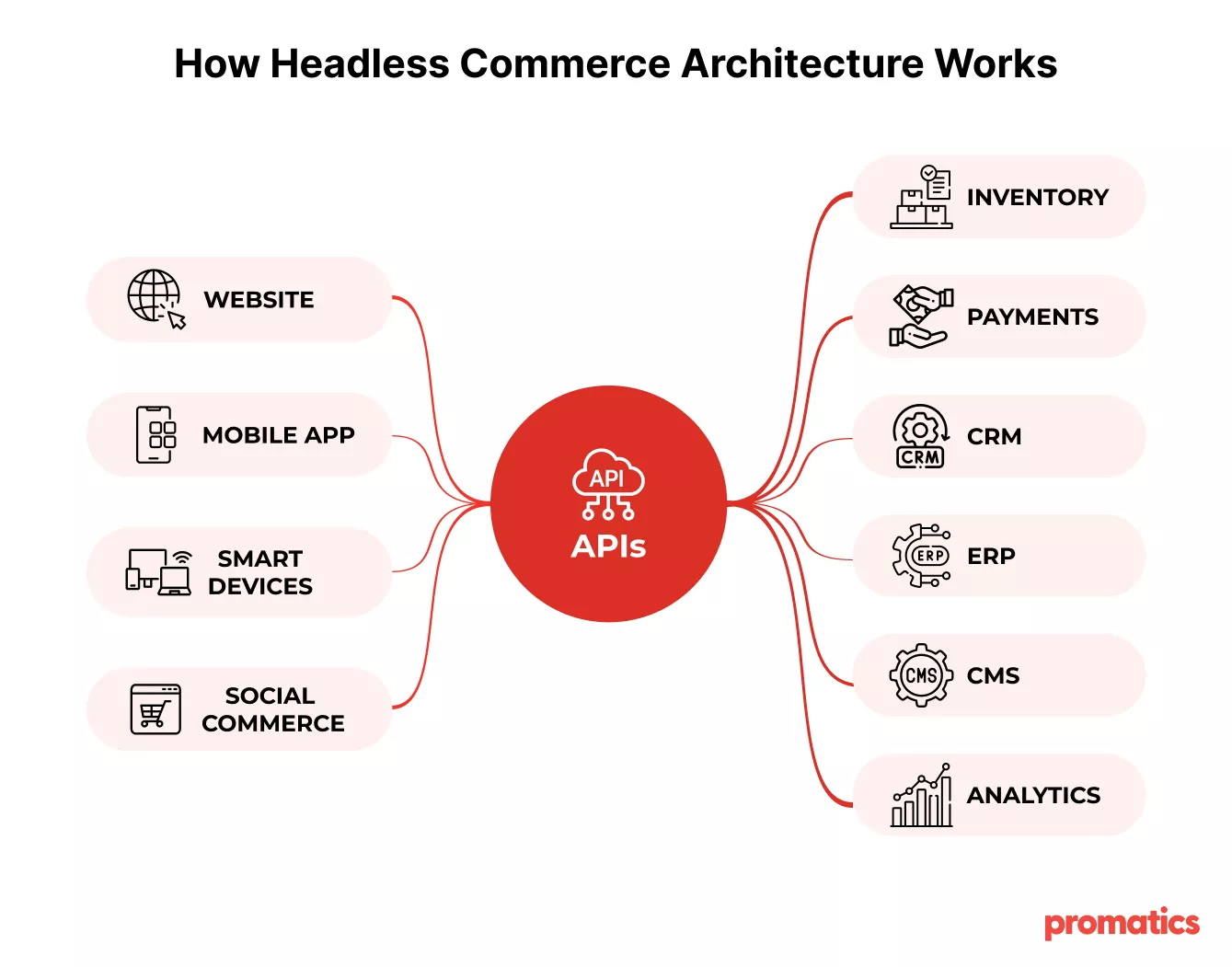
Here’s a simple example of how the process works:
- A customer discovers your brand through a social media ad or digital campaign.
- After clicking the ad, they land on your website or mobile app.
- The customer browses products, adds items to the cart, and places an order through the frontend interface.
- Behind the scenes, APIs instantly connect with backend systems to process payments, update inventory, manage customer data, and trigger order fulfillment.
Because APIs handle communication between systems, businesses can integrate multiple tools and technologies without disrupting the customer experience. This makes it easier to connect platforms such as CRM systems, payment gateways, inventory software, marketplaces, mobile applications, and marketing tools.
The biggest advantage is consistency. Whether customers shop through a website, mobile app, social platform, or third-party marketplace, headless commerce helps deliver a seamless and connected experience across every touchpoint.
Headless vs Composable vs Monolith Architecture
Understanding composable commerce vs headless ecommerce is important for businesses evaluating scalable and future-ready commerce architectures. Each approach offers a different balance of flexibility, scalability, customization, and operational complexity.
| Aspect | Monolithic Commerce | Headless Commerce | Composable Commerce |
| System Structure | All components operate within one connected platform | Frontend and backend function separately | Multiple independent services work together |
| Customization Ability | Limited design and functionality control | Flexible customer experience customization | Complete flexibility across the entire ecosystem |
| Scaling Approach | Entire platform scales together | Frontend and backend can scale independently | Individual services scale separately as needed |
| Development Workflow | Changes often affect the entire system | Faster frontend innovation through APIs | Teams can build and update modules simultaneously |
| Integration Capability | Easier but less adaptable integrations | Supports API-based integrations | Highly integration-driven architecture |
| Speed of Deployment | Longer implementation cycles | Faster experience updates | Rapid deployment with modular services |
| Dependency on Vendors | Strong reliance on one platform provider | Moderate platform dependency | Greater freedom to choose best-fit technologies |
| Maintenance Process | Updates impact the whole system | Backend and frontend maintained separately | Each module can be managed independently |
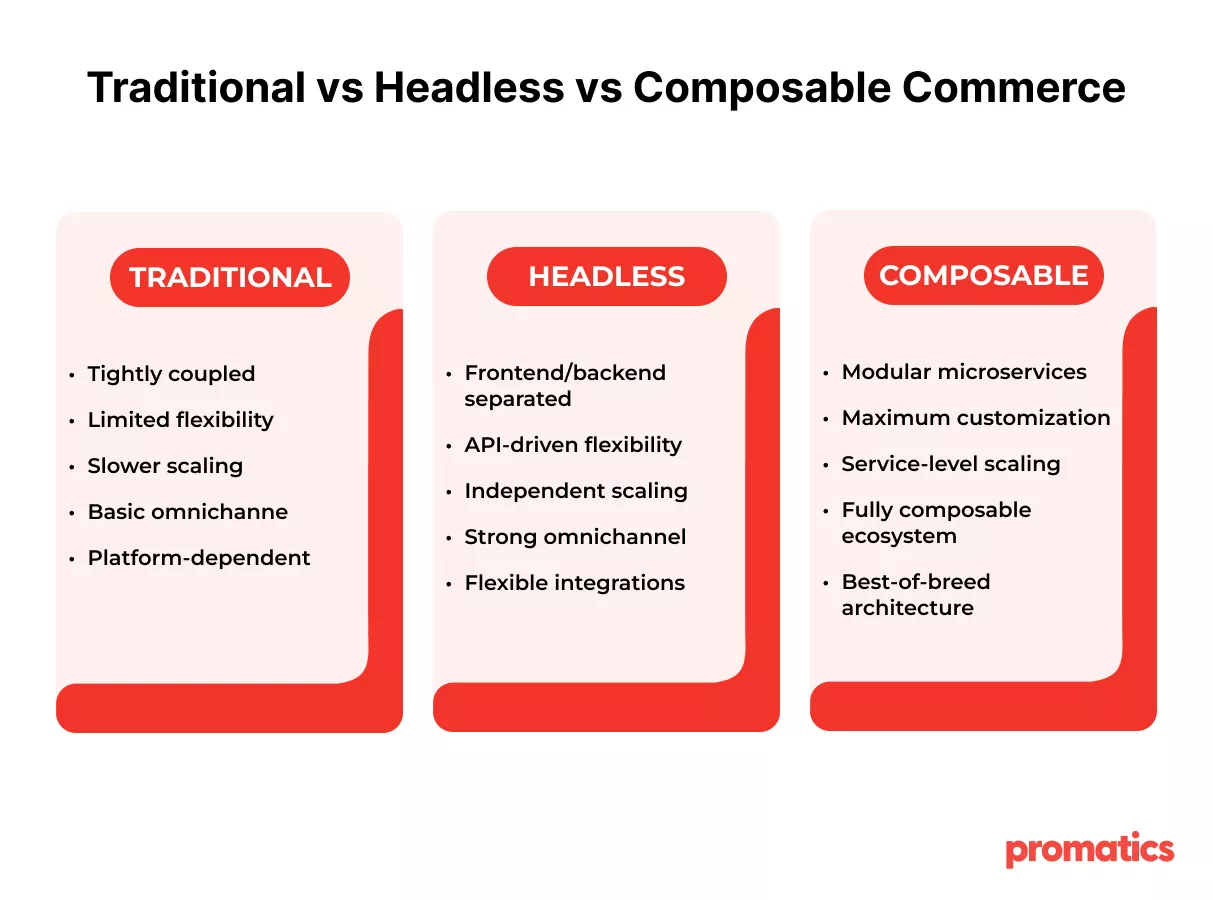
Monolithic Architecture
Monolithic architecture is built as a single connected system where the frontend, backend, and core business functions are tightly integrated into one platform. While this setup can be easier to launch and manage in the early stages, it often creates limitations as the business grows. Customization becomes more difficult, scaling requires changes across the entire system, and even minor updates can impact overall platform performance.
Headless Architecture
Headless architecture separates the customer-facing frontend from backend commerce operations. Both layers communicate through APIs, allowing businesses to create and manage digital experiences independently from the core system. This approach gives brands greater flexibility to deliver seamless experiences across websites, mobile apps, social platforms, and other digital channels without rebuilding the backend infrastructure.
Composable Architecture
Composable architecture takes flexibility a step further by dividing the commerce ecosystem into independent modules or microservices. Instead of relying on one platform for every function, businesses can choose separate tools and services for checkout, search, payments, CMS, inventory management, analytics, and more. Each component can be updated, replaced, or scaled individually without disrupting the rest of the system.
The key distinction is that headless commerce focuses primarily on separating the frontend from the backend, while composable commerce extends this modular approach across the entire technology ecosystem, giving businesses even greater control, scalability, and customization.
Headless Commerce vs Traditional eCommerce: What’s the Difference?
Traditional eCommerce and headless commerce differ significantly in how they are built, managed, and scaled. Businesses investing in headless commerce development services often achieve better flexibility, faster deployment cycles, and stronger omnichannel commerce capabilities.
While traditional platforms focus on simplicity and all-in-one functionality, headless commerce prioritizes flexibility, performance, and omnichannel scalability.
Here’s a closer look at how both approaches compare across key business and technical areas:
| Aspect | Traditional eCommerce | Headless Commerce |
| Architecture | Frontend and backend are tightly connected within one system | Frontend and backend operate independently through APIs |
| Development Process | Updates and features depend on connected workflows | Frontend and backend teams can work simultaneously |
| Customization Flexibility | Restricted by platform themes and built-in limitations | Fully customizable user experiences across channels |
| Website Performance | Performance can slow as the platform grows | Faster and optimized experiences with independent layers |
| Scalability | Scaling affects the entire platform infrastructure | Individual layers and services scale independently |
| Integration Options | Relies mostly on platform-supported integrations | Easily connects with third-party tools and services through APIs |
| Cost Approach | Lower upfront investment but increasing maintenance over time | Higher initial setup cost with better long-term flexibility and efficiency |
| Design Freedom | Limited customization within platform structure | Complete creative and functional control over the frontend |
| Technical Requirements | Easier to manage with minimal technical expertise | Requires experienced development and API management capabilities |
System Design & Architecture
Traditional eCommerce platforms use a monolithic structure where the frontend, backend, checkout, and database are tightly connected. Because everything works within one system, even small updates can affect multiple functions and slow development.
Headless commerce uses APIs to separate frontend and backend operations. This allows businesses to update storefronts, apps, or user experiences independently without disrupting inventory, payments, or backend systems.
Development Flexibility
In traditional systems, development is closely interconnected, so changes often require updates across multiple layers of the platform. This increases testing time and slows feature releases.
With headless commerce, frontend and backend teams can work independently. Businesses can launch updates faster, experiment with new experiences, and reduce the risk of platform-wide issues.
Adaptability & Personalization
Traditional platforms usually depend on fixed templates and predefined structures, limiting customization options. Building unique experiences often requires complex development work.
Headless commerce offers greater creative freedom. Businesses can deliver personalized experiences across websites, mobile apps, marketplaces, and other channels while using the same backend infrastructure.
Performance
Traditional commerce platforms may slow down during heavy traffic because the entire system processes every request together. This can impact page speed and checkout performance.
Headless commerce improves speed by loading only the required frontend content through APIs. This results in faster page loads, smoother user experiences, and better traffic management.
Scalability & High-Traffic Handling
Scaling a monolithic platform usually means upgrading the entire system, even if only one section experiences high demand. This can increase costs and reduce efficiency.
Headless commerce allows individual services to scale independently. For example, product pages can handle traffic spikes without affecting checkout or inventory systems.
Integration & Ecosystem Flexibility
Traditional platforms often rely on platform-specific integrations, making third-party connections more restrictive and harder to manage.
Headless commerce supports flexible API-based integrations, allowing businesses to connect payment gateways, CRM tools, ERP systems, analytics platforms, and other services more efficiently. It also makes upgrading or replacing tools much easier without rebuilding the entire platform.
Headless Commerce vs Traditional eCommerce: Which Is Best for Your Business?
Choosing between traditional eCommerce and headless commerce ultimately depends on your business goals, scalability needs, and customer experience strategy.
Traditional eCommerce is best suited for businesses looking for easier setup, faster deployment, and lower upfront investment. In contrast, headless commerce is ideal for brands that need greater flexibility, faster performance, scalability, and personalized omnichannel experiences. It also enables smoother integration with modern technologies like AI tools, CRMs, and ERPs.
| Traditional eCommerce | Headless Commerce |
| Easier to launch and manage | Greater flexibility and customization |
| Lower initial investment | Better long-term scalability |
| Best for standard storefronts | Ideal for omnichannel experiences |
| Limited customization options | Fully personalized customer journeys |
| Suitable for smaller businesses | Designed for growing and enterprise brands |
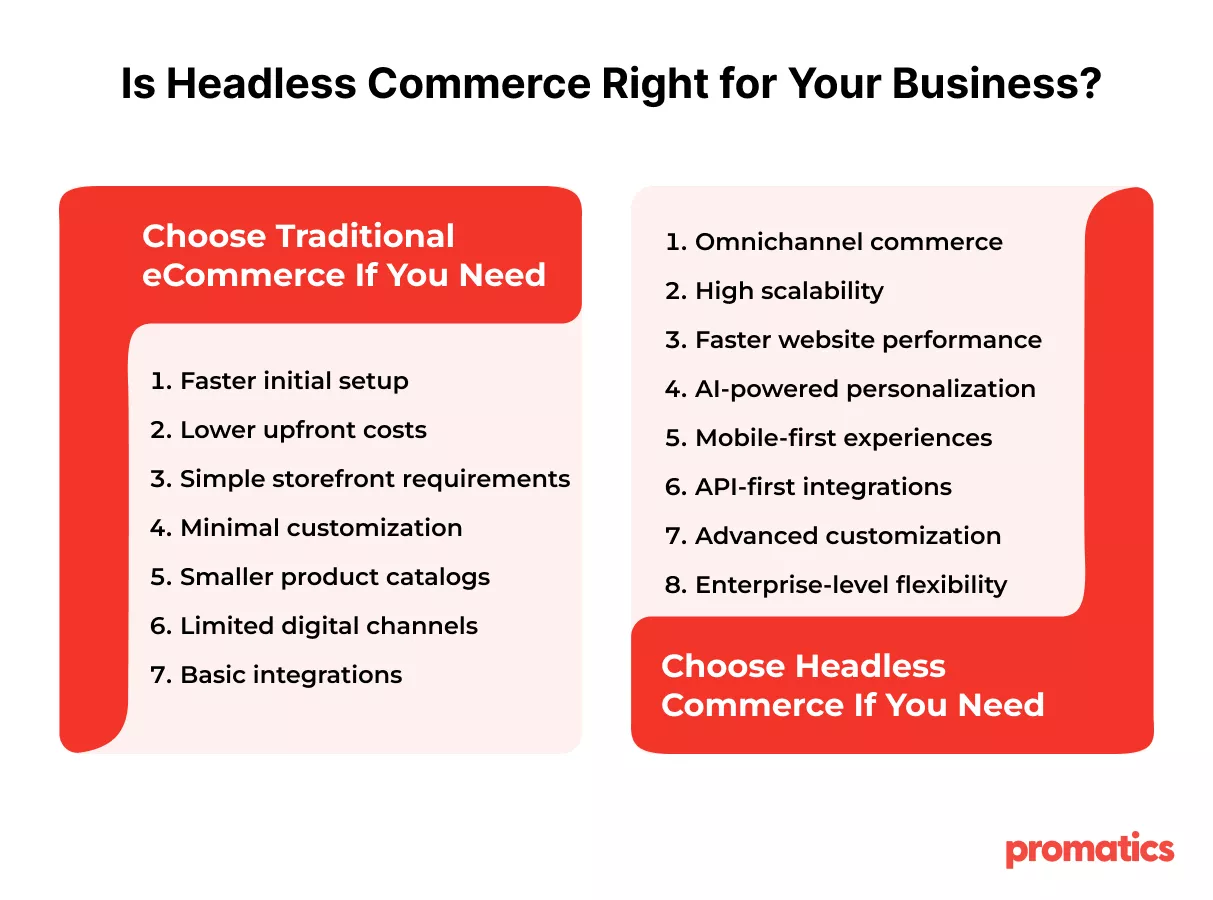
As digital commerce continues to evolve, businesses focused on speed, scalability, and seamless customer experiences are increasingly adopting headless and composable commerce architectures to support long-term growth.
Key Advantages of Headless Commerce Architecture
Modern businesses are increasingly adopting headless commerce to build faster, scalable, and highly flexible digital commerce experiences that support long-term growth and omnichannel expansion. Many enterprise brands now prefer headless e-commerce development services to build scalable storefronts optimized for performance, personalization, and modern customer experiences.
Enhanced Flexibility & Creative Control
Headless commerce gives businesses complete control over the customer experience. Unlike traditional platforms with fixed templates and design limitations, brands can create fully customized storefronts tailored to different audiences, devices, and regions without affecting backend operations.
Faster Website Performance
By delivering only the required content through APIs, headless commerce significantly improves website speed and responsiveness. Faster load times enhance user experience, improve engagement, reduce bounce rates, and contribute to better SEO rankings and higher conversions.
Seamless Third-Party Integrations
The API-first architecture makes it easier to integrate tools such as CRMs, ERPs, payment gateways, analytics platforms, inventory systems, and marketing software. This creates a more connected, efficient, and scalable commerce ecosystem.
Scalable Infrastructure for Growth
Headless commerce allows businesses to scale individual services independently based on demand. This improves performance during high-traffic events, seasonal sales, and rapid business growth while optimizing infrastructure efficiency.
Faster Development & Innovation
Frontend and backend teams can work independently, enabling faster feature releases, storefront updates, campaign launches, and customer experience improvements without disrupting core systems.
Stronger Omnichannel Experiences
Headless architecture also supports advanced mobile-first commerce experiences across apps, websites, and emerging digital touchpoints. Businesses can deliver consistent experiences across websites, mobile apps, marketplaces, social commerce platforms, kiosks, and smart devices while managing products, pricing, and customer data from a centralized backend.
Advanced Personalization Capabilities
Headless commerce supports dynamic customer experiences powered by behavioral data, preferences, and purchase history. This enables personalized recommendations, targeted promotions, AI-driven interactions, and smarter customer engagement.
Support for Emerging Technologies
The flexible architecture makes it easier to adopt modern technologies such as progressive web apps, AI-powered search, augmented reality, voice commerce, virtual try-ons, and chatbot experiences.
Reduced Operational Disruptions
Since the frontend and backend operate independently, businesses can redesign interfaces, launch campaigns, or update experiences without impacting backend operations or checkout systems.
Future-Ready Commerce Foundation
Headless commerce provides the agility and scalability businesses need to adapt to evolving customer expectations, emerging digital channels, and future technology trends without rebuilding their entire platform.
Real-World Use Cases of Headless Commerce
The rapid growth of headless commerce for B2C brands is driven by increasing demand for personalized shopping experiences, faster websites, and mobile-first customer journeys
Fashion & Apparel Brands
Fashion brands use headless commerce to deliver personalized shopping experiences across websites, mobile apps, and social platforms. It also supports features like AI recommendations, virtual try-ons, and interactive product experiences.
Omnichannel Retail
Retailers with online and offline stores use headless architecture to unify customer experiences across channels. Features like real-time inventory tracking, BOPIS, and synchronized customer accounts become easier to manage.
High-Traffic eCommerce Stores
Brands handling flash sales, festive traffic, or large product launches use headless commerce for better scalability and faster performance during peak demand periods.
B2B eCommerce Platforms
B2B businesses use headless commerce to support custom pricing, bulk ordering, approval workflows, and personalized account-based experiences while maintaining scalable backend operations.
Mobile-First Commerce
Businesses focused on mobile shopping use headless architecture to build fast, responsive mobile storefronts and progressive web apps that improve customer engagement and conversions.
Global & Multi-Region Commerce
International brands use headless commerce to manage multiple storefronts, languages, currencies, and region-specific experiences from a centralized backend system.
AI-Powered Personalization
Headless commerce supports AI-driven recommendations, predictive search, dynamic content, and chatbot integrations to create more personalized shopping journeys.
Enterprise System Integrations
Businesses integrate headless commerce with CRMs, ERPs, analytics tools, payment gateways, and inventory systems to create a connected and efficient digital ecosystem.
D2C & Digital-First Brands
Direct-to-consumer brands use headless architecture to build unique digital experiences, launch campaigns faster, and adapt quickly to changing market trends.
Emerging Commerce Technologies
Headless commerce makes it easier to support technologies like augmented reality, voice commerce, smart devices, and interactive shopping experiences without platform limitations.
Examples of Businesses Using Headless Architecture
Many global businesses are adopting headless commerce platforms to improve scalability, website performance, omnichannel experiences, and conversion rates.
White Stuff
British fashion retailer White Stuff migrated from a traditional BigCommerce setup to a headless architecture powered by ALOKai. The transition significantly improved website performance, reducing overall load times by 85% while doubling mobile speed performance. The company also reported a 37% increase in conversion rates and a 26% rise in average transaction value, demonstrating the direct business impact of faster and more responsive shopping experiences.
Burrow
Furniture brand Burrow adopted headless commerce to overcome the limitations of rigid templates and give its marketing team greater creative control. Within only two months of implementation, the company achieved a 30% improvement in conversion rates along with a 50% boost in website speed and overall performance.
Venus
Women’s fashion retailer Venus upgraded its digital commerce experience by implementing a React Progressive Web App combined with a Backend-for-Frontend architecture. This modernization improved customer retention and increased conversions by 24%. Additionally, most page load times dropped from over one second to under 320 milliseconds, creating a much smoother mobile shopping experience.
Combat Corner
Combat sports brand Combat Corner moved to a headless commerce setup using React with WP Engine Atlas and a BigCommerce backend. The company experienced a 431% improvement in website performance and page load speeds that were over six times faster than before. The new architecture also provided greater content flexibility and customization while reducing dependency on large engineering efforts.
Debenhams
British multinational retailer Debenhams implemented a React Progressive Web App to improve mobile customer engagement and reduce drop-offs. As a result, the company increased customer interaction time on-site, improved conversion rates by 20%, and achieved a 40% growth in mobile revenue.
K2 Sports
Outdoor equipment company K2 Sports adopted a headless architecture to reduce development limitations and lower maintenance complexity. By using Contentstack as its content management platform, the company accelerated website creation by 75%, reduced content publishing time by 90%, and significantly improved team productivity.
These success stories show how headless commerce helps businesses improve speed, scalability, flexibility, and customer experience while driving measurable growth in conversions and revenue. Companies looking to modernize their digital commerce infrastructure are increasingly adopting headless architecture to stay competitive in the evolving eCommerce landscape.
Conclusion
As digital commerce continues to evolve, businesses need platforms that can adapt quickly, scale efficiently, and deliver seamless customer experiences across every channel. While traditional eCommerce platforms may work for basic storefront needs, they often become restrictive as businesses grow and customer expectations become more demanding.
Headless commerce offers a more flexible and future-focused approach. By separating the frontend from backend operations, businesses gain greater control over performance, customization, integrations, and omnichannel experiences. This makes it easier to innovate faster, improve user experiences, and support long-term scalability without being limited by traditional system architecture.
Whether you’re building a modern B2C storefront, scaling a B2B platform, or expanding into omnichannel commerce, the right architecture plays a critical role in business growth, customer engagement, and operational efficiency.
As a trusted headless e-commerce development company, Promatics Technologies helps businesses build scalable, API-driven digital commerce solutions tailored for modern growth. From custom storefront development to seamless third-party integrations, our team delivers high-performance commerce experiences designed for flexibility, speed, and long-term growth.Ready to build a future-ready eCommerce platform? Connect with our experts to create a scalable headless commerce solution built for the next generation of digital commerce.
