Why Hybrid App Development Is a Smart Choice in 2026

TL;DR
- Hybrid apps use a single codebase for iOS and Android development
- Faster development, lower costs, and efficient resource usage
- Near-native performance with modern frameworks and tools
- Easier maintenance with unified updates across platforms
- Ideal for scalable, cross-platform, and business-focused applications
Delivering products quickly to market is no longer a competitive advantage, it’s a necessity for business survival. Businesses must build scalable digital products that deliver seamless user experiences while remaining cost-effective. With global mobile app revenue projected to exceed $540 billion and 75 percent of businesses plan to release their applications more quickly.
With global mobile app revenue projected to exceed $540 billion and 75% of businesses planning faster app launches, choosing the right development approach has never been more critical.
One of the biggest decisions businesses face is choosing between native and hybrid app development. This decision directly impacts development costs, launch timelines, performance, and long-term maintenance.
As development costs rise and user expectations grow, organizations are increasingly seeking efficient and scalable solutions. Hybrid app development has emerged as a smart and cost-effective approach for businesses looking to accelerate growth.
This guide compares native and hybrid app development to help businesses choose the most suitable growth strategy in 2026.
Native App Development: When Performance Matters Most
Native app development refers to building applications specifically for a single platform, such as iOS or Android. iOS applications are typically developed using Swift or Objective-C, while Android applications are built using Kotlin or Java.
Native applications provide superior performance because they are built directly for the operating system. This allows them to access device hardware and features more efficiently, resulting in faster loading times, smoother animations, and better overall user experience.
Native app development is particularly beneficial for applications that require:
- Advanced hardware access such as GPS, camera, sensors, and biometrics
- Real-time data processing and high-speed performance
- Complex animations, gaming applications, and heavy graphics
- High security requirements and data protection
- Maximum performance and stability
While native applications offer excellent performance, they also present certain challenges. Businesses must develop separate applications for iOS and Android, which requires two different codebases, development teams, and maintenance cycles.
This approach increases:
- Development costs
- Project timelines
- Maintenance complexity
- Testing requirements
As a result, many businesses are exploring hybrid app development as a more cost-effective and scalable alternative.results in higher development costs and longer project timelines together with increased challenges for maintaining system operations.
Hybrid App Development: The Smart Choice for Scalable Apps
Hybrid app development combines the strengths of native and web technologies. Hybrid applications are built using web technologies such as HTML, CSS, and JavaScript, and then wrapped inside a native container.
This allows hybrid apps to function like native applications while maintaining a single codebase for multiple platforms.
Hybrid apps offer several advantages:
- Faster development time
- Reduced development costs
- Cross-platform compatibility
- Easy maintenance and updates
- Scalability and flexibility
Because of these benefits, hybrid app development has become one of the most preferred solutions for businesses in 2026. Organizations looking for faster market entry, cost savings, and scalability are increasingly adopting hybrid app development strategies.
How Hybrid Apps Actually Work
Hybrid applications use layered systems that combine web development tools with native application capabilities to function. The following explanation presents their operational process in basic terms.
- The main application uses web development technologies, which include HTML and CSS, and JavaScript, to create its core functions.
- The code is packaged into a native wrapper, which enables it to operate as a mobile application.
- The application operates through built-in web browser elements, which include the following components.
- WKWebView for iOS
- WebView for Android
The embedded browser components operate in background mode which remains hidden from users. The application functions as a standard native application because developers can use their single codebase to develop for multiple platforms.
The approach enables businesses to achieve three main objectives which include decreasing development time and reducing expenses while making maintenance easier to handle and protecting user experience.

Role of Frameworks and Tools in Hybrid App Development
Choosing the right framework plays a critical role in performance, scalability, and development speed.
1. React Native
React Native is one of the most widely used hybrid app frameworks. It enables developers to build high-performance applications using a single codebase.
Benefits of React Native:
- Fast development
- Reusable components
- Large developer community
- Strong performance
- Scalable architecture
React Native is ideal for businesses that require dynamic applications with strong performance.
2. Flutter
Flutter, developed by Google, is another powerful cross-platform framework. It allows developers to create visually appealing, high-performance applications.
Benefits of Flutter:
- Hot reload
- Single codebase
- Custom UI components
- High performance
- Faster development
Flutter is ideal for businesses looking for modern UI and fast development cycles.
3. Xamarin
Xamarin, backed by Microsoft, allows developers to build cross-platform applications using a shared codebase.
Benefits of Xamarin:
- Code reusability
- Native UI support
- Microsoft ecosystem integration
- High performance
Xamarin is ideal for businesses already working within Microsoft technology ecosystems.
How To Develop Hybrid Mobile Apps?
1. Research & Strategizing App
The process of creating a hybrid app starts with creating foundational elements through strategic planning and market research. The point of idea development begins, but actual insights must be used for validation purposes instead of using guesswork. Businesses can discover user preferences and market weaknesses while exploring new chances through comprehensive market analysis and current industry pattern research.
A successful planning and development strategy should take into account a number of variables, such as the target market, essential features, platform specifications, financial constraints, and long-term scalability. The development process of your application will follow this step which establishes your development path and shows you which choices to make while reducing expensive future changes.
This initial stage becomes a successful path when implemented correctly because it guides you through the process of building a successful hybrid application.
2. UI/UX Designing
The app design process will start after the planning phase finishes its work. Define the essential UI components which your MVP requires to develop your product. The current phase requires development of core functions which must function properly before additional features become available. Your project requires an effective MVP which lets you quickly test your concept while obtaining initial user insights.
The current phase requires teams to focus on developing responsive design solutions which provide clear app structure and simple navigation systems to create uninterrupted user experiences throughout different devices. The design objective requires development of a basic interface which provides both operational capacity and above all functional ability.
You can start improving your visual design elements after your first design reaches validation through typography improvements and icon additions and layout enhancements and branding element implementation. Your app development process uses this structured method to achieve efficient progress while keeping a strong design base that centers on user requirements.
3. App Development
Your training includes knowledge that extends until the month of October in the year 2023. The hybrid app development process starts to develop its precise and effective workflow after you choose the appropriate Software Development Life Cycle (SDLC) for your project. The developers at this point use the necessary frameworks and libraries and tools which they select according to your project specifications to create an application that can handle increased demand while delivering high performance.
The developers you select for your hybrid app project serve as the primary factor that determines your app’s overall success. The development of a hybrid mobile app requires skilled developers who create a responsive frontend and build a solid backend system through all development stages.
The experienced teams provide complete development services through their performance optimization and debugging and testing and integration services. The system guarantees that your hybrid app maintains its stable performance while handling increased demands and achieving readiness for actual operational environments.
4. Hybrid App Testing
The development team needs to conduct both application testing and code verification procedures at the same time as they develop the application. The development team can use this method to find software defects and test system efficiency and user experience problems during the initial stages of development. The testing and troubleshooting process which developers and QA teams conduct repeatedly leads to ongoing application improvements which enhance overall product quality.
Testing creates effective enhancements which boost system performance while providing users with a seamless experience. This stage typically includes functionality testing, performance testing, security checks, and compatibility testing across devices and platforms.
Organizations that establish strong testing procedures gain the ability to discover potential operational hazards which decreases the likelihood of experiencing significant post-launch problems. The hybrid application now achieves greater stability and trustworthiness which prepares it for upcoming deployment.
5. Mobile App Development
It’s time to create your hybrid mobile application. The deployment stage begins when your application gets ready for distribution and you submit it to stores such as the Apple App Store and Google Play Store. The process requires three essential tasks, which include conducting final assessments, verifying platform guideline compliance, and confirming that your application satisfies all technical and security standards.
The approval process requires time, but proper advance planning will guarantee a successful implementation process. The public launch of your hybrid application will provide you with an opportunity to witness your entire concept come together while you start connecting with your intended customers.
The app experience requires ongoing assessment after launch, which includes performance tracking, user feedback collection, and app updates for betterment. The successful deployment of your application marks the conclusion of development work, which initiates the process of your application entering its growth phase.
6. Maintenance or Upgrades
The ongoing maintenance and performance optimization process represents the final stage which lasts the longest time in hybrid app development. The app launch represents only the initial step of your application development process. Businesses need to enhance their applications through new technology adoption and feature improvement and user experience optimization to maintain their market position.
Your app needs ongoing updates and performance checks and security updates to keep up with changing market trends and user needs. Your application development process benefits from continuous improvement because it keeps your application current and trustworthy and dedicated to achieving your business objectives.
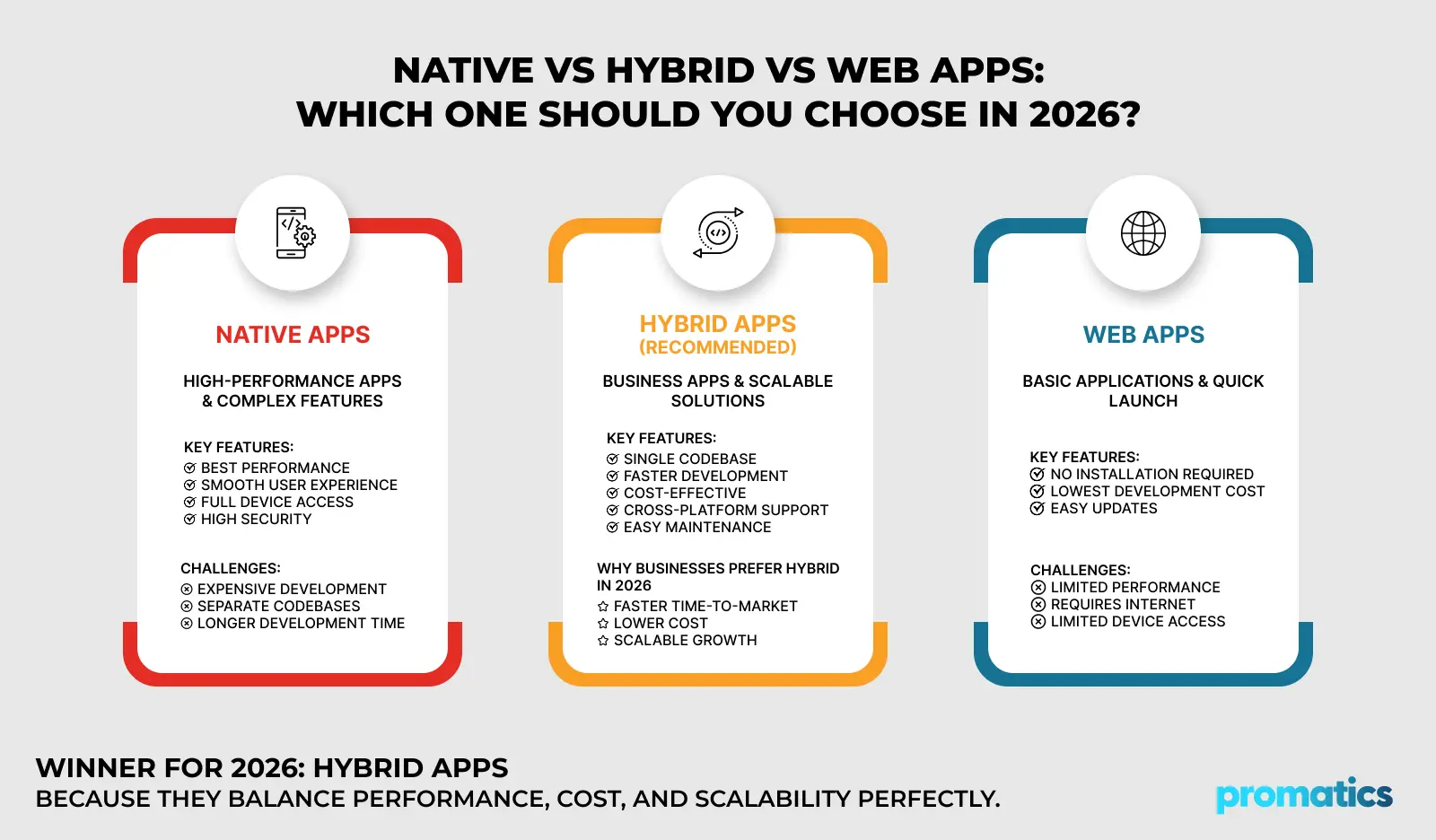
Businesses still need native applications which compete with hybrid applications that provide faster development times and simpler maintenance processes. Which app development option to choose still confuses many businesses who need to assess hybrid and native and web applications. Different business requirements drive companies to choose between the three approaches which each offer unique advantages and disadvantages.
Through this analysis we will explain the fundamental differences between hybrid applications and native applications and web applications.
Quick Difference Between Native App vs Hybrid App vs Web App
| Criteria | Native Apps | Hybrid Apps | Web Apps |
| Platforms | Only Single Platforms (Either iOS or Android) | Accessible on both Android and iOS | Accessible through web browsers without installing |
| Performance | Smooth Performance | Manages to perform without hiccups | Slowed performance than others |
| Cost | Expensive app types for separate OS | Less costly than native apps | The most affordable development cost |
| Security | Highly Encrypted & Safe | Follows Security Mea sures | Less secure or reliable app URLs |
Examples of Hybrid Apps
There are numerous successful cases of hybrid applications which people use in different parts of the world. The most recognized brands have implemented hybrid app development to create mobile applications which provide users with quick access to scalable features through economical solutions. The actual case studies demonstrate that hybrid applications can operate efficiently under heavy user traffic while providing users with uninterrupted service.
The most famous hybrid applications demonstrate the full capabilities of this development method which companies will use for their applications in 2026.
Instagram is one of the most popular social media platforms globally, known for delivering a seamless and engaging user experience across both Android and iOS devices. With millions of users accessing content daily, the platform requires high performance, scalability, and consistent functionality across multiple platforms.
Instagram offers a wide range of features, including real-time updates, multimedia content sharing, interactive stories, and advanced user engagement tools. These features demand a robust and scalable architecture capable of handling heavy user traffic while maintaining smooth performance.
By leveraging hybrid development approaches and modern frameworks, Instagram has been able to deliver consistent performance across platforms while optimizing development efficiency. This strategy allows the platform to scale effectively, introduce new features faster, and maintain a high-quality user experience, making Instagram a strong example of successful hybrid app development.
Amazon App Store
Amazon is another well-known example of a successful hybrid application that delivers a smooth and consistent shopping experience across multiple devices and platforms. The app is designed with a user-friendly interface and responsive navigation, allowing customers to browse products, search items, and complete purchases seamlessly.
The Amazon app also includes advanced features such as personalized product recommendations, secure payment options, real-time order tracking, and push notifications. These capabilities require a scalable and high-performance architecture to handle millions of users while maintaining fast and reliable performance.
By leveraging hybrid app development, Amazon has been able to ensure consistent functionality across platforms, accelerate feature updates, and improve user engagement. This approach allows the platform to continuously evolve and adapt to changing customer expectations, making Amazon a strong example of how hybrid applications can support scalable and future-ready digital commerce solutions.
Klarna
Klarna is a leading fintech platform and a strong example of how hybrid app development can support secure, scalable, and high-performance financial applications. Known for its Buy Now, Pay Later (BNPL) services, Klarna enables users to make flexible payments for online and in-store purchases, offering a smooth and convenient payment experience.
The platform features secure payment processing, real-time transaction updates, personalized payment options, and seamless checkout experiences. These advanced capabilities require a robust and scalable architecture capable of handling complex financial operations while maintaining performance and security.
By leveraging hybrid app development, Klarna has successfully delivered consistent functionality across multiple platforms, improved development efficiency, and scaled its services globally. This approach allows the company to adapt quickly to market changes, introduce new features faster, and maintain a reliable user experience.
Klarna’s success demonstrates how hybrid applications can support future-ready, scalable solutions across industries. As businesses continue to prioritize speed, flexibility, and cost efficiency, hybrid app development is expected to play an even bigger role in shaping the future of mobile applications.
Are Hybrid Apps the Future Trends for Business Growth?
The demand for hybrid app development is growing rapidly as businesses increasingly focus on delivering efficient, scalable, and seamless digital experiences. With the rise in mobile device usage and the need for cost-effective development solutions, hybrid apps have become a reliable and future-ready choice for organizations looking to expand their digital presence.
Recent industry reports show that over 70% of businesses are now adopting cross-platform or hybrid development strategies to reduce development costs and accelerate time-to-market. Additionally, hybrid app development can reduce development time by up to 30-40% and lower maintenance costs by nearly 50%, making it a practical solution for businesses aiming to scale quickly.
Modern businesses require mobile applications that support fast deployment, cloud integration, and cross-platform functionality. Hybrid app development addresses these needs by enabling companies to build once and deploy across multiple platforms, ensuring consistent performance and faster time-to-market. This flexibility allows businesses to scale efficiently while maintaining high-quality user experiences.
Additionally, advancements in technology have significantly improved the capabilities of hybrid applications. Today, hybrid apps can seamlessly integrate AI, machine learning, cloud computing, and real-time analytics, enabling businesses to create intelligent and personalized digital experiences. These capabilities help organizations enhance user engagement, operational efficiency, and business performance.
As businesses continue to prioritize speed, scalability, and cost efficiency, hybrid mobile app development is emerging as a strategic investment for long-term growth. Companies that adopt hybrid app solutions can maintain their competitive advantage while remaining flexible enough to adapt to changing business needs and emerging technologies.
Build Future-Ready Hybrid Apps with Promatics Technologies
Developing a platform-independent application has become a strategic necessity for businesses aiming to scale and innovate in today’s competitive digital landscape. Hybrid app development enables organizations to launch faster, reduce costs, and deliver seamless user experiences across multiple platforms. By shifting from native to hybrid app development, businesses can benefit from improved operational efficiency, faster time-to-market, and reduced long-term maintenance costs.
However, the success of your hybrid application largely depends on choosing the right development partner. A reliable mobile app development company should combine technical expertise, industry experience, and scalable development practices to build high-quality hybrid applications that align with your business goals.
At Promatics Technologies, we specialize in end-to-end hybrid mobile app development services designed to help businesses grow and scale efficiently. Our team builds custom, high-performance hybrid applications tailored to your specific business requirements. From initial strategy and design to development, deployment, and ongoing support, we ensure your application remains future-ready and competitive.
Whether you’re launching a new application or upgrading an existing one, Promatics Technologies delivers scalable, cost-effective, and performance-driven hybrid app solutions. Contact us today to schedule a consultation and start building your next-generation hybrid mobile application.
