Mobile Marketing Trends in 2026: AI, Personalization and Smarter User Acquisition

TL;DR
- AI is making mobile marketing more personalized, predictive, and automated.
- Mobile advertising is shifting from install-focused campaigns toward user quality and lifetime value.
- Predictive analytics can help marketers identify conversion and churn risks earlier.
- RCS, SMS, and mobile wallets are creating more connected customer journeys.
- Privacy-first attribution is becoming essential as deterministic tracking becomes harder.
- App retention, onboarding, and engagement are becoming as important as acquisition. 7.Businesses may need AI-ready mobile applications and dedicated development teams to execute these strategies at scale.
Your customers are changing how they discover, evaluate, and interact with brands on mobile. Is your marketing strategy keeping up?
In 2026, mobile marketing strategies are moving far beyond push notifications, app-install campaigns, and social media ads. Businesses now need to turn every mobile interaction into an opportunity to acquire, convert, and retain high-value customers.
AI assistants are reshaping how users discover and use apps, privacy changes are challenging traditional tracking, and customers expect faster, more personalized experiences. Research suggests mobile app usage could decline by 25% as AI assistants take on more user tasks, while global RCS business revenue is projected to reach $3 billion.
For businesses, these mobile marketing trends present both a challenge and an opportunity. The right approach can help reduce acquisition costs, improve engagement, increase conversions, and strengthen customer lifetime value.
But which mobile marketing strategies will actually drive results in 2026? From AI in mobile marketing and personalized experiences to RCS, predictive analytics, mobile advertising, acquisition, and retention, this guide explores the key strategies shaping the future of mobile app marketing.
Read on to discover the most effective mobile marketing strategies for 2026, how they work, and how your business can turn emerging mobile trends into measurable growth.
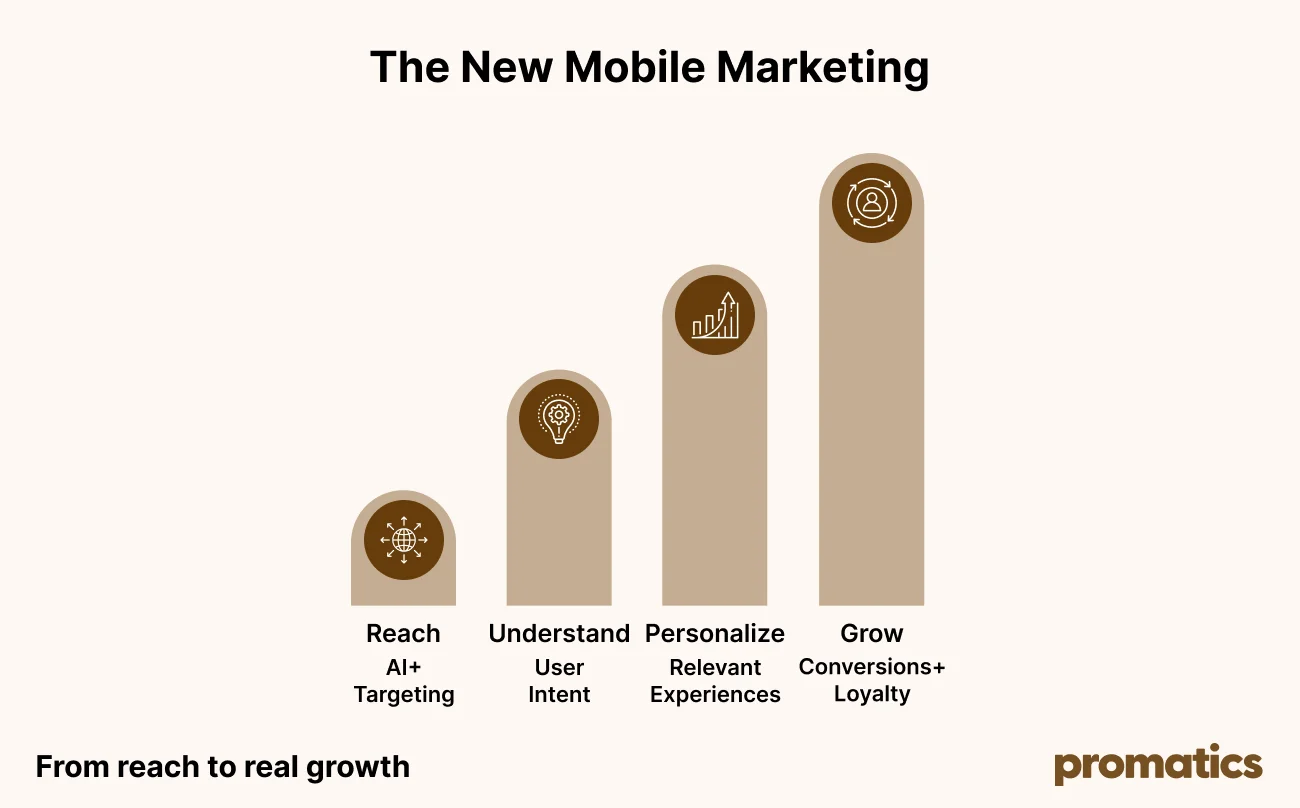
What Are the Biggest Mobile Marketing Trends in 2026?
The most important mobile marketing trends for 2026 include:
- AI-powered personalization
- Predictive mobile analytics
- Smarter app user acquisition
- AI-powered mobile advertising
- Privacy-first attribution
- UGC and creator-led acquisition
- RCS and conversational marketing
- Mobile wallet experiences
- Retention-focused engagement
- AI-ready mobile app development
Let’s look at each trend and how businesses can use it.
1. AI-Powered Personalization Is Becoming the New Standard
Personalization has existed in digital marketing for years. What is changing in 2026 is the ability to personalize experiences at a much greater scale.
Instead of placing users into broad groups such as “new customer” or “returning customer,” AI can analyze:
- User behavior
- Purchase history
- Browsing activity
- Engagement patterns
- Location and context
- Product preferences
- Campaign responses
It can then determine what content, product, offer, or message is most relevant.
For example, an eCommerce app could identify that a customer frequently browses running shoes, responds to evening notifications, and typically purchases after receiving a discount.
The app could automatically personalize the product recommendation, offer and communication timing.
Vibes found that 45% of consumers want brands to use their past behavior for communication, while only 34% of brands say they execute behavioral personalization effectively.
That gap makes AI personalization one of the strongest opportunities in mobile marketing.
AI personalization can support:
- Personalized push notifications
- Product recommendations
- Dynamic offers
- In-app content
- Personalized onboarding
- Re-engagement campaigns
- Loyalty experiences
- SMS and RCS communication
The important shift is from audience segmentation to individual behavioral journeys.
2. Predictive Analytics Is Changing Mobile Analytics
Traditional mobile analytics answers:
What happened?
Predictive analytics asks:
What is likely to happen next?
For example, instead of simply reporting that users are abandoning an onboarding flow, predictive analytics can identify users who are most likely to abandon it.
Businesses can use machine learning models to predict:
- Churn probability
- Purchase intent
- Conversion probability
- Customer lifetime value
- Engagement likelihood
- Campaign response
- Next-best action
This enables marketers to act before users become inactive.
The evolution of mobile analytics
Traditional approach:
Analyze → Report → React
Predictive approach:
Analyze → Predict → Personalize → Act → Learn
This makes mobile analytics a strategic growth tool rather than simply a reporting function.
3. App User Acquisition Is Moving Beyond Installs
One of the biggest changes in app user acquisition is the shift from install volume to user quality.
An advertising campaign that generates 100,000 installs may look successful. But if those users do not activate, purchase, or return, the campaign may not create sustainable growth.
Modern acquisition strategies should therefore track:
- Cost per install
- Cost per activated user
- Customer acquisition cost
- Conversion rate
- D7 and D30 retention
- Customer lifetime value
- Revenue per user
- Return on ad spend
AI can help marketers identify audiences that are more likely to become valuable customers.
This changes the question from:
How many users did we acquire?
to:
How many valuable users did we acquire?
4. AI Is Reshaping Mobile Advertising Trends
AI is also changing how mobile advertising campaigns are created and optimized.
Generative AI can help marketers produce multiple variations of:
- Ad copy
- Images
- Videos
- Headlines
- CTAs
- Product messages
- Offers
This allows marketing teams to increase creative velocity and test more ideas.
A modern AI-powered advertising workflow can look like this:
Audience data → AI segmentation → Creative generation → Campaign launch → Analytics → Optimization
AI can also help with:
- Audience prediction
- Campaign optimization
- Bid optimization
- Creative testing
- Conversion prediction
- Budget allocation
However, AI-generated campaigns still require human oversight. Brand consistency, privacy, factual accuracy, and compliance remain important.
5. Privacy-First Attribution Is Becoming Essential
Privacy changes have made mobile measurement more complex.
Apple’s App Tracking Transparency framework and broader privacy changes have reduced the reliability of traditional deterministic tracking approaches. Actualizatec’s 2026 analysis highlights the growing importance of combining multiple signals, predictive modeling, incrementality testing, and marketing mix modeling to understand marketing performance.
Businesses are increasingly using:
- First-party data
- Aggregated attribution
- Predictive modeling
- Marketing Mix Modeling
- Incrementality testing
- Cohort analysis
Attribution vs. incrementality
Attribution asks:
Which channel received credit?
Incrementality asks:
Did this campaign actually create additional conversions?
This distinction can help businesses make better decisions about advertising budgets.
For organizations building sophisticated mobile products, privacy and analytics should therefore be considered during mobile app development, not added after launch.
6. UGC and Creator-Led Marketing Are Strengthening Acquisition
Consumers are increasingly exposed to professionally produced advertisements, making authentic content more valuable.
User-generated content can include:
- Product demonstrations
- Customer reviews
- Testimonials
- Tutorials
- Unboxing videos
- Short-form videos
- Creator recommendations
UGC can make an advertisement feel more like a recommendation and less like traditional advertising.
This is particularly useful for mobile products because short-form content can quickly demonstrate how an app works or what problem it solves.
A strong acquisition loop can be:
Creator content → App install → Onboarding → Engagement → Purchase → Review → New UGC
The important point is to measure UGC against downstream outcomes rather than engagement alone.
7. RCS Is Becoming a Major Mobile Marketing Channel
RCS is one of the most significant emerging mobile marketing trends in 2026.
According to research, more than half of marketing leaders are familiar with and interested in RCS, but only 10% are actively using it. Meanwhile, 81% of consumers surveyed said RCS messaging is better than SMS.
RCS supports richer experiences such as:
- Images
- Videos
- Rich cards
- Carousels
- Suggested replies
- One-tap actions
- Verified business identities
Also it helps customers see 3x engagement and a 30% increase in revenue compared with SMS.
This makes RCS particularly interesting for:
- eCommerce
- Retail
- Travel
- Banking
- Food delivery
- Healthcare
- Customer support
The future is not necessarily about choosing SMS or RCS.
It is about using the right channel for the right customer journey.
8. SMS and Mobile Wallets Are Creating Connected Experiences
SMS continues to be a valuable mobile marketing channel.
reports that mobile-first brands using its SMS platform achieve an average 90x ROI.
Consumer behavior also supports the continued importance of mobile messaging. Vibes’ 2026 Mobile Consumer Insights found that 65% of consumers made a direct purchase from a brand’s SMS/MMS message in 2025.
Mobile wallets add another layer to the customer journey.
Consumers can store:
- Coupons
- Loyalty cards
- Membership passes
- Offers
- Event tickets
3 in 4 consumers are more likely to engage with brands that offer mobile-wallet options for promotions, coupons, or loyalty cards.
Combining SMS with Mobile Wallet can make these campaigns even more impactful, with businesses seeing up to 19x higher revenue per message compared with SMS alone.
The takeaway is clear:
Effective mobile marketing should create a seamless journey from discovery and engagement to purchase.
9. App Retention Is Becoming as Important as Acquisition
Acquisition gets users into the funnel.
Retention creates long-term value.
An app can generate thousands of installs but still struggle commercially if users do not return.
That’s why modern app retention strategies increasingly focus on:
- Personalized onboarding
- Behavioral triggers
- Push notifications
- Loyalty programs
- Gamification
- Personalized recommendations
- Re-engagement campaigns
- Churn prediction
Actualizatec highlights gamification and onboarding optimization as important 2026 retention strategies, including behavioral personalization, progress mechanics, and reducing friction during the first user experience.
A retention strategy should therefore begin from the first session.
A strong retention journey
Install → Onboard → First value → Engage → Personalize → Convert → Retain → Advocate
10. AI-Ready Mobile Apps Will Become a Competitive Advantage
Marketing technology cannot compensate for a weak product experience.
If an application cannot collect meaningful behavioral data, support personalization, or integrate with marketing systems, executing advanced mobile marketing strategies becomes difficult.
A future-ready mobile application may include:
- AI recommendation engines
- Predictive analytics
- Behavioral tracking
- Personalization engines
- Intelligent notifications
- AI chatbots
- Generative AI
- Customer segmentation
- Churn prediction
- Marketing automation
This is where mobile marketing and mobile app development services increasingly overlap.
The application becomes part of the marketing engine rather than simply a destination for customers.
How to Build a Mobile Marketing Strategy for 2026
Following trends is not enough. Businesses need a practical implementation framework.
Step 1: Define the business objective
Start with a measurable goal:
- Increase app installs
- Improve activation
- Increase purchases
- Reduce churn
- Improve retention
- Increase customer lifetime value
Step 2: Understand your users
Analyze:
- Demographics
- Behavior
- Preferences
- Purchase history
- Engagement
- Customer journey
Step 3: Build a reliable data foundation
Connect:
- Mobile analytics
- CRM
- Advertising platforms
- Product analytics
- Customer data
- Marketing automation tools
Step 4: Personalize the customer journey
Use behavioral signals to personalize:
- Content
- Offers
- Recommendations
- Notifications
- Onboarding
- Communication timing
Step 5: Automate repetitive workflows
Automate:
- Welcome journeys
- Abandoned carts
- Re-engagement
- Cross-selling
- Renewal reminders
- Loyalty campaigns
Step 6: Measure the right metrics
Track both marketing and product outcomes.
Acquisition
- CPI
- CAC
- Conversion rate
- ROAS
Engagement
- DAU/MAU
- Session frequency
- Feature adoption
- Notification engagement
Retention
- D7 retention
- D30 retention
- Churn
- Repeat purchases
Revenue
- LTV
- ARPU
- Subscription revenue
- Revenue per campaign
Step 7: Test and optimize
The best mobile marketing strategy is continuous:
Test → Measure → Learn → Personalize → Automate → Repeat
Mobile Marketing Trends: Acquisition vs. Retention
A successful mobile growth strategy needs both sides of the funnel.
| Acquisition | Retention |
| Paid advertising | Personalized engagement |
| ASO | Push notifications |
| UGC | In-app recommendations |
| Influencer marketing | Loyalty programs |
| Referral campaigns | Gamification |
| App-install campaigns | Re-engagement |
| Social advertising | Predictive churn prevention |
The strongest strategy connects them.
For example, acquisition data can help personalize onboarding, while retention data can identify the audiences most likely to generate high lifetime value.
When Should You Hire Mobile App Developers?
Businesses often need technology support when their mobile marketing strategy becomes more sophisticated.
You may want to hire mobile app developers when you need to:
- Build a new iOS or Android app
- Upgrade an existing application
- Add AI personalization
- Implement predictive analytics
- Integrate CRM and marketing platforms
- Develop recommendation engines
- Build customer loyalty functionality
- Improve app performance
- Create an eCommerce mobile application
- Connect third-party APIs
For larger or long-term products, businesses can also hire dedicated mobile app developers or hire a dedicated mobile app development team.
This can provide access to multiple specialists under one development model.
Why Hire a Dedicated Mobile App Development Team?
A mobile product that combines AI, analytics, backend systems, and marketing integrations usually requires more than one technical skill set.
A dedicated team can include:
- Mobile developers
- Backend developers
- UI/UX designers
- QA engineers
- DevOps engineers
- AI/ML engineers
- Project managers
Businesses can choose to:
- Hire expert mobile app developers
- Hire dedicated mobile app developers
- Hire a mobile app development team
- Hire a dedicated mobile app development team
- Hire mobile app developers for your project
- Hire mobile app developers on demand
- Hire AI mobile app developers
- Hire dedicated AI developers
The right model depends on the product’s complexity, timeline, internal capabilities, and long-term development requirements.
For a startup, an on-demand or dedicated team can provide specialized expertise without building a large engineering department internally.
For an enterprise, a dedicated team can support continuous feature development, AI integration, analytics, and long-term product optimization.
What to Look for When Hiring Mobile App Developers
Don’t select a development partner based only on cost.
Evaluate their expertise in:
Mobile development
- iOS
- Android
- Flutter
- React Native
AI and analytics
- Machine learning
- Generative AI
- Predictive analytics
- Recommendation engines
- AI personalization
Integrations
- CRM
- Payment gateways
- Marketing platforms
- Analytics tools
- Cloud services
- Third-party APIs
Product engineering
- UI/UX
- Backend development
- QA
- DevOps
- Security
- Maintenance
Most importantly, the team should understand the business objective behind the app.
A marketing-focused mobile application should be designed around the complete journey:
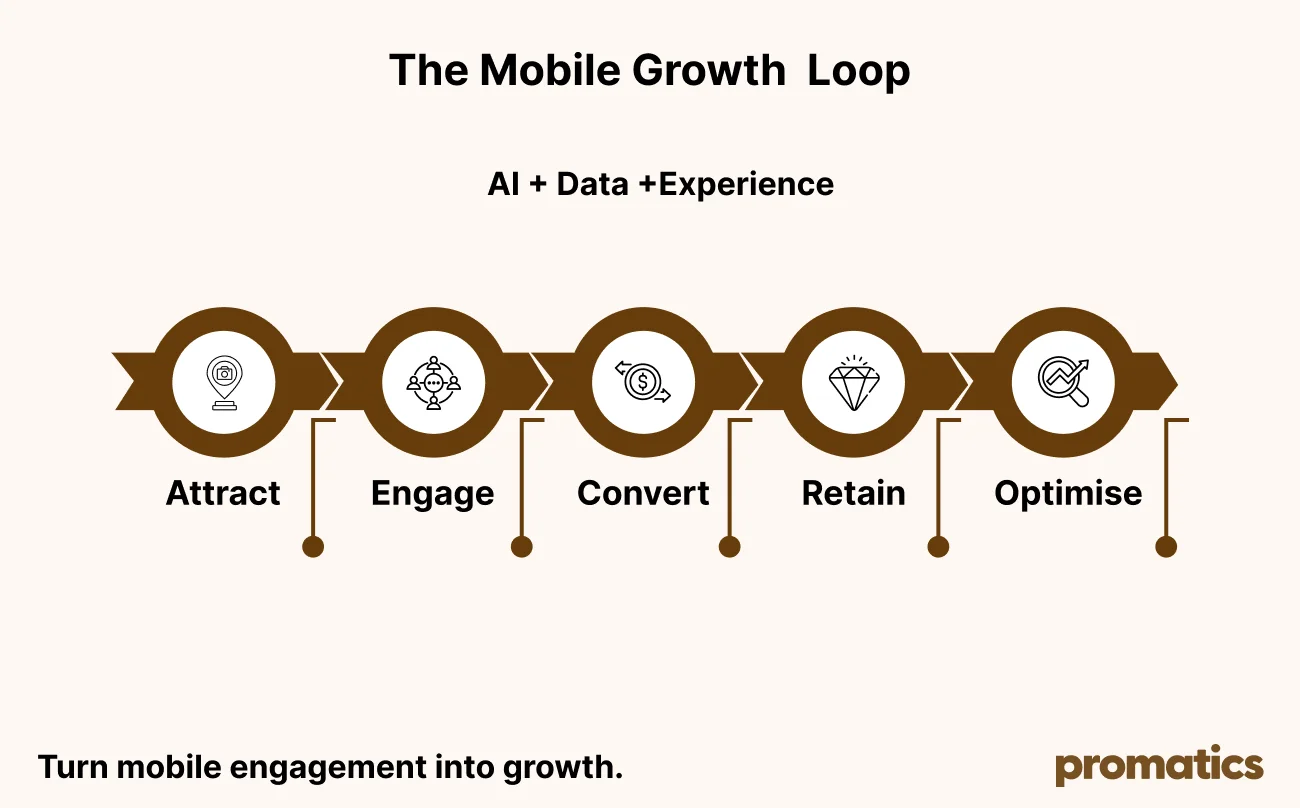
Acquisition → Activation → Engagement → Conversion → Retention
The Future of Mobile Marketing: From Campaigns to Intelligent Journeys
The biggest mobile marketing shift in 2026 is not a single technology.
It is the movement from campaign-centric marketing to intelligent customer journeys.
Traditional approach
Create campaign → Launch → Measure → End
Emerging approach
Understand → Predict → Personalize → Automate → Measure → Learn → Adapt
AI makes this continuous cycle possible.
Future mobile experiences will increasingly be able to:
- Predict purchase intent
- Recommend the next best action
- Identify churn risks
- Personalize onboarding
- Optimize communication timing
- Generate creative variations
- Recommend relevant products
- Automate customer engagement
Vibes’ research reinforces this direction: brands show strong interest in AI, but the challenge is moving from AI experimentation to usable AI that produces measurable outcomes.
The competitive advantage will therefore not come from simply “using AI.”
It will come from using AI where it improves a measurable customer or business outcome.
Conclusion
Mobile marketing in 2026 is about smarter engagement, not simply reaching more users.
AI-powered personalization, predictive analytics, privacy-first attribution, UGC, RCS, SMS, mobile wallets, and retention are reshaping how businesses acquire and engage customers.
But marketing alone is not enough. Your mobile app needs the right technology, analytics, integrations, and AI capabilities to turn these strategies into measurable growth.
Whether you want to hire mobile app developers, hire dedicated mobile app developers, or build a dedicated mobile app development team, the right technology partner can make execution faster and more effective.
Promatics Technologies helps businesses build scalable mobile products with mobile app development, AI, analytics, and automation tailored to their goals.
Ready to build a smarter mobile experience? Partner with us to attract high-value users, increase engagement, and turn mobile marketing into measurable business growth.
