Mobile Wallet App Development Guide 2026: Build Apps Like PayPal & Stripe
TL;DR
- Mobile wallet apps enable fast, secure, and contactless digital payments for global users
- To build a mobile wallet app, define the business model and ensure compliance with KYC and PCI DSS
- Essential features include instant money transfers, QR/NFC payments, wallet balance, and transaction history
- Use a scalable tech stack with cloud infrastructure and secure APIs for high performance
- Investing in mobile wallet development helps businesses scale faster and stay competitive in the digital payments market
Digital payments have become the backbone of modern commerce, transforming how people pay, transfer money, and manage finances. From buying groceries and paying utility bills to sending money instantly, users now expect payment experiences that are fast, secure, and effortless. This growing demand has pushed businesses to invest heavily in payment app development and mobile wallet app development that deliver seamless performance, strong security, and global scalability.
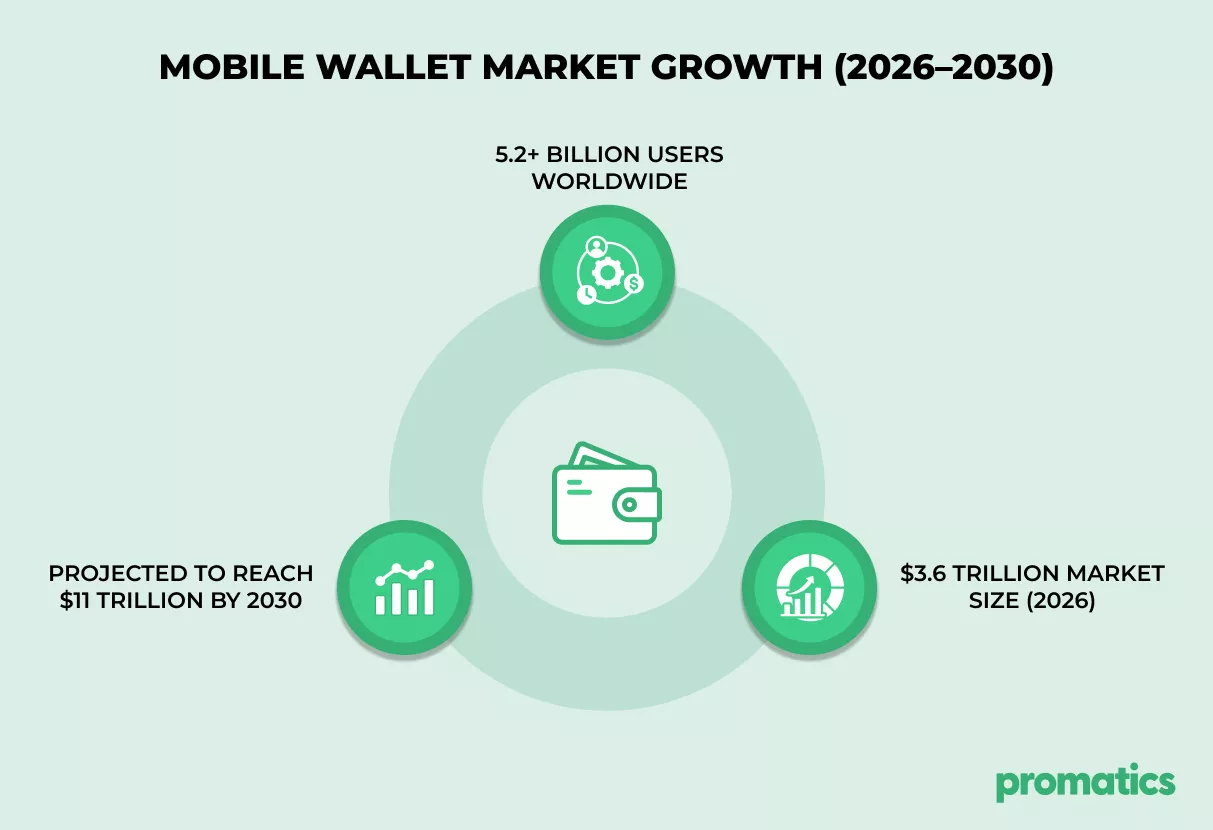
By mid-2026, the global digital wallet market has crossed 5.2 billion users, covering more than half of the world’s population. This growth clearly shows how fast mobile payment apps are becoming the preferred way to transact.
In this blog, we’ll walk through how to build a mobile wallet app like PayPal or Stripe, covering key features, tech stack, development steps, and important considerations. Whether you’re planning a fintech startup or expanding an existing product, this will help you build a practical, scalable, and user-friendly digital wallet app.
Market Valuation & Growth (2026 Update)
The total transaction value processed through digital payments is projected to reach $26.89 trillion in 2026, representing an 11.7% increase from 2025. Recent data from The Business Research Company indicates that the specific mobile wallet market size has grown to $3,635.3 billion in 2026, expanding at a robust CAGR of 32.0% as it heads toward a projected $11 trillion by 2030.
Key Statistics for 2026 and Beyond
- Dominant Transaction Methods: QR codes have become the most popular transaction type globally, expected to reach 380 billion transactions in 2026, accounting for over 40% of all wallet volume.
- User Adoption Milestones:
- Global Total: Surpassed 5.2 billion in early 2026.
- India: Continues to lead real-time volume; UPI alone crossed 106 billion transactions in the first half of 2025, providing a massive base for 2026 expansion.
- United States: Usage has surged to 69% of adults having used a digital wallet in the past year, with in-store weekly usage hitting 31%.
- Shift in E-Commerce: Digital wallets now account for over 50% of global e-commerce spend. In North America, they are projected to handle 52% of all online transactions by 2027, officially displacing credit cards as the primary online payment method.
Emerging 2026 Trends
- AI & Security: Over 80% of banks now deploy AI-driven fraud detection, saving an estimated $9 billion annually in India alone by identifying abnormal patterns in real-time.
- Biometric Maturity: The biometric payment market is expanding rapidly, with systems expected to serve over 3 billion users by 2026 as FaceID and fingerprint recognition replace traditional PINs.
- Embedded Finance: Invisible “Log in and Pay” experiences are becoming standard. Netcetera reports that by 2026, identity and payments will converge into a single authenticated action, making the physical act of “paying” virtually invisible.
What is a Mobile Wallet and How Does It Work?
A digital wallet is a software application, typically used on smartphones, that stores digital versions of credit cards, debit cards, loyalty cards, and other financial information. It acts as a digital alternative to a physical wallet, offering enhanced convenience and security.
With a mobile wallet, users can make quick and secure payments both online and in physical stores without carrying physical cards.
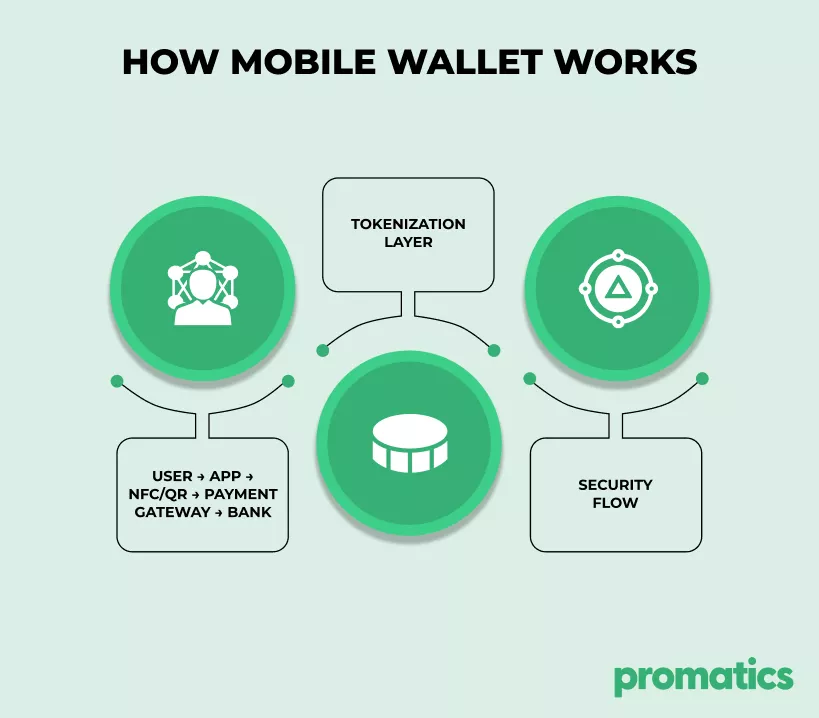
Mobile wallets function through a combination of technologies:
- Near Field Communication (NFC): Enables tap-to-pay transactions by allowing devices to communicate over short distances
- QR Codes: Users can scan a merchant’s QR code to complete payments instantly
- Tokenization: Replaces sensitive card details with encrypted tokens, ensuring secure transactions without exposing actual card data
These technologies work together to deliver fast, secure, and seamless payment experiences.
Why Are Mobile Wallet Apps Essential in 2026?
Quick Answer : Mobile wallet apps are transforming global payments by offering fast, secure, and seamless digital transactions, replacing traditional cash and card-based systems.
Digital Wallet vs Mobile Wallet vs Digital Bank
The terms “digital wallet,” “mobile wallet,” and “digital bank” are often used interchangeably, but they serve different purposes.
| Feature | Digital Wallet | Mobile Wallet | Digital Bank |
| Primary Purpose | Store payment information | Enable mobile-first payments | Provide full banking services |
| Platform | Desktop + Mobile | Mobile devices only | Mobile or web apps |
| Core Function | Facilitate digital payments | Contactless and in-app payments | Savings, transfers, investments |
| Examples | PayPal, Amazon Pay | Apple Wallet, Google Pay, Samsung Pay | Chime, Ally Bank, Revolut |
Quick Answer : Mobile wallets are a type of digital wallet focused on mobile payments, while digital banks offer full banking services.
How to Create a Mobile Wallet App?
Building a mobile wallet app is not just about coding, it’s a structured process that combines business strategy, security, compliance, and scalable technology. Based on industry best practices and platforms like Promatics Technologies, here’s a step-by-step, in-depth roadmap to help you go from idea to launch.
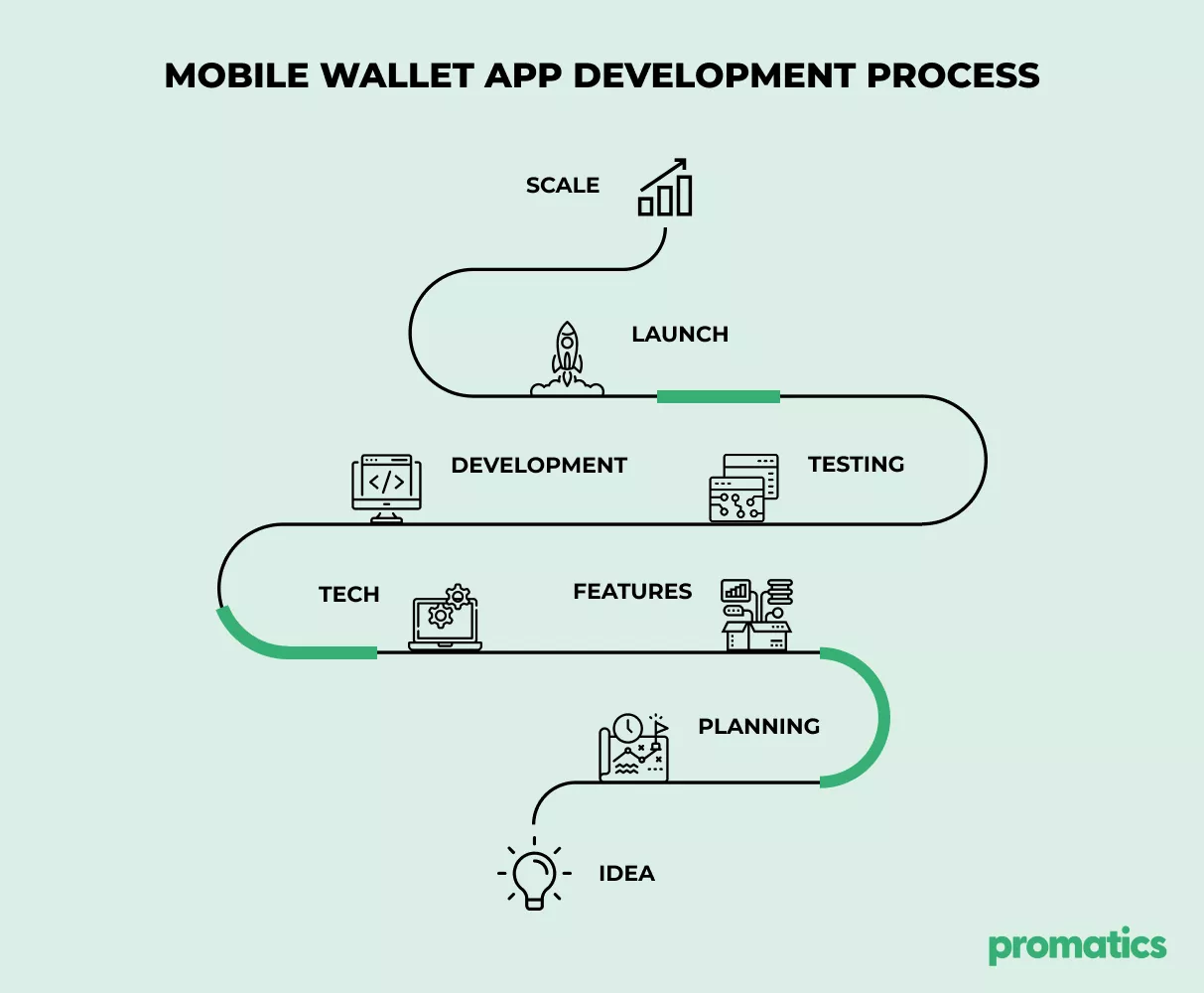
1. Define Your Wallet Type and Business Model
Before writing a single line of code, you need clarity on what kind of wallet you’re building.
- Decide whether your app will be a closed wallet (brand-specific), semi-closed wallet (usable across partner merchants), or open wallet (bank-integrated)
- Identify your target users: consumers, businesses, or both
- Define revenue streams such as transaction fees, subscriptions, or value-added services
- Analyze competitors like Paytm or Google Pay to understand feature expectations
- Ensure your business model aligns with regional regulations and compliance requirements
This stage lays the foundation for your entire product strategy.
2. Conduct Market Research and Compliance Planning
Mobile wallets operate in a highly regulated environment, so compliance is non-negotiable.
- Research your target market’s payment behavior and user expectations
- Identify regulatory requirements such as KYC (Know Your Customer) and AML (Anti-Money Laundering)
- Ensure compliance with standards like PCI DSS for secure transactions
- Understand regional fintech laws and licensing requirements
- Plan data privacy and storage policies
A clear compliance roadmap helps avoid legal risks and delays later.
3. Define Core Features and Functionalities
Your feature set will determine both user experience and development cost.
Essential features include:
- User registration and profile management
- Wallet balance and transaction history
- Add/withdraw money
- QR code and NFC-based payments
- Peer-to-peer transfers
- Push notifications
Advanced features (for scalability):
- AI-based expense tracking
- Multi-currency support
- Loyalty programs and rewards
- Fraud detection systems
- Integration with banking APIs
A well-defined feature roadmap ensures smoother development and better user adoption.
4. Choose the Right Tech Stack and Platform
Technology decisions directly impact performance, scalability, and cost.
- Decide between native (iOS/Android) or cross-platform frameworks like Flutter
- Use cloud platforms (AWS, Azure, GCP) for scalability
- Select secure backend technologies for transaction processing
- Implement API-driven architecture for integrations
- Plan database systems for handling high transaction volumes
Modern mobile wallets rely heavily on cloud-native and API-first architectures for flexibility and growth.
5. Design UI/UX for Seamless User Experience
User experience is a key differentiator in fintech apps.
- Create wireframes and prototypes to visualize app flow
- Focus on minimal steps for transactions (speed matters)
- Ensure intuitive navigation and clean design
- Optimize for accessibility and mobile responsiveness
- Conduct usability testing before development
A well-designed interface increases user retention and engagement significantly.
6. Develop the Core Wallet Infrastructure
This is where your product starts taking shape.
- Build backend systems for transaction processing
- Set up user roles, permissions, and wallet accounts
- Configure currencies, commissions, and exchange rates
- Develop APIs for payments, transfers, and integrations
- Implement real-time transaction tracking
Platforms like Promatics Technologies finance highlight the importance of robust backend systems and API layers to ensure scalability and performance.
7. Integrate Payment Gateways and Financial Services
Your wallet must connect seamlessly with financial systems.
- Integrate payment processors like Stripe or PayPal
- Enable bank account linking and card payments
- Add support for UPI, QR codes, and NFC payments
- Connect with third-party services for analytics and fraud detection
- Ensure real-time transaction processing
Strong integrations are critical for delivering a smooth and reliable payment experience.
8. Implement Advanced Security Measures
Security is the backbone of any mobile wallet app.
- Use end-to-end encryption for all transactions
- Implement tokenization to protect card details
- Add biometric authentication (fingerprint/face ID)
- Enable multi-factor authentication (OTP, device verification)
- Conduct regular security audits and penetration testing
These measures help build user trust and protect sensitive financial data.
9. Test, Launch, and Deploy
Before going live, thorough testing is essential.
- Perform functional, security, and performance testing
- Use sandbox and staging environments for validation
- Fix bugs and optimize performance
- Deploy the app on app stores and cloud infrastructure
- Monitor real-time performance after launch
A structured testing and deployment process ensures a smooth user experience.
10. Post-Launch Support and Scaling
Launching is just the beginning; continuous improvement is key.
- Monitor user behavior and transaction patterns
- Roll out updates and new features regularly
- Scale infrastructure as user base grows
- Provide customer support and issue resolution
- Optimize performance and security continuously
Successful mobile wallet apps evolve based on user feedback and market trends.
Quick Answer
Building a mobile wallet requires strategy, compliance, scalable tech, and user-focused design.
Key Benefits Driving Mobile Wallet Adoption
1. Seamless Payment Experience
One of the biggest reasons behind the widespread adoption of mobile wallets is the ability to complete transactions instantly with minimal effort. Users no longer need to carry physical cash or cards, remember PINs for multiple accounts, or go through lengthy checkout processes. With just a tap, scan, or biometric authentication, payments can be completed within seconds.
This level of convenience significantly enhances the user experience, especially in fast-paced environments like retail stores, transportation, and online shopping platforms, where speed and efficiency directly impact customer satisfaction.
2. Advanced Security Infrastructure
Mobile wallets have gained strong user trust due to their robust security mechanisms, which are often more advanced than traditional payment methods. Features such as tokenization ensure that sensitive card details are never directly exposed during transactions, while biometric authentication methods like fingerprint scanning and facial recognition add an extra layer of protection.
Additionally, multi-factor authentication systems, real-time fraud detection, and encrypted data storage work together to create a highly secure ecosystem. This strong emphasis on security reassures users and encourages them to adopt digital payment solutions confidently.
3. All-in-One Financial Convenience
Modern mobile wallets are no longer limited to simple peer-to-peer payments. They have evolved into comprehensive financial tools that allow users to perform a wide range of activities within a single platform. From paying utility bills and recharging mobile plans to booking tickets, shopping online, and transferring money instantly, mobile wallets offer unmatched versatility.
This consolidation of multiple financial services into one application eliminates the need to switch between different platforms, making everyday transactions more streamlined and efficient for users.
4. Strong Incentive Ecosystem
Another major factor driving the popularity of mobile wallets is the attractive ecosystem of rewards, cashback offers, and loyalty programs. These incentives not only encourage users to try mobile wallets initially but also play a crucial role in retaining them over time. Regular discounts, exclusive deals, referral bonuses, and personalized offers create a sense of value for users, making digital payments more appealing than traditional methods.
Over time, this reward-driven engagement helps build habitual usage patterns and strengthens customer loyalty toward specific wallet platforms.
5. Mobile-Driven Digital Adoption Growth
The exponential growth in smartphone usage and affordable internet access has significantly contributed to the rise of mobile wallets, especially in emerging markets. As more people gain access to digital devices, mobile wallets become an easy entry point into the financial ecosystem.
Additionally, these platforms support financial inclusion by enabling users with limited or no access to traditional banking services to participate in digital transactions.
What Technologies Are Used in Mobile Wallet Development?
Quick Answer : Mobile wallet apps rely heavily on secure API integrations and third-party services. To explore this further, check out our guide on popular payment gateways and mobile apps.
Global Mobile Wallet Usage Statistics and Adoption Rates
The shift from physical cash to digital payments is no longer a future trend. It is already happening at scale. By 2026, mobile wallets have evolved from being an optional payment method to becoming one of the most preferred ways to pay globally, both online and in physical stores. Businesses, consumers, and even small vendors are rapidly embracing this change, driven by convenience, speed, and growing digital infrastructure.
Popular Digital Wallets and Their Reach
Several major players dominate the mobile wallet ecosystem, each with a strong and growing user base:
- PayPal is used by approximately 42% of consumers in the United States, making it one of the most widely adopted digital wallets
- Apple Pay is used by around 34% of users, with strong adoption among iPhone users and in-store payments
- Venmo is used by nearly 33% of consumers, particularly popular for peer-to-peer transactions
- Google Wallet is used by about 17% of users, with growing adoption across Android devices
- Google Pay has achieved massive global scale, serving over 820 million active users worldwide
These platforms continue to expand their ecosystems by integrating financial services, rewards, and AI-driven features.
User Demographics: Who is Using Mobile Wallets?
Adoption varies across age groups, but the overall trend clearly shows increasing usage across all generations:
- 43.2% of Gen Z users use mobile wallets for in-store payments on a weekly basis
- 49.4% of Millennials actively use digital wallets every week, making them one of the most engaged user groups
- 66.7% of Bridge Millennials rely on digital wallets regularly
- 43.7% of Gen X users have adopted mobile wallets for routine transactions
- In comparison, only 7.9% of Baby Boomers use digital wallets weekly, indicating slower adoption among older demographics
This data highlights a clear generational shift. Younger users are leading adoption, while older groups are gradually catching up.
Market Share and Usage Trends
The widespread adoption of mobile wallets is also reflected in market penetration and usage frequency:
- Around 69% of U.S. adults have used a digital wallet within the last 30 days
- Apple Pay holds nearly 38% of the U.S. digital wallet market share, making it a dominant player
- PayPal follows with approximately 28% market share
- Venmo continues to grow, being used by 33% of U.S. consumers
These numbers reflect both adoption and strong user retention.
Future Projections: What Lies Ahead?
The future of mobile wallets looks promising, with strong growth projections:
- The number of global digital wallet users is expected to exceed 5.2 billion
- The mobile wallet market is projected to reach $784 billion by 2034
- By 2027, nearly 46% of all POS transactions will be onducted via digital wallets
- Digital wallets are expected to contribute to 73% of global transaction value growth
- The overall mobile payments market is forecasted to surpass $2 trillion by 2035
What This Means for Businesses
These statistics clearly indicate that mobile wallets are shaping the future of payments. Businesses that adapt early by integrating mobile wallet solutions can gain a competitive advantage, improve customer experience, and tap into a rapidly growing digital economy.
As adoption continues to rise across regions and demographics, investing in mobile wallet technology is now a strategic necessity.
Mobile Wallet App Development Made Easy with Promatics Technologies
Building a mobile wallet app today goes beyond basic coding. It requires a secure, scalable, and user-friendly digital payment solution that meets modern user expectations. Promatics Technologies simplifies this process with a strategy-first approach tailored for global businesses.
From startups to enterprises, the development process is aligned with your business model, target audience, and regional compliance requirements. Whether you are targeting markets in the US, UK, UAE, or India, the focus remains on building a high-performance digital wallet app that supports seamless transactions and long-term scalability.
The development approach combines intuitive UI/UX design with a robust, cloud-based architecture. Features like real-time payments, secure API integrations, and scalable backend systems ensure your app performs efficiently under growing user demand. This creates a smooth and reliable mobile payment experience for end users.
Security and compliance are integrated at every stage. From data encryption and tokenization to KYC and PCI DSS readiness, every layer is built to protect sensitive financial data and meet global fintech standards. This helps businesses build trust and expand confidently across regions.
Post-launch, continuous optimization, feature upgrades, and performance monitoring ensure your app stays competitive in the evolving fintech landscape. With the right mix of technology, strategy, and innovation, launching a future-ready mobile wallet solution becomes faster, smarter, and more effective.
Conclusion
Digital payments are no longer the future, they are the present. As mobile wallets continue to redefine how users pay, transfer, and manage money, businesses have a clear choice: adapt quickly or risk falling behind. The real opportunity lies in building a solution that is not just functional, but secure, scalable, and designed for long-term user engagement.
A successful mobile wallet app goes beyond transactions. It creates a seamless financial experience that builds trust, drives retention, and supports global growth. This requires the right mix of strategy, technology, and execution from day one.
That is where Promatics Technologies comes in. With expertise in building high-performance, compliant, and user-centric fintech solutions, the journey from idea to launch becomes faster, smoother, and more impactful.
If you are ready to build a future-ready mobile wallet that stands out in a competitive market, now is the time to act. Get in touch with Promatics Technologies today to turn your idea into a secure, scalable, and market-ready mobile wallet solution.
