DevOps in FinTech: CI/CD, Compliance & Security
TL;DR
- DevOps in fintech enables faster releases with CI/CD, helping teams respond quickly to market demands
- Integrates security and compliance through DevSecOps, ensuring safe and regulated deployments
- Supports real-time transactions with high reliability, minimal downtime, and continuous monitoring
- Enables seamless scalability using cloud and microservices to handle growing user demand
- Improves collaboration across development, operations, and security teams for efficient delivery
- Drives continuous innovation while maintaining performance, stability, and customer trust
Speed is no longer a differentiator in fintech. It is the minimum expectation. The industry runs on real time transactions, constant innovation, and zero tolerance for downtime. In such a high stakes environment, the ability to deliver quickly must be matched with consistency, security, and reliability. This is where DevOps moves beyond technical practice and becomes a strategic pillar. It enables fintech organizations to release faster, respond to change instantly, and maintain operational resilience without compromising compliance or user trust.
The global DevOps market continues to grow rapidly and is projected to reach approximately USD 25.5 billion by 2028, expanding at a CAGR of 19.7 percent. This growth highlights how organizations are increasingly relying on DevOps to streamline development, improve collaboration, and accelerate delivery cycles.
DevOps is rooted in the principles of agile development and lean programming, both designed to enhance speed and efficiency. Over time, it evolved from early efforts to align development and operations teams into a structured methodology that supports continuous integration, continuous delivery, and seamless collaboration.
At its core, DevOps enables organizations to deliver business value faster, more efficiently, and with greater security. It allows for frequent releases, quicker feature rollouts, and faster resolution of bugs, while maintaining high standards of quality and compliance. The focus is not only on speed but also on how efficiently issues are identified, resolved, and redeployed.
For fintech CTOs, adopting DevOps is critical. The ability to deploy updates quickly, ensure strong security, and maintain compliance in a highly regulated environment directly impacts business performance and customer trust. In this blog, we will explore the key insights and strategies needed to implement DevOps effectively in the fintech ecosystem. Let’s get started.
Inside Fintech: Managing Scale, Risk, and Rapid Innovation
Modern financial services are shaped by rising user expectations. Customers today look for experiences that are fast, reliable, and available at all times. From instant payments to digital lending and investment platforms, convenience and security are no longer optional.
For fintech companies, delivering this level of experience comes with significant challenges.
They operate in a highly demanding environment that includes:
- Large volumes of real-time transactions
- Handling of sensitive financial and personal data
- Strict regulatory and compliance frameworks
- Continuously evolving customer expectations
- Ongoing pressure to innovate and stay competitive
Achieving the right balance between speed, security, and stability is complex. Fintech platforms must innovate rapidly while ensuring systems remain resilient and compliant.
DevOps plays an important role in this situation. It enables organizations to streamline development, improve collaboration, and deliver updates more quickly while maintaining quality and security standards.
What Challenges Do Fintech Companies Face Today?
Quick Answer: Fintech companies deal with real-time transactions, strict regulations, sensitive data, and constant pressure to innovate securely and quickly.
What is DevOps?
DevOps is a modern software development approach that unifies development and operations to deliver applications faster, more reliably, and more efficiently. It emphasizes automation, continuous integration and delivery CI/CD (continuous integration and delivery best practices), and strong collaboration across teams.
Rather than working in isolation, DevOps promotes a shared-responsibility model in which development, operations, and quality assurance teams collaborate throughout the entire lifecycle.
In fintech, DevOps plays a critical role due to the industry’s unique challenges. Organizations must balance rapid innovation with strict regulatory compliance, high-level security, and uninterrupted system availability. DevOps achieves this balance by developing systems that are both agile and robust.
What is DevOps in Fintech?
Quick Answer: DevOps is a collaborative approach that combines development and operations to deliver secure, reliable, and faster financial applications.
The Evolution of DevOps in Fintech
The DevOps in the fintech industry is undergoing a profound transformation, propelled by the relentless pursuit of agility, innovation, and customer-centricity. Traditional software development methodologies, characterized by rigid structures and lengthy release cycles, are increasingly ill-equipped to meet the dynamic demands of the modern fintech ecosystem.
This necessitates a paradigm shift towards DevOps, a philosophy that fosters collaborations, automation, and continuous improvements.
Cloud Adoption
Cloud computing is a cornerstone of fintech innovation, offering unparalleled scalability, flexibility, and cost-efficiency. By leveraging cloud platforms like AWS, Azure, and Google Cloud, fintech companies can rapidly provision resources, deploy applications, and scale infrastructure on demand.
This agility is essential for responding to market filtration, launching new products, and adapting to evolving customer needs. Cloud adoption also facilitates the implementation of Infrastructure as Code (IaC), enabling automated provisioning and management of infrastructure, a key component of DevOps.
Microservices Architecture
The adoption of microservices architecture is transforming how fintech applications are designed and deployed. By breaking monolithic systems into smaller, independent services, developers gain greater agility and scalability. Each microservice can be built, tested, and deployed independently, enabling faster releases with lower risk, while also supporting scalable mobile app development approaches required to handle millions of users.
This approach improves system resilience, as a failure in one microservice does not impact the entire application. By isolating components, fintech platforms can maintain stability even during disruptions. Technologies such as containerization and orchestration tools like Docker and Kubernetes form the backbone of these scalable systems, enabling fintech solutions to handle growing workloads efficiently while maintaining performance, flexibility, and reliability.
Regulatory Pressures
Fintech companies operate in a highly regulated environment, facing stringent data security, privacy, and compliance requirements. Regulations like GDPR, PCI DSS, and PSD2 necessitate robust security measures, audit trails, and data protection practices.
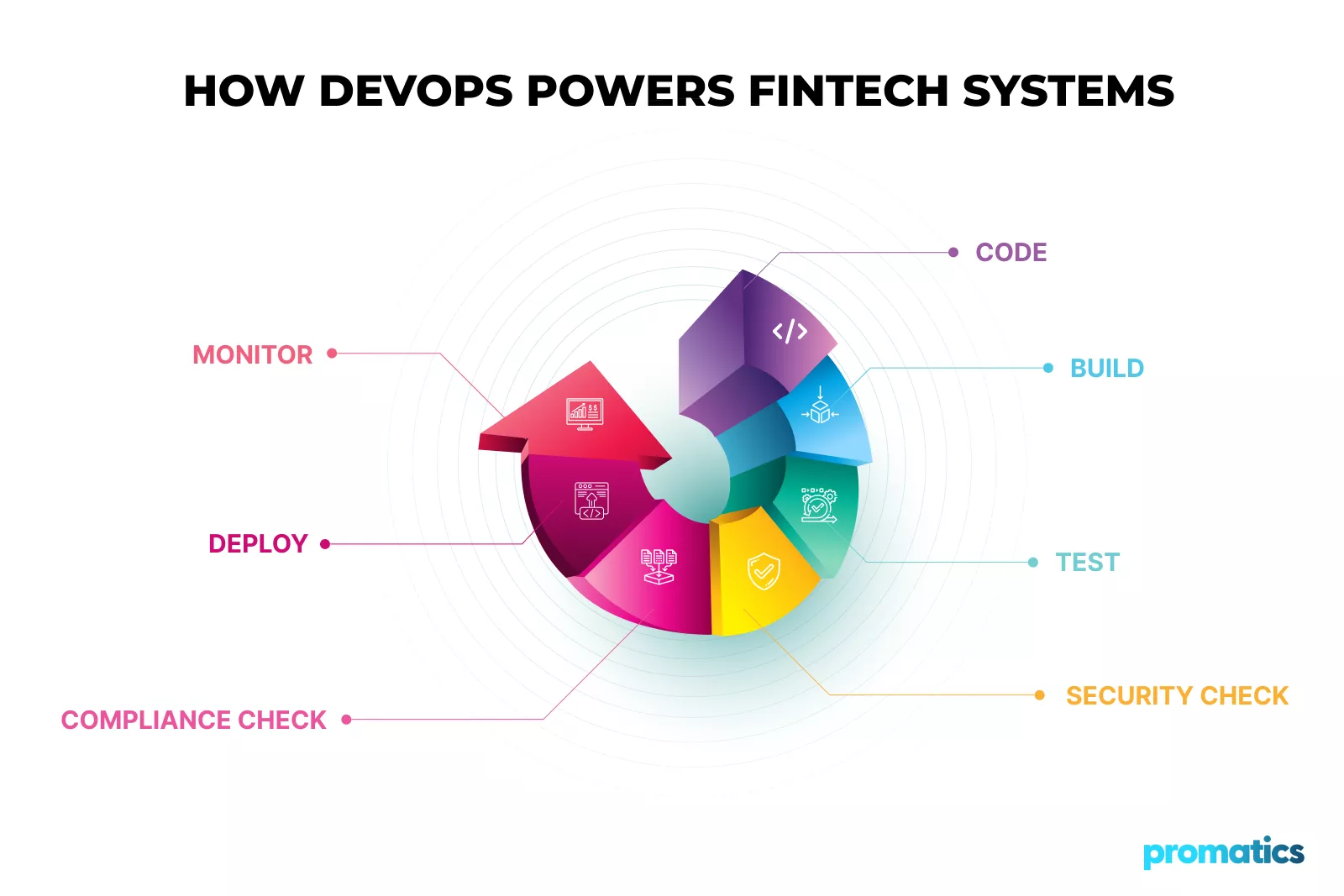
DevOps addresses these challenges by automating compliance checks, implementing security best practices, and ensuring continuous monitoring. Fintech companies can mitigate risks and maintain regulatory adherence by integrating security and compliance into the development lifecycle.
Customer Expectations
Today’s customers expect seamless, secure, and personalized financial services. They demand intuitive interfaces, real-time access to information, and tailored solutions that meet their needs. DevOps enables fintech companies to respond to these expectations by fostering rapid iteration, continuous feedback, and data-driven decision-making.
By embracing DevOps practices, organizations can enhance customer satisfaction, build trust, and drive loyalty. This also facilitates the rapid deployment of security updates and bug fixes, which are essential for customer trust.
By understanding and adapting to these landscape elements, fintech organizations can leverage DevOps to gain a competitive edge and thrive in the digital age.
Why is DevOps Essential for Fintech Growth?
Quick Answer: It enables faster deployments, improves system reliability, and ensures compliance while handling high transaction volumes efficiently.
Enterprise vs Basic DevOps in Fintech: Key Differences
While DevOps principles remain consistent, their implementation in fintech environments is far more complex. Enterprise fintech systems require deeper security, strict compliance, and high scalability compared to standard DevOps setups. The comparison below highlights these differences.
| Aspect | Enterprise DevOps in Fintech | Basic DevOps Implementation |
| Primary Objective | Ensures secure, compliant, and high-performance financial operations at scale | Focuses on improving development speed and deployment efficiency |
| Security Integration | Security is embedded throughout the lifecycle (DevSecOps), with continuous threat monitoring and risk mitigation | Security is often handled as a separate phase with limited automation |
| Compliance Requirements | Built to meet strict regulations like PCI DSS, GDPR, and PSD2 with automated compliance checks and audit trails | Minimal or no regulatory constraints, with basic compliance handling |
| Data Sensitivity | Handles highly sensitive financial and personal data with encryption, access controls, and governance policies | Manages general application data with standard protection measures |
| Infrastructure Setup | Hybrid or multi-cloud environments with legacy system integration and high availability architecture | Primarily cloud-based with simpler infrastructure and fewer dependencies |
| Scalability Needs | Designed for real-time scaling to support high transaction volumes and global user bases | Supports moderate scaling for smaller applications or user bases |
| Deployment Strategy | Advanced deployment models, like blue-green and canary releases, ensure zero downtime | Standard deployments with possible service interruptions |
| Monitoring & Observability | Real-time monitoring, predictive analytics, and end-to-end observability for critical systems | Basic logging and monitoring with limited insights |
| Failure Impact | Even minor failures can impact financial transactions, compliance, and customer trust | Failures usually have a limited business impact |
| Team Structure | Cross-functional teams including DevOps, security, compliance, and risk management experts | Smaller teams with limited specialization |
| Automation Depth | End-to-end automation, including testing, infrastructure, compliance, and security validation | Partial automation mainly focused on CI/CD pipelines |
How Has DevOps Evolved in the Fintech Industry?
Quick Answer: DevOps evolved through cloud adoption, microservices, automation, and compliance integration to support scalable and secure fintech systems.
Key DevOps Use Cases in Fintech
Automated Payment Processing at Scale
Fintech platforms handle massive transaction volumes where speed and reliability are critical. DevOps enables automated deployments and continuous monitoring to ensure seamless payment processing.
For example, companies like Stripe use automated infrastructure and continuous deployment practices to handle millions of transactions daily with minimal downtime.
Real-Time Fraud Detection and Risk Response
Fraud detection systems must evolve continuously to counter new threats. DevOps allows rapid updates to detection models and real-time monitoring pipelines.
Platforms like PayPal leverage continuous deployment and data-driven monitoring to quickly adapt to suspicious activity and reduce fraud risks.
Continuous Compliance and Audit Readiness
Regulatory compliance is a constant challenge in fintech. DevOps integrates automated compliance checks and audit trails into the development pipeline.
For instance, Square ensures regulatory adherence by embedding security and compliance practices directly into its deployment workflows.
Real-Time Data Processing and Decision-Making
Fintech platforms rely on instant data insights for services like credit scoring and transaction analysis. DevOps supports scalable, real-time data pipelines.
Companies like Robinhood process large volumes of market data in real time to deliver instant trading insights and decisions.
Customer Experience Optimization and Feature Rollouts
Continuous updates and quick bug fixes are essential for delivering smooth user experiences. DevOps enables rapid iteration based on user feedback.
For example, Revolut frequently rolls out new features and updates using continuous delivery practices to enhance customer experience.
Scalable Infrastructure for Dynamic Workloads
Fintech systems must handle unpredictable traffic spikes, especially during market events or peak hours. DevOps, combined with cloud-native practices, enables dynamic scaling.
Platforms like Coinbase rely on scalable cloud infrastructure and automated deployments to handle sudden surges in trading activity.
DevOps Implementation Strategy for Fintech
Successfully implementing DevOps in fintech requires more than just tools. It demands a structured approach that balances speed, security, and compliance while aligning with business goals.
Start with a Clear Assessment and Roadmap
Begin by evaluating your existing infrastructure, workflows, and bottlenecks. Identify areas where automation and collaboration can create the most impact, and define measurable goals for your DevOps journey. A phased implementation approach helps reduce risks while ensuring steady progress.
Build a Culture of Collaboration
DevOps is not just about technology. It is about people and processes. Encourage collaboration between development, operations, and security teams to break down silos and improve efficiency. This alignment leads to faster issue resolution and smoother delivery cycles.
Implement CI/CD Pipelines Early
Continuous integration and continuous delivery form the backbone of modern DevOps. Automating testing, integration, and deployment ensures faster releases while maintaining consistent quality and reliability across environments.
Adopt Cloud-Native and Scalable Architecture
Leveraging cloud platforms and infrastructure as code (IaC) enables fintech applications to scale efficiently and adapt to changing workloads. Building on a scalable application architecture designed to handle millions of users ensures long-term performance and flexibility.
Integrate Security from the Start (DevSecOps)
In fintech, security and compliance must be embedded throughout the development lifecycle. Implement automated security checks, vulnerability assessments, and compliance monitoring to ensure continuous protection of sensitive data.
Enable Continuous Monitoring and Feedback Loops
Real-time monitoring and observability help teams detect issues early and optimize system performance. Continuous feedback allows organizations to improve processes and deliver better user experiences over time.
How Does DevOps Handle Compliance and Security in Fintech?
Quick Answer: DevOps integrates security checks, audit trails, and automated compliance directly into development pipelines (DevSecOps).
Tools and Technologies Powering Fintech DevOps
DevOps tools for fintech are essential for automating and streamlining processes. Some DevOps tools are:-
- Version Control (Git): Tracks changes to code and enables collaboration.
- CI/CD (Jenkins, GitLab CI): Automates the build, test, and deployment processes.
- Infrastructure as Code (Terraform, CloudFormation): Manages infrastructure using code.
- Containerization (Docker): Packages applications and their dependencies into containers.
- Orchestration (Kubernetes): Manages and scales containerized applications.
- Configuration Management (Ansible, Chef): Automates the configuration of servers and applications.
- Monitoring and Logging (Prometheus, ELK Stack): Provides application and infrastructure performance insights.
- Security Tools (SonarQube, Snyk): Identify security vulnerabilities in code and dependencies.
- Cloud Platforms (AWS, Azure, GCP): Provide the infrastructure and services needed for DevOps.
What is the Difference Between Enterprise and Basic DevOps?
Quick Answer: Enterprise DevOps in fintech focuses on security, compliance, and scalability, while basic DevOps mainly improves development speed.
Why is DevOps a Game Changer for Fintech?
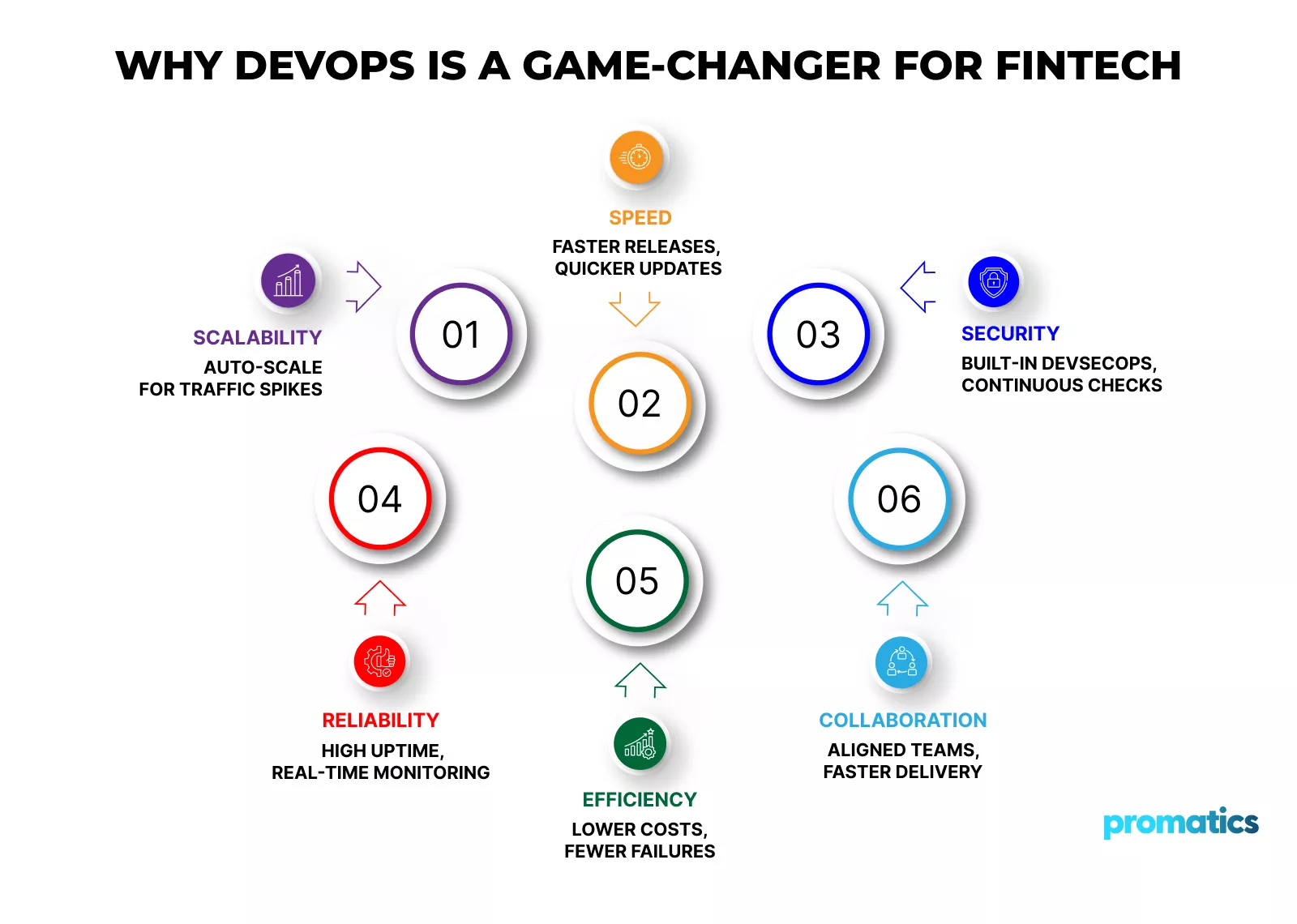
The fintech industry demands speed, precision, security, and constant innovation. Traditional development models often fall short in meeting these expectations. DevOps transforms how fintech companies build, deploy, and manage applications by enabling faster delivery, stronger security, and seamless scalability.
1. Faster Innovation and Time-to-Market
In a competitive fintech landscape, speed is everything. DevOps enables continuous integration and continuous delivery (CI/CD), allowing teams to:
- Release new features quickly
- Respond rapidly to market trends
- Reduce development and deployment cycles
This helps fintech companies stay ahead of competitors and meet evolving customer expectations.
2. Built-In Security and Compliance
Fintech applications deal with sensitive financial data and strict regulations. DevOps integrates security directly into the development lifecycle (DevSecOps), ensuring:
- Continuous security testing
- Early detection of vulnerabilities
- Automated compliance checks
This reduces risks while maintaining regulatory standards.
3. High Reliability and System Stability
Even a few minutes of downtime can result in major financial and reputational losses. DevOps improves reliability by:
- Enabling real-time monitoring and alerts
- Automating incident response
- Ensuring high availability with resilient infrastructure
This guarantees consistent and uninterrupted financial services.
4. Seamless Scalability
Fintech platforms often face sudden spikes in traffic, especially during peak transactions. DevOps supports:
- Cloud-native infrastructure
- Containerization and orchestration
- Auto-scaling capabilities
This ensures applications perform smoothly, regardless of user demand.
5. Stronger Collaboration and Efficiency
DevOps breaks down silos between development, operations, and security teams:
- Encourages shared ownership
- Improves communication and workflows
- Speeds up issue resolution
This results in more efficient and productive teams.
What Are Key DevOps Use Cases in Fintech?
Quick Answer: DevOps supports payment automation, fraud detection, compliance monitoring, real-time data processing, and scalable infrastructure.
Challenges of DevOps in Fintech
Regulatory Complexity and Compliance Pressure
Fintech companies operate under strict regulations such as PCI DSS, GDPR, and other regional frameworks. Ensuring continuous compliance while maintaining rapid development cycles can be challenging, especially when regulations frequently evolve.
Integration with Legacy Systems
Many financial institutions still rely on legacy infrastructure that is not designed for modern DevOps practices. Integrating new DevOps workflows with these systems can slow down transformation and increase technical complexity.
High Security and Data Protection Requirements
Fintech platforms handle sensitive financial and personal data, making them prime targets for cyber threats. Implementing strong security measures across the entire DevOps lifecycle without affecting speed and performance is a major challenge.
Cultural Resistance and Organizational Silos
DevOps requires a shift in mindset and collaboration across teams. Resistance to change, lack of alignment, and siloed departments can hinder successful adoption and slow down progress.
Managing Scalability and Performance Under Load
Fintech applications often face unpredictable spikes in traffic and transaction volumes. Ensuring systems can scale efficiently without compromising performance or reliability requires careful planning and robust infrastructure.
How to Implement DevOps in Fintech Successfully?
Quick Answer: Start with assessment, adopt CI/CD, enable collaboration, integrate security, and use cloud-native architecture for scalability.
Future of DevOps in Fintech
The future of DevOps in fintech is being shaped by rapid advancements in automation, AI, cloud-native architectures, and regulatory technology. As financial services continue to digitize, DevOps will move beyond efficiency and become a strategic driver of innovation, resilience, and compliance.
1. AI-Driven DevOps (AIOps)
Artificial intelligence is set to redefine DevOps in fintech. AIOps will enable:
- Predictive monitoring to detect issues before they impact users
- Automated incident resolution and root cause analysis
- Intelligent resource allocation for optimized performance
This will significantly reduce downtime and enhance system reliability, which is critical in financial ecosystems.
2. Rise of Platform Engineering
Fintech companies are increasingly adopting platform engineering to standardize development workflows. Internal developer platforms (IDPs) will:
- Provide self-service infrastructure
- Improve developer productivity
- Ensure consistency across environments
This shift allows teams to focus more on innovation rather than infrastructure management.
3. Hyperautomation Across Pipelines
DevOps pipelines will become fully automated using advanced tools and integrations. From code commits to deployment and monitoring:
- Manual interventions will be minimized
- CI/CD pipelines will become faster and more reliable
- Compliance checks will be embedded into workflows
Hyperautomation will be essential for scaling fintech applications efficiently.
4. DevSecOps as a Standard Practice
Security will no longer be a separate function but a core part of DevOps. In fintech:
- Security testing will be integrated into CI/CD pipelines
- Continuous compliance monitoring will be automated
- Zero-trust architectures will become standard
This ensures secure financial transactions while meeting strict regulatory requirements.
5. Cloud-Native and Multi-Cloud Adoption
The future will see deeper adoption of cloud-native technologies such as:
- Containers and Kubernetes for scalability
- Serverless architectures for cost efficiency
- Multi-cloud strategies to avoid vendor lock-in
These approaches will enable fintech companies to build resilient and scalable systems.
6. Real-Time Data and Observability
Fintech systems require real-time insights. Advanced observability tools will:
- Provide end-to-end visibility across systems
- Enable faster troubleshooting and performance optimization
- Support real-time fraud detection and transaction monitoring
Observability will become a cornerstone of DevOps strategies.
7. Regulatory Automation (RegTech Integration)
Compliance is a major challenge in fintech. Future DevOps practices will integrate RegTech solutions to:
- Automate reporting and auditing
- Ensure continuous compliance with global regulations
- Reduce the risk of penalties and legal issues
This will streamline operations in highly regulated environments.
8. Microservices and API-First Architecture
Fintech platforms will increasingly rely on:
- Microservices for modular and scalable development
- API-first approaches to enable seamless integrations
This will support faster innovation and better customer experiences.
What Tools Power DevOps in Fintech?
Quick Answer: Common tools include Git, Jenkins, Docker, Kubernetes, Terraform, Prometheus, and cloud platforms like AWS and Azure.
Conclusion
DevOps has become essential for fintech companies that need to move fast without compromising on security or compliance. In an industry where reliability and trust matter the most, the ability to deliver stable and scalable systems is a clear competitive advantage.
It helps teams release updates faster, handle growing user demand, and maintain consistent performance across platforms. More importantly, it brings development, operations, and security together, making the entire process smoother and more efficient.
That said, adopting DevOps successfully is not just about tools. It requires the right approach, the right architecture, and a clear understanding of your business needs.
This is where an experienced partner can help. Promatics Technologies works with fintech businesses to set up practical DevOps workflows, improve system reliability, and ensure secure, scalable deployments.
If you are planning to upgrade your infrastructure or build a fintech platform that can scale without issues, it is worth having the right support from the start.
Talk to Promatics Technologies experts to build a DevOps setup that actually works for your fintech business.
