Web Development Agency in New York: Services, Costs, Trends, and What to Expect in 2026

TL;DR
- Costs vary based on project complexity, features, and tech stack
- Services include UI/UX, custom development, cloud, and integrations
- Trends focus on AI, scalable architectures, and performance-driven design
- Choosing the right agency impacts scalability, ROI, and long-term growth
In New York City, your website is more than a marketing tool; it is your most powerful business asset. It works 24/7, communicates your brand authority instantly, and often determines whether a prospect becomes a client within seconds.
In 2026, digital expectations are higher than ever. Users expect fast-loading pages, seamless mobile performance, AI-powered personalization, accessibility compliance, airtight security, and intuitive user experiences. Businesses in Manhattan, Brooklyn, Queens, and beyond are not just competing locally; they are competing globally.
So the real question is not just “How much does a website cost in New York?”
It is, “What level of digital sophistication does my business need to compete in NYC, and what investment does that require?”
This guide provides a complete breakdown of web development services in New York, accurate 2026 pricing benchmarks, cost drivers, ongoing expenses, and strategic insights to help you invest wisely.
Why Web Development in New York Is Different
New York operates at a different level of business intensity. From finance firms near Wall Street to fashion brands in SoHo and tech startups in Brooklyn, the digital bar is exceptionally high. Three major factors influence NYC web development pricing:
1. Elite Talent Pool
NYC attracts engineers, designers, and strategists who have worked at global tech leaders such as Google and Meta. Agencies must offer competitive salaries to retain top-tier professionals.
2. High Market Expectations
A website that might succeed in a smaller city may not survive in New York. Here, branding, UX precision, and performance optimization are critical to credibility.
3. Operational Overhead
Office space, compliance insurance, and staffing costs in Manhattan contribute to what many call the “NYC premium.”
Understanding this context makes pricing more logical and less intimidating.
Top 5 Web Development Trends Businesses Are Using in 2026
AI-Driven User Experiences
Modern websites are increasingly integrating AI to personalize content, enhance search, power chatbots, and deliver tailored recommendations, making each visitor’s journey more relevant and dynamic.
Progressive Web Apps (PWAs)
PWAs combine the best of web and mobile apps, offering fast load times, offline capabilities, and app-like experiences, helping brands reduce bounce rates and increase engagement across devices.
Headless & Decoupled Architectures
Separating the front-end and back-end allows businesses greater flexibility, faster performance, and improved scalability, especially useful for omnichannel platforms that serve multiple touchpoints.
Voice & Visual Search Optimization
With voice assistants and visual search growing rapidly, websites are adopting structured data, natural language queries, and visual indexing, making their content discoverable in new ways beyond traditional text search.
Focus on Cybersecurity & Privacy-By-Design
As cyber threats evolve, secure coding practices, encryption standards, MFA, and privacy compliance (like CCPA and GDPR) have become essential features, not add-ons, in modern web development strategies.
Website Development Pricing in New York (2026 Benchmarks)
Below are realistic, market-aligned pricing ranges based on U.S. agency standards and NYC positioning.
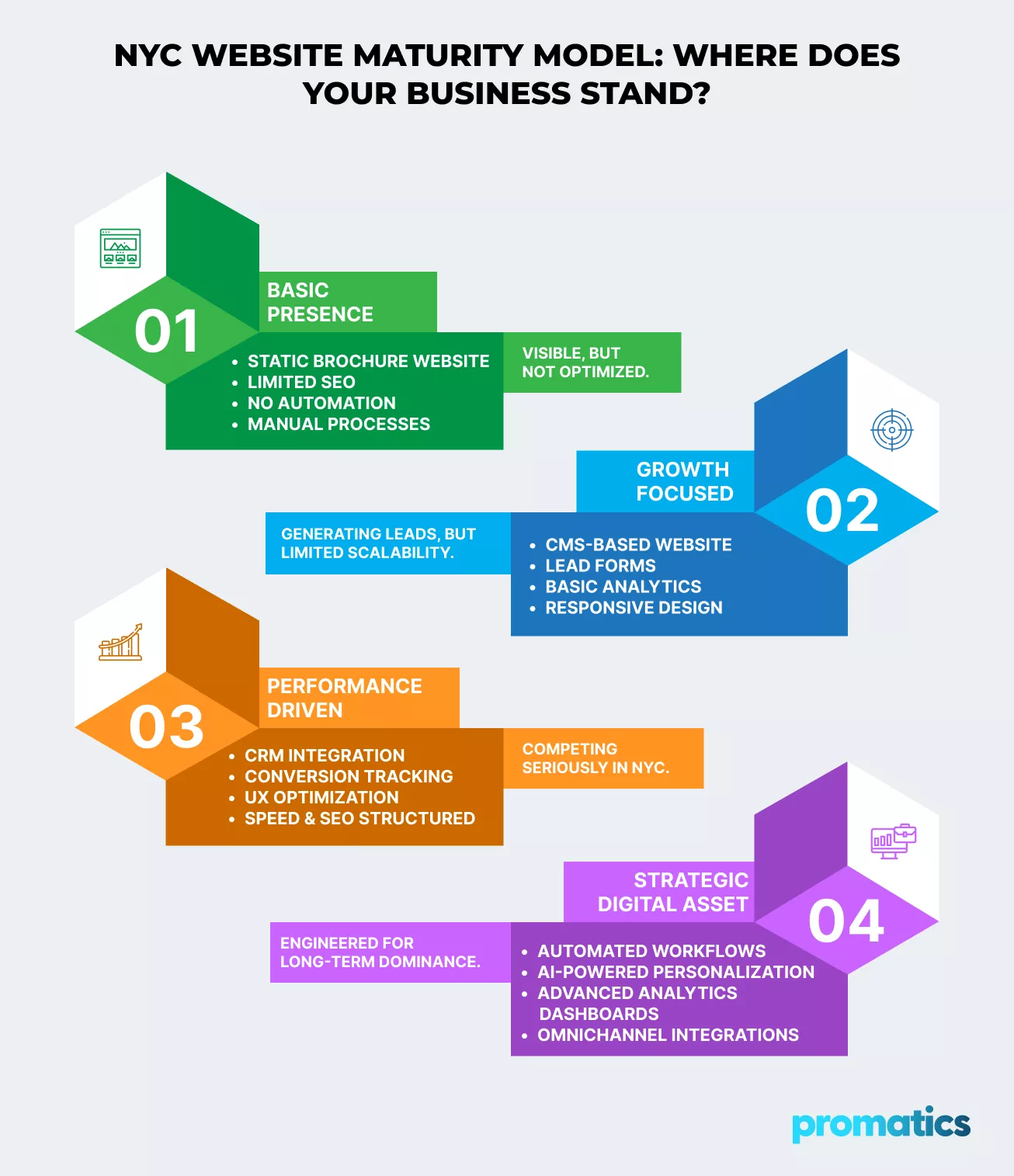
1. Small Business or Brochure Website
This is ideal for consultants, restaurants, law firms, medical practices, and local service businesses.
Typical Features:
- 5–10 pages
- Mobile-responsive design
- Basic SEO setup
- Contact forms
- Google Maps integration
- Security certificates
NYC Pricing Range (2026):
- Freelancers: $3,500–$8,000
- Boutique Agencies: $8,000–$20,000
Most reputable NYC agencies rarely begin below $8,000 due to labor and quality standards.
2. Corporate or Growth-Focused Website
Designed for mid-sized companies that rely heavily on inbound marketing and lead generation.
Typical Features:
- 20–50 pages
- Custom WordPress or Webflow CMS
- Blog architecture
- CRM integrations (HubSpot, Salesforce)
- Technical SEO foundation
- Conversion-focused UX
NYC Pricing Range (2026):
- Small Teams: $10,000–$30,000
- Mid-Sized Agencies: $30,000–$70,000+
Many established Manhattan agencies treat $35,000 as a starting point for serious corporate builds.
3. E-commerce Website
For retail brands selling locally, nationally, or globally.
Typical Features:
- Shopify Plus or WooCommerce
- 100+ products
- Secure payment gateways
- Subscription systems
- Inventory automation
- Conversion optimization
- Email marketing integration
NYC Pricing Range (2026):
- Small Agencies: $20,000 – $60,000
- Established Agencies: $60,000 – $150,000+
- Enterprise Builds: $150,000+
Luxury and omnichannel brands in New York frequently invest in advanced UX testing and performance optimization to maximize ROI.
4. Custom Web Applications & SaaS Platforms
When your website functions as your core product, such as fintech dashboards, healthcare portals, property management systems, or enterprise SaaS platforms.
Typical Features:
- Custom front-end (React, Vue)
- Backend architecture (Node.js, Python)
- Secure user authentication
- API integrations
- Cloud infrastructure
- Role-based dashboards
- Advanced security layers
NYC Pricing Range (2026):
- Entry-Level Custom App: $50,000–$80,000
- Complex Enterprise Build: $150,000 – $500,000+
Large fintech or compliance-heavy builds can exceed this depending on scale.
Hourly Rates in New York (2026)
For ongoing work, maintenance, or modular projects:
- Freelancers: $70–$150/hour
- Mid-Tier Agencies: $150–$300/hour
- Premium Agencies: $300 – $500+/hour
Highly specialized experts (security architects, AI engineers) may charge more.
What Actually Drives the Cost?
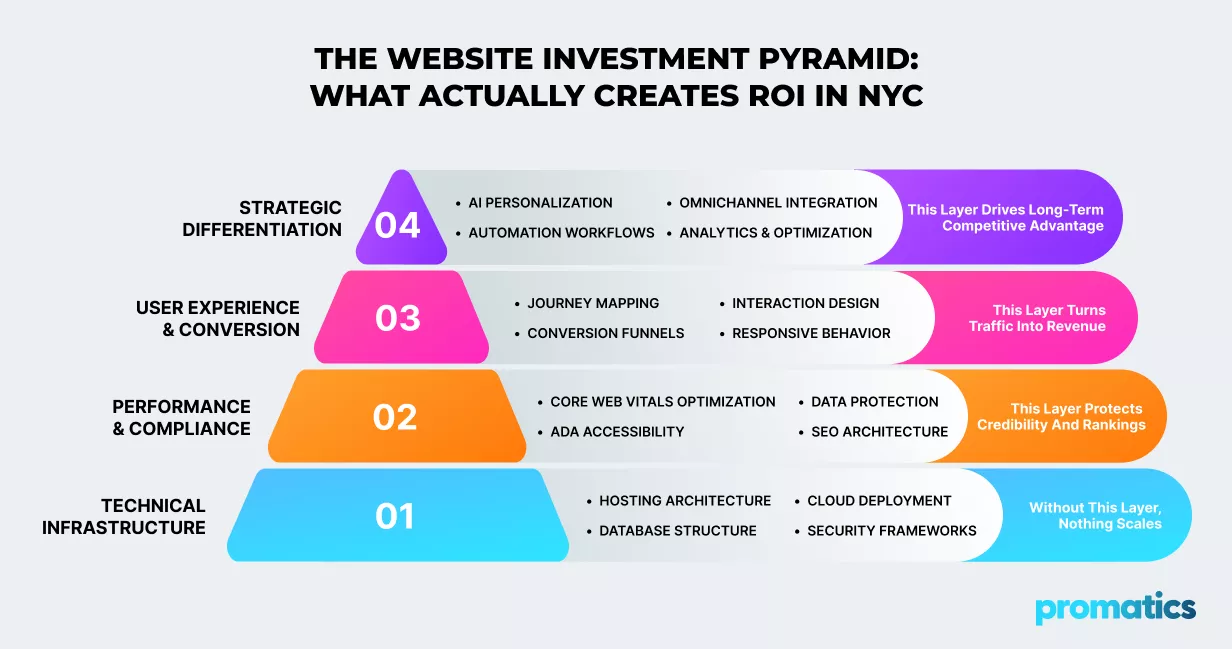
Many business owners assume design is the main expense. In reality, most of the budget goes into infrastructure, performance, and compliance.
1. User Experience Strategy
Before coding begins, agencies conduct research, competitor audits, and journey mapping to ensure optimized conversion flows.
Estimated Cost Impact: $5,000–$20,000
2. AI & Automation Integration
Modern websites frequently include chatbots, personalization engines, or recommendation systems. These require API logic, testing, and system integration.
Estimated Cost Impact: $4,000–$12,000
3. ADA & Accessibility Compliance
New York businesses must comply with accessibility standards aligned with WCAG guidelines to prevent lawsuits.
Estimated Cost Impact: $2,000–$6,000
4. Technical SEO Architecture
Ranking for competitive NYC keywords requires structured data, schema markup, performance optimization, and strategic content frameworks.
Estimated Cost Impact: $3,000–$10,000
Ongoing Costs After Launch
A website is not a one-time expense.
- Hosting & Infrastructure
$100–$600 per month
- Security Monitoring
$200–$1,200 annually
- Maintenance Retainers
$500 – $3,000 per month
- Professional Content Updates
$250–$1,000 per page
Neglecting post-launch support can lead to performance decline and security risks.
How to Reduce Web Development Costs Without Sacrificing Quality
- Start with an MVP
Launch essential features first, then scale. - Provide Your Own Media Assets
Professional photography in NYC is expensive. Providing assets reduces costs. - Use Scalable CMS Platforms
WordPress remains a powerful, flexible solution in 2026. - Prepare Integrations Early
Organized CRM and marketing tools reduce custom coding time. - Prioritize ROI Over Vanity Features
Not every animation or feature increases conversions.
How Web Development Services in New York Facilitate Industry Growth
Professional web development agencies in New York do more than build websites. They create scalable digital ecosystems.
1. Build Scalable Digital Infrastructure
Ensures performance, stability, and growth readiness.
2. Deliver Industry-Specific Customization
Healthcare, fintech, retail, and real estate all require tailored digital systems.
3. Enhance User Experience
Better navigation, speed, and responsiveness increase conversions.
4. Integrate Business Systems
CRM, ERP, analytics, and automation create centralized operational control.
5. Strengthen Security & Compliance
Protects brand trust and reduces legal risks.
Why Choose Promatics Technologies for Web Development in New York?
Choosing the right web development partner is just as important as defining your project scope. In a competitive market like New York, you need more than just developers; you need a strategic technology partner who understands performance, scalability, and ROI.
Promatics Technologies delivers enterprise-grade digital solutions tailored for businesses targeting the New York market without the inflated overhead typically associated with Manhattan-based agencies.
Proven Results Across Competitive Industries
Promatics Technologies has delivered scalable digital platforms for startups, mid-sized businesses, and enterprise clients across industries, including healthcare, fintech, retail, education, logistics, and real estate.
Over the years, Promatics has:
- Successfully delivered 500+ digital solutions globally
- Built platforms handling high traffic volumes and multi-location users
- Designed conversion-focused websites that improved lead generation performance
- Developed secure enterprise-grade applications with scalable architecture
For businesses targeting competitive markets like New York City, execution quality and reliability are critical. Promatics brings structured expertise and measurable impact to every project.bility.
A Transparent, Structured Development Process
One of the biggest concerns businesses have when hiring a web development agency is uncertainty. Promatics eliminates that uncertainty through a clear, milestone-driven process.
1. Discovery & Strategy
Business analysis, competitor research, and requirement mapping ensure the website aligns with long-term goals.
2. UX Wireframing & Prototyping
Before development begins, structured wireframes define user flow, navigation, and conversion pathways.
3. Agile Development Sprints
Incremental development cycles allow flexibility, continuous improvement, and faster feedback loops.
4. Quality Assurance & Security Testing
Performance testing, security audits, device responsiveness checks, and accessibility validation ensure reliability.
5. Launch & Continuous Optimization
Post-launch monitoring, performance tracking, and iterative enhancements ensure sustained growth.
This structured methodology reduces risk, prevents scope creep, and ensures clarity throughout the project lifecycle.
Built with Modern, Scalable Technology
To compete in New York’s fast-evolving digital ecosystem, businesses need technology that is future-ready.
Promatics works with:
- WordPress & Headless CMS architectures
- React, Vue, and modern JavaScript frameworks
- Node.js and scalable backend environments
- Cloud-native deployment models
- API-first integration systems
- AI-powered automation and personalization tools
This ensures your website is not just built for today but engineered for long-term scalability and evolving market demands.
Final Thoughts
In a city like New York, your website is not just part of your marketing strategy, it is your frontline business asset. It creates first impressions in seconds, builds trust instantly, and often determines whether a potential client chooses you or your competitor.
Web development in NYC is an investment. But when approached strategically, it becomes far more than a cost. It becomes a scalable revenue engine, a brand authority builder, and a long-term growth platform.
The key lies in understanding what you are paying for: performance architecture, user experience, security, scalability, and future readiness, and partnering with a team that prioritizes results over surface-level design.
If your business is ready to compete in one of the world’s most ambitious markets, your digital presence must rise to the same level.
Ready to build a website that drives measurable growth?Connect with Promatics Technologies today, and let’s transform your digital vision into a high-performing reality.
